8 min read
You're not trying to win a writing contest. You're trying to survive a thirty-second scan after your resume already passed the first filter. That's a different game than the essay templates still floating around career sites.
Before you draft, check your resume for free on the file you'll upload. A standout letter can't rescue a resume that fails parsing. Pair both files or skip the letter until the primary file is clean.
If you're unsure whether to attach a letter at all, read do I need a cover letter first. This page assumes you're writing one tonight and want it to read like a human wrote it for this req, not a mail merge.
This won't fix applying to roles you aren't qualified for. It stops a good resume from looking like every other attachment in the stack because paragraph one could belong to any employer.
Quick wins
- Swap the passion opener for title plus one posting-tied metric.
- Paste the body into Notepad; if line one loses the role name, fix layout.
- Rename the PDF with employer or req ID so you do not upload the wrong file.
Invisible vs readable in a thirty-second scan
US corporate screeners often open the letter after the resume looks plausible. They are not reading for voice. They are checking whether you named the role, added something the resume did not carry, and wrote in plain text that survives a Greenhouse paste box.
Before: "I am excited to apply for your open position and believe I would be a perfect fit for your innovative team."
After: "Req 8842, Senior Analyst. I cut the reporting cycle from nine days to four on the same ERP stack your posting lists."
Before: Three sentences on company history with no proof you did the work in the ad.
After: One sentence linking your shipped outcome to a priority the posting named, then stop.
Standing out is not a clever hook. It is evidence density in the only lines many readers see before they click back to the resume list.
By role type, the proof changes but the scan rule does not. Engineering line one should name a shipped feature or reliability metric tied to the stack in the ad. Sales should cite quota or pipeline in the same segment the posting targets. Operations should show throughput or cycle time at scale. New grads should lead with internship or capstone outcomes that mirror a duty in the req, not an apology for limited tenure.
Referral letters belong in this frame too. Name the referrer in sentence one with their tie to the team. Pivot letters state old field, new field, and one transfer metric without hedging. Do not invent a referral; if the internal form is not in yet, wait to name someone until it is submitted.
For opener tone without cringe, cross-check cover letter opening lines . This page focuses on what changes between generic and specific once you pick the line.
How to make a cover letter stand out: tear down and rebuild
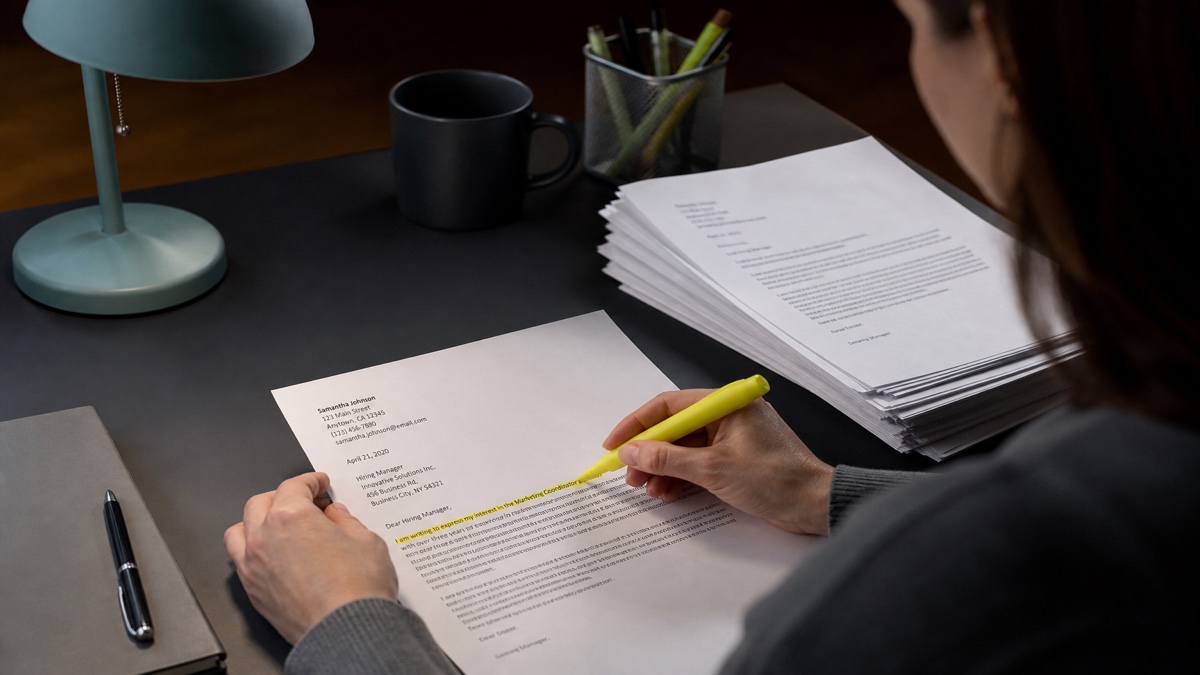
Work from the posting, not from a saved template. Highlight the top duty, one required tool, and any req ID in the header. Those three items decide paragraph one.
- Step 1: Delete the first sentence if it starts with "I am writing to apply." Replace with exact title or req ID plus one metric.
- Step 2: Pull one resume bullet that truncates scope. Expand it in paragraph two with team size, stack, or constraint.
- Step 3: Add referral, pivot, or gap context only if the resume does not already carry it. Otherwise skip paragraph three.
- Step 4: Close with availability or work authorization in two sentences, not a paragraph of thanks.
- Step 5: Export PDF, copy the body into Notepad, and confirm line one still names the role.
- Step 6: Read paragraph one aloud to someone who has not seen the posting. They should state the job title and one reason you fit.
Copy-paste four-paragraph frame (swap bracketed lines per posting; numbers below are sample outcomes only):
[Exact title or Req ####]. I [verb] [metric] [scope tied to posting duty].

In my current role at [Employer], I [second proof with tool from the ad]. The resume bullet lists the outcome; this letter adds [team size / region / ticket volume] the bullet could not fit.

[Optional: Referred by [Name] on [team]. OR: I am moving from [adjacent field] and closed $1.2M in year one using the same discovery structure your AE posting describes.]

I can start [date] and am authorized to work in the US. Thank you for your time reviewing this application.
Before: "Your company's culture inspires me daily."
After: "Customer Success Manager. I raised NRR from 94% to 101% across 120 mid-market accounts by rebuilding the QBR template your posting describes."
Before: "I believe my teaching background makes me a strong sales candidate."
After: "Enterprise AE, former teacher. I closed $1.2M in year one with 28% demo-to-close by running discovery like structured lesson planning."
I've screened stacks of these in Workday and Greenhouse, and the file that earns the second look almost always names the req in line one instead of opening with enthusiasm.
Need a shorter letter that still passes the scan? See short cover letter example . Keep the same line-one rule; trim paragraphs two and three.
Lines that make letters blend into the stack
- Passion without proof: adjectives in line one waste the only sentence many readers see.
- Skills pasted as prose: ten tools with zero outcomes reads like a second resume nobody asked for.
- Job description paraphrase: repeating duties without showing you did them adds no new information.
- Creative PDF layout: text boxes and columns can strip words on upload; the human never sees what the parser dropped.
- Same file name everywhere: letter_final.pdf across employers signals a template swap, not a tailored letter.
Put must-have keywords on the resume. Use the letter for framed proof. For how portals treat letter text, read cover letter keyword search .
Exception: creative postings that request a portfolio letter or design sample. Follow their format rules instead of a business letter frame.
Draft and test before upload
Run the resume through HireFlow's ATS checker first. When the primary file extracts cleanly, generate a cover letter draft, then replace paragraph one with your req ID and metric. Generated openers often score zero on the scan until you swap in posting-specific proof.
After you edit, paste the letter body into the same Notepad test you used on contact lines. If the role name vanishes, simplify PDF layout before you attach it to the application.
Workday paste boxes and Greenhouse text fields strip fonts and margins. When a portal asks for both a PDF and a paste, keep the paste as four plain paragraphs with single breaks. A fancy PDF that does not match the paste looks like two different letters.
Rename exports with employer or req ID: Firstname_Lastname_Acme_CoverLetter.pdf. That habit prevents the wrong attachment on the wrong posting, which coordinators flag faster than a typo in paragraph four.
Proof in line one
How to make a cover letter stand out comes down to one contrast: generic praise versus role, proof, and plain text that survives paste. Use the before/after pairs, fill the copy-paste frame for this req, and run the Notepad test before you upload.
Run the free ATS check on the resume you are pairing with the letter. You will know both files still read cleanly after the portal finishes parsing.
Read more
Frequently asked questions
The exact posting title or req ID, plus one metric or scoped outcome tied to a duty in the ad. Generic excitement lines look identical after a few opens. Names and numbers do not.
No. The resume holds timeline and skills. The letter frames one or two proofs the bullet truncated: team size, referral, pivot bridge, or a constraint that needs a full sentence.
One page with three to four tight paragraphs for most US corporate roles. Standing out is proof density, not length. Half a page of specifics beats a full page of praise.
When the field is required or you add new context, yes, often in a quick scan before a deeper resume read. When the letter is optional and generic, many screeners skip it. Write for the scan.