7 min read
You've tailored bullets for the posting. You've got the right years of experience. You're still buried on page three of the recruiter's filtered list while someone with thinner tenure shows up first. That's not always a keyword gap. It's often a consistency gap the parser can't stitch back together.
You don't need a new template tonight. You need one employer block, one title string, and one date format repeated everywhere the ATS reads.
Run your file through an extraction pass before you upload again. Check your resume for free and confirm each job still shows employer, title, and dates on consecutive lines. If they don't, ranking won't improve no matter how many posting keywords you add.
Job searching is draining enough without fighting your own file versions. Consistency isn't vanity formatting. It's how the system knows your SQL experience belongs to the analyst role and not a stray skills sidebar.
Quick wins
- Pick one date format and apply it to every job entry.
- Match headline title, experience title, and application form title exactly.
- Upload the same file type you used when you passed the extraction test.
Symptoms when ranking lags behind your qualifications
The symptom: you pass knockout questions, mirror posting language in bullets, and still never make the short list. The upload preview looks mostly fine on screen. Recruiters who do open your file say the background fits. Something in the structured profile still keeps you out of keyword sorts.
That pattern usually means the ATS holds fragments of your history, not one clean timeline. Search runs on fields. When fields disagree, ranking treats you like a partial match even when the PDF tells a full story.
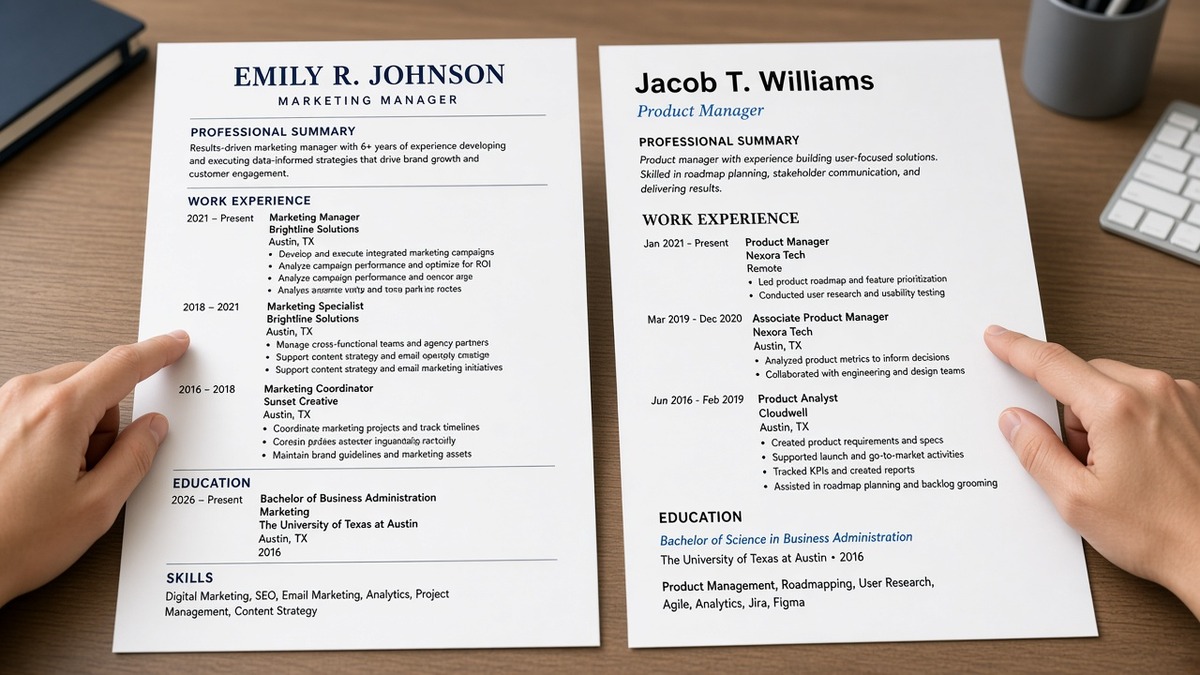
Before: Headline reads "Senior Financial Analyst" but the experience block lists "Finance Analyst II" at the same employer with overlapping dates.
After: One title string in the headline, summary, and job line. Parser attaches three years of analyst work to a single searchable title.
Before: First job uses "Jan 2022 to Present," the next uses "01/2020-12/2021," and education uses "2020."
After: Month Year everywhere: "January 2022 to Present" and "January 2020 to December 2021." Date ranges import without breaking tenure math.
Why resume consistency improves ranking starts here: the scorer can't credit depth it can't link. Split titles and mixed dates look like job hopping or missing years even when you stayed put.
Four consistency breaks that tank ATS ranking
Each break hits a different parser layer. Fix the one you actually have instead of rewriting every bullet at once.
Title and employer drift
Creative headlines, internal company labels, and promotion lines that rename the same role confuse title filters. Workday might store "Revenue Operations Lead" while Greenhouse parsed "Sales Ops Manager" from an older upload. Recruiters searching the posting title won't see both strings as one career line.
Fix: Choose the market-standard title from the posting or your offer letter. Repeat it in the headline, first line under the employer, and the portal field labeled current title.
Date format chaos
Slash dates, season labels, and year-only ranges parse into different buckets. Some systems read "03/21" as March 2021; others read it as the third day of an unknown month. Tenure filters then flag you under the years-of-experience rule even when you qualify.
Fix: Standardize on Month Year with the word "to" between start and end. Spell out Present only for a current role.
Layout that scrambles field order
Two-column files and skill sidebars import left column before main experience. Keywords land on the wrong employer. Ranking credits a skill to a college job while your recent role shows blank in the skills field recruiters filter on.
Fix: Rebuild as a single-column DOCX. Put skills below experience or inside bullets where you used them.
Version mismatch between edits
You tweak bullets in Word, export a PDF for one posting, then upload an older DOCX somewhere else. The files look similar visually but plain-text export shows different section order. Each upload trains a different parsed profile.
Fix: Keep one master file. Duplicate per application, change bullets only, and always upload the format you tested.
Copy-paste consistent job block:
Northwind Bank
Senior Financial Analyst
March 2020 to Present
• Built monthly variance decks for three business units in Excel and Looker
• Supported SOX testing on revenue recognition controls across two close cycles
I've skipped candidates in keyword sorts because the grid showed "Analyst" at one employer and "Financial Analyst" at another for the same dates. The PDF made sense. The parsed record looked like two thin jobs instead of one strong tenure line.
Terminology drift hurts the same way titles do. How ATS interprets role names walks through when to mirror the posting label versus your official title.
How to tell which consistency break you have
You don't need guesswork. Run three checks on the file you're about to upload and match the failure to the cause above.
| What you see | Likely break | First move |
|---|---|---|
| Title filter misses you; bullets mention the role | Title drift | Unify headline and job line title strings |
| Years-of-experience filter cuts you early | Date chaos | Convert every range to Month Year |
| Skills search hits wrong employer | Layout scramble | Flatten to one column; move skills into bullets |
| Preview differs between uploads of the "same" resume | Version mismatch | Test and upload one canonical file per role type |
Paste plain text into Notepad and read top to bottom. If your email appears after your skills list, you've got a column problem, not a keyword problem. If the same employer name shows twice with different titles, you've got title drift.
Upload previews are the honest signal. How to preview your resume the way ATS sees it shows the same read-order test on Greenhouse and iCIMS grids.
Cover letters and portal forms should repeat the same title string you used in experience. A mismatch there won't always break parsing, but recruiters notice when the application form says "Product Manager" and the resume header says "Product Owner."
Fix each break, then re-test ranking inputs
Work cause by cause. Unify titles first if search misses you. Fix dates if tenure filters cut you. Flatten layout if skills attach to the wrong job. Only then add posting keywords into bullets where they belong.
Run the ATS check on your canonical file after each fix. Re-upload to the live posting when title, employer, and date fields match what you typed in Word.
Generate a cover letter using the same job title and employer spelling so every document in the packet tells one story.
This won't rescue applications where you're genuinely under the years requirement. It stops a qualified profile from ranking like a fragmented one because the parser couldn't stitch your timeline together.
One timeline beats a prettier layout
Ranking follows structured data. Resume consistency improves ranking when every upload tells the same story in the same field order: one title per role, one date format, one column, one tested file. Tailor what you prove in bullets, not how the parser reads your employers.
Save the fixed version under a clear file name and reuse it for every similar posting this month. You'll spend less time wondering why weaker profiles outrank you and more time on the three bullets recruiters actually read.
Read more
Frequently asked questions
Yes, on most corporate ATS setups. Ranking and recruiter search run on parsed fields like current title, employer, dates, and skills tied to each job block. When those fields disagree with each other or with your bullets, the system treats your experience as fragmented. A consistent file keeps one role attached to one employer and one date range, so keyword matches count toward the right record.
Mixed date formats on different jobs, job titles that change between the headline and experience block, skills listed in a sidebar that import before your real employer, and bullets that switch tense without a reason. File-level drift counts too: a polished PDF export that reads differently from the DOCX you edited last week.
You should tailor bullets and keyword emphasis per posting. Keep the skeleton stable: same employer names, same title strings for each role, same date format, same section order, same file type. Change what you prove in bullets, not how the parser reads your job blocks.
They rarely tank ranking on their own, but they signal sloppy editing to recruiters who open the file. For parsing, tense mix-ups matter less than title and date inconsistency. Use past tense for prior roles and present tense for a current job, applied the same way in every version you upload.