12 min read
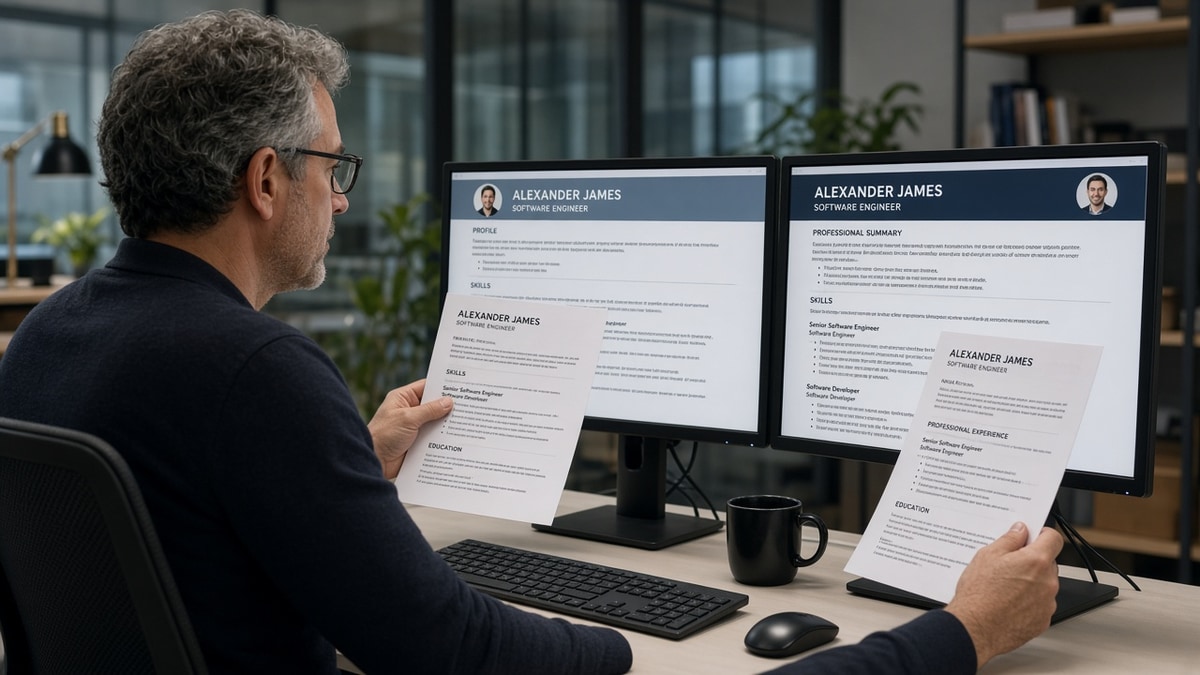
You're a staff engineer in London applying to a US remote role, or a principal architect in Austin targeting a UK scale-up. You've got the scope. Your file still dies in upload. That's usually not keyword density. It's a UK two-page narrative layout meeting a US single-column parser that reads date tables out of order.
Check your resume for free against the posting before you rebuild ten years of history. US vs UK CV formatting for senior tech roles comes down to document shape, not a new career story. Same employers. Different column rules, date placement, and section labels the ATS expects.
Below you'll see the bar each market scores against, before/after pairs across senior tech titles, what weak cross-border files share, and copy-paste blocks for US and UK exports. Job searching across borders is slow enough without reformatting from scratch every Sunday night.
And if you're batching applications on Workday tonight, don't upload the UK Canva template first. Build the US single-column version, confirm plain-text order, then keep a British English export for UK reqs in a separate folder.
When the posting asks for a cover letter, match the market you're targeting. Generate a cover letter from the same title line and top bullet you put in the resume or CV so all three surfaces agree.
Quick Wins
- Export your current file to plain text and confirm each employer name sits directly above its bullets.
- Collapse any two-column UK template into a single column before a US Workday upload.
- Move Month Year dates to the same line as the job title for US reqs.
- Save two files: Lastname_Resume_US.pdf and Lastname_CV_UK.pdf from the same fact base.
US vs UK CV formatting senior tech roles: what parsers score first
Senior tech hiring on both sides of the Atlantic still runs through upload parsers before a human opens the file. The difference is what each parser treats as a job block versus decoration.
The US bar for staff-and-above tech files: single column, standard headings like Professional Experience and Education, Month Year dates on the same line as title and employer, no photo, city and region only for location, impact bullets with tools named inside the sentence. Workday, Greenhouse, Lever, and iCIMS read top to bottom. Sidebars become phantom employers.
The UK bar for the same level: often two pages with a short personal profile, Employment History or Career History headings, degree classification when relevant, British English spellings, and sometimes a fuller narrative under each role. UK teams still use ATS, and tables in headers can scramble there too. The tolerance for design flourishes is slightly higher until upload strips them.
A composite staff backend engineer whose UK CV leads with a skills grid and paragraph-style job stories looks senior to a human skimming page one. Uploaded to a US req, the parser may read Kubernetes as a job title and bury the real employer on row six. Same person. Different read order.
I've screened senior tech stacks in Workday and Greenhouse for years. Cross-border failures rarely mean you're underqualified. They mean the file shape from one market fought the parser in the other.
Read Workday resume format 2026 when the US employer routes through Workday specifically. This page is the US versus UK layout split before you touch keywords.
Edge case: you're a US citizen targeting UK remote roles from abroad. Strip US-style state abbreviations if the posting lists UK location norms, add degree class honestly, and switch organise, programme, and licence spellings. Keep one fact base. Two exports.
Edge case: you're on a skilled visa path and must show continuous employment. Don't compress date ranges to save space on the US file. Gaps draw questions in both markets. Month Year ranges on every role beat a clever one-page squeeze.
Before/after pairs across senior tech titles
Each pair shows a UK-leaning layout that breaks US parsing, then the market-appropriate rewrite. Illustrative titles and metrics inside bullets only.
Pair 1: Staff software engineer, two-column UK template on a US req
Before: Left column lists Python, AWS, Terraform, and Kafka with proficiency bars. Right column holds three jobs as short paragraphs without bullets. Dates sit in a header table above the name.
After: Single column. Staff Software Engineer, FinTech Co., London (remote US), March 2021 to Present. Built payment routing service on Kafka handling 12k TPS; cut p99 latency 18% after partition tuning in Q2 2024. Skills appear inside bullets, not a sidebar.
US parsers read the left column first. Your real employer drops below a wall of tools. Collapse to one column before any US upload.
Pair 2: Engineering manager, narrative CV vs metric resume
Before: Responsible for engineering culture and delivery across multiple squads. Worked closely with product leadership on roadmap priorities.
After: Engineering Manager, SaaS Platform Ltd, January 2020 to Present. Led 14 engineers across three squads shipping billing and identity modules; reduced escaped defects 22% after introducing weekly release trains in GitHub Actions.
UK CVs sometimes carry softer narrative lines that read fine to a hiring manager over coffee. US ATS and US recruiters want scope and a number in bullet one. Translate the same work, don't shrink it.
Pair 3: Principal architect, skills table detached from employers
Before: Technical Skills table on page one lists cloud, data, and security tools. Page two lists employers with one line each.
After: Principal Solutions Architect, Enterprise Retail, September 2018 to Present. Designed multi-region AWS landing zone for 40+ microservices; authored Terraform modules adopted by six product teams; cut infra provisioning time from three weeks to four days.
Tables are a common UK CV habit for senior architects with broad stacks. On US upload, the table rows often parse as separate jobs. Inline tools inside dated bullets fix matching.
Pair 4: DevOps lead, date format and section labels
Before: Employment History heading. Dates as 01/2019 to 06/2024. Company address block under each role.
After: Professional Experience heading for US file. January 2019 to June 2024 on the title line. DevOps Lead, Logistics Cloud, Chicago IL. Built GitLab CI pipelines for 28 services; maintained 99.95% deploy success over FY23.
US parsers map Professional Experience reliably. Employment History usually works but fails on older Taleo configs. Month Year in words beats numeric-only date cells in tables.
Pair 5: Data platform lead, personal statement vs three-line summary
Before: Half-page personal profile describing passion for data-driven culture and stakeholder collaboration.
After: Summary: Data Platform Lead with 11 years building batch and streaming pipelines on Spark and Airflow. Shipped self-serve metrics layer used by 200+ analysts. Targeting staff data platform roles in fintech.
UK personal statements can run long. US senior tech resumes get three lines max above experience, and only if every line names a system or scope. Cut philosophy. Keep proof.
Pair 6: Security architect, photo and address stripped for US
Before: Headshot top right. Full home address, date of birth line, and National Insurance note. Career history begins on page two.
After: No photo. City and country only: Bristol, UK or Austin, TX. Security Architect, Cyber Defence Group, March 2017 to Present. Led zero-trust rollout for 8k endpoints; passed SOC 2 Type II audit with zero critical findings in 2024 cycle.
US anti-bias norms and parser quirks both argue against photos and full street addresses. UK files sometimes still include them. Strip for US. Keep a UK export with profile and classification lines when the employer is UK-based.
Copy-paste US senior tech experience block
Use for US reqs. Replace bracketed lines. Keep one column in Word or Google Docs before PDF export.
[Job Title] | [Company Name] | [City, ST or Remote US]
[Month Year] to [Month Year or Present]
- [Verb] [system] [scope]; [metric outcome from your real work].
- [Second bullet with posting keyword in first eight words].
- [Third bullet on leadership scope: team size, services owned, or budget].
Skills: [Comma list only if posting asks; otherwise keep tools in bullets]
Copy-paste UK senior tech employment entry
Use for UK reqs. British English spellings. Degree class goes in Education, not repeated in every bullet.
[Job Title]
[Company Name], [City, UK]
[Month Year] to [Month Year or Present]
- [Duty with technology and outcome].
- [Stakeholder or compliance line if relevant: GDPR, FCA, ISO].
- [Team leadership or architecture decision with scale].
Education: [Degree], [University], [Classification if strong], [Year]
See PDF vs Word resume for ATS when a UK employer's portal specifies DOCX only. Format choice matters after layout is fixed.
What weak cross-border senior tech files still share
One Canva template for every country. Design tools export pretty PDFs that parsers hate. Build plain layout first. Brand colour headers are optional for humans, fatal for upload order.
Mixing spellings mid-file. organise in bullet two and optimize in bullet five signals carelessness to UK and US readers alike. Pick a market per export and run spell check on that version only.
Listing every cloud cert in a sidebar. Senior tech candidates drown in credentials. Keep active certs in a short block or inside bullets for the job that used them. Move expired entries off the US first page.
Creative job titles parsers don't map. Code Wizard or IT Ninja breaks keyword filters. Use Staff Engineer, Principal Engineer, or Engineering Manager as the market labels them on the posting.
Shipping the UK CV to a US req because it's more complete. More text in the wrong column order is worse than a shorter US-shaped file. Completeness only helps when the parser can attach lines to employers.
Hiding leadership scope in prose. UK narrative paragraphs often bury team size. US files need 14 engineers or three squads in a bullet, not implied in adjectives.
Ignoring education placement. US senior tech resumes tuck degrees after experience unless you're a recent grad. UK CVs may keep Education higher with classification. Mirror local norms per export, not per guess.
Skipping the plain-text test. If paste into Notepad scrambles order, the ATS saw that first. Fix before you blame the market or the competition.
Verify layout before you upload cross-border
Run the US export through the free ATS checker with the US posting pasted in. You're confirming single-column read order and title keywords, not chasing a perfect score on a UK-shaped file.
Then score your job match on the same req after you rewrite bullet one for that market. A strong match on a two-column upload still dies when employer lines detach on import.
Build both exports tonight
US vs UK CV formatting for senior tech roles is an application strategy problem, not a talent problem. Same career. Two document shapes. US single column, Month Year dates, metric bullets. UK profile and classification lines when the employer is UK-based.
Open your current file. Paste to plain text. If skills parsed before employers, collapse columns and rewrite pair one from this page. Save US and UK versions before you apply to the next cross-border req.
This won't turn a stretch role into an interview if the scope isn't there. It does stop qualified staff and principal candidates from getting filtered out because a UK template fought a US parser.
Run a free ATS check on the US export after layout fixes. Then tailor bullet one to each posting. Direction beats sending one pretty PDF everywhere.
When you need a clean single-column base, build your resume in plain layout first, then fork a UK CV with localized headings. Shape first. Keywords second.
Read more
Frequently asked questions
Use resume on US postings and keep the file name plain: Firstname_Lastname_Resume.pdf. Hiring teams in Workday and Greenhouse expect a single-column layout with Professional Experience headings and Month Year dates. Calling the document a CV does not hurt you, but importing a UK two-page template with sidebar skills and narrative paragraphs often breaks parsing before anyone reads your staff-engineer scope.
US senior tech files usually land at two pages when you have ten or more years of scope to show. UK CVs for the same level often run two pages with fuller role narratives and education detail. Going past two pages in either market risks truncation in some ATS exports. Cut older internships before you cut metrics on your current principal or staff role.
One hybrid file is a compromise that often fails both parsers. US uploads want left-aligned single column, no photo, and impact bullets up top. UK employers may expect degree classification lines and sometimes a short personal profile in British English. Maintain two exports from the same fact base: a US resume and a UK CV with localized headings and spellings.
The failures that show up most are two-column layouts where skills read as a separate job, date tables in headers that detach from employer names, and text boxes for summaries that drop on upload. Icons, skill bars, and embedded charts also scramble order in Workday. Export to plain text once. If employer lines float away from bullets, fix layout before you apply.
Photos are less common on UK tech CVs than they were a decade ago, and many London and remote-first teams skip them. Full home addresses appear on some UK templates but create privacy risk when you apply to US remote roles. For US applications, stick to city, state or region, phone, email, and a profile URL if the posting allows it.