11 min read
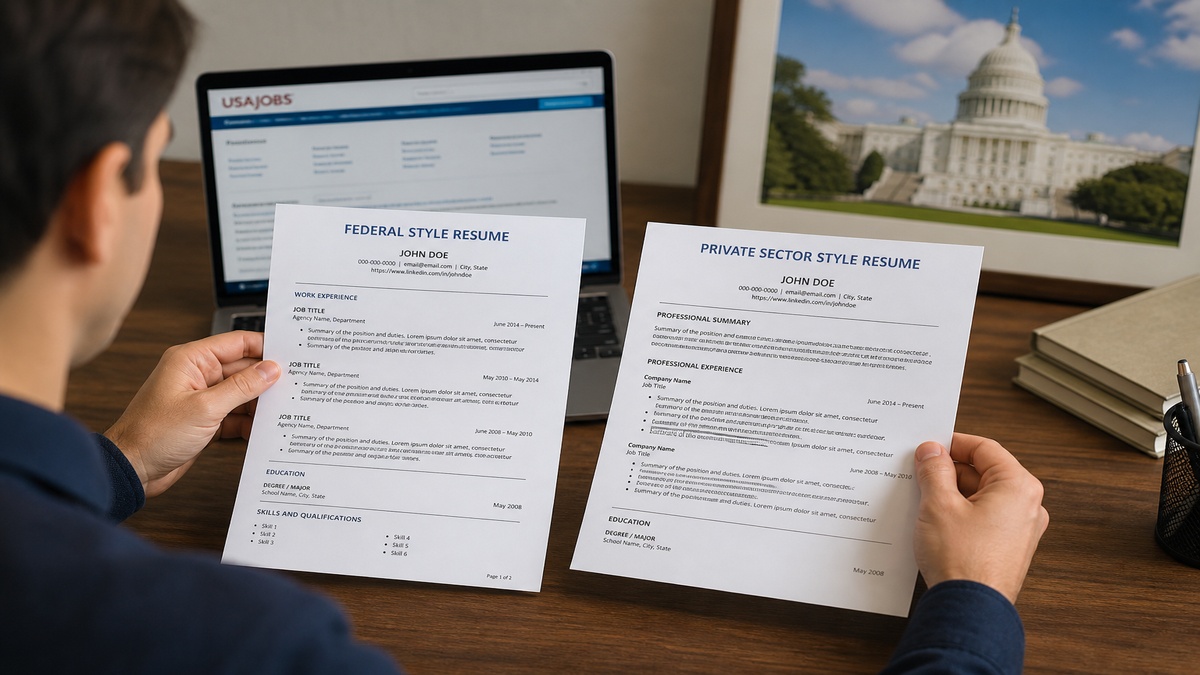
The short answer: federal resumes must prove hours per week, grade-level duties, and specialized experience in long dated blocks. Private resumes must prove scope and outcomes on one page. Upload the wrong file and both parsers treat you like you never did the work.
You've managed teams, cleared audits, and shipped real programs. If you're toggling between a USAJOBS announcement and a corporate req on Greenhouse, you're not confused about your career. You're confused about which proof format each side can read. That's fixable tonight with two forks, not one heroic document that pleases nobody.
Check your resume for free against whichever posting is open. You'll see fast whether hours and series language sit in Experience or whether your best metric is trapped on page four.
Below is why the US federal resume vs private resume split exists, where hybrid files break, and what to change before your next upload. Job searching across sectors is already draining. This page is about formatting proof the screen can score, not a lecture on whether government or industry pays better.
Quick Wins
- Add hours per week and supervisor line to every federal role block tonight.
- Cap your private fork near one page; move GS codes and salary history out.
- Mirror specialized experience phrases from the announcement into federal duty bullets.
- Paste each PDF into Notepad and confirm employer lines parse in order.
Why US federal resume vs private resume rules diverge
Federal hiring screens score specialized experience against grade, series, and tenure in the announcement. The resume is evidence for questionnaire answers and human certifiers, not a marketing one-pager. Private corporate screens score title match, recent scope, and outcomes a hiring manager can ctrl-f in under a minute. Same person, different proof bar.
Federal files carry administrative facts private files skip. Hours per week, full employment dates, employer address, pay when the form asks, supervisor name and phone when allowed, citizenship, clearance level, and job series or occupational code when you held a graded position. Those fields are not decorative. Missing hours on a role that needed 52 weeks at 40 hours per week can zero out credit even when the duties sound perfect.
Private files carry compressed impact. One page for most mid-level US roles. Bullet one names scope, tool or domain, and a metric or operational proxy in the first eight words. Years-only date ranges are common. Supervisor contact lines look odd on a product manager resume and get cut.
A composite program analyst whose federal block still reads Managed various projects with no hours, series, or specialized experience keywords loses to a longer file that says Program Analyst, GS-0343-11, 40 hours per week, 01/15/2020 to 03/30/2024, with duty lines copied from the announcement's specialized experience section. Same analyst applying on Greenhouse with that federal block gets skimmed past because the metric sits on page three.
Edge case: contractor going permanent. Federal reqs want each contract stint with dates, hours, and duties spelled out. Private reqs often let you group Client A, Client B under one consulting employer if dates don't overlap. Do not merge blocks on the federal fork.
Edge case: military to civilian. Translate MOS duties into civilian occupational language on both files, but keep months, hours, and supervisor chain on the federal fork. On the private fork, lead with transferable scope and drop rank jargon a corporate recruiter will not parse.
Read whether a resume can be two pages when you're deciding how long the private fork should run. Federal length follows announcement proof, not page-count anxiety.
What to do now: maintain two resume forks
Run these in order on the posting open on your screen. You're building two masters you fork per application, not one document you shrink or stretch in panic.
Step 1: Label your federal master with administrative headers
Open a federal master in plain Word or DOCX. For each role after 2015, add employer name, city and state, job title, series and grade if federal, hours per week, salary when the announcement requests it, supervisor name and contact when policy allows, and Month Day Year start and end dates.
Before: Program Analyst, HHS, 2020 to 2024. Supported policy teams.
After: Program Analyst, GS-0343-11, Department of Health and Human Services, Washington, DC. 40 hours per week. 01/06/2020 to 03/29/2024. Supervisor: Jane Doe, 202-555-0142. Duties mirror specialized experience from the vacancy.
Step 2: Mirror specialized experience language on the federal fork
Highlight repeated duty phrases in the announcement: budget execution, stakeholder facilitation, regulatory compliance, contract oversight, or whatever the specialized experience block repeats. Paste those verbs into duty bullets under the matching employer. Federal screens match literal duty language more than clever impact headlines.
Before: Improved program outcomes across multiple initiatives.
After: Executed budget formulation and execution for a $4.2M program account; prepared procurement documentation and monitored contractor performance against FAR clauses cited in the announcement.
Step 3: Build the private master for one-page scope proof
Duplicate your work history into a private master. Delete hours lines, supervisor contacts, series codes, and salary history. Collapse each role to three or four bullets. Bullet one carries scope, domain, and a defensible outcome. Month Year dates are enough for most corporate ATS imports.
A mid-level operations lead whose private bullet still reads Responsible for stakeholder meetings loses to Led cross-agency rollout for 12 field offices; cut processing backlog 26% in two quarters. Numbers here illustrate the bullet shape, not hiring odds.
Step 4: Fork before each upload, never mid-format
USAJOBS or agency portal gets the federal fork with administrative lines intact. Corporate career site gets the private fork. If you're tempted to upload the federal file to a startup because you already have it open, stop. Recruiters won't scroll six pages for one metric.
Edge case: state or local government. Some municipal reqs want federal-style detail; others want private brevity. Read the instruction line on the portal. When it says resume may not exceed two pages, treat it as a private fork even if the employer is public sector.
Step 5: Run Notepad on both exports
Export each fork as PDF. Select all, paste into Notepad. Employer names should appear before bullets. Federal fork should show hours and dates in plain text. Private fork should show your strongest metric before the oldest job title. Blank squares or scrambled order mean rebuild single column without text boxes.
See how to format dates on a resume for ATS when your private fork still mixes formats that confuse parsers.
Copy-paste federal duty bullet skeleton
Copy-paste this skeleton into your federal master, then fill with announcement language: "[Duty verb from specialized experience] for [program, system, or population]; [scope: dollars, FTE, geography, or caseload] at [grade or responsibility level]; [compliance framework, regulation, or contract type when listed in the posting]."
Example fill: "Monitored contractor performance against SOW milestones for IT modernization program; tracked 14 deliverables across three vendor teams; escalated FAR non-compliance findings to contracting officer within 5 business days." Swap verbs and objects per vacancy. Keep hours and dates in the header, not inside every bullet.
Copy-paste private impact bullet skeleton
Copy-paste for corporate forks: "[Verb] [scope object] in [tool or domain]; [metric or operational proxy] across [team, region, or product line] in [time window]."
Example fill: "Led Salesforce case-routing redesign for 9 support pods; cut average first-response time from 11 hours to 6 hours across Q1 2026." One outcome per bullet. Leave GS codes and supervisor phones off this file.
Composite: IT specialist crossing sectors
Before: Federal fork lists Help desk support with no hours; private fork lists IT support with no ticket volume.
After (federal): IT Specialist, GS-2210-09, 40 hours per week, 06/01/2021 to present. Resolved Tier 2 incidents for 800-seat agency; administered Active Directory group policies per NIST controls named in the announcement.
After (private): Resolved 340 Tier 2 tickets monthly in ServiceNow; cut repeat-incident rate 14% after KB rollout for SaaS billing stack.
Composite: budget analyst with clearance
Before: One resume lists Secret clearance in a footer with no duty tie-in.
After (federal): Budget Analyst, GS-0560-11, Secret clearance, 40 hours per week. Prepared apportionment trackers and execution reports for $18M O&M account cited in specialized experience.
After (private): Built rolling forecast model for $18M O&M portfolio; improved variance explanations delivered to CFO staff by two business days each month.
Where the wrong format fails parsers and humans
Private one-pager on a federal vacancy. Strong metrics, no hours, no grade narrative, duties that don't echo specialized experience. The questionnaire may auto-disqualify specialized experience even when you did the work.
Federal dump on a corporate req. Six pages of supervisor phone numbers and series codes bury the outcome a Greenhouse recruiter needed in line one. Skim stops before your best bullet.
Hybrid abbreviations. Cutting hours to save space on the federal fork. Keeping GS-0343 in a corporate headline. Both signals tell each side you didn't read what they score.
Two-column templates. Sidebars park clearance or skills under contact blocks. Notepad shows clearance before employer names. Parsers read clearance as a job title. Single column on both forks.
Same filename, wrong content. resume.pdf uploaded everywhere. Hiring teams can't tell which proof bar you aimed for. Name files federal-master.docx and private-master.docx so you don't grab the wrong export at midnight.
I've screened corporate batches where a candidate's federal USAJOBS export landed in Workday with page-one metrics missing because duty blocks pushed impact to page five. The federal file wasn't wrong for government. It was wrong for the req in front of us.
Announcement keywords without duty proof. Pasting FAR, NIST, or program names into a Skills row without a dated duty line. Federal certifiers look for where you performed the work, not that you heard the acronym.
Parse-check each fork against its posting
After you rebuild both masters, paste the corporate req into the free ATS checker with your private PDF. Confirm scope and title language appear in parsed Experience text, not only in a header graphic.
For federal forks, paste the announcement's specialized experience block into score your job match and check whether duty verbs land in Experience strips rather than orphaned in Skills. You're confirming placement, not chasing a perfect percentage.
Save checker output with each fork so you know which file went to which portal. Ten minutes of labeling beats uploading the six-page version to a one-page req because it was already on your desktop.
Pick the right fork before you upload
The US federal resume vs private resume split is not about better or worse careers. It's about which proof each parser and certifier can score. Federal files earn credit with hours, grade duties, and announcement language in long blocks. Private files win with one-page scope and metrics in bullet one.
Open your two masters tonight. Add missing hours and specialized experience verbs to the federal fork. Strip administrative lines from the private fork and rewrite bullet one with scope in the first eight words. Export single-column PDFs, run Notepad on both, and run a free ATS check on the corporate req before you submit.
This won't fix applying to a GS-13 req with six months of specialized experience. It does stop qualified people from losing credit because they uploaded a one-pager to USAJOBS or a federal dump to a startup career page.
And if you're juggling both sectors this month, name your files so you can't grab the wrong one at midnight. Ten minutes of labeling beats another silent month from the right experience in the wrong format.
When a corporate portal wants a letter, generate a cover letter that repeats the same scope metric from private bullet one. Keep it plain text so the upload box reads it the same way parsers read your resume.
Read more
Frequently asked questions
You can upload it, but you will usually lose specialized experience credit. Federal screens expect hours per week, supervisor contact, full Month Day Year dates, and GS series language tied to each duty block. A private one-pager that ends at years and impact metrics rarely proves the grade and tenure the announcement asks for. Keep a federal master file and fork it per vacancy instead of recycling your corporate PDF.
Private corporate files for most US roles stay near one page with scope in the first two bullets. Federal files often run several pages because each role needs employer, address, hours, salary when requested, and duty lines that mirror specialized experience from the posting. Length is not padding when every line answers a questionnaire field. Length without hours and grade narrative is still a private resume wearing a government filename.
No. Corporate ATS in Workday, Greenhouse, and Lever weight recent impact and title match. A six-page federal dump buries the one metric a hiring manager would ctrl-f in ten seconds. Strip hours, supervisor names, and series codes from your private fork. Lead with scope, tool, and outcome in the first eight words of bullet one instead.
Using tables, text boxes, or two-column layouts that read fine in Word but scramble employer lines in Notepad. Federal builders and corporate portals both import plain text order. A sidebar that parks GS-0341-12 under Education instead of Experience fails both parsers. Single column, standard fonts, and Month Year or full federal dates in the body text survive either upload path.
Yes. One federal master with hours, grade narrative, and announcement keywords per role. One private master capped near one page with impact bullets and corporate title strings. Fork each before upload rather than deleting lines in a panic. The ten minutes you spend choosing the right file beats weeks of silence from the wrong format sitting in the wrong queue.