10 min read
You've got twelve years of real work, three employers, and a certification list that does not fit on one page without shrinking the font to nonsense. Someone told you ATS only accepts one page. That's not how US screening works. But a messy two-page file will still get you filtered.
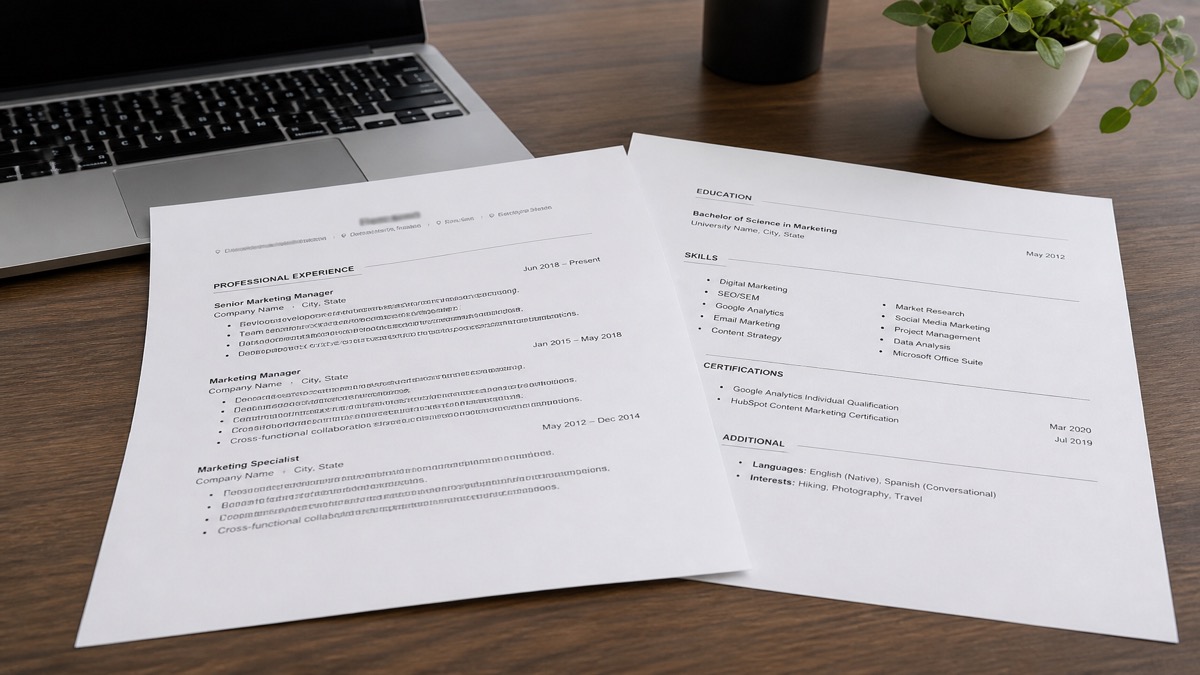
So can a resume be 2 pages? Yes, for many US corporate roles. when every line earns its space and the file stays parser-friendly. Before you export, check your resume for free to confirm both pages extract in order. This guide covers when two pages make sense, when to cut, and how ATS reads page breaks.
Length is a readability question for humans and a structure question for machines. We're not debating international CV norms here. this is US hiring through Workday, Greenhouse, Lever, and Taleo. Get the format right and recruiters will read page two if page one proves you belong.
Quick Wins
- Paste your resume into Notepad. confirm page-two bullets appear after page-one jobs in logical order.
- Delete one oldest job if you are under ten years of experience and still spilling to page two.
- Move your page break so no job title sits alone at the bottom of page one.
What a two-page US resume is (and is not)
In US hiring, a resume is a marketing document, not a full career archive. One page is the default for early-career candidates because recruiters want proof fast. Two pages are normal when you have a decade or more of relevant roles, technical depth, or leadership scope that cannot be compressed without losing evidence.
A two-page resume is two pages of dated, specific evidence. Not one page of content stretched with margins, and not a life story that repeats the same duty twelve times.
ATS does not reject files for hitting page two. Parsers choke on layout: multi-column templates, text boxes, icons, charts, and headers that repeat your name in a way that scrambles reading order. A boring Word document with Calibri 11 and standard headings can be three pages and still extract. though humans rarely want three.
This is not a European CV. US recruiters expect brevity unless your level demands detail. Academic CVs, federal resumes, and portfolio-heavy creative roles follow different rules. this article is for standard corporate and professional applications.
I've screened stacks of two-pagers where page two was old jobs nobody asked for. Cut that before you worry about whether length is "allowed."
Step-by-step: decide length and format both pages
One page vs two: quick decision table
| Your situation | Likely length | First edit if you spill over |
|---|---|---|
| 0–7 years relevant experience | One page | Cut oldest jobs; tighten bullets |
| 8–12 years, one industry | One or two pages | Collapse pre-2010 roles to one line |
| 10+ years, technical depth | Two pages | Move weak bullets off page two |
| Manager with direct reports | Two pages common | Lead with team outcomes, not task lists |
| Career change under 5 years proof | One page | Summary + transferable bullets only |
Step 1: Use the ten-year rule as a starting point
Under roughly eight years of relevant experience, aim for one strong page. Between eight and twelve, two pages is fine if every bullet adds proof. Beyond twelve, two pages is expected for individual contributors with depth; managers may still need two if they cut early-career retail from page two.
Relevance beats chronology. A fifteen-year career with five years in your target field might still be one page plus a short additional-employment line. A eight-year specialist with patents, tools, and metrics might need two without fluff.
Step 2: Cut before you shrink the font
Remove high school, old campus jobs, and every bullet older than ten to fifteen years unless it is directly tied to the posting. Collapse pre-2005 roles into one line: Earlier roles include [Title] at [Employer] and [Title] at [Employer].
Trim skills you cannot discuss. Drop "References available upon request." Kill the objective paragraph. If you are two lines over one page, edit content. do not go to 9-point font. Recruiters notice, and parsers sometimes misread tiny text in PDF exports.
Step 3: Format for ATS on both pages
Single column. Standard headings: Summary, Experience, Education, Skills. spelled plainly. Month Year dates aligned right or left consistently. No tables for layout. No photo. No skill bars. If you use Word, turn on gridlines and confirm you are not inside invisible tables.
Put contact info on page one only. Repeating headers and footers on page two can confuse some parsers or duplicate your email mid-document. Page numbers are optional; if you use them, keep them in the margin without wrapping text around them.
Step 4: Place the page break between jobs, not through them
The worst break splits employer name on page one and bullets on page two. Keep title, employer, dates, and at least two bullets together. Ideal break: after a completed job block, before the next heading.
Page two should open with strong material. Not education from 2012 unless you are a new grad. Lead page two with your next most recent role or a projects section tied to the posting. If only your oldest job spills over, consider collapsing it instead.
Step 5: Strengthen bullets so page two earns attention
Take a senior analyst who still writes Responsible for reporting on page two:
Before: Responsible for reporting.
After: Built monthly variance decks in Excel and Power BI for six regional directors, standardizing KPI definitions across finance and operations.
For a nurse manager spanning two pages:
Before: Managed nursing staff.
After: Supervised 28 RNs and CNAs on a medical-surgical unit, scheduling, competency tracking, and Epic documentation audits under Joint Commission standards.
Specific scale beats vague duty on any page. Page two is where weak resumes dump old jobs. make yours dump proof instead.
Step 6: Export and test both pages the employer will receive
Export DOCX and PDF if the posting allows either. Paste both into plain text. Compare order line by line. If PDF shuffles page-two content, simplify margins or submit DOCX when permitted.
Print once. Skim page one in ten seconds like a recruiter, then page two. If page two only repeats page one with different adjectives, cut it. If page two adds licenses, publications, or projects the posting cares about, keep it.
File name pattern: LastName_Senior_Analyst_2026.pdf. Two pages deserve the same discipline as one. version control prevents sending the wrong length to the wrong req.
Edge case: career change, overlap, and federal-style length
Career changers often fit one page by leading with a tight summary and transferable bullets. Two pages works when you have parallel evidence. same tools, regulated environments, or client-facing volume. even if titles differ.
Overlapping contract and W-2 dates should be labeled honestly on one page if possible. Two pages is not permission to hide overlap with formatting tricks.
USAJOBS and some public-sector forms ask for detailed history. That is not the same as a corporate two-pager. follow the application instructions even when they exceed two pages. For standard ATS uploads, stay at two unless the employer asks for more.
Academic CVs for faculty roles are a different document entirely. publications and grants belong there, not on a corporate two-page resume. If you are applying to industry from academia, translate publications into outcomes bullets and cap at two pages unless the posting requests a CV.
Contractors with twenty short gigs should group related clients under one consulting header when possible. Two pages of one-month contracts reads chaotic; three bundled engagements with outcome bullets reads intentional.
For format help, read which ATS-friendly template to use in 2026 and what the ATS actually reads .
Common two-page resume mistakes
Using two pages because the template has two columns. Sidebars push content to page two artificially. Switch to a single-column layout even if it feels plain.
Repeating the summary on page two. Once is enough. Page two should be new evidence, not a recap.
Listing every job since 1998. Ancient roles dilute your story. Summarize early career in one line when it is not directly relevant.
Breaking mid-job across pages. Parsers and humans both lose context when bullets orphan on the next page.
Shrinking font instead of editing. If you need 9-point type to fit, you have too much text or the wrong margins.
Assuming page two is never read. Recruiters skim page one, then read page two when page one matches. Burying weak content there wastes the chance.
Keeping hobbies and interests to fill page two. Unless the posting asks for community leadership relevant to the role, use the space for work evidence. Volunteer board service with budget responsibility can stay. generic interests should go.
Using a second page for references. Omit references on the resume; provide them when asked. That block often pushes strong bullets off page one.
Test both pages before you upload
A two-page resume fails when page two does not parse. Upload your file to HireFlow's free ATS resume checker and confirm warnings about order, missing sections, or scrambled dates. Fix structure before you debate length with a friend.
Also run the plain-text paste test: copy from PDF or Word into Notepad. If page-two employers appear before page-one bullets, your export order is wrong. The checker complements that test with keyword alignment against the posting.
Need a clean starting layout? Try the free resume builder for a single-column base, then tailor with the cover letter generator when the posting asks for a letter.
When page two holds certifications, list only current credentials the posting values. Expired licenses belong off the resume or in a clearly dated inactive line. Not as implied active qualifications.
Two pages is fine when both pages work
Can a resume be 2 pages for US jobs? Yes. when you have the experience to fill them with proof, not filler. ATS cares about readable structure; recruiters care about whether page one makes them want page two.
- Default to one page early career; use two when ten plus years of relevant evidence needs room.
- Cut old roles and weak bullets before shrinking fonts or adding graphics.
- Test parsing on both pages. order matters as much as length.
Open your file, paste it plain, and run the free check . A two-page resume only helps when both pages tell the same clear story.
If you are still over two pages after cuts, you likely have three jobs too many in full detail. Not a formatting problem. Collapse, do not shrink. One clear story beats a long archive.
Read more
Frequently asked questions
No. length alone is not a rejection trigger. Bad layout is. Use a single column, standard headings, and test extraction on both pages before you submit.
Most candidates under eight years of relevant experience should keep one page if the content is specific. Students, recent grads, and career changers with limited direct proof also benefit from one tight page.
They dislike padding, not length. Ten plus years of relevant work on two readable pages is normal. Twelve vague bullets across two pages is not.
Between complete job entries or major sections. Never split a title from its bullets. Lead page two with strong recent evidence when possible.
Follow the posting. DOCX often parses cleanly; text-based PDFs work when tested. Avoid scanned image PDFs entirely.