9 min read

Should You Optimize for ATS or Recruiters First? A Strategic Guide

HireFlow Editorial Team
August 19, 2026

Learn whether to prioritize ATS optimization or recruiter appeal first. Get proven strategies for balancing both in your job application approach.

When you submit a resume online, it faces two gatekeepers: an applicant tracking system (ATS) and a human recruiter. The question isn't whether to optimize for one or the other—it's how to balance both effectively. Should you optimize for ATS or recruiters first? The answer is more nuanced than most job seekers realize.

Many candidates believe they must choose: either format their resume to pass ATS parsing, or write it to impress human eyes. In reality, a resume that works well for ATS often performs better with recruiters too. The key is understanding how both systems work and where their priorities overlap.

In this guide, you'll learn:

  • Why the ATS vs. recruiter debate misses the real strategy
  • How modern ATS systems actually evaluate candidates
  • What recruiters prioritize when reviewing resumes
  • Practical techniques to optimize for both simultaneously
  • Common mistakes that fail both systems
  • A step-by-step approach to resume optimization

Understanding the ATS-Recruiter Dynamic

Before choosing which to optimize for first, you need to understand what each system actually does. The ATS is not your enemy—it's a database management tool. Its primary job is to parse your resume, extract key information, and rank candidates based on job description alignment.

Recruiters use ATS dashboards to filter through hundreds of applications. They rely on ATS scoring to identify top candidates, but they also manually review resumes. The problem: if your resume doesn't parse correctly, recruiters never see it. If it parses but scores low, it gets buried in the queue.

The real insight is this—optimizing for ATS doesn't mean sacrificing readability. Clean formatting, strategic keyword placement, and logical structure benefit both systems. A resume that's easy for ATS to parse is also easier for recruiters to scan quickly.

Key Elements: What ATS Systems Actually Evaluate

Keyword Matching and Job Description Alignment

ATS systems use keyword matching as their primary ranking mechanism. When you apply for a job, the system compares your resume against the job description. It looks for exact matches, synonyms, and contextual relevance. If the job posting mentions "project management" and your resume says "managed cross-functional initiatives," the system recognizes the connection.

However, keyword stuffing backfires. Modern ATS platforms are sophisticated enough to detect unnatural language. If you list "Python Python Python" in your skills section, the system flags it as spam. Instead, weave keywords naturally throughout your experience descriptions and skills section.

Parsing and Data Extraction

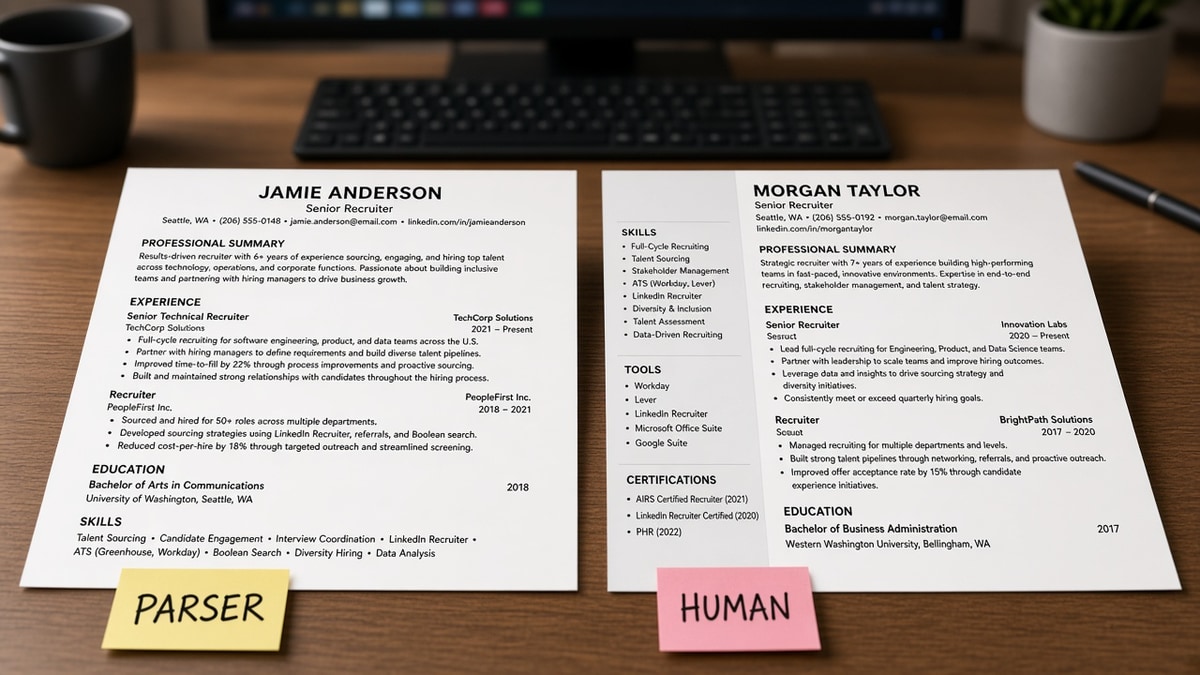
ATS systems must extract structured data from your resume: contact information, work history, education, and skills. This is where formatting matters most. Complex layouts, unusual fonts, headers and footers, and graphics can confuse parsers. The system needs to clearly identify where one job ends and another begins.

Use standard section headers like "Experience," "Education," and "Skills." Stick to common fonts like Arial, Calibri, or Times New Roman. Avoid tables, text boxes, and graphics. Save as .docx or .pdf depending on the application requirements. These choices don't limit recruiter appeal—they enhance it.

Experience Recency and Relevance

ATS systems weight recent experience more heavily. A role you held two years ago ranks higher than one from ten years ago. This aligns with recruiter thinking—recent work is more relevant. When describing your experience, emphasize accomplishments that relate directly to the job you're applying for, even if they're from earlier positions.

Education and Certifications

Many ATS systems filter by minimum education requirements. If the job requires a bachelor's degree and you have one, include it clearly. The same applies to certifications. List them in a dedicated section with the full name, issuing organization, and date. ATS systems look for exact matches, so if the job mentions "AWS Certified Solutions Architect," use that exact phrase if it applies to you.

What Recruiters Actually Prioritize

Recruiters spend an average of 6-7 seconds reviewing each resume. They're not reading every word—they're scanning for specific information. Understanding this changes how you format and structure your resume.

Recruiters prioritize:

  • Relevant experience first: They want to see jobs that match the role they're hiring for. If you've held similar positions, lead with those accomplishments.
  • Quantifiable results: "Increased sales by 23%" beats "responsible for sales growth." Numbers prove impact and are memorable.
  • Clear career progression: Recruiters look for growth. Moving from coordinator to manager to director shows ambition and capability.
  • Company recognition: If you've worked at well-known companies, recruiters notice. This signals you've met hiring standards elsewhere.
  • Gaps and inconsistencies: Recruiters flag unexplained employment gaps or job-hopping. Be transparent about career transitions.

The key insight: recruiters want to understand your value quickly. They're not reading your resume to learn about you—they're reading it to decide if you're worth a phone call. Every section should answer the question: "Why should we interview this person?"

Common Mistakes That Fail Both Systems

  • Over-formatting: Fancy fonts, colors, graphics, and unusual layouts look good in Word but break ATS parsing. Recruiters also struggle to read them quickly. Stick to clean, simple formatting.
  • Generic descriptions: "Responsible for managing projects" tells ATS nothing and gives recruiters no reason to interview you. Use specific, quantifiable language tied to business outcomes.
  • Keyword stuffing: Listing "Python, Python, Python" in your skills section fools no one. ATS systems detect artificial keyword repetition, and recruiters immediately recognize it as desperation.
  • Inconsistent dates or titles: If your resume says you worked at Company X from 2018-2020 but your LinkedIn shows 2017-2021, both ATS and recruiters will flag the discrepancy. Consistency matters.
  • Burying important information: Don't hide your most relevant experience in the middle of a long job description. Lead with your strongest accomplishments. ATS systems weight earlier content more heavily, and recruiters scan top-to-bottom.
  • Ignoring the job description: Applying with a generic resume wastes everyone's time. Customize your resume for each role, emphasizing skills and experience that match the specific job posting.

Best Practices for Optimizing Both Simultaneously

  1. Start with the job description: Before writing anything, analyze the job posting. Identify key skills, responsibilities, and qualifications. These become your optimization targets.
  2. Use natural keyword placement: Incorporate job description keywords into your experience descriptions and skills section. Don't force them—let them flow naturally as part of your accomplishments.
  3. Structure for scanning: Use clear section headers, bullet points, and white space. Recruiters scan resumes visually. ATS systems parse structured data. Both benefit from organization.
  4. Lead with impact: Start each job description with your most relevant accomplishment. Use the format: "Action verb + Task + Result." Example: "Reduced customer churn by 18% through implementation of personalized retention strategy."
  5. Include a skills section: ATS systems rely heavily on dedicated skills sections. List 10-15 relevant skills in order of importance. Recruiters use this section to quickly assess fit.
  6. Quantify everything possible: Numbers stand out to both ATS and recruiters. Percentages, dollar amounts, and metrics make your accomplishments concrete and memorable.
  7. Keep it to one page (if possible): ATS systems handle multi-page resumes fine, but recruiters prefer conciseness. If you have less than 10 years of experience, one page is ideal. For more experience, two pages is acceptable.
  8. Use standard formatting: Save as .docx or .pdf (check the application requirements). Use Arial, Calibri, or Times New Roman in 10-12pt font. Avoid tables, text boxes, headers, and footers.

Step-by-Step Resume Optimization Process

Step 1: Extract Keywords from the Job Description

Copy the job posting into a document. Highlight all skills, tools, responsibilities, and qualifications mentioned. Create a list of 15-20 priority keywords. These are your optimization targets.

Step 2: Audit Your Current Resume

Review your existing resume. Does it include the keywords from Step 1? Where can you naturally incorporate them? Identify weak descriptions that lack quantifiable results.

Step 3: Rewrite Experience Descriptions

For each relevant job, rewrite bullet points to include keywords and quantifiable outcomes. Use the formula: Action verb + Task + Result + Keywords. Example: "Led cross-functional team of 8 to deliver cloud migration project using AWS, reducing infrastructure costs by 34% and improving system uptime to 99.9%."

Step 4: Optimize Your Skills Section

Create a dedicated skills section. List 10-15 skills in order of relevance to the job. Include technical skills, tools, and soft skills. Ensure your top skills match the job description.

Step 5: Test Formatting

Save your resume in the required format. Open it on a different computer or device to ensure formatting is clean and consistent. Check that all text is readable and no content is cut off.

Step 6: Final Review

Read your resume as if you're a recruiter with 6 seconds. Can you quickly identify your value? Do your most relevant accomplishments stand out? Are there any typos or inconsistencies?

The Real Answer: Optimize for Both, Strategically

The question "Should you optimize for ATS or recruiters first?" contains a false premise. You don't choose one—you optimize for both by understanding that good ATS practices and good recruiter practices overlap significantly.

A resume that parses cleanly, includes relevant keywords, and presents information logically serves both systems. Clean formatting helps ATS extract data correctly and helps recruiters scan quickly. Strategic keyword placement improves ATS ranking and helps recruiters identify relevant experience. Quantifiable results impress both algorithms and humans.

The priority order is: clarity first, then keywords, then recruiter appeal. If your resume is clear and well-organized, ATS can parse it. If it includes relevant keywords naturally, ATS will rank it higher. If it emphasizes quantifiable results and relevant experience, recruiters will want to interview you.

This approach eliminates the need to choose. You're not sacrificing recruiter appeal for ATS optimization or vice versa—you're building a resume that works for both because both systems value clarity, relevance, and evidence of impact.

Conclusion: The Integrated Approach Wins

The false choice between optimizing for ATS or recruiters has confused job seekers for years. The reality is that both systems reward the same fundamental practices: clarity, relevance, and evidence of impact. A resume optimized for ATS parsing is easier for recruiters to read. A resume written for recruiter appeal performs better in ATS ranking when it includes relevant keywords naturally.

Your strategy should be integrated, not divided. Start by analyzing the job description and extracting key requirements. Customize your resume to highlight relevant experience and skills. Use clean formatting, quantifiable results, and strategic keyword placement. Test your resume to ensure it parses correctly. This approach optimizes for both systems simultaneously, maximizing your chances of getting past both the ATS and the recruiter's initial scan.

The job market is competitive, and every application counts. By understanding how both ATS and recruiters evaluate resumes, you can craft applications that work for both. Stop choosing between them—optimize for both, and watch your interview rate improve.

Frequently asked questions

No. ATS optimization focuses on clean formatting, clear structure, and relevant keywords—all of which improve recruiter readability. You're not sacrificing design for function; you're using design that serves both purposes. Simple, well-organized resumes are easier to scan quickly, which is exactly what recruiters do. The "boring" resume is actually the most effective one.

Yes, especially for your skills section and job descriptions. Customize by reordering your skills to match the job description and emphasizing relevant accomplishments. You don't need to rewrite everything—focus on highlighting what matters most for that specific role. This approach improves both ATS ranking and recruiter perception of fit. Generic resumes perform worse with both systems.

Include 15-20 relevant keywords naturally distributed throughout your resume. Don't force them—they should appear in your job descriptions, skills section, and summary if applicable. Quality matters more than quantity. A resume with 20 well-placed, relevant keywords outperforms one with 50 awkwardly stuffed keywords. ATS systems recognize natural language, and recruiters immediately spot keyword stuffing.

Check the job application requirements. Both formats work with modern ATS systems, but .docx is slightly more reliable for parsing. PDF preserves formatting better, which helps recruiter readability. If the application doesn't specify, use .docx. If you're uploading directly to an ATS, test your resume with an ATS parser tool first to ensure it extracts correctly.

Not initially. Recruiters spend 6-7 seconds on a first pass, scanning for relevant experience and qualifications. If your resume passes that scan, they spend more time reviewing details. This is why leading with your strongest accomplishments and using clear formatting matters. Make the first scan count—if it doesn't, recruiters won't invest more time reading.

Avoid graphics, unusual fonts, and creative layouts in your main resume. They break ATS parsing and distract from content. If you want to stand out, use strong accomplishments and clear structure. For certain creative roles (design, marketing), a portfolio link is more effective than a formatted resume. Focus on substance—your achievements and results will make you stand out more than design ever could.

Done for you

Turn this advice into an interview-ready resume

Professional writers rebuild your resume for ATS + recruiters — unlimited revisions, interview guarantee.

Job match tool·Free builder

Tags

ATS optimizationrecruiter resume tipsATS vs recruiterresume optimizationjob application strategyATS resumehiring softwareresume screening