11 min read
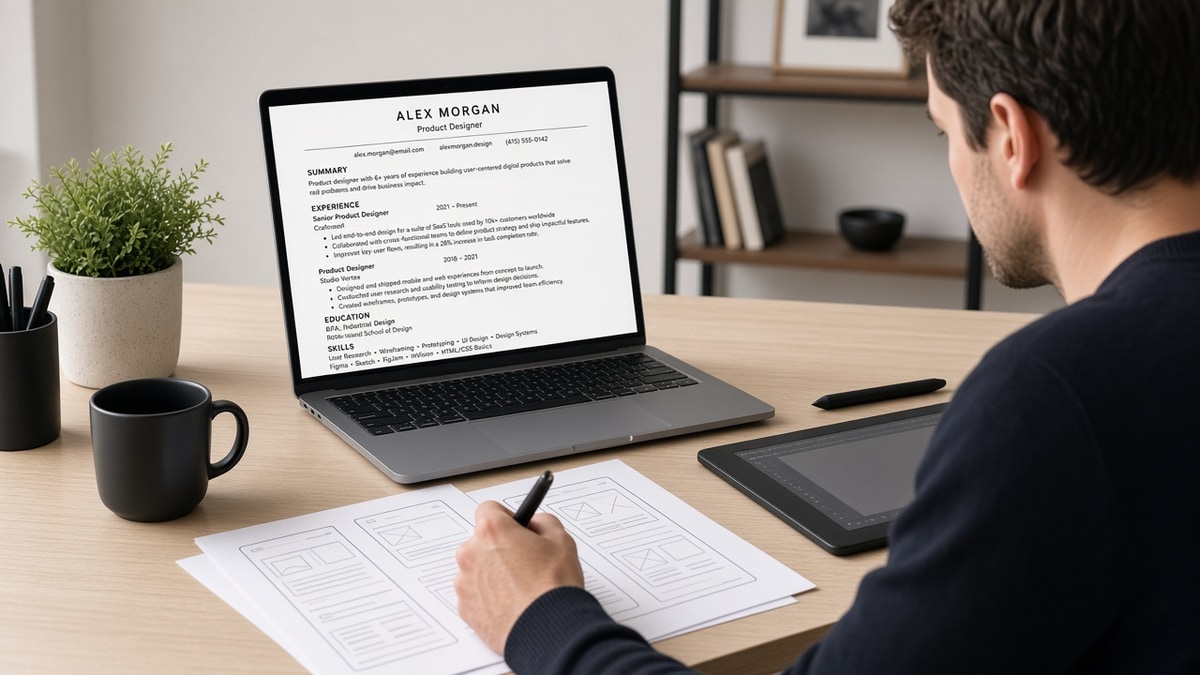
Your PDF shows a 22% conversion lift. Greenhouse doesn't show your checkout scope. That's what a product designer resume that passes ATS without visual tricks actually fixes: import order, not keyword density. It isn't a hidden score penalty. SaaS and consumer brands run Workday and Greenhouse on high-volume product design reqs. When you pack case study metrics into a thumbnail strip or list Figma only under Skills with icon fonts, the parser flattens design bullets and drops research scope recruiters ctrl-f before they'll open your portfolio. You're not losing on craft you lack. You're losing on export layout.
Check your resume for free with the posting pasted in after you paste your export into Notepad. If your task-success rate merged into a paragraph or Figma vanished behind a two-column header, structure broke before a human opened the file. You won't rescue a design upload by stuffing tool names into a Skills footer. Don't rewrite bullet verbs until metrics parse on their own lines.
You've probably been told to show your portfolio and quantify impact. Good advice, useless when bullet three never imported as its own line. Job searching through corporate portals is already slow. Below you'll get five steps with before/after pairs for UX and product design files, two edge cases for agency and in-house pivots, where designer uploads break parsing, and a copy-paste export rule you can run in ten minutes tonight. It's a placement fix, not a branding exercise.
Don't assume the design manager will open your Behance link when the parsed profile looks empty. Many design recruiters skim Greenhouse first. If your usability study sample size sat inside a designed metrics strip, they may never see it. Fix plain structure, then tune design language.
Open your master design file now. Select the Experience block. Paste into Notepad. If employer names and conversion digits merged into one string, keep reading. Product roles fail on proof of research scope and shipped features, not on whether you used a muted accent bar.
Quick Wins
- Put conversion lift, task-success rates, and research sample sizes in bullet one under the employer where you earned them.
- Name Figma, FigJam, and design systems in bullet one, not only in Skills with icons.
- Remove tables, thumbnail grids, and two-column headers around Experience.
- Paste export into Notepad and confirm every design bullet starts on its own line.
What Greenhouse drops when designer resumes use portfolio strips
Greenhouse attaches your upload to a candidate profile design recruiters skim inside the platform. They see parsed text alongside or instead of your PDF. For UX, product design, and design systems roles, the first ctrl-f is often Figma, then research method, then ship scope. When import flattens structure, those fields disappear or attach to the wrong employer line.
The bar your file must clear: Experience as reverse-chronological employer blocks with Month Year dates on the same line as the company name, and three to five bullets per role where bullet one names the method, platform, and one metric.
A composite product designer whose PDF shows a neat case study grid but Greenhouse imports one block reading Product Designer Figma user research prototyping loses to the same facts on plain lines with hyphen bullets. Same qualifications. Different skim surface for a coordinator verifying research ownership before forwarding to a design lead.
I've screened Greenhouse stacks where a UX designer's checkout metrics buried inside a sidebar imported after job two, so the parser attached mobile redesign bullets to a contract role from 2021. The recruiter never reached the conversion number because the parsed view looked like job hopping without research scope up top.
Edge case: agency-to-in-house pivot. Keep agency name and client product on separate lines inside the employer block when both matter. Write Agency Name (Client: B2B SaaS) as plain text, not a nested table. In-house recruiters ctrl-f the product they sell, not your agency homepage URL.
Edge case: designer with a portfolio link. Put one URL on the contact line or in a plain Projects section below jobs. When a Behance or personal site link replaces the company name on an experience row, Greenhouse often parses that URL as the employer field and leaves dates orphaned.
Read why your resume looks different after Workday upload when design lines flatten for the same glyph and text-box reasons as marketing roles.
Product designer resume: five parsing steps
Work top to bottom. Run the Notepad paste test after each step so you catch flattening before you tailor keywords.
Step 1: Pull every case study metric out of portfolio strips
Before: Conversion lift, task-success rate, and research sample size inside a three-column thumbnail grid beside a hero header.
After: Plain Experience block:
Product Designer | Northwind Payments | March 2022 to Present
Led checkout redesign in Figma; raised completed purchases 14% in 8 weeks across iOS and web.
Place metrics in bullet one under the employer where you earned them. Parsers read top to bottom inside each job block. If numbers sit in a footer portfolio column, they may import after Education and attach to nothing.
Step 2: Put Figma in bullet one, not icon rows in Skills
Before: Figma, Sketch, FigJam, Miro, and Principle listed only under Skills with icon fonts and design thinking.
After: Bullet one under current employer: Owned onboarding flows in Figma and FigJam; cut time-to-first-value 19% in Q3 through 12 usability sessions and 3 prototype rounds. Bullet two adds engineering handoff or systems scope. Skills holds six terms max as backup, typed in plain text.
Treat design tools as applied platforms, not decoration. Write high-fidelity prototypes in Figma with dev-ready specs, not creative problem solver on a resume line unless you owned research and visual design under one title.
Step 3: Flatten designed designer templates
Downloaded creative templates love wireframe thumbnails, colored section bands, and two-column layouts with Skills on the left. They photograph well and parse badly. Clear formatting on the whole Experience section. Rebuild with Word's standard Heading 2 for section titles typed in plain text, not banner graphics.
Before: Summary inside a shaded text box with a six-icon tool row squeezed beside it.
After: Summary as three plain sentences. Experience next. One column start to finish.
Step 4: Rebuild design bullets with standard list styles
Use Word's bullet button or hyphen-space at line start. Avoid checkmarks, Figma glyphs, and emoji from template sites. Design bullets should carry method, platform, and one outcome per line.
Before: UX role written as one semicolon chain covering research, wireframes, stakeholder workshops, and ship dates.
After: Three bullets: Ran 14 moderated sessions on mobile checkout; identified 3 friction points blocking card entry. Shipped revised flows in Figma with 28 screens handed to engineering in 2 sprints. Raised task-success rate from 71% to 89% in follow-up testing.
Step 5: Match posting language in bullet one, then export
Open the job description. Highlight three must-have terms: research method, design tool, and scope if listed. Rewrite bullet one under your current role so one term lands in the first eight words. Export DOCX when Greenhouse allows choice. Otherwise PDF from Word only.
Product design example after tailoring: Scaled design system components in Figma; cut handoff questions 31% across 4 squads shipping weekly. UX research example: Led diary study with 18 participants; informed roadmap prioritization that lifted activation 9 points in 6 weeks.
Copy-paste product designer export rule
Copy-paste before every corporate design apply:
1. Metrics in bullet one under the employer where you earned them
2. Remove tables, thumbnail grids, and two-column layouts
3. Figma/FigJam/design systems in bullet one, not only Skills icons
4. Standard bullets only; no semicolon chains
5. Save DOCX; PDF from Word if required
6. Paste into Notepad: each employer line and bullet on its own row
Read how many keywords a resume should have in 2026 once structure survives import and bullet one still needs sharper term placement.
Where designer Greenhouse uploads still break
Case study numbers only in a header graphic. Parsers skip styled headers. Digits never reach Experience. Move figures into body bullets.
Tool lists without project context. Figma and FigJam mean less when import drops the bullet that named checkout scope. Pair platform with feature area in the same line.
Semicolon chains to save space. Design resumes run long. Recruiters still need skim points. One outcome per bullet survives Greenhouse better than one paragraph per job.
Portfolio thumbnails as filler. Wireframe screenshots belong in your portfolio site, not inline on the resume file recruiters upload. Thumbnails flatten into unreadable strings on import.
Assuming the design lead always opens the PDF. Hiring managers forwarded in Slack often see parsed text only. If metrics flattened, your champion cannot quote your scope without retyping it.
Edge case: product designer applying to B2B and consumer roles in the same week. Keep one master file and swap bullet one terms per posting. Do not maintain two layouts with different column structures. Parsing breaks on the fancy version every time.
Edge case: designer title with both bootcamp certificate and HCI degree. List degree under Education and certification on its own plain line. Do not merge credentials into the employer line for your current role. Parsers attach certificates to the wrong date range when degrees sit inline with job titles.
Greenhouse is not punishing design experience. It is reading export order from a template built for print, not import. Plain single-column files look boring and map correctly. That is the trade design candidates in saturated markets need to make before they rewrite bullet verbs for the fifth time.
Candidates often add another portfolio link while the export method stays in a table. If Notepad still shows one paragraph under Product Designer, new verbs will not help. Swap the container first. Then tune the words inside each line.
Parse check before your next design apply
After you rebuild metrics and bullets, run a free ATS check with the job description pasted in. Confirm must-have research and Figma terms appear inside parsed Experience lines, not only in a Skills footer that imported cleanly while employer blocks flattened.
When the req lists eight must-haves and your file feels thin on two of them, score your job match before you spend an hour rewriting bullets for a role where structure still breaks import. Fix layout first, then close real gaps with dated proof in bullet one.
Rebuild bullets before the next product design apply
A product designer resume that passes ATS without visual tricks comes down to plain employer lines and design bullets that survive import, not another Skills row with icons. Tables, thumbnail grids, and compact headers drop conversion metrics and Figma scope recruiters ctrl-f before they open your portfolio. Single-column Word exports with bullet one carrying research and tool terms fix most corporate uploads without changing your track record.
Open your master file tonight. Pull case study metrics into bullet one. Move Figma into the first line under each employer. Paste into Notepad. Upload when each digit and bullet stands alone. This will not fix applying to roles you are not qualified for. It stops qualified designers from dying as a paragraph nobody skimmed.
When the posting asks for a cover letter, generate a cover letter that repeats bullet one scope in prose. Letter and resume should match; neither rescues a flattened metrics block on its own. Keep a Greenhouse-safe master labeled Design_Upload.docx next to any polished copy you use for networking. Boring filename, accurate import.
Read more
Frequently asked questions
Greenhouse reads a text stream, not your portfolio layout. Conversion lift, task-success rates, and research sample sizes parked in a thumbnail strip or sidebar often import after Education or drop entirely. Numbers that looked bold on your PDF can land under the wrong employer line in the recruiter view. Move every metric into Experience bullet one under the job where you earned it, then paste your export into Notepad to confirm the figure sits on the same line as the company name.
Skills is backup, not proof. Parsers weight dated Experience bullets higher than undated tool clouds and icon fonts that render as blank squares. Write bullet one under the employer where you ran the stack: Led checkout redesign in Figma; raised completed purchases 14% in 8 weeks across iOS and web. List Figma again in Skills with six terms max. Recruiters ctrl-f the tool name inside a job block before they open your portfolio link.
Structure stays the same: single column, plain employer lines, standard bullets. Content shifts. UX designers lead bullet one with research method, user segment, and one outcome metric. Product designers lead with feature scope, cross-functional partners, and ship cadence in the first line. Both roles lose screens when Behance links replace company names or wireframe thumbnails sit in tables that flatten on import.
Try DOCX first when the portal allows it. Word files with built-in heading styles usually keep employer blocks and bullets separated better than designed PDFs exported from Figma, Canva, or resume template sites. If the employer requires PDF, export from Word after you strip tables and columns, not from a design tool. Always run a plain-text paste test so you see what the recruiter view receives.
Yes, and you should label them clearly. Keep Design_Network.pdf for coffee chats and Portfolio_Review.pdf for creative directors who asked for polish. Upload Product_Designer_Upload.docx to Workday and Greenhouse every time. Do not swap files mid-process because the designed version parses faster in your head. The boring file is the one that carries dated proof recruiters forward without retyping your scope.