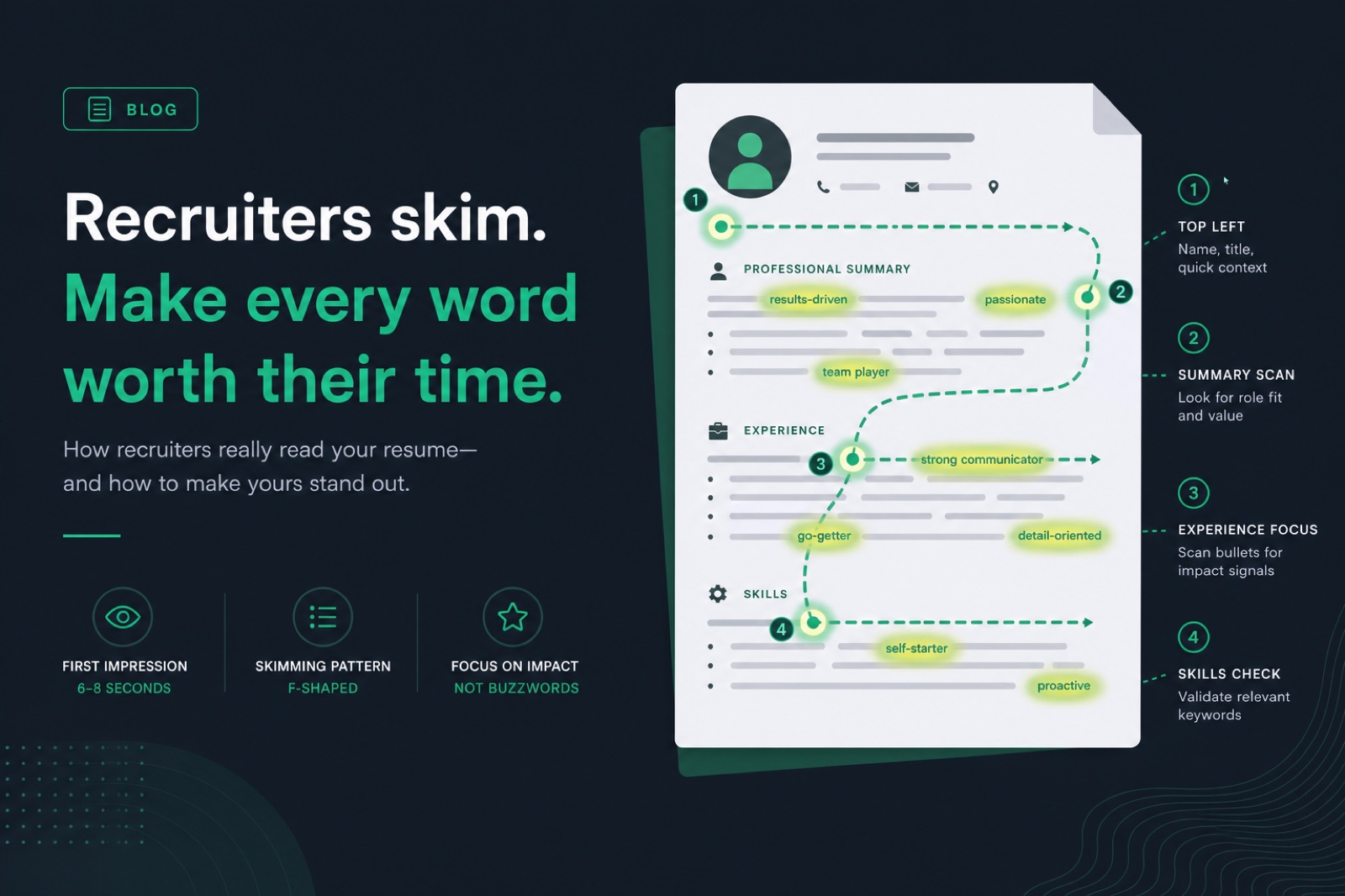
Recruiters do not run an AI detector on your resume—they pattern-match. After a few hundred screens, unedited ChatGPT output has a recognizable silhouette: uniform bullet length, inflated verbs with no matching scope, generic summaries that describe a category of person instead of you, and round percentages with no baseline. One signal alone rarely matters; two or three clustered on the same page triggers the "reads templated" file within the first ten seconds.
Using AI to draft or brainstorm is not the problem. Shipping the first draft without a human edit is. Workday and Greenhouse do not score writing style—they parse fields and match keywords—so a generic AI resume can pass ATS while a recruiter rejects the tone. This guide maps the markings recruiters flag, explains why they exist, and gives a rewrite checklist to sound human again. If you already use ChatGPT for drafts, pair this with our guide on whether ChatGPT writes good resumes for a full before-and-after workflow.
Key Takeaway
- Recruiters flag clusters of patterns—not single words
- Uniform bullets, inflated verbs, and round numbers do the most damage
- AI as assistant is fine; unedited output is not
- Specific numbers with baselines read more credible than clean round percentages
- Reading your resume aloud catches more AI tone than any checker
How recruiters actually read a resume in 2026
Corporate recruiters on Greenhouse and Lever typically spend 6–10 seconds on the first pass. They look for title match, recent relevant employer, named tools, and at least one proof metric. Writing quality matters on the second pass—when they decide whether to call—but the first filter is fit and evidence, not grammar.
Research on hiring decisions from the Society for Human Resource Management consistently shows that recruiters rely on quick heuristics under time pressure. AI resumes fail that heuristic when they sound interchangeable—because interchangeable candidates rarely get phone screens.
Common Mistake: assuming a high ATS score means recruiters will love the wording. Parsers and humans evaluate different things—see AI resume checker vs human recruiter review .
The telltale-signs table recruiters use
None of these markings are unique to AI—humans wrote generic resumes for decades. What changed is the rate: these signals now show up clustered together on the same page far more often in unedited model output.
| Signal | What it looks like | Why it reads as AI |
|---|---|---|
| Uniform bullet rhythm | Every bullet is nearly the same length | Real work varies in scope; models default to even output |
| Verb inflation | Orchestrated, pioneered, drove on junior scope | Title and years rarely match the verb size |
| Job-description summary | Results-driven professional with proven track record | Describes a category, not this candidate |
| Perfectly parallel structure | Summary, experience, skills all follow one template | One prompt produces one structural pattern everywhere |
| Suspiciously round numbers | Improved performance by 30%, no baseline | Reads as a placeholder never filled in |
| Orphaned skills | Trendy tools listed once, never in bullets | Generated lists optimize keyword coverage, not proof |
| Transition-word overload | Furthermore, Additionally, Moreover in bullets | Common in generated prose, rare in hand-written resumes |
| No specificity anywhere | Nothing only this person at this company would say | Generic prompts produce generic output by default |
Quick Check: highlight every line that could appear on someone else's resume with the same job title. If more than half the page highlights, you have a template problem—not a you problem.
Three patterns worth a closer look
Uniform bullet rhythm
Real accomplishments are not evenly sized. Some need a clause of context; others land in one line. When six bullets all run exactly two lines and open with a strong verb, the page develops an evenness genuine experience rarely has—because nobody experiences their career in identically-sized chunks.
Recruiter Lens
"When I see six bullets that all run exactly two lines, I am not thinking impressive consistency. I am thinking this was generated in one pass and never touched again."
Verb inflation without evidence
Orchestrated a project you coordinated, pioneered a process three other people also worked on—the gap between verb and actual scope is one of the fastest tells because recruiters cross-check against your title and tenure in the same glance.
Suspiciously round numbers
Increased efficiency by 30% with no baseline, timeframe, or method reads as a placeholder. Recruiters trust numbers more than almost anything on the page—but only when the number has a source behind it.
Pro Tip: give me cut ticket backlog from 340 to 90 over one quarter over the clean round 30% every time. The ugly number is the one I believe.
Before/after rewrites across three roles
| Role | Before (AI silhouette) | After (human, defensible) |
|---|---|---|
| Marketing | Results-driven marketing professional with proven track record of driving engagement across dynamic environments. | Grew organic email signups from 1,200 to 4,800/month over two quarters by rebuilding the lead-capture flow and testing seven subject line variants. |
| Software engineering | Orchestrated cross-functional initiatives to optimize system performance and drive operational excellence. | Rewrote checkout database queries, cutting page load from 2.1s to 640ms and removing ~40 weekly timeout tickets. |
| Customer success | Utilized best practices to enhance client satisfaction across a diverse portfolio. | Cut 90-day churn on a 60-account portfolio from 18% to 11% by restructuring onboarding around each client's first reported blocker. |
Every strong rewrite shares the same ingredients: a real number with context, a concrete action, and a detail only someone who did the work would include.
Common Mistake: keeping the AI summary and only fixing experience bullets. Patterns hide in every section—run the full humanize checklist on the whole file.
What still works when AI is in the loop
| How AI is used | Recruiter reaction | Risk |
|---|---|---|
| Brainstorming bullet angles for one accomplishment | Invisible once rewritten in your voice | Low |
| Grammar and spelling pass | Invisible; same as spellcheck | Low |
| Pulling keywords from a job description | Fine if woven into real bullets | Low |
| Drafting a full summary paragraph | Risky unless heavily rewritten | Medium |
| Generating entire resume unedited in one pass | Flagged quickly | High |
The dividing line is not the tool—it is whether a human made the final pass sentence by sentence. For where ChatGPT drafts tend to go wrong before that edit, see does ChatGPT write good resumes . For builder-specific risks, read AI resume builder pros and cons .
Key Takeaway: AI is an excellent first-draft machine and a poor editor of itself. Let it draft; do the editing yourself.
Tone fixed but still no callbacks? The file may not be reaching recruiters at all.
Run a free parse check on HireFlow's ATS resume checker — formatting issues no amount of rewording will fix.
The humanize checklist
- Vary bullet length on purpose. Let bigger wins run two lines; keep sharp wins to one.
- Swap inflated verbs for accurate ones. If you coordinated it, write coordinated—not orchestrated.
- Attach the number behind the number. Name what improved, the timeframe, and the baseline.
- Delete phrases you would not say out loud. If it sounds strange in an interview, cut it.
- Match every skill to a bullet that proves it. Skills are claims; bullets are evidence.
- Cut transition words from bullets. Furthermore and Additionally are connective tissue models reach for by default.
- Read the whole resume aloud. Unnatural phrasing is obvious the moment it leaves your mouth.
Recruiter Lens: two-minute gut check
- Would a friend recognize your voice in this writing?
- Does every bullet have a distinct shape and length?
- Can you name the exact source of every number on the page?
- Is there one detail unique to this specific job?
Quick Check: reading aloud catches tone problems. An ATS check catches parse problems. You need both passes before applying on iCIMS or Workday.
Industry-specific proof recruiters expect
AI tone is only half the problem—missing domain proof is the other. Recruiters in different functions scan for different evidence on the first pass:
- Sales: quota attainment %, pipeline managed, deal size, ramp time to full quota—not generic relationship language.
- Engineering: languages and frameworks named, scale (requests/sec, users, data volume), incident reduction, shipping cadence.
- Healthcare: patient volume per shift, EHR systems (Epic, Cerner), certifications (BLS, ACLS, RN license state), unit type.
- Operations: process cycle time, error rate, vendor count, budget owned, tools (SAP, NetSuite, Asana).
Generic AI summaries flatten these differences into interchangeable adjectives. After humanizing tone, verify each function's proof signals still appear—otherwise you sound human but unqualified.
Key Takeaway: human voice plus domain-specific proof beats perfect prose with no numbers every time.
Prepare to defend every line in the interview
Recruiters who flag AI resumes often verify suspicion in the phone screen: "Walk me through how you measured that 30% improvement." If you cannot answer, the resume line gets retracted mentally—even if the tone sounded fine on paper.
Before you submit, highlight every metric and ask: do I know the baseline, timeframe, tool, and stakeholder? If not, rewrite the bullet to something defensible or drop the number. Interviewers forgive modest results; they do not forgive invented ones.
Reading aloud helps here too—if a line makes you pause because you are not sure it is true, a recruiter will pause for the same reason. Edit until you can tell the story without notes.
Common Mistake: letting AI invent metrics you never tracked. That fails faster in interviews than generic tone ever did.
A practical AI-assisted editing workflow
Treat AI like a junior writer who drafts fast but never fact-checks. A workflow that keeps quality high without banning the tool:
- Brain dump your raw facts first. Titles, dates, tools, messy numbers—even bullet fragments. Give the model facts, not a blank page.
- Ask for options, not finals. "Give me three ways to phrase this accomplishment" beats "write my resume."
- Pick one angle and rewrite in your voice. Change word order, swap verbs, add a detail only you know.
- Run the humanize checklist on the full file. Not just the section you edited.
- ATS check last. Confirm single-column parse after all edits—layout breaks are separate from tone fixes.
Candidates who follow this workflow rarely trigger the AI silhouette because the final pass is always human. Candidates who paste a prompt and upload the first export almost always do—regardless of how strong their real experience is. Budget 30–45 minutes for the human edit pass on a one-page resume; rushing that step is what creates the pattern recruiters recognize.
Pro Tip: save your raw fact dump in a separate doc. When you interview, that doc is your source of truth for every metric on the resume.
ATS vs human screening: two different problems
Most ATS platforms are not designed to detect AI authorship. They parse structure, extract fields, and match keywords. A generic AI draft can parse cleanly in Greenhouse while a recruiter rejects the tone on the second pass.
The NIST AI Risk Management Framework emphasizes human oversight for high-stakes decisions—hiring included. Your resume needs to satisfy both the parser and the person: honest keywords in plain text, plus writing that sounds like you did the work.
For how keyword matching differs from human proof evaluation, see semantic matching in ATS . For why a clean parse still gets silence, read how ATS really works .
Pro Tip: fix parse and tone in that order. A human-sounding resume in a two-column Canva export still dies in the portal.
Common mistakes when you try to sound human on purpose
- Throwing out every AI-assisted line. Nobody edited it afterward—that was the problem, not the tool.
- Adding deliberate typos to seem more human. Specificity is the signal, not sloppiness.
- Fixing tone but forgetting numbers. A casual bullet with no metric is still a weak bullet.
- Assuming one read-through is enough. Patterns hide in summary, experience, and skills—check all three.
Common Mistake: pasting the job description into Skills to raise ATS match while leaving AI tone in the summary. You fix one gate and fail the other.
Frequently asked questions
Not with certainty on a single line, but experienced recruiters recognize a cluster of patterns—uniform bullet length, inflated verbs with no matching scope, generic summaries, and round unsupported numbers—that show up together far more often in unedited AI output than in resumes written slowly by hand.
Using AI as a drafting assistant is not the problem recruiters flag. Submitting the unedited first draft is. If you rewrite the output in your own voice, add real numbers, and vary sentence length, a heavily AI-assisted resume becomes indistinguishable from one written from scratch.
The most common are uniform bullet rhythm (every line the same length), inflated verbs like coordinating work described as leading it, generic job-description-style summaries, and suspiciously round percentages with no baseline or timeframe attached.
Yes. Recruiters do not flag grammar and spelling passes—that is functionally the same as spellcheck. The risk only appears when an entire summary or bullet set is generated and shipped without a human editing pass afterward.
Vary your bullet lengths on purpose, swap inflated verbs for accurate ones, attach a real number and baseline to every claim, delete phrases you would not say out loud, and read the whole resume aloud before you submit it.
Most ATS platforms are not designed to detect AI authorship—they parse structure, extract fields, and match keywords. Workday and Greenhouse both prioritize field extraction and Boolean filters over writing-style signals.
No. AI is a strong brainstorming and first-draft tool. The dividing line is whether a human made the final pass and confirmed every sentence sounds like them, with real, defensible details attached.
Phrases like results-driven professional with a proven track record, dynamic fast-paced environment, utilized best practices, and furthermore at the start of bullets. Clustered with uniform structure, they signal an unedited template.