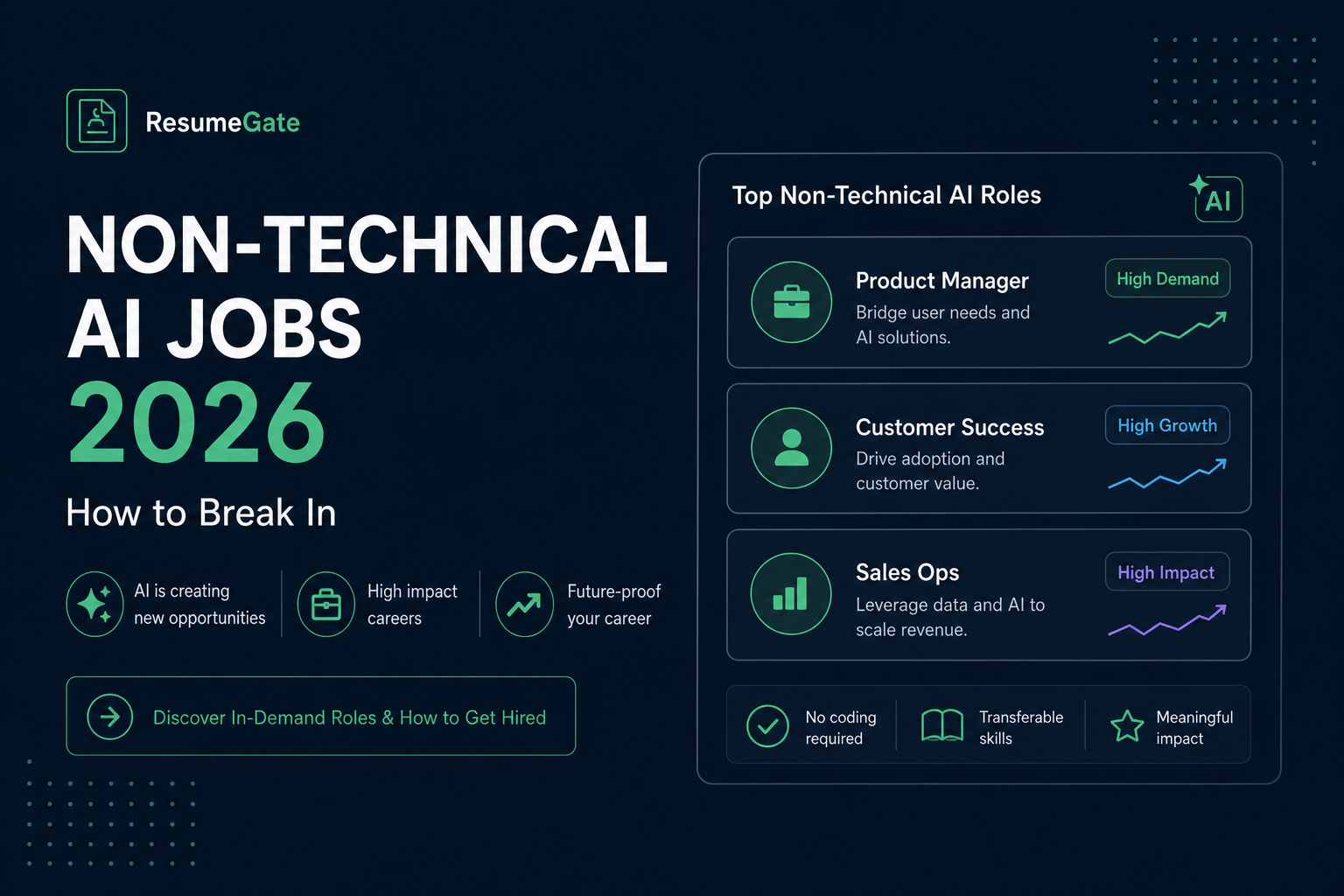
You can work in AI in 2026 without writing code. The fastest-growing hiring categories are AI program management, output evaluation, internal enablement, responsible-AI policy, and customer-facing solutions roles—jobs built around judgment, communication, and domain expertise, not model training. Enterprise teams on Workday, Greenhouse, and iCIMS search for plain-text proof of deployment, evaluation, and adoption work; a generic "interested in AI" line will not match those filters.
The public narrative still centers on machine learning engineers and research scientists. That slice is real—but it is not where most accessible opportunity sits. Banks, hospital systems, insurers, and retailers are buying AI from vendors and hiring people to roll tools out safely, review outputs, train staff, and explain limits to executives. Those problems are organizational, not algorithmic. This guide maps the role families, the skills that transfer, and how to rewrite your resume so ATS parsers and hiring managers see qualified experience instead of a vague career pivot.
| Role family | Typical background | ATS keywords to mirror |
|---|---|---|
| AI program / project manager | PMO, operations, IT project lead | LLM deployment, vendor management, stakeholder alignment, rollout |
| AI evaluator / trainer | QA, editorial, compliance, clinical review | RLHF, output quality, rubric, red-teaming, annotation |
| AI enablement lead | L&D, change management, ops training | adoption, playbooks, Copilot rollout, training, utilization |
| Responsible AI / policy | Legal, risk, privacy, ethics | governance, bias review, data privacy, model risk, compliance |
| AI solutions / customer success | CS, account management, pre-sales support | implementation, escalation, product limits, enterprise AI |
Key Takeaway
- Search by responsibility keywords, not one fixed job title
- Domain expertise in regulated fields is often the primary qualification
- Honest reframing beats inventing model-building experience
- Named tools plus measurable adoption or quality outcomes build credibility
Six non-technical AI role families companies hire for in 2026
Titles vary by company—a "machine learning product operations" role at one employer may look like "AI implementation manager" at another. The work clusters into six families. Understanding which family fits your background matters more than chasing a hype title from 2023.
AI program and project management
These roles coordinate vendor selection, pilot design, security review, training schedules, and executive reporting. You are not tuning hyperparameters—you are keeping a cross-functional deployment on track when legal wants slower rollout and operations wants faster access. Prior PMO, IT implementation, or operations leadership maps directly here.
Evaluation, training, and quality review
Labs and enterprises need humans who can score model outputs against rubrics, flag unsafe or inaccurate responses, and document why an answer fails. The cognitive task mirrors editorial QA, audit sampling, or clinical documentation review. A paralegal who spots subtle contract errors is more useful for legal-AI evaluation than a generalist engineer who cannot read a indemnity clause.
Enablement and internal adoption
Rolling out Microsoft Copilot or ChatGPT Enterprise to 2,000 employees is a change-management problem. Enablement leads build playbooks, run office hours, measure utilization, and kill workflows that create more risk than value. L&D and operations trainers who have driven software adoption before already have the core skill set.
Policy, trust, and safety
The NIST AI Risk Management Framework pushed many US enterprises to formalize governance roles. Policy specialists define acceptable-use rules, review high-risk use cases, and document controls for regulators—not build models. Legal, compliance, and privacy backgrounds transfer cleanly when you learn product-specific vocabulary.
Customer-facing AI solutions
AI software vendors need people who explain capabilities honestly, guide implementation, and triage escalations. The job is relationship management plus enough fluency to discuss context windows, data retention, and integration limits without bluffing.
Workflow and prompt design
Standalone "prompt engineer" postings are rarer, but workflow design is everywhere inside product ops, content strategy, and internal automation teams. The deliverable is documented prompts, guardrails, and handoff steps—often in Notion or Confluence, not in a Python notebook.
Common Mistake: applying only to AI lab research titles when your background fits enterprise deployment at a bank or hospital—where most non-technical openings actually sit.
Transferable skills that beat a computer science degree for these roles
Hiring managers for non-technical AI roles screen for three capabilities that rarely appear on a CS transcript: structured evaluation, cross-functional translation, and domain depth in fields where models still err.
Structured evaluation. Can you compare an output to a written standard and explain the gap in actionable language? Auditors, editors, nurses reviewing documentation, and mortgage underwriters do this daily. That is the same mental model as RLHF annotation or enterprise output QA—without touching model weights.
Cross-functional translation. AI pilots stall when nobody can explain retention policies to finance and latency tradeoffs to legal in the same meeting. If you have run steering committees, vendor negotiations, or compliance-heavy rollouts, you already know the rhythm these teams need.
Domain depth where errors are expensive. The Bureau of Labor Statistics management analyst outlook notes growing demand for analysts who interpret data and recommend process changes—skills adjacent to AI operations hiring. In regulated domains, subject-matter experts who catch subtle model mistakes are harder to replace than generalist technologists who cannot read the underlying source material.
Quick Check: if you can write a one-page rubric explaining what "good" looks like in your field, you have evaluator-ready thinking—name that skill explicitly on your resume.
How Workday, Greenhouse, and iCIMS match non-technical AI resumes
Enterprise AI hiring runs through the same ATS stacks as other corporate roles. Workday Recruiting extracts plain text from uploads—two-column Canva layouts and skill icon rows often drop searchable terms. Greenhouse weights exact phrase matches from the job description; "AI adoption" and "AI enablement" may not register as the same keyword. iCIMS boolean searches used by staffing firms often filter combinations like "change management" AND "generative AI" AND "training."
Matching is not a mystery score—it is extractable text compared to posting language. Put AI-relevant terms in your headline, a plain skills block, and experience bullets tied to employers. For format guidance that keeps keywords visible, see Workday resume format tips and how semantic matching in ATS still depends on readable text even when systems go beyond exact keywords.
Mid-article check: upload a tailored file to HireFlow's ATS resume checker against a specific AI program manager or enablement posting before you apply. The checker surfaces missing terms and formatting traps that hide skills from Workday extraction.
Pro Tip: copy-paste your resume into Notepad—if "LLM," "evaluation," or "change management" disappear, parsers will miss them too.
Before/after resume bullets for non-technical AI pivots
Reframe real work—do not invent model training. Lead with mechanism, AI context, and measurable outcome.
| Before (weak) | After (ATS-friendly) |
|---|---|
| Managed software rollout and trained staff on new tools. | AI Enablement Lead—rolled out Microsoft Copilot to 180-person operations team; authored prompt playbooks, ran weekly office hours, raised weekly active utilization from 12% to 71% within eight weeks while legal reviewed acceptable-use policy. |
| Reviewed vendor documents for accuracy and compliance. | Contract QA specialist—applied 42-point rubric to third-party deliverables; piloted LLM-assisted first-pass review with human sign-off, cutting average review cycle from 4.2 days to 2.1 days without increasing error escalations. |
| Interested in AI and machine learning applications. | Customer success manager—used ChatGPT Enterprise and Claude to draft and quality-check tier-2 escalation responses; documented prompt guidelines adopted by 6-person pod; reduced average handle time 18% QoQ while CSAT held at 4.6/5. |
Notice what stayed the same: rollout, review, and customer work you actually did. What changed is searchable vocabulary—Copilot, rubric, prompt guidelines, utilization— and numbers a recruiter can repeat in a debrief.
Common Mistake: claiming "built an LLM" when you used a vendor chatbot—interviewers will ask about data pipelines on the first screen.
How to build credibility without a GitHub portfolio
Technical candidates show repositories. Non-technical candidates show artifacts and scoped outcomes:
- Track named tool use. ChatGPT Enterprise, Copilot, Claude, Gemini, Salesforce Einstein—plus what you used it for and the result. Vague "AI tools" lines fail keyword filters.
- Join or propose an internal pilot. Even informal participation on an AI working group beats a certificate stack. Document playbook contributions and stakeholder groups.
- Publish a short case study. A 400-word LinkedIn post walking through a real workflow improvement demonstrates communication skill hiring teams need—more than three generic badges.
- Choose certificates selectively. Google AI Essentials or vendor-specific enterprise AI training can help when tied to tools in the posting. Skip listing five completion certificates with no assessment—they read as filler.
Recruiters also run AI-assisted sourcing before you apply. Understanding what recruiter AI copilots surface from your profile helps you align public headline and skills with the same keywords on your resume.
Key Takeaway: three months of documented, honest tool use outranks a weekend certificate on most hiring screens.
Job search tactics: titles and keywords that surface real openings
Run boolean searches across LinkedIn, Indeed, and company career sites with combinations like:
- "AI program manager" OR "AI implementation" OR "LLM deployment"
- "responsible AI" OR "AI governance" OR "model risk"
- "AI enablement" OR "Copilot adoption" OR "gen AI training"
- "RLHF" OR "AI evaluator" OR "output quality"
- "AI operations" OR "MLOps" with "program" (non-engineering track)
Many strong postings hide AI work inside neutral titles—"Senior Project Manager, Digital Transformation" with Copilot rollout in the body. Read responsibilities, not headlines only. For broader tooling context, tested AI job search tools in 2026 compares platforms—but no tool replaces tailoring each application.
Quick Check: if a posting lists 12 ML engineering requirements and one line about change management, it is an engineering role—not your target.
What interviewers ask in non-technical AI screens
Phone screens for AI program and enablement roles rarely test coding. They test whether you understand deployment reality: change resistance, data handling, vendor limits, and how you measure adoption. Expect prompts like "Describe an AI pilot you supported—what went wrong?" or "How would you train skeptical managers on a Copilot rollout?" Prepare two stories with numbers: one success, one controlled failure you learned from.
Evaluator and trust-and-safety interviews often include live exercises—rate this model output, explain your rubric, flag the subtle error a non-expert would miss. Bring domain vocabulary from your field. A compliance analyst should reference control frameworks; a nurse should reference clinical documentation standards—not generic "attention to detail."
Interviewers at enterprises using Workday or iCIMS may compare your spoken examples to uploaded resume bullets. If you describe a Copilot rollout on the call but your resume still says "software implementation," credibility drops. Align spoken and written language before the screen.
Pro Tip: bring a one-page pilot summary (tools, users, metric, lesson) to reference—not to hand over if confidential, but to keep dates and numbers consistent under pressure.
Compensation context: what to expect by role family
Pay varies more by employer type than by the word "AI" in the title. Contract evaluator gigs pay differently from staff enablement leadership. Use ranges as orientation, not promises—always verify against your market and level.
| Role family (US enterprise, 2026) | Typical level | Broad cash band orientation |
|---|---|---|
| AI program / project manager | Senior IC or manager | Often aligned with senior PMO or IT program roles at same company |
| AI enablement lead | Manager | Comparable to L&D or change-management leadership tracks |
| Evaluator / trainer (staff) | IC | Wide spread—domain experts (legal, clinical) command premiums |
| Evaluator (contract) | Hourly / project | Lower base than staff; flexibility is the tradeoff |
| Responsible AI / policy | Senior IC or counsel-adjacent | Often tracks risk, privacy, or compliance compensation |
Frontier labs pay ML engineers substantially more than program managers—that gap is real. Hospital systems and regional banks hiring deployment leads often sit closer to existing director-band compensation for non-engineering leaders. Negotiate on scope and level, not on hype keywords.
When comparing offers, include bonus structure, equity if offered, and travel expectations. Enablement roles may require multi-site training weeks; contract evaluator work may be fully remote but without benefits. A higher hourly contract rate is not automatically better than staff total compensation once you account for utilization gaps between projects.
Title inflation is common—"AI strategist" at a small agency may pay less than "Senior Operations Manager" at a Fortune 500 running a Copilot rollout. Read the req and team size, not the buzzword in the headline.
Key Takeaway: compare offers to non-AI equivalents at the same employer before assuming an AI label automatically means a higher band.
Mistakes that block non-technical AI candidates
- Inflating technical scope: "trained models" when you tested prompts in a spreadsheet.
- Keyword dumping: pasting the job description into a skills section—recruiters and parsers both flag it.
- Ignoring domain angle: a nurse applying to clinical AI QA should lead with clinical documentation review, not generic project management.
- Format traps: icon skill bars and two-column templates that hide "evaluation" and "governance" from Workday.
- Same file for every AI title: evaluator keywords differ from program management keywords—maintain two tailored bases if you target both.
Internal transfers are underrated. If your employer already runs an AI working group, a lateral move with a title change may be faster than an external search—and you keep institutional context competitors cannot match. Document pilot work now so you have bullets when the internal req posts.
Common Mistake: leading with certificates instead of one measurable pilot outcome—hiring managers hire proof, not badges alone.
Pre-submit checklist for non-technical AI applications
- Headline names target family (enablement, program manager, evaluator, policy).
- Skills block lists plain-text tools and methods from the posting.
- Each recent role includes one AI-adjacent outcome with a number when honest.
- No invented model-building claims you cannot defend in a screen.
- Single-column layout passes copy-paste extraction test.
- ATS check run against the specific posting on Workday or Greenhouse.
- LinkedIn headline and resume use the same title vocabulary.
Key Takeaway: tailor one resume per role family—program management keywords differ from evaluator keywords.
Before and after (ATS-safe wording)
Key Takeaway: keep the same fact, add the tool name and a number.
| Before | After |
|---|---|
| Responsible for reports and team support. | Built weekly Workday headcount reports that cut manager follow-ups by 30%. |
| Used office software and helped customers. | Processed 40+ Greenhouse tickets/week in Zendesk with 96% CSAT. |
| Improved processes across the department. | Mapped the Taleo requisition workflow and cut time-to-post from 5 days to 2. |
Breaking into AI without coding is a repositioning project, not a restart. Map your evaluation, coordination, or domain skills to the role family enterprises actually staff, rewrite bullets with honest outcomes, and verify parsers can read your keywords on Workday and Greenhouse before you submit.
Run a free match check on HireFlow's ATS resume checker against your target posting, then build a clean single-column base in the free resume builder if your format is hiding the AI-adjacent work you already have.
Frequently asked questions
Yes. Most enterprise AI hiring in 2026 is for people who deploy, evaluate, govern, and train others on AI tools—not people who build models. Roles like AI program manager, AI enablement lead, output evaluator, and responsible-AI policy specialist rarely list Python or machine learning engineering as requirements. You may need enough technical literacy to read a dashboard or understand what an engineer means by 'latency' or 'hallucination,' but that is different from writing production code.
The fastest paths usually start from work you already do: operations or project management into AI program management; QA, editorial, or compliance into AI evaluation; L&D or change management into AI enablement; legal or risk into AI policy. The common thread is reframing existing judgment and coordination skills toward AI deployment language—not starting from zero.
At frontier AI labs, senior ML engineers still out-earn most non-technical AI roles by a wide margin. At banks, hospitals, insurers, and retailers deploying vendor-built AI, the gap is much smaller—senior AI program managers and trust-and-safety leads often sit in the same compensation band as other director-level individual contributors. Contract AI evaluator work pays less than staff roles unless you bring rare domain expertise (medicine, securities law, clinical coding).
As a standalone title, it is less common than in 2023–2024. The skill did not disappear—it got absorbed into AI workflow designer, solutions specialist, content strategist, and product operations titles. On a resume, lead with outcomes (reduced handle time, improved output quality, documented playbooks) rather than the standalone title unless the posting uses it verbatim.
Mirror the posting: AI program management, LLM deployment, change management, prompt guidelines, model evaluation, RLHF annotation, responsible AI, data governance, stakeholder training, vendor selection, and the specific tools named (Copilot, ChatGPT Enterprise, Salesforce Einstein, etc.) when you have actually used them. Workday and Greenhouse index plain-text skills blocks—avoid icon-only skill bars that hide searchable terms.
Yes. Support maps cleanly to AI customer success at AI software vendors and to evaluator roles where patience, precision, and rubric-based judgment matter. Strong transitions usually include one proof point beyond 'I used ChatGPT'—internal pilot participation, documented escalation workflows, or a measurable quality metric from AI-assisted responses.
No. Most accessible hiring is at enterprises adopting vendor AI—financial services, healthcare systems, law firms, retailers, and government agencies. Those employers often prefer domain experts who understand regulated workflows over generalist technologists. AI-native startups and research labs remain more competitive and more technical.
Document named tools, scoped outcomes, and artifacts: pilot participation, training materials you authored, evaluation rubrics you applied, vendor RFP criteria you helped write, or a short LinkedIn case study on a real workflow you improved. Three months of specific, honest use beats a stack of generic certificates completed in a weekend.