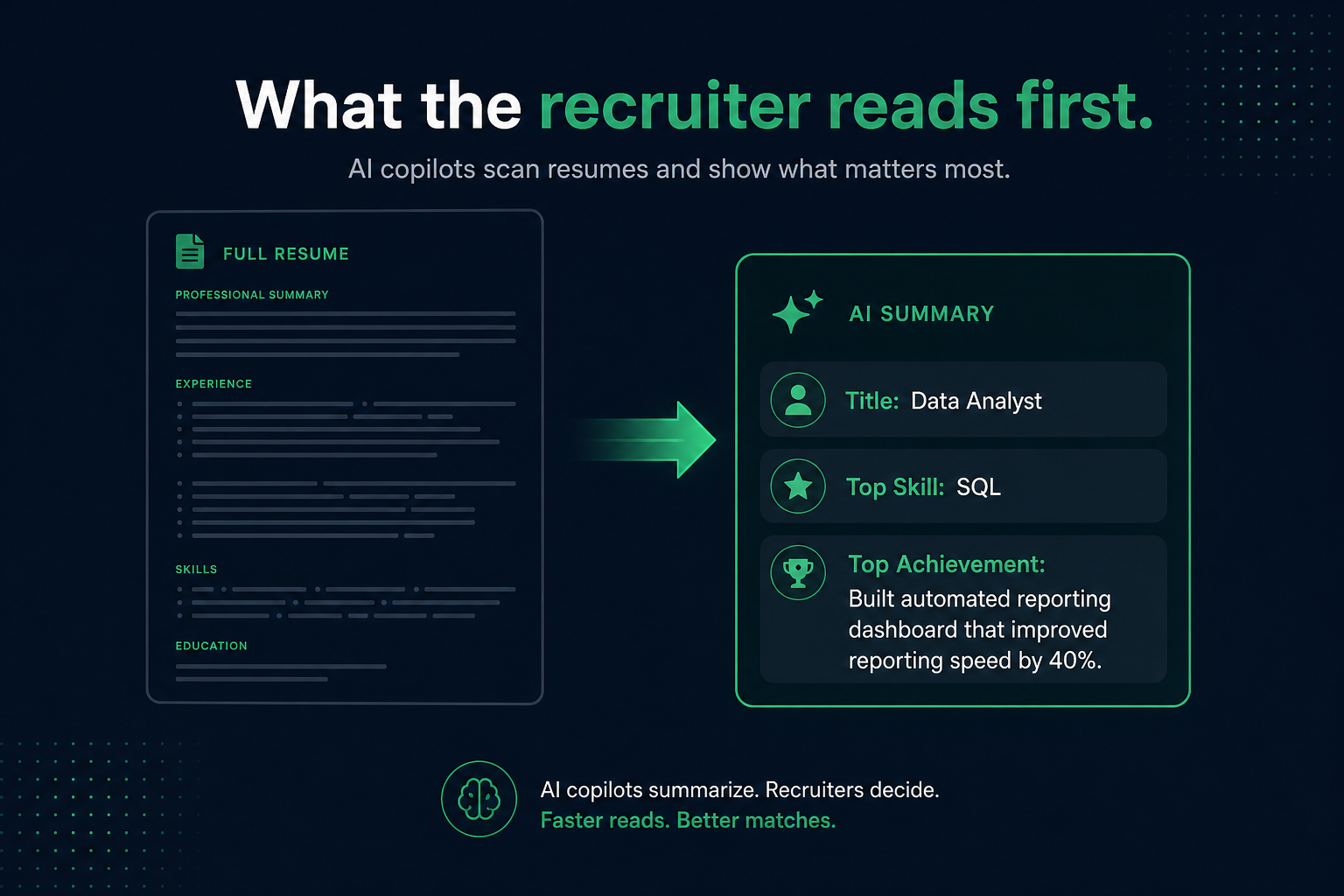
Ask most recruiters in 2026 what they read first when a new application comes in, and increasingly the honest answer is not "the resume"—it is a short, AI-generated candidate summary sitting on top of it inside their recruiting platform. Overall AI use for day-to-day HR tasks has climbed sharply in the last two years, and summarizing incoming applications into a scannable card is one of the most widely adopted uses, because it lets a recruiter triage a hundred applications in the time it used to take to read ten.
This is a distinct layer from the ranking-and-scoring agents covered elsewhere on this site. A recruiter AI copilot's job is narrower: take your resume, pull out the handful of facts a busy human needs to decide whether to open the full file, and present them as a short card. Whether that card looks compelling has a real effect on whether the full resume gets a proper read at all.
Key Takeaways
- What a recruiter AI copilot actually extracts and displays
- Why a weak summary can bury a strong resume
- The specific resume habits that produce a strong AI summary
- What these tools consistently struggle to summarize well
- A quick self-test: summarize your own resume in three sentences
What a recruiter AI copilot actually extracts
Implementations vary by platform, but the summary card a recruiter sees typically pulls from a consistent set of fields:
- Current or most recent title and company, normalized against standard industry terminology when your listed title is unusual
- Years of relevant experience, inferred from your dates and role descriptions, not just a number you state
- Top 3-5 skills or competencies the model judges most relevant to the open role, pulled from both your skills section and language in your bullets
- One or two standout achievements, usually whichever bullets contain the clearest quantified outcome
- A fit rationale, a sentence explaining why the system surfaced you for this specific req
That "one or two standout achievements" line is the one most within your control and most commonly wasted. If your strongest, most quantified bullet is buried in your third job down the page instead of visible near the top of your most relevant role, the summarizer may pull a weaker line instead simply because it is more prominent in the document structure.
Key Takeaway: The AI summary pulls your title, inferred years of experience, top skills, and one standout achievement — put your strongest line where it can actually be found.
Why a weak summary can bury a strong resume
A recruiter triaging a large volume of applications often decides whether to open the full resume based on the summary card alone. A genuinely strong candidate with a vague or poorly structured resume can produce a flat, unconvincing summary—and never get the deeper read that would have revealed the real depth of their background. This is the same underlying mechanism covered in our guide to AI resume screening agents , applied specifically to the human-facing summary layer rather than the scoring layer.
In practice, this means the cost of a vague bullet is now two-fold: it scores worse in automated ranking, and it is less likely to be selected as the "standout achievement" a human recruiter actually reads before opening your file.
Key Takeaway: A vague resume now pays a double penalty — it scores worse in ranking and is less likely to be picked as the "standout achievement" a human actually reads.
Resume habits that produce a strong AI summary
- Put your single strongest, most quantified bullet first in your most recent, most relevant role—not buried third or fourth down.
- Use a real, recognizable job title. Internal or unusual titles ("Growth Ninja," "Ops Wizard") are harder for a normalization step to map cleanly to standard industry terminology, which weakens the summary's title line.
- Name your top skills explicitly, not just implicitly. A dedicated, current skills section gives the summarizer a clean list to draw from rather than forcing it to infer everything from prose.
- Keep your summary/objective section current and specific. Many copilots weight your own professional summary heavily as a starting point—an outdated or generic one can anchor the entire generated summary in the wrong direction.
- Make sure the file parses cleanly in the first place. A summarizer working from a garbled extraction produces a garbled or incomplete summary, regardless of how well the underlying resume was actually written.
Key Takeaway: Front-load your strongest bullet, use a recognizable title, and keep your summary section current — these five habits do the most to shape a strong AI-generated card.
Not sure how your resume actually parses? Run a free scan on hireflow.net before you find out from a recruiter's silence.
What these tools consistently struggle to summarize well
- Career changes and nonlinear paths. A summarizer optimized for a straightforward title-to-title progression can flatten a genuinely interesting pivot into a confusing or understated line—if you are changing industries, your own written summary needs to do more of the framing work than usual, since the AI is less likely to connect the dots for you.
- Understated achievements. If you consistently undersell your own work ("helped with," "assisted in"), the model has little to elevate into a standout line—there is no substitute for writing your own accomplishments with appropriate ownership language.
- Highly technical niche roles. Very specialized domains sometimes get summarized at a generic level ("technical professional with relevant experience") when the model is not confident mapping niche terminology—a clear skills section with the exact terms of your field helps counter this.
Key Takeaway: Nonlinear career paths, understated language, and niche technical roles are the cases where you need to do more of the framing work yourself.
A quick self-test: summarize your own resume in three sentences
Before you submit your next application, try this: cover your resume and write, from memory, a three-sentence summary a stranger could use to decide whether to interview you—title, top achievement, top skill match. If you struggle to produce a compelling version yourself, an AI summarizer working from the same document is unlikely to do meaningfully better. Rewrite your top bullets until your own three-sentence summary would make you want to open the file.
Key Takeaway: If you cannot summarize your own resume compellingly in three sentences, neither can an AI copilot working from the same document.
The specific fields a recruiter copilot surfaces first
When a recruiter opens an application in a modern platform, they often see a structured summary card before the resume itself loads. That card is not a random slice of your document—it is built from a predictable set of extracted fields. Understanding exactly which fields get surfaced, and why each one matters to a busy hiring professional, gives you a concrete checklist to run against your own resume before you submit.
| Field | Why it matters to the recruiter | How to make sure yours reads well |
|---|---|---|
| Total years of experience | The first filter for most roles: a copilot infers this from your date ranges, not from any number you state yourself. | Use consistent month-and-year formatting across every role so the inference is accurate. A missing start year on any job can deflate the total significantly. |
| Most recent title and company | The single strongest signal of seniority level and domain. A recruiter's eye lands here first on the card, even before reading the blurb. | Use a market-standard title even if your internal title was creative or abbreviated. If your real title is unusual, add a parenthetical so normalization stays clean. |
| Auto-generated "why this candidate might fit" blurb | This is the one line that can make a recruiter feel excited enough to open the full resume—or not. It is generated primarily from your professional summary and top bullets. | Write a sharp, role-specific professional summary at the top of your resume. Copilots weight it heavily as a source for this blurb. A generic summary produces a generic blurb. |
| Flagged gaps and short tenures | Many platforms surface a visual indicator when they detect an employment gap longer than a few months, or a run of roles each shorter than a year. Recruiters notice these flags before reading any context. | Add at least one line of context to any short role—"contract engagement," "company acquired," "parental leave"—directly in the role entry. The copilot reads your text, and a human explanation in the right place can prevent an unnecessary flag. |
| Match percentage against the role | A numeric or label-based score helps recruiters prioritize their read pile when volume is high. This is where keyword alignment actually moves the needle on where your card lands in the stack. | Mirror the specific language from the job description—particularly titles, tools, and required qualifications—naturally within your bullets. Exact-phrase alignment matters more here than it did with older parsing systems. |
One practical implication: because these are the exact fields the card displays, any weakness in one of them does not stay hidden in a footnote—it sits visibly on the summary a recruiter reads before deciding to open your file. A vague most-recent-title line or an ambiguous gap is not a quiet flaw; it is front-page information on the card.
Key Takeaway: Total experience, most recent title, the auto-generated fit blurb, flagged gaps, and match percentage are the five fields most likely to appear on the card first.
How to write a resume that survives being summarized by AI before a human reads it
Most ATS advice focuses on parsing and keyword matching—getting your resume into the consideration pool. Writing for a summarization layer is a meaningfully different challenge: the document that survived the first filter now needs to produce a short, compelling card, and the habits that achieve that are more specific than generic "use keywords" guidance.
Front-load your most recent, most relevant title and one measurable outcome. Summarization models weight content near the top of each role entry more heavily than content buried in the fourth or fifth bullet. If your single strongest line—"Reduced customer churn by 18% in 90 days"—sits below three vague, softer bullets, the copilot is more likely to pull one of those softer lines for the summary card. Move your best, most specific achievement to bullet one. This single habit has an outsized effect on the output the recruiter sees.
Make every employment date unambiguous. Do not write "2021–2023" when you mean "March 2021–February 2023." Summarizers that infer total experience from date ranges can miscount when months are missing, which can understate your experience by six months or more—or, worse, introduce an apparent gap in a year when you were continuously employed. Month-year format throughout is a small edit with a meaningful payoff.
Treat every role under a year as one that needs one line of context. A copilot cannot infer that a nine-month role was a contract position that ended as scoped, or that a company was acquired, or that the layoff was part of a large reduction. A human recruiter might have guessed—the AI will not. It will surface a short tenure and let the recruiter draw their own conclusion. One parenthetical or a brief note in the role description prevents that conclusion from being drawn automatically and incorrectly.
Write your professional summary as if it is the only section that will be read. Because in a copilot workflow, it often effectively is—at least for the first pass. The summary anchors the generated blurb the recruiter sees on the card. If yours is outdated, role-agnostic, or filled with filler phrases like "results-driven professional with a passion for excellence," the copilot has nothing strong to work with. Two to three sentences that name your field, your level, and your most relevant recent outcome give it the raw material for a compelling card.
Match specific role language, not just topic areas. The match percentage a copilot assigns is often driven by phrase alignment, not semantic similarity alone. If the job description asks for "pipeline management" and your resume says "managed the sales process," you may score lower on that field than a candidate who used the exact matching phrase. This is not about stuffing—it is about using the same vocabulary the role itself uses, where it accurately describes your work.
A useful two-minute test before you submit
Paste your resume into a general-purpose AI assistant and ask it to write a three-sentence recruiter summary. What it produces is a rough proxy for what a recruiter copilot will generate. If the output is vague, generic, or omits your strongest achievement, your resume is telling you exactly where to revise— before it tells a recruiter the same thing.
Key Takeaway: Front-load your best line, use unambiguous month-year dates, add context to short tenures, and match the job description's exact phrasing where it is accurate.
What candidates cannot control, and should not try to game
There is a limit to how far you can optimize for this layer, and it is worth being clear about where that limit sits—both because spending time past it has diminishing returns, and because some attempts to game it actively hurt the resume a human eventually reads in full.
You cannot see which copilot a company is using. Platforms like Greenhouse, Lever, Workday, iCIMS, and LinkedIn Recruiter all have their own AI-assisted features, and many enterprise clients add additional third-party layers on top of those. There is no public specification for how any of them extract or weight content. You are writing for a reasonable common denominator, not for a known algorithm—which means clean structure, honest and specific language, and prominent achievements will serve you across all of them better than trying to reverse-engineer any single one.
Some flags will appear regardless of how you phrase things. A two-year employment gap is a two-year employment gap. A career pivot from engineering to marketing is a career pivot. A copilot will surface these as notable signals because they are notable signals. You can add context in your resume text that a recruiter will read once they open the full document—and you should—but the flag on the summary card is likely to appear anyway. The goal is not to make a real gap invisible; it is to make sure the full context is waiting when the recruiter looks for it.
Over-engineering for the summary layer at the expense of human readability is a net loss. A recruiter who finds the summary card compelling will open the full resume. If that full resume reads as written for an algorithm—stuffed with keywords, structured oddly, stripped of the voice and specificity that make a candidate compelling—the human read will underperform the AI summary that preceded it. The optimization that matters is writing a resume that is genuinely strong: specific, well-structured, and honest. A genuinely strong resume also summarizes well. The reverse is not always true.
Keyword stuffing does not work the way it once did. Earlier ATS systems sometimes rewarded keyword frequency in ways that made stuffing a viable, if unpleasant, tactic. Summarization models read for coherence and meaning. Repeating "project management" eight times in a resume does not improve a copilot's match score—it produces a lower-quality summary and a resume that reads as engineered rather than authentic when the human finally opens it.
The useful frame is this: optimize up to the point where your resume is as clear and specific as it can honestly be. After that, the remaining variables are outside your control, and your time is better spent on the quality of your outreach, your network, and your interview preparation.
Key Takeaway: You cannot know which copilot a company uses, so write for a reasonable common denominator — clean structure and honest specificity beat trying to game any single platform.
Where to take this next
A resume that summarizes well and a resume that parses cleanly are related but separate concerns—both matter before a recruiter's AI copilot ever generates a card about you. Check your formatting with a free scan on HireFlow , then make sure your top achievement is genuinely leading your most relevant role using HireFlow's free resume builder , so the sentence a busy recruiter reads first is the one you would have chosen yourself.
Frequently asked questions
No—adoption varies significantly by company size, industry, and which recruiting platform the organization uses. Large enterprises and high-volume tech recruiters are the most likely users; smaller teams and those on simpler applicant tracking systems may not be using an AI copilot at all. That said, adoption has grown quickly enough that treating it as a realistic possibility for any application at a company with structured recruiting is the safer assumption in 2026.
In most current implementations, a copilot assists the recruiter rather than making autonomous pass or reject decisions. It surfaces and ranks candidates; a human still takes the disqualification action. However, a low match score or a weak summary card can mean the recruiter never actively chooses to open your full resume—which is a functional rejection even if no automated decision was formally made. The distinction matters less in practice than most candidates hope.
LinkedIn Recruiter has its own AI-assisted summary features that work from your LinkedIn profile data, not your uploaded resume. Other platforms may pull from a LinkedIn integration depending on how the company has configured its tech stack. In practice, your LinkedIn headline, About section, and most recent role entry are doing similar work to your resume's professional summary and top bullets—keeping them current and specific matters for the same reasons.
No, and it is likely to hurt. Older parsing-based ATS systems sometimes rewarded keyword frequency in ways that made stuffing a viable tactic. Summarization models read for coherence and meaning; a resume with the same skill listed ten times produces a lower-quality summary than a resume that uses that skill in specific, meaningful context once or twice. The readable, coherent version also performs better when a human reads the full document.
You can ask, and in some jurisdictions—particularly in the EU under AI Act provisions and in certain US states—you may have a legal right to that information in some form. In practice, many recruiters will not know the precise details of the tools their platform uses, and some companies may treat the specifics as proprietary. It is a reasonable question to raise later in a process if you want to understand the company's approach to AI in hiring—it also signals genuine curiosity about the organization.
Yes—if anything, it increases the value of a strong referral. A referral that routes your application to a specific recruiter's attention, or that attaches a personal note, can short-circuit the summary card layer entirely: a recruiter who has been told to look at you by someone they trust is going to open the full resume regardless of what the copilot summary says. The summary card matters most in the high-volume, cold-application pipeline. A warm introduction moves you out of that pipeline.