A good CV proves, in under 30 seconds of skimming, that you can do the role you are applying for. Recruiters do not read top to bottom on the first pass—they scan for title match, recent relevant work, named tools, and proof metrics. Everything below is built around that reality: standard structure, outcome-driven bullets, ATS-safe formatting, and light tailoring per posting.
Whether you call it a CV or a resume, corporate hiring outside academia follows the same rules in 2026. Applicant tracking systems on Workday, Greenhouse, and Taleo extract text before a human opens the file—so structure and plain language matter as much as content. This guide walks through section order, the bullet formula, format rules, tailoring, and the mistakes that quietly reject strong candidates.
Key Takeaway
- Standard order: contact, summary, experience, education, skills
- Every bullet: active verb + what you did + measurable result
- Single-column layout with standard headers for ATS parsers
- Tailor summary, skills, and top bullets per posting—not the whole CV
- Test the finished file with an ATS checker before you submit
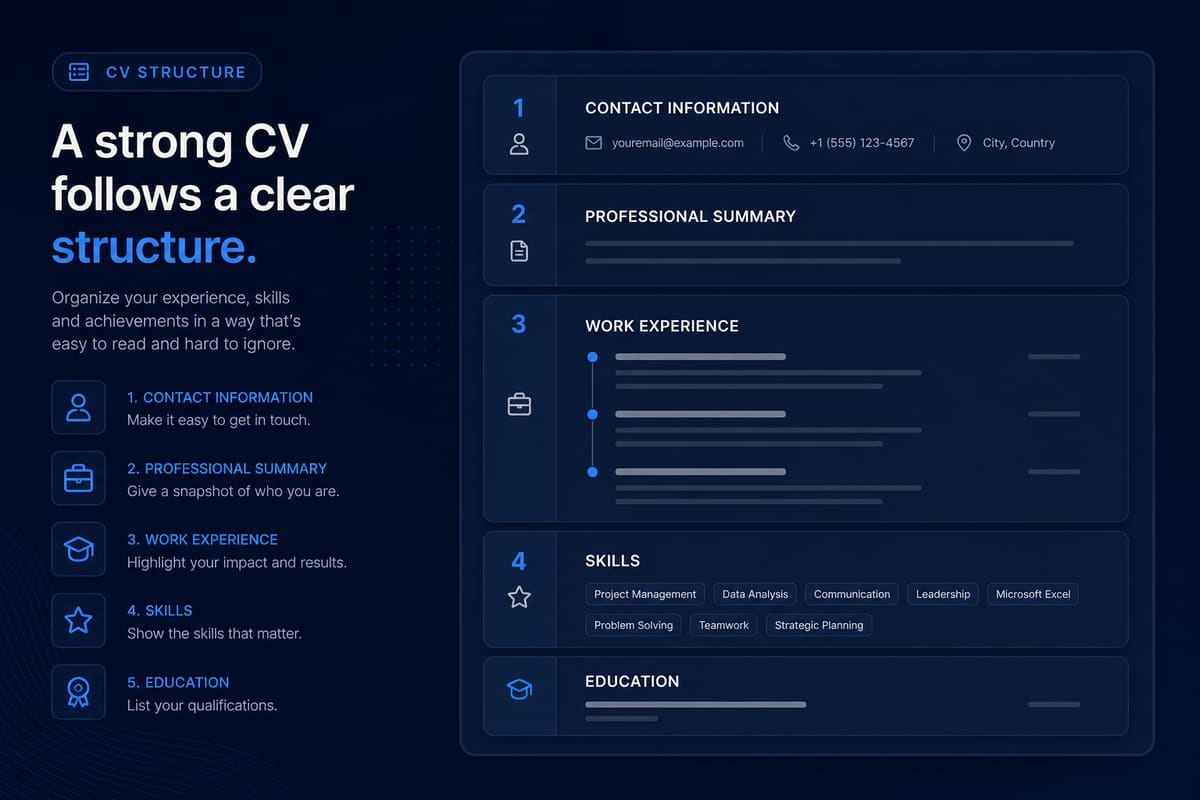
The correct CV structure (with section order)
Nearly every CV that performs well follows the same underlying order because it matches how a recruiter reads: who are you, what is your pitch, what have you done, what credentials do you hold, and what tools can you use. Deviating without a strong reason makes scanning harder, not more memorable.
| Order | Section | Purpose |
|---|---|---|
| 1 | Contact information | Name, phone, email, city, LinkedIn or portfolio |
| 2 | Professional summary | Two-to-three line pitch with role, scope, and proof |
| 3 | Work experience | Reverse chronological roles with outcome-driven bullets |
| 4 | Education | Degree, institution, graduation year |
| 5 | Skills | Tools, technical skills, languages relevant to the role |
| 6 (optional) | Certifications / projects | Only when directly relevant to the position |
Early-career candidates with limited work history can move education above experience. Everyone else should keep work experience above education—employers weigh recent professional proof more heavily after the first few years.
Common Mistake: burying contact details in a header graphic. Workday's parser frequently skips header and footer regions entirely.
How to write each section
Contact information
Keep this to one block: full name, phone, professional email, city and country, and LinkedIn or portfolio URL. Put it in the main body—not only in a header or footer. Use a firstname.lastname@ email; drop nicknames and old school handles.
Professional summary
Two to three sentences stating your role, years of experience, and one or two concrete strengths backed by a number. This is often the only section a recruiter reads in full on the first scan, so it must work standalone.
Example: "Marketing coordinator with 4 years running paid social for e-commerce brands. Grew one client account from $40K to $210K in monthly ad spend while maintaining a 3.5x return on ad spend."
Work experience
List roles reverse-chronologically: job title, company, dates, and three to five bullets per role. Use this formula: [Active verb] + [what you did] + [measurable result or scale].
| Before (weak) | After (strong) |
|---|---|
| Responsible for managing projects and improving processes. | Managed 6 concurrent projects across 3 teams; cut average delivery time from 5 weeks to 3 by restructuring the intake process. |
| Helped with customer issues and maintained good relationships. | Resolved 40–50 support tickets weekly in Zendesk; maintained 4.7/5 CSAT over 12 months on a 2,000-ticket queue. |
| Worked on marketing campaigns and social media content. | Ran Meta and Google ads for 8 SKUs; increased ROAS from 2.1x to 3.4x in Q2 by pausing underperforming audiences and reallocating $12K/month budget. |
Use the market title if your internal title is obscure—"Client Success Associate" instead of "Happiness Guru." If you lack revenue metrics, use operational ones: tickets closed, pages migrated, class size, budget owned, regions covered.
Education
Degree, institution, and graduation year, most recent first. After three or four years of professional experience, keep this section short—GPA and coursework matter far less than they did on your first CV.
Skills
List specific tools, technical skills , and languages—not generic traits like "hard worker." Pull exact platform names from the job posting when you genuinely have that experience. Automated filters on iCIMS and Greenhouse often match on literal terms rather than synonyms.
Pro Tip: duplicate critical skills inside experience bullets so they appear in context—not only in a lonely list at the bottom.
Format, length, and file-type rules
Content quality only matters if the document is readable—by a human skimming in 30 seconds and by the ATS parsing it first. Greenhouse and Taleo extract text in document order, not visual position. A multi-column layout that looks fine to you can scramble into interleaved lines once parsed.
The W3C guidance on text alternatives applies to PDFs too: if text is not selectable, parsers and screen readers cannot read it. Always confirm your export contains real text before uploading.
Do
- Keep it to 1–2 pages
- Use a single-column layout
- Use standard section headers
- Save as text-based PDF or DOCX when requested
- Use one clean, readable font throughout
Avoid
- Multi-column layouts that scramble under parsing
- Text inside tables, text boxes, or graphics
- Creative section titles like "My Journey"
- Scanned or image-based PDFs with no selectable text
- Icons used as a substitute for words
For file-format specifics, see PDF vs DOCX for ATS . For Workday-specific layout traps, read Workday resume format guidance .
Quick Check: select all text in your PDF. If nothing highlights, the file is image-only and will fail most ATS uploads.
10 CV mistakes that cost candidates interviews
- An unprofessional email address. Use firstname.lastname@; drop nicknames and numbers.
- Including a photo where it is not expected. Skip photos in US, UK, and Canadian corporate hiring unless the market norm says otherwise.
- Listing duties instead of outcomes. "Responsible for" tells what the job was, not how well you did it.
- Unnecessary personal information. Age, marital status, and religion add legal risk and no value.
- More than two pages. Trim anything older than 15 years so recent proof gets attention.
- One CV for every application. Adapt summary, skills, and top bullets per posting.
- Vague generic statements. "Improved efficiency and saved costs" says nothing actionable.
- Overusing I, me, and my. Write impersonally; start bullets with active verbs.
- Spelling and grammar errors. One mistake can undo an otherwise strong application—have someone proofread.
- Lying or inflating credentials. Background checks and reference calls surface inflated titles and dates quickly.
Common Mistake: listing references directly on the CV. Keep them in a separate document and share only when asked.
Want to see how your current CV actually parses before you fix these mistakes?
Run a free ATS check on HireFlowCV vs resume: what is the actual difference
The terms are often used interchangeably, but the distinction matters depending on where you apply:
| CV | Resume | |
|---|---|---|
| Common usage | UK, Europe, academia, most non-US markets | United States, Canada (private sector) |
| Typical length | 1–2 pages (longer for academic CVs) | 1 page, 2 for senior roles |
| Content scope | Full career history (academic) or tailored highlights (corporate) | Tailored highlights relevant to the role |
In practice, most corporate CVs follow the same tailored, outcome-driven structure described here—regardless of which name your target market uses. Academic CVs are the exception: they list publications, grants, and committee service in full.
Key Takeaway: for corporate roles, CV and resume mean the same one-to-two-page tailored document—not a multi-page life history.
Tailoring your CV for each job application
A generic CV sent to every posting consistently underperforms one adjusted for the specific role—even when the underlying experience is identical. Tailoring does not mean rewriting the whole document. Adjust three things:
- The professional summary. Mirror posting language where it matches your background.
- The skills section. Reorder or add tools named in the posting when you have them.
- The top two or three bullets in your most recent role. Lead with achievements most relevant to this employer.
Use HireFlow's Job Match Score to see which requirements your draft is missing before you submit. For keyword strategy without stuffing, see what keywords ATS look for .
Pro Tip: maintain one parse-safe master CV and light variants per role family—do not merge five templates into a Frankenstein file.
When to add a cover letter (and when to skip it)
A cover letter cannot rescue a weak CV, but it can add context a CV cannot—career changes, employment gaps explained in one line, or passion for a niche industry where fit is not obvious from titles alone. Keep it to half a page: role name, one proof point, and why this company specifically.
Skip the cover letter when the posting does not allow one and there is no upload field. Recruiters on Lever and Greenhouse often never open optional attachments when the CV already answers the screening questions. Spend that time tailoring the CV instead.
Pro Tip: if you write a cover letter, mirror the CV's facts—do not introduce new job titles, dates, or metrics that do not appear on the CV. Inconsistencies fail background checks faster than weak prose.
International CV differences worth knowing
UK and EU corporate CVs follow the same one-to-two-page tailored structure as US resumes for private-sector roles—but norms differ on photos, date of birth, and nationality lines. In Germany and France, photos remain more common; in the UK and Ireland, omit them unless the employer requests one.
US applicants targeting UK roles should use "CV" in the file name, spell out month names in dates (March 2022 – Present), and convert metrics to local currency only when the posting is UK-based. Academic CVs everywhere remain longer and list publications in full—do not apply corporate rules to faculty applications.
| Market | Typical length | Photo | Personal details |
|---|---|---|---|
| US / Canada | 1–2 pages (resume) | Omit | City + state only |
| UK / Ireland | 1–2 pages (CV) | Usually omit | City + country; no DOB |
| Germany / France | 1–2 pages | Often included | Follow local posting norms |
Key Takeaway: structure and proof bullets transfer across markets; photos and personal-data lines do not—check the posting country before you export.
CV writing by career stage
Students and early career
Lead with education if work history is thin. Include internships, part-time roles, class projects with scope (team size, tools, outcome), and relevant coursework only when it proves a skill the posting requires. One page is the target.
Mid-career professionals
Experience dominates. Trim early roles to title + company + dates once you have 10+ years. Each recent role needs 3–5 bullets with metrics. Certifications (PMP, CPA, AWS) belong in plain text when the posting searches them.
Career changers
Summary must bridge old domain to new target. Pull transferable bullets to the top of recent roles. Add projects, coursework, or volunteer work that proves the new skill set. A cover letter helps here when the CV alone cannot tell the story.
Senior leaders
Two pages is acceptable. Lead with scope: revenue managed, headcount, regions, budget. Cut tactical bullets from roles more than 10 years old. Board seats, speaking, and patents go in optional sections only when relevant to the target role.
Quick Check: could a recruiter understand your level from the first third of page one? If not, rewrite the summary and top bullets first.
How to verify your CV passes ATS screening
Before you upload to Workday or Greenhouse, run three checks:
- Copy-paste test: paste into Notepad—sections should appear in reading order with contact intact.
- Select-text test: highlight all text in the PDF—if nothing selects, the file is image-only.
- ATS checker: upload to an ATS tool against the specific job description and clear ranked flags.
If the score is low despite good content, the layout is usually the culprit. See why ATS rejects resumes for the five causes beyond structure alone.
Common Mistake: editing in Google Docs but uploading yesterday's PDF export. Align the file you check with the file you submit.
Pre-submit CV checklist
- Contact in body text with professional email and full LinkedIn URL.
- Summary includes target title, years, and one proof metric.
- Each role has employer, market title, dates, and 3–5 outcome bullets.
- Skills list names specific tools from the posting where truthful.
- Single-column layout; standard headings; 1–2 pages.
- Text-based PDF (or DOCX if portal requests it).
- Summary, skills, and top bullets tailored to this posting.
- ATS check run against the job description.
- File named FirstName-LastName-CV.pdf—not Resume_final_v4.pdf.
Key Takeaway: a good CV is scannable in 30 seconds, parse-safe in Workday, and honest enough to defend in an interview.
Frequently asked questions
One to two pages for most candidates. Early-career candidates should aim for one page; anyone with more than roughly eight to ten years of relevant experience can reasonably extend to two. Beyond two pages, recruiters tend to skim less carefully, so trimming older or less relevant material usually helps more than it hurts.
In the United States, United Kingdom, and Canada, no—it is not expected and can distract from your qualifications or expose an employer to discrimination-related risk they would rather avoid. In parts of continental Europe and some other regions, a professional photo is more customary. When in doubt, follow the norm of the specific country and industry you are applying to.
A single-column layout with standard section headers, saved as a text-based PDF (or DOCX if the specific portal requests it), with contact information in the main body rather than a header or footer. Avoid tables, text boxes, and multi-column designs, since many parsers read them out of order or skip them entirely.
If the application allows one, include it—a short, specific cover letter can add context a CV cannot, particularly for a career change or an unconventional background. If the posting does not request one and there is no obvious place to attach it, do not go out of your way to add one; it will not offset a weak CV.
Regionally, "CV" is the standard term in the UK, Europe, and most non-US markets, while "resume" is standard in the US and Canadian private sector. Academic and research CVs are the exception everywhere—they are genuinely longer and list publications, grants, and full academic history rather than a tailored highlight reel.
Update it every time you finish a project worth mentioning, not only when you start job hunting again—specific numbers and outcomes are far easier to recall accurately right after the work happens than a year or two later. At a minimum, review and refresh it every six months even if you are not actively applying anywhere.
Use past tense for completed roles and present tense only for your current job. Start each bullet with a strong active verb—Managed, Built, Reduced, Launched—not Responsible for. Write impersonally without I, me, or my.
Adjust three things per application: the professional summary, the skills section order, and the top two or three bullets in your most recent role. Mirror posting language only where it reflects your real experience. Re-scan against the job description before submitting.