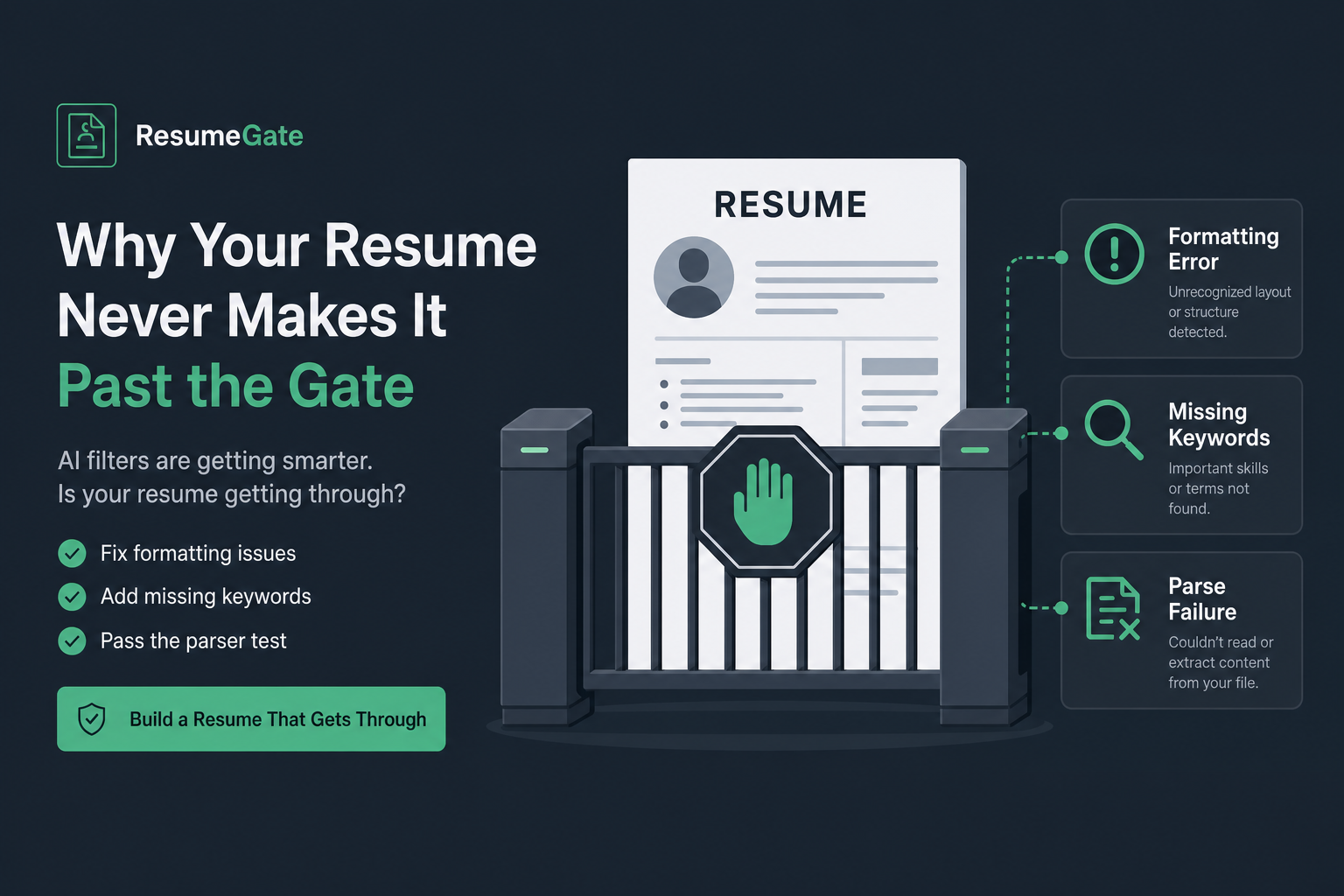
Treat this like a diagnostic, not a pep talk. Something specific happened between you hitting "submit" and the silence (or the instant rejection) that followed, and it is almost always one of a small number of mechanical failures—not a judgment about your career. The fix depends entirely on getting the diagnosis right first.
Being qualified is not the same as being readable to the system deciding whether a recruiter ever sees your resume. Most rejections that feel unfair trace back to one of five root causes: the file did not parse correctly, a required skill or credential never appeared in the text, a knockout screening question filtered you out before any human looked at anything, your bullets read as duties instead of evidence, or you submitted the wrong file type for that particular portal.
None of those five are about your actual qualifications. They are about whether the system and the recruiter could see your qualifications at all. This guide works like a troubleshooting flow: match your symptom, confirm the likely cause, apply the fix, and move to the next item on the checklist.
Key Takeaways
- A symptom-to-cause table so you can self-diagnose in under a minute
- All five root causes, expanded with concrete, real-world examples
- Before/after bullet rewrites showing exactly what "weak evidence" looks like
- A numbered fix-order checklist so you address the biggest risk first
Start here: match your symptom to a likely cause
Before diving into the five causes individually, use this table the way you would use a troubleshooting flowchart. Find the pattern that matches what actually happened to your application, then jump to that section.
| Symptom | Likely cause | Where to fix it |
|---|---|---|
| Rejected within minutes of applying | Knockout screening question | Cause #3 |
| Never heard back, weeks of silence | Parse failure or low rank/match | Cause #1 or #4 |
| Rejected despite meeting every listed requirement | Missing must-have keyword in the text | Cause #2 |
| Get interviews at small companies, never at large ones | Parse failure specific to enterprise ATS platforms | Cause #1 |
| Recruiter mentions they "can't see your work history clearly" | Layout/column parse failure | Cause #1 |
| Good response rate on LinkedIn Easy Apply, none through company portals | Wrong file type or unsupported format for that ATS | Cause #5 |
| Recruiters open your resume but do not call | Weak evidence: duties without outcomes | Cause #4 |
| Referral got an interview, cold application to the same job did not | Ranking/match score too low without a human advocate | Cause #2 and #4 together |
If more than one row matches your situation, that is normal—these causes compound. A resume with a parse failure and weak bullets will underperform worse than either problem alone, and fixing only one will still leave you rejected.
Key Takeaway: match your symptom to the table above before you start editing—the fix differs completely depending on which cause is actually responsible.
Cause #1: Parse failures
Symptom: Silence across many applications, especially to larger companies; a recruiter says they "couldn't find" something that is clearly on your resume; strong response rate on informal channels but near-zero on formal portals.
Many ATS platforms extract resume text with simple, literal parsing logic built for plain, linear documents. Layout choices that look polished visually can scramble or drop content entirely once the system tries to convert your PDF or DOCX into raw text for its database. The system is not being harsh—it is often just wrong about what it read.
Concrete failure modes
- Multi-column layouts. A two-column resume with skills on the left and experience on the right often gets read left-to-right, line-by-line, across both columns—merging "Python, SQL, Tableau" with an unrelated job title into one garbled string that matches nothing.
- Text inside tables, text boxes, or graphics. If your dates or job titles live inside a text box or a table cell rather than the main document flow, some parsers skip that content entirely rather than misplace it.
- Headers and footers. Contact info dropped into a page header or footer (common with template downloads) is frequently outside the region the ATS actually scrapes, so your email and phone number never make it into the candidate record at all.
- Non-standard section titles. "My Journey" instead of "Experience," or "What I Bring" instead of "Skills," can go uncategorized. Some systems tag content by section to weight it differently; uncategorized text can be weighted lowest by default.
- Icons standing in for words. A phone icon next to a number, or a location pin next to a city, adds nothing to the extracted text if the icon is an image rather than a font glyph—so the label disappears and only the raw number or city name remains, sometimes without context.
If your resume fails here, no amount of keyword tailoring fixes it. The system never correctly read your experience to begin with, so it has nothing accurate to match keywords against—you would be optimizing text that does not exist from the ATS's point of view.
This is also the cause most likely to explain a pattern where you do fine with smaller companies (which may have a human skim resumes manually) but consistently strike out at large enterprises running strict automated parsing at scale.
Key Takeaway: a single column, standard section headers, and body-text contact info fix the majority of parse failures across most ATS platforms.
Cause #2: Missing must-have keywords or requirements
Symptom: Rejected despite meeting every requirement in the posting; a referral got a callback on the identical role while your cold application to the same posting did not.
Job postings usually list a small number of genuinely non-negotiable requirements—a certification, a specific number of years, a particular tool or platform, a security clearance level. If that exact requirement never appears in your resume text, even if you meet it in practice, automated filtering or a fast recruiter scan can drop you before anyone reads your full history.
This is different from general keyword stuffing, and treating it as the same problem leads people to cram their resume with every term from the job description instead of fixing the two or three that actually matter. A resume that says "led compliance initiatives" will not satisfy a filter looking for the literal string "SOC 2," even though the experience clearly overlaps.
How this plays out in practice
- A posting requires "PMP certification or equivalent." You have the equivalent experience but never earned or listed the credential by name—some systems filter on the literal term regardless of the "or equivalent" clause.
- A posting requires "5+ years of Salesforce administration." Your resume says "managed CRM systems" without naming the platform, so a filter built around the specific tool name never registers a match.
- A posting requires "active Series 7 license." This detail exists on your LinkedIn but was left off your resume because you assumed it was implied by your job title—it is not implied to a filter reading raw text.
The fix is narrow and specific: identify the two or three genuinely required qualifications in the posting, and if you meet them, state them explicitly and literally in your resume text, not just implied through job titles or responsibilities.
Key Takeaway: if you genuinely meet a non-negotiable requirement, state it in literal, explicit terms—don't rely on it being implied by your job title or a related phrase.
Cause #3: Knockout questions
Symptom: Rejection arrives within minutes, sometimes seconds, of submitting the application—faster than any human or algorithm could plausibly have read your resume.
Many application portals ask screening questions before your resume is ever reviewed at all: work authorization status, willingness to relocate, required certifications, minimum acceptable salary, willingness to work a specific shift. These are frequently configured as automatic disqualifiers. Answer in a way that does not match the requirement—even truthfully—and the application is filtered out regardless of resume quality.
This is one of the only true "automatic rejection" mechanisms in most ATS setups, and it has nothing to do with your resume file at all. If your rejection consistently arrives faster than a human could have opened the attachment, this is almost certainly the cause, not a parsing or content issue.
Questions that commonly knock candidates out
- "Are you legally authorized to work in [country] without sponsorship?" — a "no" or "need sponsorship" answer is an automatic disqualifier at many companies, regardless of how strong the resume is.
- "Do you currently hold an active [certification]?" — answered honestly as "in progress" when the system only accepts "yes."
- "What is your minimum acceptable salary?" — a number even slightly above the posted band can trigger an automatic filter before negotiation is ever on the table.
- "Are you willing to relocate to [city]?" — answered "no" on a role technically listed as remote-eligible but internally treated as hybrid-required.
There is no resume fix for this category. The fix is either accuracy (make sure your answers are consistent with your actual situation and with your resume) or targeting (apply to roles where your true answers do not trip the filter in the first place).
Key Takeaway: if a rejection arrives within minutes, it's almost certainly a knockout question, not your resume—no amount of editing will change that outcome.
Not sure which of these five is actually happening to you? Run your resume through HireFlow's free ATS checker to see exactly what a parser extracts from your file before you keep guessing.
Cause #4: Weak evidence
Symptom: Recruiters appear to open or view your resume (tracked via read receipts, portal activity, or a quick follow-up call that goes nowhere) but you never advance—the resume gets seen, just not ranked highly enough to act on.
Even when a resume parses cleanly and includes the right keywords, vague bullets give a recruiter—or an AI-assisted ranking layer—nothing concrete to score you on. Systems and humans alike default to treating a list of duties as a baseline expectation of the role, not as a differentiator. Duties tell the reader what your job was; outcomes tell them how well you did it.
Before / after: turning duties into evidence
Weak
"Responsible for managing projects and improving processes."
Strong
"Managed 6 concurrent projects across 3 teams; cut average delivery time from 5 weeks to 3 by restructuring the intake process."
Weak
"Handled customer support inquiries and resolved issues."
Strong
"Resolved 40+ support tickets weekly with a 96% first-contact resolution rate, reducing escalations to senior staff by 30%."
Weak
"Assisted with sales efforts and helped grow the client base."
Strong
"Closed $420K in new business across 18 accounts in FY25, exceeding quota by 22%."
Notice the pattern: every strong version adds a number, a comparison point, or a named outcome. None of them require exaggeration—they require you to remember and state the result of the work, not just the activity itself.
Systems that rank rather than binary-filter—which describes most modern ATS scoring—tend to favor specificity in exactly this way. A resume full of responsibilities with no outcomes ranks lower even with a decent keyword match, because there is nothing distinguishing your version of the role from anyone else's.
Key Takeaway: every strong bullet adds a number, a comparison, or a named outcome—duties alone rank lower even with a decent keyword match.
Cause #5: Wrong file type or format
Symptom: Noticeably better response rates through LinkedIn Easy Apply or Indeed's built-in apply flow than through a company's own career portal for equivalent roles.
Older or legacy ATS platforms can struggle with certain file types, embedded fonts, or scanned/image-based PDFs where no selectable text exists at all. Taleo, still used by many large enterprises, has historically been stricter about DOCX formatting than newer platforms like Greenhouse or Lever, which tend to parse a wider range of well-structured PDFs cleanly. If your PDF was exported from a design tool with flattened text layers, or your resume is effectively a photograph of text rather than real text, some systems extract nothing usable—not garbled text, but literally nothing.
Situations that commonly cause this
- Exporting from a graphic design tool (Canva, Figma, InDesign) without confirming the output PDF has selectable, copyable text rather than flattened/rasterized content.
- Submitting a resume that was originally scanned from a printed copy, producing an image-only PDF with zero embedded text for any parser to read.
- Using a heavily styled DOCX with embedded custom fonts that render differently—or not at all—once the ATS strips formatting during extraction.
- Applying to an older or regional ATS deployment that only reliably supports DOCX, when your only prepared file is a PDF (or vice versa).
When in doubt, use a text-based PDF as your default, and keep a clean DOCX version ready if a posting specifically hints at an older or more restrictive portal. See our full breakdown in PDF vs DOCX for ATS , including how to verify your PDF actually contains selectable text before you submit it anywhere.
Key Takeaway: default to a text-based PDF, and keep a clean DOCX ready as backup for older or regional ATS deployments.
Fix-order checklist
Diagnostics only matter if you act on them in the right order. Fix these sequentially—each later step matters less if an earlier one is still broken, because a resume that does not parse cannot be saved by better bullets, and better bullets cannot save you from a knockout question you answered wrong.
- Confirm the file actually parses: text-selectable PDF or clean DOCX, single column, no tables or text boxes holding critical content.
- Use standard section headers (Experience, Education, Skills) instead of creative alternatives that may go uncategorized.
- Put contact info in the body text, not only in a header or footer region some parsers skip entirely.
- State the 2-3 non-negotiable requirements from the posting explicitly, in literal terms, if you genuinely meet them.
- Answer every screening question accurately and in a way consistent with what your resume actually says—inconsistency reads as a red flag even when accidental.
- Rewrite vague, duty-based bullets into bullets with a number, a comparison, or a concrete outcome attached.
If the layout itself is the underlying problem, rebuilding on a clean, ATS-tested structure is faster than patching a document that was never structured correctly to begin with—try HireFlow's free resume builder to start from a foundation designed to parse correctly the first time.
Key Takeaway: fix these in order—parsing first, then content and screening questions—since later fixes can't compensate for an earlier one still being broken.
Portal-specific formatting quirks
Some rejection causes are not universal—they are specific to how one particular ATS platform handles extraction, which means the same resume can behave differently depending entirely on where you submit it.
If you are applying through Workday in particular, which powers a large share of enterprise career sites and has well-documented parsing quirks around dates, section ordering, and multi-entry fields, see our Workday resume format guide for platform-specific fixes that go beyond the general causes covered above.
Key Takeaway: the same resume can behave differently across ATS platforms—check platform-specific guides before assuming a universal fix will work everywhere.
Common mistakes people make chasing rejection causes
- Assuming it's always keywords. Parsing failures and knockout questions are just as common as keyword mismatches, and no amount of keyword editing will fix either one—you will spend hours optimizing text the system never even read.
- Rewriting the whole resume before checking the file itself. Confirm the ATS can actually extract your text before optimizing content; otherwise you are polishing words that may never reach the recruiter's screen intact.
- Skipping screening questions or rushing through them. An inconsistent or careless answer can silently disqualify an otherwise strong application in seconds, with no notification of why.
- Leaving bullets as responsibilities instead of outcomes. This hurts rank-based systems and human reviewers equally—both are looking for evidence of impact, not a restated job description.
- Treating every rejection as the same rejection. A knockout question, a parse failure, and a low match score produce the identical visible outcome—silence—which is exactly why diagnosing the actual cause matters more than guessing.
Key Takeaway: don't assume every rejection has the same cause—a knockout question, a parse failure, and weak evidence produce the same silence but need completely different fixes.
Most ATS rejection is not a verdict on your qualifications—it is a diagnosis waiting to happen, and the five causes above cover nearly all of it. Start with a free scan on HireFlow to see exactly what was extracted from your file. If the layout is the bottleneck, rebuild it with the free resume builder , and if the issue is positioning or evidence rather than structure, HireFlow's resume writing service can help rebuild the content itself.
Frequently asked questions
Usually one of five mechanical issues, not your actual qualifications: the file didn't parse correctly, a non-negotiable requirement never appeared in the text, a knockout screening question filtered you out automatically, your bullets read as duties instead of measurable outcomes, or you submitted a file type the specific portal can't process.
Common warning signs include silence across many applications (especially to large enterprises), a recruiter mentioning they "couldn't find" something clearly on your resume, or noticeably better response rates through informal channels like LinkedIn Easy Apply than through a company's own career portal.
Yes. Many application portals use screening questions—work authorization, willingness to relocate, minimum salary, required certifications—as automatic disqualifiers before your resume is ever opened. If your rejection arrives within seconds or minutes of submitting, this is the most likely cause.
No, and it can make things worse. If the underlying problem is a parse failure or a knockout question, no amount of keyword tailoring changes the outcome, since the system either never read your text correctly or filtered you out before content mattered at all.
This pattern usually points to a parse failure specific to enterprise ATS platforms. Smaller companies often have a human skim resumes manually and can work around formatting issues, while large enterprises running strict automated parsing at scale cannot.
Missing keywords means a literal required term (a certification name, a specific tool) never appears in your resume text even though you meet the requirement. Weak evidence means the keywords are present, but your bullets describe duties instead of measurable outcomes, so nothing distinguishes your version of the role from anyone else's.
A text-based PDF (not a scanned image or flattened export from a design tool) is a safe default for most modern ATS platforms. Keep a clean DOCX version ready as a backup, since some older or regional ATS deployments only reliably support one format.