12 min read
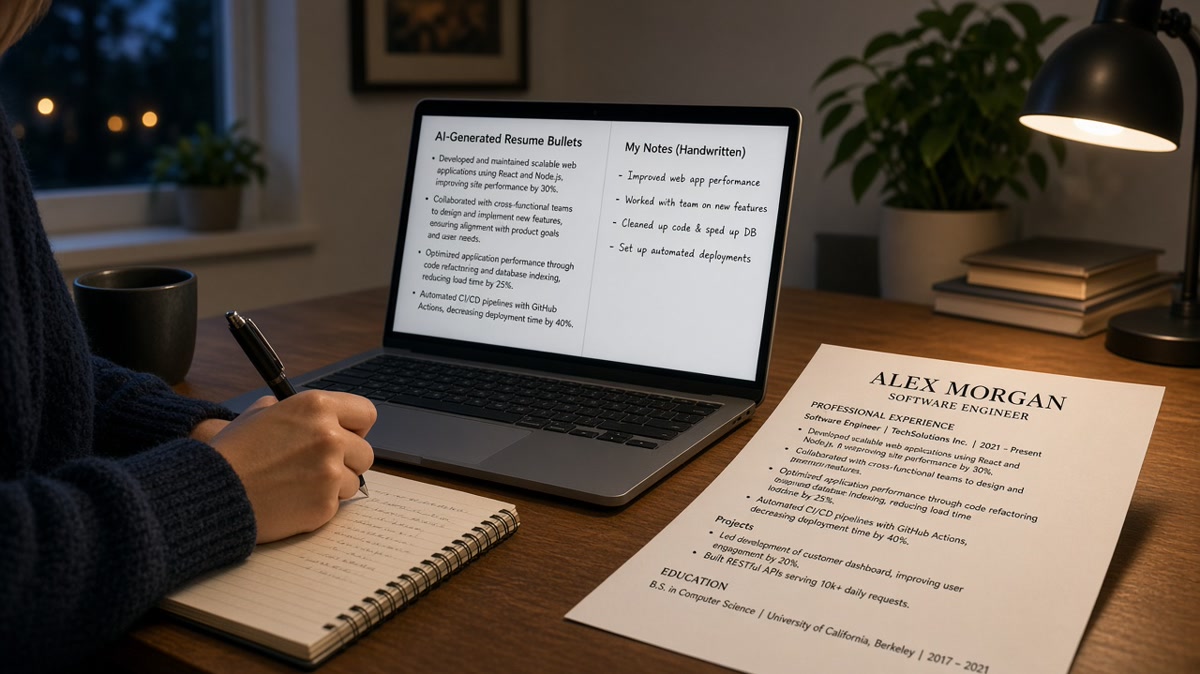
You've run your old job notes through ChatGPT and pasted six polished lines that still aren't getting callbacks. You're not failing because you skipped keywords. AI bullets fail because they describe duties in passive voice without employer scope, and US recruiters decide in the first eight words whether a line is proof or filler.
Check your resume for free with the posting pasted in before you rewrite a fourth draft. Greenhouse, Lever, and Workday will read the words. They won't invent the stack, team size, or metric your AI draft left blank.
Below you'll see the bar recruiter-ready bullets clear, before/after pairs for software engineering, operations, and marketing roles, what weak AI lines share, and a copy-paste bullet skeleton you can drop under your current employer tonight. When you rewrite AI resume bullets, you're not chasing prettier verbs. You're attaching each line to an employer, a stack, and one outcome a US recruiter can picture in under six seconds. Job searching is draining. This page is about turning generic AI output into dated proof, not collecting action verbs.
If your Experience section still opens with assisted on team projects while Skills lists twelve tools, flip the order. Bullets first. Skills second. You can't prompt your way past a recruiter who needs to see which employer owned the work.
And when the portal asks for a cover letter after upload, don't paste the same AI block. Generate a cover letter from the rewritten bullets so the note names the outcomes your resume now proves.
Quick Wins
- Replace passive openers with a verb, employer scope, and one metric in the first eight words.
- Move stack nouns from Skills into the bullet under the job where you used them.
- Delete duplicate AI lines that share the same sentence shape across three roles.
- Export a single-column PDF and confirm Month Year employer lines stayed paired after upload.
The bar US recruiter bullets must clear after an AI draft
Responsible for improving processes tells a parser you held a job. It does not tell a recruiter what you built, for whom, or what changed after you shipped it.
The standard your bullets are judged against: each claim sits under a Month Year employer line, opens with an active verb plus scope, names the stack or workflow in plain text, and ends with one honest outcome. AI defaults skip the employer and the number because your prompt did not include them.
A mid-level analyst whose top bullet still reads Worked on reporting dashboards while Skills lists SQL, Tableau, and Python looks like someone who ran a prompt and stopped. The same person with one line on Looker dashboards for a 12-market retail roll-up, cutting ad-hoc ticket volume 18% in Q2, reads like someone who owned a reporting surface recruiters can picture.
US reqs on Greenhouse and Lever often surface keywords before a human opens the PDF. I've passed on files that hit every tool in Skills because Experience never attached work to a dated role. The attachment sometimes never gets opened when the parsed profile already looks thin.
Read why weak bullet points get ignored for the wider pattern. This page is the AI-specific teardown: what to prove, where to put it, and how to rewrite lines that only repeat the duty ChatGPT guessed.
Naming Greenhouse, Workday, or a stack from the posting is allowed. Claiming how an ATS scores writing style is not. This teardown sticks to what you control: bullet order, stack nouns in context, and plain-text export that keeps employer lines paired with outcomes.
Edge case: you're a career changer and AI invented a senior title. Keep the title you held, write the scope you actually owned, and put transferable tools in bullets that match the new field's nouns without inflating rank.
Edge case: you're returning from a gap and your last strong project was eighteen months ago. Keep the employer line with real dates. Put the stack in bullet one. A stale but truthful line beats a current fake one tied to a side project with no Month Year header.
Edge case: you're early career and AI padded a thin internship into five senior-sounding bullets. Keep one strong line per internship with dates, stack, and a metric your manager would recognize. Cut the rest before a phone screen asks which team owned the work.
How to rewrite AI resume bullets: before/after pairs by role
Each pair shows a weak AI line recruiters skim past, then a rewrite that names employer context, stack, and scope. Swap in your companies. Illustrative titles and numbers only inside the sample bullets.
Pair 1: Software engineer, duty-only AI line
Before: Developed software applications to improve system functionality.
After: Jan 2023 to Present · Software Engineer · PayFlow Inc · Shipped three Node.js payment APIs on AWS Lambda for merchant onboarding; cut failed checkout events 19% after adding idempotent retry logic reviewed in weekly architecture syncs.
Developed software without stack, surface, or consumer count reads like a bootcamp template. The rewrite names the runtime, the product area, and what moved after deploy.
Pair 2: Software engineer, passive team bullet
Before: Assisted in team meetings and contributed to project goals.
After: Mar 2022 to Aug 2024 · Backend Engineer · HealthMetrics · Led schema migrations for PostgreSQL claims tables serving 2.1M monthly API calls; paired with QA on contract tests that dropped production rollback incidents from nine per quarter to two.
Assisted and contributed are AI's favorite verbs because they need no proof. Lead with the system, the scale, and the guardrail you added.
Pair 3: Operations manager, generic process line
Before: Managed inventory and improved operational efficiency.
After: Jun 2021 to Present · Operations Manager · RetailHub · Rebuilt SKU receiving workflow in NetSuite across four distribution centers; reduced dock-to-stock time from 36 hours to 22 hours while holding shrink below 0.4% on weekly cycle counts.
Managed inventory without ERP name, site count, or time metric sounds like a summary paragraph. Ops recruiters want the system, the footprint, and the clock you moved.
Pair 4: Operations coordinator, buzzword stack dump
Before: Skills: Excel, SAP, process improvement, cross-functional collaboration.
After: Sep 2020 to Feb 2023 · Ops Coordinator · LogStream · Automated carrier chargeback reconciliation in SAP and Excel for 140 weekly LTL lanes; recovered $310K in disputed freight fees in FY2022 with audit trails shared with finance.
Process improvement in Skills without a dated bullet is still an AI-shaped file. Move SAP and Excel into the sentence that names the workflow and the dollars recovered.
Pair 5: Marketing manager, vanity metric AI line
Before: Managed social media campaigns and increased brand awareness.
After: Apr 2022 to Present · Marketing Manager · MediaCo · Ran paid social on Meta and LinkedIn for three product lines; lifted demo-request conversion 24% in six months while holding CAC flat against a $180K quarterly spend cap.
Brand awareness without channel, spend, or downstream conversion reads like a prompt default. Marketing screens want the platform, the budget guardrail, and the pipeline outcome.
Pair 6: Content marketer, tool name with no proof
Before: Created content using SEO best practices to drive website traffic.
After: Nov 2021 to Jun 2024 · Content Marketer · InspectAI · Published 42 technical posts in Contentful targeting manufacturing keywords; grew organic demo traffic 31% year over year with three pillar pages ranking on page one for core product terms.
SEO best practices without CMS, volume, and ranking proof is filler. Name the CMS, the cadence, and the traffic surface recruiters can verify in a portfolio link.
Pair 7: Customer success, support duty list
Before: Provided customer support and resolved technical issues.
After: Jan 2022 to Present · Customer Success Manager · AdTech Labs · Owned Zendesk queue for 120 mid-market accounts on a Salesforce health score; closed 94% of tier-two tickets within 24 hours and lifted renewal rate 8 points across two enterprise cohorts in 2025.
Provided support without ticket system, account tier, or renewal outcome sounds interchangeable with every other AI draft on the req. Anchor the line to the CRM and the cohort size.
After you rewrite AI resume bullets for one posting, read the first eight words of each line aloud. If you hear the same opener twice, change the verb or move the metric forward. Recruiters notice rhythm before they notice vocabulary.
Copy-paste bullet skeleton after an AI draft
Paste under your current employer and replace bracketed lines:
[Month Year] to [Month Year or Present] · [Employer] · [Title]
[Active verb] [scope: team / system / region] with [stack from posting]; [workflow change] and [metric outcome].
[Optional second bullet: cross-functional partner, compliance guardrail, or cost/time saved]
Export a single-column PDF after you edit. Open the portal preview if Greenhouse or Workday shows one. Bullets only help when they stay attached to the right employer line.
See how to write resume experience ATS understands when you need the wider Experience formatting rules beyond AI rewrites.
What weak AI resume lines still share on US screens
Passive openers in every role. Assisted, supported, and was responsible for across five jobs is a template fingerprint recruiters spot in one skim.
Stack nouns trapped in Skills. Python, Salesforce, and Tableau in a comma list without a dated bullet underneath triggers the same skip as keyword stuffing on analyst roles.
Identical sentence shape on every line. AI loves verb plus object plus vague outcome. Three bullets that rhyme read generated even when the facts are true.
Missing Month Year employer headers. Bullets floating without dates make parsers pair lines with the wrong job. Keep the header line even when AI only returned duties.
Inflated titles from the prompt. Senior Manager on a coordinator scope gets challenged on the phone screen. Match title to the work you can defend.
Metrics with no anchor. Improved efficiency by 20% without saying what moved, for which team, or in what time frame reads like a hallucinated number. Tie each metric to a system or cohort.
Two-column exports after editing. Tools in a left rail can parse before your current employer. Flatten to one column before you tailor nouns.
Same AI block submitted to every req. A backend posting wants API and latency proof. An ops posting wants ERP and throughput proof. Tailor the first bullet under your current role per posting.
Pasting AI summary paragraphs into a cover letter. If the letter repeats Skills verbatim, rewrite it from the bullets you fixed so the note adds context, not duplicate duties.
Check rewritten bullets against the posting before you submit
Run the edited file through the free ATS checker with the job description pasted in. You're confirming stack terms land in Experience, not only Skills, and that employer lines stayed paired after export.
Then score your job match on the same plain-text order. A high Skills match with empty duty bullets still loses to a moderate match where proof sits under the right title. Keywords follow scope, not the other way around.
Rewrite one role tonight
Solid work to rewrite AI resume bullets for US recruiters comes down to proof in Experience, not polish in Skills. Name the employer scope you owned, cite the stack in the same sentence, and drop prompt defaults that have no dates.
Pick the next req on your list. Rewrite the first bullet under your current job using the copy-paste skeleton. Run a free ATS check. Submit when your verbs stay attached to the right Month Year line.
This won't turn a thin background into a staff hire overnight. It does stop qualified candidates from losing screens because the parser found tools in Skills while Experience still read like a ChatGPT duty list.
When you need a clean single-column base file, build your resume before you tailor bullets for each posting. Proof first. Keyword lists second.
Read more
Frequently asked questions
Use AI as a draft, not a final file. Chat tools default to duty lists in passive voice with no employer, stack, or metric. US recruiters on Greenhouse and Workday skim the first eight words of each bullet under a Month Year line. If those words are responsible for or helped with, the line reads empty even when the Skills section is full.
Run a quick scan for repeated openers, missing dates, and verbs with no object. AI lines often start with assisted, supported, or worked on and never name the system, team size, or outcome. A human rewrite puts the verb, employer scope, and one number in the opening clause. If three bullets in a row share the same sentence shape, rewrite two of them.
Start with the first bullet under your current employer and the two roles that match the posting. Those three lines get the most recruiter time on a six-second skim. Once the pattern is verb plus scope plus metric, work backward through older jobs. Keep honest depth on junior roles instead of inflating titles AI suggested.
Parsers do not score writing style. They read plain text order and keyword tokens in Experience. What fails is structure: two-column exports, icons, and bullets with no employer pairing. Rewrite AI output into single-column dated lines with stack nouns inside sentences. Style only matters when a recruiter opens the PDF and every bullet sounds the same.
Name each tool once in Skills if the req lists it, then prove it in a dated bullet under the job where you used it. Salesforce in Skills with no CRM bullet underneath is still an AI-shaped file. Move the noun into bullet one with the employer, the workflow, and what changed after you touched the system.