11 min read
You've got ten bullets under your current job and you're proud of the page count. Recruiters still move on in seconds. Weak bullet points get ignored because the line doesn't start with an action and a thing you moved. Parsers capture the words; neither machines nor humans award credit for duty language.
Check your resume for free and search the extracted text for helped, assisted, and responsible for. If those verbs dominate bullet one, you're losing the scan before anyone reads bullet four.
Below you'll see the standard weak bullets are judged against, six before-and-after pairs across roles, what the weak versions share, and a copy-paste formula you can run tonight. You don't need a writing coach. You need a verb, an object, and one number on line one.
Job searching is hard enough without guessing why qualified files go quiet. This won't fix applying three levels above your scope. It stops strong experience from reading like a job description you copied from HR.
Quick Wins
- Replace Responsible for with a past-tense verb and a deliverable.
- Add one countable object to bullet one under your current title.
- Delete any bullet that only restates the job posting duties.
The standard weak bullet points get ignored against
Recruiters scan for verb, object, scale. Did you move something for someone measurable? Weak lines skip one or all three. Parsers still index the text, but without objects and outcomes the line does not reinforce keyword matches from the posting.
The bar: past-tense verb, what you built or changed, who or what was affected, optional metric. Cut weekly status slides to one page for director staff meeting passes. Participated in cross-functional projects fails.
I've screened thousands of these lines in Workday. The ignored bullet almost always opens with a passive frame or a verb with no direct object. Helped improve processes. Assisted team with deliverables. Those lines are wallpaper.
Weak bullet points get ignored faster on mobile previews where only the first two lines show per job. If line one is duty language, line four never renders on the recruiter's phone.
Keywords in a skills cloud do not rescue a weak experience bullet. The matcher may tag Excel in the sidebar, but the proof line under your job title is what convinces a human you used it on real work. Put the tool inside the bullet with the outcome.
Long bullets are not strong bullets. Two lines with a comma splice and four clauses still scan as weak because the eye cannot find the verb. Split or cut until verb and object sit in the first half of line one.
Duty bullets also fail phone screens. If you cannot say the metric out loud, the line is still weak even when it looks fine on paper. Write bullets you can defend in the first question recruiters ask.
Parsers assign less weight to lines buried under sub-bullets or dashes. Keep one level of bullets per job. Nested lists break in iCIMS and Taleo more often than in Word on your screen.
Edge case: executive roles with fewer bullets. Each line carries more weight. One vague board reporting bullet costs more than three weak lines buried under a junior role.
For how experience blocks parse, read how ATS normalizes resume text and why it matters . Clean bullets survive normalization better than nested sub-bullets with dashes.
Six before-and-after bullet pairs
Each pair is a composite from roles I've seen in Greenhouse queues. Copy the After structure, not the numbers. Swap in your deliverable, stakeholder, and metric.
Pair 1: Customer support lead
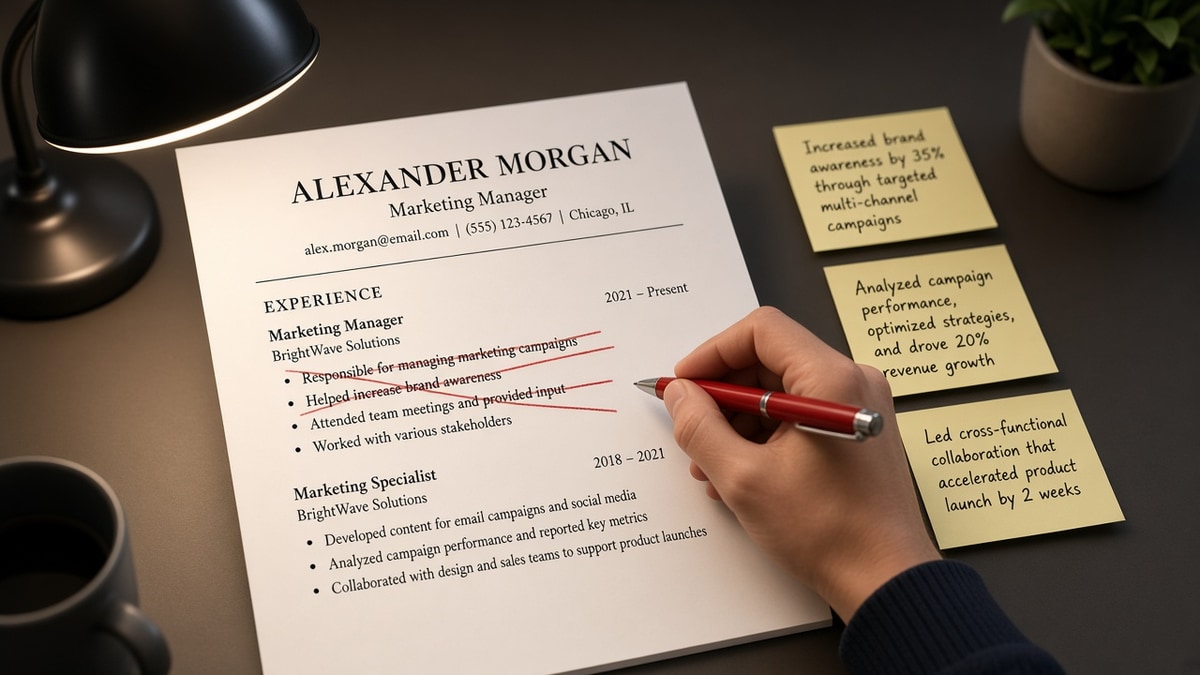
Before: Responsible for customer service and team meetings.
After: Led eight-agent tier-one team handling 400+ daily tickets in Zendesk, raising CSAT from 86% to 91% in two quarters.
Pair 2: Marketing coordinator
Before: Helped with email campaigns and social media.
After: Built segmented Mailchimp flows for 120k subscribers, lifting trial signups 14% on the product launch series.
Pair 3: Software engineer
Before: Worked on backend services using Java.
After: Refactored billing microservice in Java and Spring, cutting p95 latency 220ms and reducing payment timeout tickets 18%.
Pair 4: Registered nurse
Before: Provided patient care on med-surg unit.
After: Managed average census of 28 on 32-bed med-surg unit, precepted four new hires, and maintained fall-rate below unit benchmark four straight quarters.
Pair 5: Operations analyst
Before: Involved in process improvement initiatives.
After: Mapped pick-pack-ship workflow with warehouse leads, removing two manual handoffs and saving 11 labor hours per week.
Pair 6: Account executive
Before: Managed client relationships and sales activities.
After: Closed $1.4M new ARR across 22 mid-market SaaS accounts in FY24, 118% of quota with 9-month average cycle.
Pair 7: HR generalist
Before: Assisted with recruiting and onboarding tasks.
After: Owned hourly hiring for three distribution centers, filling 140 roles in Q1 with 18-day average time-to-fill and 92% 90-day retention.
Pair 8: Financial analyst
Before: Prepared reports for management team.
After: Built rolling 13-week cash model in Excel used in weekly CFO review, flagging $2.1M shortfall six weeks before prior process would have caught it.
The After lines work because you can picture the artifact: Zendesk queue, Mailchimp list, Java service, cash model. Weak lines hide the artifact behind process words.
Copy-paste bullet rewrite formula
[Past-tense verb] [deliverable/system/process] for [stakeholder/team],
using [tool if relevant], [metric or countable object].

Weak: Responsible for [duty from job description].
Strong: [Verb] [thing] for [who], [number/%/time saved].
Edge case: military or union titles with fixed duty language. Translate to civilian deliverables: supervised maintenance crew of twelve, completed 96% of work orders on schedule. Keep rank in the title line, not in every bullet opener.
Edge case two: concurrent part-time roles. Put the stronger bullets under the role that matches the posting. Trim the other job to two lines so weak bullets do not dominate the first screen.
Run the highlight test: bold only the verb, object, and number in each bullet. If nothing is left to bold, the line is still weak. Rewrite until at least three words earn the highlight.
Ask a colleague to read bullet one cold. If they follow up with what metric, you have not finished. If they ask which company, the bullet is strong enough to stand alone.
What weak bullets share
They start with nouns instead of verbs. Customer service and team leadership as openers force the recruiter to hunt for what you did. Lead with the action.
The pattern: duty copied from the internal job description. If a bullet could apply to anyone with your title, delete or rewrite it.
They stack soft skills without proof. Strong communicator means nothing without an artifact: training deck, exec readout, client workshop.
They hide metrics in sub-bullets parsers flatten wrong. Put the number in the main line, not indented under a dash.
They repeat the same verb six times. Managed, managed, managed reads monotonous. Vary verbs while keeping objects specific.
They use present tense on past jobs. Mixed tense makes timelines feel sloppy. Past roles get past tense unless you still hold the job.
They bury the company context inside the bullet. Company and title already sit on the header line. The bullet should spend its words on what changed, not repeating where you worked.
They list meetings attended. Facilitated weekly sync is still weak unless you name the decision or deliverable that came out of the room. Outcomes beat calendars.
They clone bullets across roles with only the company name changed. Each job needs its own object and metric. Recycling the same line three times signals you did not read what you wrote.
They use jargon without a plain noun. Optimized synergy across verticals tells me nothing. Reduced vendor invoice disputes from 40 to 12 per month tells me you touched accounts payable.
They front-load adjectives. Successfully managed a challenging initiative spends words on tone, not proof. Cut the adjectives until the line still makes sense. If it does not, add a number.
For bullet formulas recruiters prefer, see resume bullet formula recruiters actually like . Same spine, different examples.
Test the rewrite before you apply again
You fixed bullet one. Confirm the parser still reads it as a single line and that the posting's top skill appears in the first eight words.
Run a free ATS check on the updated file. If weak bullet points get ignored because of formatting, the checker flags broken lines before a human sees them.
Generate a cover letter that repeats bullet one's verb and metric. Consistency helps you defend the line on a phone screen without sounding surprised by your own resume.
Edge case: you're tailoring ten applications. Rewrite bullet one only per posting. Do not rewrite all bullets every time unless you have the bandwidth. Top line moves the needle.
Edge case two: internal promotion track. Weak bullets hurt inside the company too. Hiring managers run the same six-second scan on internal postings. Upgrade bullets before you post on the internal board, not after you lose to an external candidate with sharper lines.
Save Before and After versions in a doc dated by quarter. When review season ends, capture new metrics while emails still have the numbers. Future you will not remember Q3 ticket counts in six months.
Fix line one tonight
Open your resume. Read bullet one under your current job. If it starts with responsible, helped, or involved, rewrite it with the formula above before you send another application.
Weak bullet points get ignored because they ask the recruiter to do your writing for you. Hand them a verb, an object, and a number. That's the whole game on the first scan.
Work top down. Fix three bullets tonight. Ship the file. Apply tomorrow. Perfection on all twenty lines can wait; ignored line one cannot.
Keep a swipe file of After lines from this page. Swap verbs and nouns per role. You'll write faster when you're not inventing structure from a blank bullet each time.
And when a bullet is honestly thin because the work was new, say what you shipped in month one, not what the team eventually achieved without you. Honest scope beats inflated duty language every time.
Read each bullet without the job header. If you cannot tell which company it belongs to but you still know what moved, you wrote a strong line. If you need the header for context, rewrite.
Weak bullet points get ignored in cover letters too when you paste duty language from the resume. Reuse the After verb and metric, not the Before frame. One voice across files reads senior; mixed voices read rushed.
Block thirty minutes on your calendar this week. Rewrite three bullets using the pairs above as models. Ship the file Friday. Waiting for a perfect rewrite Monday never comes; ignored line one costs callbacks every day you wait.
When you review a colleague's resume, count how many bullets start with responsible or helped. You will see the pattern everywhere. Fix yours first, then share the formula. Most people do not need more experience; they need a clearer first line.
Sort bullets by strength after you rewrite. Move the best line to position one under each job. Recruiters rarely read in the order you drafted at midnight. They read in the order that appears on the page. Put your proof up front.
Weak bullet points get ignored in referral intros too. When a friend forwards your resume in Slack, they usually paste bullet one. Make sure that line is the one you want representing you in someone else's message.
Print the page and highlight every verb on the left margin. If the highlighter skips the first word of most lines, you still have passive openers hiding in plain sight. That print trick takes five minutes and catches what on-screen skimming misses every time.
Read more
Frequently asked questions
Both. Parsers still capture passive lines, but they carry no searchable outcome or object. Humans skip them on the six-second scan because nothing signals scale or ownership. A line that starts with Responsible for does not tell the matcher what you actually moved. Fix the verb and object first; keywords second.
Three to five for recent roles, two to three for older ones. More lines rarely help if each one is thin. One strong bullet beats four duty lists. Recruiters remember the first line under your current title; spend your rewrite time there before you add volume.
Reporting structure belongs in the job context, not the opening verb. You can still own outcomes while reporting up. Swap Responsible for weekly reports with Produced weekly P&L package for CFO, cutting revision cycles from three to one. Ownership and hierarchy are not the same word choice.
Use countable objects: number of clients, tickets, stores, models, or people trained. If counts are blocked, name the deliverable and consumer: Built onboarding deck adopted by HR for all US hires. Avoid empty adverbs like significantly. One concrete noun beats a vague intensifier.
Start with bullet one under your current job, then any line with helped, assisted, or involved. Those are the lines parsers and humans skim past. Leave strong bullets alone until the top three are fixed. Partial rewrites beat a full rewrite that never ships.