8 min read · Bullet format before upload
Your file can pass a keyword scan and still die on a ten-second skim. That's not a mystery. Parsers and recruiters aren't reading the same way, and most bullet advice won't fix both sides at once.
Before you tweak wording, check your resume for free on the PDF or DOCX you'll upload. If the checker sees your bullets as one mashed paragraph, a recruiter won't piece them together either.
This page compares what parsers extract against what humans skim, with a format table and a decision rule you can run tonight. Pair it with why weak bullet points get ignored when the verbs look fine but callbacks stay flat.
Job searching's already draining when you're not sure which format wins. Bullets are one place you can settle the parser-versus-human split before the portal timer starts. If the posting asks for a short note, use the cover letter generator after your bullets are locked.
Criteria parsers and recruiters both use on every bullet
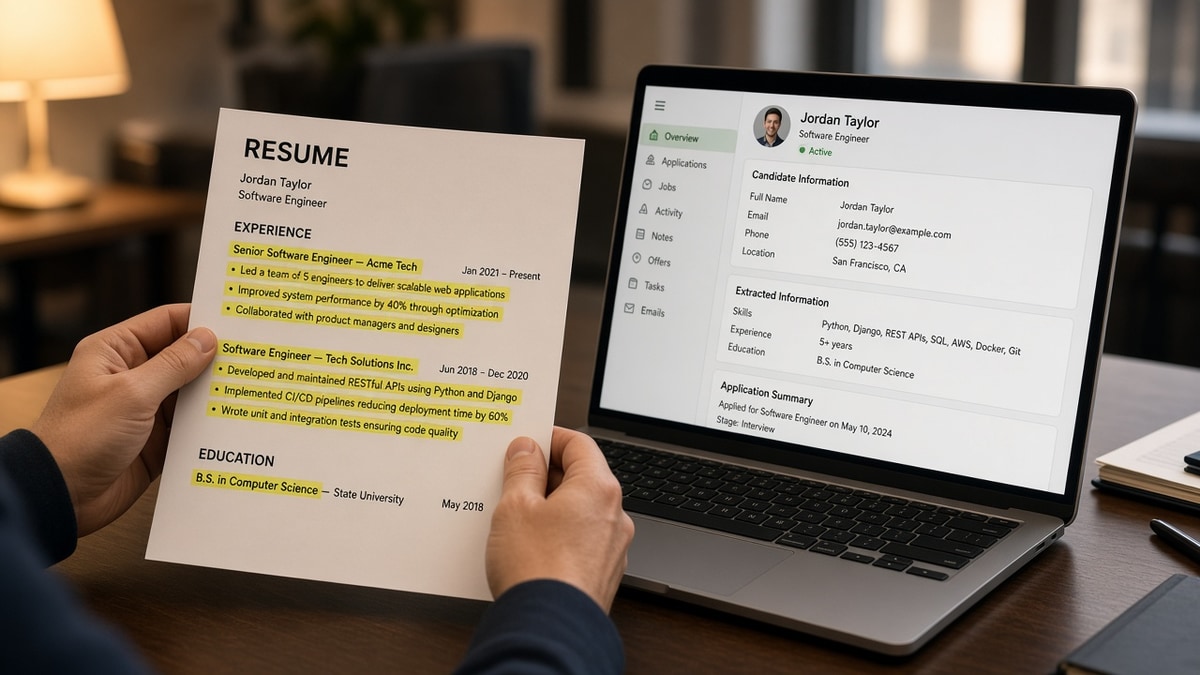
Workday, Greenhouse, Lever, and iCIMS don't admire your layout. They strip the file to text, split on line breaks, and score tokens against the posting. A recruiter on the same file looks at title match, recency, and whether the first line under each job proves scope.
The split: parsers need clean line boundaries and early keywords. Recruiters need a verb, a scope noun, and one proof point before they scroll. A bullet can satisfy the parser and fail the skim when duty verbs lead and outcomes trail off.
Four criteria show up in almost every screen, human or automated:
- Line integrity: one achievement per line in the exported file, not a wrapped paragraph the parser fragments
- Early tokens: verb plus tool or scope in the first eight words, where both parsers and skimmers weight heavily
- Posting overlap: exact terms from the job description, not synonyms the matcher may miss
- Proof density: one metric or scope marker per bullet, not three outcomes crammed into one line
Paste test is the cheapest diagnostic. Copy your resume into Notepad or TextEdit. If bullets collapse into one block, fix structure before you argue about word choice.
Before: "Responsible for weekly reporting, stakeholder updates, and cross-team coordination across the business."
After: "Built weekly Looker dashboards for 14 stakeholders, cutting ad-hoc report requests in Q3."
The second line gives parsers a tool token early and gives recruiters a scope marker fast. The first line is a duty cloud that both readers treat as filler.
How resume bullet points are parsed: structured vs unstructured formats
Think of two bullet families. Structured bullets follow verb, scope, proof. Unstructured bullets list duties, hide tools mid-sentence, or rely on line wraps inside one point. Both can contain keywords. Only one reads clean to a parser and a tired recruiter at 4 p.m.
| Format | What the parser sees | What the recruiter skims | Example |
|---|---|---|---|
| Structured (verb + tool + outcome) | One line, early keywords, clean token match | Scope obvious in first eight words | "Reduced ticket backlog 22% by rebuilding Zendesk macros for Tier 1." |
| Duty list (responsible for…) | Keywords present but weighted late | Reads as generic; skim stops early | "Responsible for Zendesk queue management and customer communication." |
| Wrapped long bullet | May split into fragments on export | Proof buried below the fold of the line | "Worked with sales, marketing, and product to improve funnel conversion through email tests and landing page updates that increased signups." |
| Paragraph block under a job | No bullet boundaries; achievements merge | Wall of text; no scan path | "In this role I handled reporting, vendor calls, and process documentation for the team." |
| Icon or text-box bullet | Text may drop or reorder in Taleo | Pretty PDF, missing lines in the ATS view | Custom arrow glyphs inside a Canva sidebar |
Structured bullets: what machines count as separate lines
A structured bullet opens with a past-tense verb for closed roles, names the system or scope next, and closes with one outcome. Parsers tokenize left to right. Recruiters do the same skim whether they admit it or not.
Pattern: [Verb] + [tool or scope] + [metric or boundary].
"Automated month-end close in NetSuite for 6 entities, cutting manual journal entries from 40 to 12." The parser gets NetSuite early. The recruiter sees entity scope before the scroll.
Keep each bullet to one or two lines at 11-point Calibri. If you're stacking three outcomes, you're writing three bullets, not one hero line. For density targets per role, see how to write resume bullet points that get interviews .
Before: "Helped with Salesforce data cleanup and various reporting tasks for leadership."
After: "Cleaned 18,000 duplicate Salesforce contacts, improving campaign match rates for the demand gen team."
Unstructured bullets: what survives a skim but fails extraction
Unstructured bullets aren't always ugly. They can read politely and still break parsing. Duty verbs push keywords to word twelve. Soft returns inside a cell make Greenhouse read one bullet as three. Skills buried in parentheses become orphan tokens.
Paragraph blocks under a job title are the worst of both worlds. You lose bullet boundaries, so the parser sees a blob. The recruiter sees a wall. Neither extracts "Python" from "comfortable with various programming tools including Python when needed."
Nested sub-bullets in a two-column template are another trap. The right column may parse after the left, so your strongest proof shows up under the wrong employer in the ATS view. Single column fixes that before you touch verbs.
Before: "Supported leadership on special projects (Tableau, SQL) and other analytics work as assigned."
After: "Built 12 Tableau views from SQL pulls for the CFO staff, replacing weekly slide decks."
Copy-paste block: bullet format decision tonight
Copy-paste decision (answer yes or no)
{`1. Paste your resume into plain text. Does each bullet stay on its own line?
   NO → fix columns, text boxes, or icons; re-export
   YES → go to question 2

2. Do the first eight words of your top bullet include a verb and a tool or scope noun?
   NO → rewrite the lead; don't add keywords at the end
   YES → go to question 3

3. Is any bullet starting with "Responsible for" or "Helped with"?
   YES → rewrite to verb-first structured format
   NO → go to question 4

4. Does one bullet contain more than one metric or unrelated outcome?
   YES → split into two bullets
   NO → upload; run the checker on the same file`}
Decision rule in one sentence
If the plain-text paste shows one verb-led line per achievement with a tool or scope in the first eight words, keep the format. If duties, wraps, or paragraph blocks show up, restructure before you synonym-swap keywords.
Where bullets break in Workday and Greenhouse
These failures show up after export, not while you're editing in Word. Fix the file, then tune the verbs.
Metrics trapped in parentheses: "Improved CSAT (96%)" can parse as noise. Write "Raised CSAT to 96% in Zendesk for Tier 2" instead.
Bullets inside tables: Taleo and older iCIMS builds sometimes read cells out of order. Move bullets to the main body in a single column.
Keyword stuffing at the tail: Adding "Python, SQL, Excel" after a duty sentence boosts token count without proof. Put each tool in a bullet where you used it.
I've screened files in Greenhouse where the parser pulled clean keyword lines, but every bullet started with "Responsible for," and the hiring manager never moved past the first role.
Before: "Duties included vendor management, budgeting, and team meetings on Mondays."
After: "Renegotiated 4 vendor contracts, saving $180K annual spend without service cuts."
For file-level parse checks beyond bullets, read how to check if your resume is ATS-friendly on the export you plan to submit.
Test the file before you rewrite every bullet
Run structure checks on the same PDF or DOCX you'll upload. A bullet rewrite won't help if the parser still sees a single paragraph under your current job.
Use the job match score tool on your structured draft. If must-have terms only appear in duty lines without scope, rewrite the lead before you add more keywords at the end.
When columns or icons broke your last export, build your resume in a single-column template, paste verb-first bullets, then export once the plain-text paste passes.
Do this now: Paste your file into plain text, then read only the first eight words of each bullet aloud. If you cannot name the tool or scope, rewrite the lead before you upload.
Your bullet format tonight
Open your export, paste into plain text, and count whether each achievement stands alone. Rewrite duty lines to verb-first structured bullets with one proof point each. That's the format parsers extract and recruiters skim without friction.
Run the copy-paste decision block above on the file you're uploading. Fix line breaks before synonyms. When the first eight words show scope, you're aligned with how resume bullet points are parsed and how humans actually read them.
Read more
Frequently asked questions
Most corporate parsers care about line breaks more than the glyph. A standard round bullet, hyphen, or asterisk usually parses the same if each achievement sits on its own line in a single-column file. Custom icons, arrows, or bullets inside a text box can merge lines or drop text entirely. Paste your export into plain text. If bullets stack as separate lines, the parser likely sees them that way too.
Yes when soft line breaks, narrow columns, or table cells split the text. The parser may treat each wrapped row as its own fragment, which breaks keyword matching. Keep each bullet on one logical line in Word or Google Docs, then export. If a bullet needs two outcomes, split it into two bullets instead of forcing a wrap inside one point.
No. Parsers tokenize the full line and match terms from the posting. Recruiters skim the first eight words for scope and proof, then move on. A duty bullet that lists every task can still contain keywords the parser likes. It fails the human skim because the outcome sits at the end or never appears.
Stick with bullets for experience sections. Paragraphs remove the line boundaries parsers use to separate achievements. If you need narrative room, write a two-line bullet with a clear verb first, not a mini essay. Senior files still win on scoped bullets, not dense blocks.