9 min read
Most candidates assume the Skills grid does the heavy lifting. It doesn't. The parser may import both blocks, but the matcher asks a narrower question: did this person use the tool while they held a title that overlaps the req?
You can't fix that mismatch with density alone. You need the same noun sitting on the employer line where dates live. That's why two files with identical Skills lists can sort miles apart once you read Experience.
If you're stuffing posting terms into Skills while your Experience bullets still read like a duty list, you're optimizing the wrong layer. Check your resume for free and read the plain-text export. When Salesforce or SQL only appears under Skills, the matcher often treats them as labels, not history.
Below you'll see how bullets attach to employer records in Workday and Greenhouse imports, before/after lines across common roles, a copy-paste skeleton, and the patterns that keep strong tools invisible even when the PDF looks fine on screen.
If you've been told to keyword-stuff Skills, ignore that advice for tonight. We're fixing Experience lines first because that's where matchers expect proof.
Quick wins
- Move one posting must-have from Skills into bullet one under your current job.
- Replace Responsible for with a verb plus tool plus unit in the first eight words.
- Paste-test after edits so nested bullets did not flatten into one paragraph.
How resume bullet points are interpreted by ATS inside Experience
Think of the upload as two passes. Pass one is parsing: employer, title, start and end dates, then the bullet text nested under that job. Pass two is matching: does this block contain the verbs, tools, and scope the req asks for, and do the dates overlap what the hiring manager set?
Skills imports flat. A comma list under Skills rarely keeps which year you used Tableau or whether it was a side project. Matchers treat that as weak evidence compared with the same word inside a 2023 to 2025 analyst role.
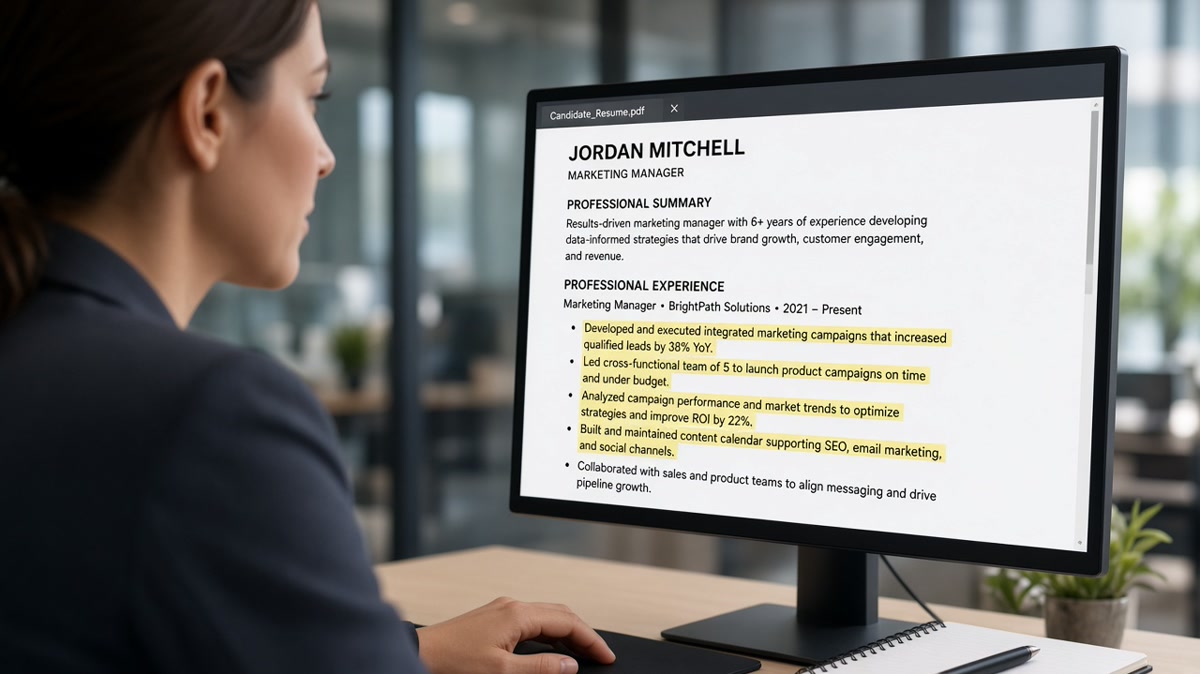
Bullets import with context. When a line opens with Built Looker dashboards for weekly churn reviews, the tool, verb, and cadence sit on the employer record recruiters sort by. That is the block I scan when I only have six seconds on your tab.
Duty language still parses, but it does not compete. Responsible for reporting tells me you had a seat. It does not tell me you owned SQL models, cut prep time, or shipped a dashboard hiring managers used in Q3 reviews.
Pair this mental model with why resume bullet points matter more than you think when you need the human scan habits spelled out beside the matcher side.
I've sorted Greenhouse queues where the Skills section was a perfect copy of the posting and Experience bullets never named the same tools. The file parsed clean. The match score still lost to a shorter resume that said the quiet part in bullet two.
Before/after bullets recruiters and matchers both read
Use the posting as a highlighter, not a word cloud. Pick three must-haves. Each gets one Experience line with a verb, tool, and unit. These pairs show the shift without inventing employers.
Operations coordinator targeting project coordinator
Before: Responsible for scheduling and vendor emails.
After: Coordinated 14 vendor renewals in NetSuite, cutting purchase order cycle time from 9 days to 5 across Q2.
The after line keeps honest scope. NetSuite and cycle time live on the employer record, not as orphaned labels.
Retail lead targeting customer success
Before: Helped customers and handled complaints.
After: Resolved 35 to 50 Zendesk tickets weekly, holding CSAT at 96% while mentoring three new floor leads on de-escalation scripts.
Zendesk and CSAT are posting language. The volume range is defensible in an interview without pretending you ran the whole department.
Marketing generalist targeting marketing analyst
Before: Worked on campaigns and social content.
After: Built weekly funnel dashboards in Looker from HubSpot exports, flagging a 12% drop in trial signups that led to a revised landing test in March.
Looker and HubSpot move from Skills into proof. The percentage is illustrative of a single campaign window, not a claim about the whole market.
Support specialist keeping tools on the right job
Before: Skills line lists Salesforce, Jira, and SQL.
After: Triaged 40+ Salesforce Service Cloud cases daily, logging root-cause tags in Jira that cut repeat contacts on billing errors by 18% in one quarter.
Finance analyst moving toward FP&A
Before: Prepared reports for leadership team.
After: Built monthly variance packs in Excel and Power BI for a $42M cost center, surfacing a vendor overspend pattern that trimmed discretionary spend 8% in H2.
Power BI on the Experience line beats a Skills tag when the req lists forecasting and variance review in the same breath.
Copy-paste into your editor and swap the bracketed pieces:
[Verb] [scope] in [tool], [outcome with unit] during [timeframe].
Example: Automated [process] in [tool], saving [hours or dollars] per [week/month].
Rule: first eight words must include one posting must-have.
For readability checks after you rewrite, see how ATS evaluates resume readability so nested bullets did not turn into a single mashed paragraph on export.
Lines parsers read as noise
- Duplicating the posting inside Skills while Experience still says duties only.
- Burying the tool in bullet four when bullet one is still generic.
- Using symbols parsers strip, such as odd bullets, tables, or ampersands mid-line.
- Stacking six soft skills with no verb, tool, or unit attached.
- Repeating the same keyword in every bullet without new scope each time.
Before: You add Python to Skills and leave bullets about team meetings.
After: You open bullet one with Built Python scripts to clean vendor CSVs, cutting manual prep from 6 hours to 90 minutes weekly.
Before: You list every certification as its own bullet with no outcome.
After: You fold one cert into the line that shows the work it enabled, and you drop the rest to save space.
Weak bullets are not a moral failure. They are a formatting habit from old HR templates. Swap the habit on the current role first; older jobs can stay shorter.
When you are unsure which line to cut, keep the bullet that names a tool the posting repeats twice. Drop the bullet that only restates attendance or participation with no unit attached.
And if you inherited a template with fourteen bullets per job, trim to five on the current role before you add new keywords. Long blocks flatten on export and push your best line below the fold in recruiter preview panes.
More teardown patterns live in why weak bullet points get ignored when you want the human skim side beside matcher logic.
Score bullets against the posting
After you rewrite bullet one, compare the plain-text export to the req. You are checking whether must-haves landed on dated lines, not whether you remembered to add a Skills heading.
Run the free ATS check on the PDF you plan to submit. If a tool only highlights under Skills, move it into Experience before you apply again.
Score your job match against one posting to see which must-haves still sit outside your top three bullets.
Generate a cover letter only when the posting still asks for one, using the same facts as your reframed bullets.
Put proof in Experience tonight
How resume bullet points are interpreted by ATS is simpler than the SEO articles make it sound: verbs and tools on the job record beat labels floating below. You do not need twenty new bullets. You need three honest lines that name what you used and what changed.
Start with your current role. Rewrite bullet one with a posting must-have in the first eight words. Paste-test. Apply once with that file before you chase ten more reqs with the old duty list.
This will not fix applying far above level. It stops qualified files from losing to a Skills cloud while Experience stays silent.
Keep a screenshot of your plain-text export beside the posting the next time you tailor. When bullet one changes but Skills stays static, you'll know the matcher saw the move.
Read more
Frequently asked questions
Usually no. Parsers often import Skills as a flat list without dates or employer context. Matchers weight the same keyword higher when it sits inside a dated Experience line with a verb and scope. A tool named only under Skills reads like a label. The same tool in bullet one reads like proof.
Lead with a real verb when you can: built, reduced, launched, audited. Duty openers like Responsible for or Duties included parse as text but score weakly because they hide the outcome. If you must keep a duty phrase, put the posting keyword and tool inside the same line before the period.
One must-have from the posting per bullet is enough. Stack two only when both appeared in the job description and you used both on the job. Keyword stuffing in a single line can look unnatural to a human reader and still fail if the tools never appear under the right employer dates.
Matchers look for digits and units as context, not magic points. A line that says cut ticket backlog from 180 to 95 in six weeks gives the parser a scope signal. Numbers do not replace missing title or tool terms from the posting.