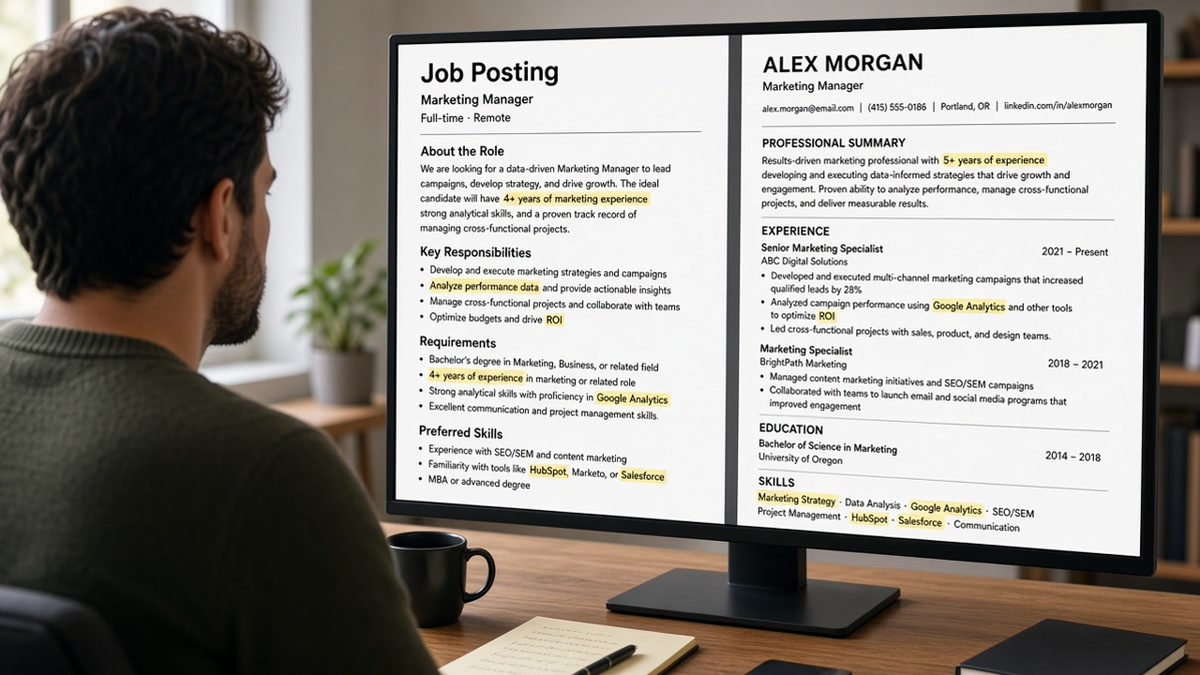
When you submit your resume online, it doesn't go directly to a hiring manager's desk. Instead, it enters an Applicant Tracking System (ATS)—software that automatically screens, parses, and ranks candidates before any human ever sees your application. Understanding how ATS matches your resume to a job description is critical to landing interviews in today's competitive job market.
The process sounds simple but operates on complex algorithms that evaluate keyword relevance, skill alignment, experience level, and formatting quality. A resume that looks perfect to human eyes can fail ATS screening if it doesn't match the job description in ways the system recognizes. This guide explains exactly how ATS matching works, why it matters, and how to optimize your resume to pass these automated gatekeepers.
In this article, you'll learn:
- How ATS systems parse and analyze resumes
- The role of keyword matching in job description alignment
- How scoring algorithms rank candidates
- Common mistakes that cause resume rejection
- Proven strategies to improve your ATS match score
- Best practices for formatting and structure
Understanding How ATS Matches Resume to Job Description
ATS matching is a multi-stage process that begins the moment your resume is uploaded. The system first extracts text from your document, then compares it against the job description using pattern recognition and keyword analysis. The ATS doesn't understand context the way humans do—it looks for specific terms, phrases, and structural patterns that indicate job fit.
The matching process typically involves three main components: parsing (extracting data from your resume), keyword matching (comparing your resume against the job description), and scoring (ranking your candidacy relative to other applicants). Different ATS platforms weight these components differently, but the fundamental logic remains consistent across most systems used by major employers and recruiting firms.
Key Components of ATS Matching
1. Keyword Extraction and Matching
The ATS identifies critical keywords from the job description—skills, job titles, certifications, software tools, and industry terminology. It then searches your resume for exact or near-exact matches. If the job requires "Python" and your resume says "Python programming," that's a match. If your resume only mentions "coding" without specifying the language, the system may not recognize it as relevant.
Keyword matching isn't just about presence; it's about density and placement. Keywords appearing in your skills section, job titles, or early in bullet points carry more weight than those buried in paragraph text. The ATS also recognizes variations—"JavaScript" and "JS" may both trigger matches, depending on the system's sophistication.
2. Semantic Analysis and Context
Modern ATS platforms use natural language processing (NLP) to understand context beyond simple keyword matching. If a job description asks for "experience managing cross-functional teams," the system can recognize that your resume's mention of "led 5-person product development team" demonstrates this capability, even without using the exact phrase.
However, this semantic understanding has limits. Older or less sophisticated ATS systems rely heavily on exact keyword matches, making traditional keyword optimization still essential. The safest approach incorporates both strategies: use exact keywords from the job description while also demonstrating relevant experience through well-written bullet points.
3. Scoring and Ranking Algorithms
Once the ATS extracts and matches data, it assigns a match score—typically a percentage or numerical rating. This score determines whether your resume reaches a recruiter's queue. Most systems require a minimum threshold (often 60-75%) for human review. The scoring algorithm weighs different factors: keyword match percentage, required vs. preferred skills, years of experience, education level, and job title relevance.
Understanding your resume's likely ATS score helps you identify gaps. If a job requires 5 years of experience and you have 3, that's a significant scoring penalty. If you match 80% of required keywords but only 40% of preferred ones, you're in a stronger position than someone with the reverse profile.
4. Formatting and Parseability
ATS systems must extract readable text from your resume file. Formatting that looks attractive to humans—graphics, unusual fonts, tables, text boxes—can confuse parsing algorithms. If the ATS can't properly read your resume, it can't match you to the job description effectively. A well-formatted resume with clear section headers, standard fonts, and logical structure ensures the system captures all your relevant information accurately.
Common Mistakes That Reduce ATS Matching
- Ignoring exact job description keywords: Using synonyms instead of the specific terms from the job posting reduces match scores. If the posting says "project management" and you write "overseeing initiatives," you miss direct matches.
- Over-relying on graphics and formatting: Logos, charts, text boxes, and creative layouts often break ATS parsing. Your resume may look professional but become unreadable to the system, causing critical information to be lost.
- Submitting PDF files when Word is requested: While many ATS systems handle PDFs well, some still struggle with them. When in doubt, follow the application instructions precisely—if Word format is specified, use it.
- Using abbreviations inconsistently: Write out terms on first mention ("Application Programming Interface (API)") then use abbreviations. This helps the ATS recognize both versions as related.
- Burying key information in narrative paragraphs: ATS systems prioritize structured sections like skills, job titles, and bullet points. Important qualifications hidden in paragraph text may not be weighted appropriately.
- Mismatching job titles and experience descriptions: If your title was "Coordinator" but your responsibilities were managerial, the ATS may underweight your experience. Use your actual title but ensure bullet points reflect your true scope.
Best Practices for Improving ATS Matching
- Mirror job description language: Extract 10-15 key terms from the job posting and naturally incorporate them into your resume. Use the exact job title if you've held a similar role, and match the terminology for skills and responsibilities.
- Optimize your skills section: Create a dedicated skills section listing relevant competencies in a simple, scannable format. This section is heavily weighted in ATS matching and should include both technical and soft skills mentioned in the job description.
- Use standard formatting: Stick to clean, simple designs with standard fonts (Arial, Calibri, Times New Roman), clear section headers, and bullet points. Avoid tables, graphics, headers/footers, and unusual formatting that confuses parsing.
- Include relevant keywords in context: Don't just list keywords—use them naturally in your experience descriptions. "Managed SQL databases" is stronger than a skills list that includes "SQL" without context.
- Quantify achievements with specific metrics: Numbers help ATS systems recognize impact. "Increased sales by 25%" or "Reduced processing time from 5 days to 2 days" provides concrete evidence of capability.
- Maintain consistent terminology: If the job uses "machine learning," don't alternate between "ML" and "artificial intelligence." Consistency helps the ATS recognize all instances as the same skill.
- Include education and certifications: If the job requires specific degrees or certifications, list them clearly. ATS systems often screen for these as hard requirements before evaluating experience.
- Tailor for each application: While maintaining honesty, adjust your resume for each job to emphasize the most relevant experience and skills. This targeted approach significantly improves match scores.
Step-by-Step Guide: Optimizing Your Resume for ATS Matching
- Analyze the job description: Read it carefully and highlight 15-20 keywords, phrases, and requirements. Note both required and preferred qualifications. Create a list of specific skills, tools, certifications, and job responsibilities mentioned.
- Review your resume structure: Ensure you have clear sections: Contact Information, Professional Summary or Objective, Skills, Experience, Education, and Certifications. Use standard headers that ATS systems recognize easily.
- Update your skills section: Add skills from the job description that you genuinely possess. Organize them by category (Technical Skills, Languages, Tools, Soft Skills) for clarity. Include both specific tools and broader competencies.
- Revise your experience descriptions: Rewrite bullet points to incorporate relevant keywords naturally. Start with action verbs and include specific metrics. Ensure job titles and dates are accurate and clearly formatted.
- Add relevant keywords throughout: Incorporate job description keywords in your professional summary, job titles, bullet points, and skills section. Avoid keyword stuffing—every keyword should fit naturally within the context.
- Check formatting for ATS compatibility: Remove graphics, tables, text boxes, and unusual fonts. Use a simple, clean format with standard fonts and clear section breaks. Save as both Word and PDF to test compatibility.
- Test your resume: Use free ATS parsing tools to see how your resume appears when parsed. Check that all sections are readable and information is in the correct categories. Make adjustments if parsing reveals issues.
- Proofread thoroughly: Spelling and grammar errors can affect keyword matching and create parsing issues. Review multiple times and have someone else check your work.
Matching Beyond Keywords: What Else ATS Evaluates
While keywords are crucial, modern ATS systems evaluate additional factors that affect your match score. Experience level is a primary consideration—if the job requires 5-7 years of experience and you have 10, you may be overqualified, which some systems penalize. Conversely, having only 2 years for a 5-year requirement significantly lowers your score.
Career progression and job stability also matter. ATS systems can identify patterns like frequent job changes, unexplained gaps, or lateral moves that don't advance your career trajectory. While these factors shouldn't automatically disqualify you, they affect your overall ranking relative to other candidates. How ATS interprets career progression is increasingly sophisticated, with systems recognizing promotions, expanded responsibilities, and skill development over time.
Education and certifications are weighted heavily if they're required or preferred qualifications. The ATS checks for specific degrees, institutions, or professional certifications. If you have relevant certifications not explicitly mentioned in the job description, include them—they may still improve your match score if they're common in your field.
Conclusion: Taking Control of Your ATS Matching
Understanding how ATS matches your resume to job descriptions removes the mystery from online job applications. These systems aren't arbitrary or unfair—they're designed to efficiently identify candidates with relevant skills and experience. By optimizing your resume for ATS matching, you're not gaming the system; you're ensuring your qualifications are accurately recognized and presented to hiring teams.
The key takeaway is that ATS matching depends on three factors working together: relevant keywords naturally incorporated into your resume, a clean, parseable format that the system can read correctly, and genuine alignment between your experience and the job requirements. Tailor your resume for each application, use job description language strategically, maintain a professional format, and verify that your resume parses correctly.
Start by analyzing your next job posting, identifying its key requirements, and revising your resume to match those specifications. Test your resume with ATS parsing tools, and track which applications result in interviews. Over time, you'll develop a sense for what works and can refine your approach. The investment in understanding and optimizing for ATS matching pays dividends in interview opportunities and job offers.
Frequently asked questions
ATS matching combines keyword extraction, semantic analysis, and scoring algorithms. The system identifies key terms from the job description (skills, tools, job titles, certifications), searches your resume for matches, and assigns a score based on the percentage of keywords matched, the relevance of your experience level, and your resume's structural quality. Modern systems use natural language processing to understand context, but exact keyword matches remain important. Your resume is ranked against other applicants, and those scoring above a threshold (usually 60-75%) are sent to recruiters.
Required keywords are skills, qualifications, or certifications explicitly stated as necessary for the role. Missing these significantly hurts your match score. Preferred keywords are "nice-to-have" qualifications that strengthen your candidacy but aren't deal-breakers if absent. ATS systems weight required keywords more heavily—matching all required keywords but few preferred ones still produces a strong score. Conversely, matching many preferred keywords doesn't compensate for missing required ones. Prioritize matching required qualifications first, then add preferred ones where applicable.
Keyword stuffing—repeating keywords unnaturally or listing them without context—can backfire. Modern ATS systems recognize this tactic and may penalize resumes that appear spammy or dishonest. Additionally, recruiters who receive your resume will immediately notice artificial language, damaging your credibility. The best approach uses keywords naturally within genuine descriptions of your experience. If you've truly used a skill or tool, mentioning it multiple times across different contexts (in your summary, skills section, and relevant job descriptions) is acceptable and effective.
Formatting is critical because ATS systems must parse your resume to extract information. Poor formatting prevents the system from reading your content correctly, which directly impacts keyword matching and scoring. A beautifully designed resume that breaks during parsing becomes useless. Use standard fonts, clear section headers, bullet points, and simple layouts. Avoid graphics, tables, text boxes, colored text, and unusual formatting. Test your resume with ATS parsing tools to ensure it remains readable and properly structured when processed by automated systems.
Yes, tailoring your resume for each application significantly improves your ATS match score. Every job description uses slightly different language and emphasizes different skills. By adjusting your resume to mirror the specific job posting—using their terminology, prioritizing relevant experience, and highlighting matching qualifications—you increase the likelihood of matching their keywords and passing their ATS screening. This doesn't mean fabricating experience; rather, it means emphasizing the aspects of your background most relevant to each specific role.
If your resume scores below the ATS threshold, it's filtered out before reaching a recruiter. You won't receive feedback about why you were rejected—the system simply doesn't forward your application. This is why understanding ATS matching is crucial: a strong candidate with a poorly optimized resume may never get the chance to interview. If you're not receiving interviews despite applying to relevant positions, your resume likely isn't matching job descriptions effectively. Review the job postings you're targeting, identify common keywords and requirements, and revise your resume to better align with these patterns.
Done for you
Turn this advice into an interview-ready resume
Professional writers rebuild your resume for ATS + recruiters — unlimited revisions, interview guarantee.