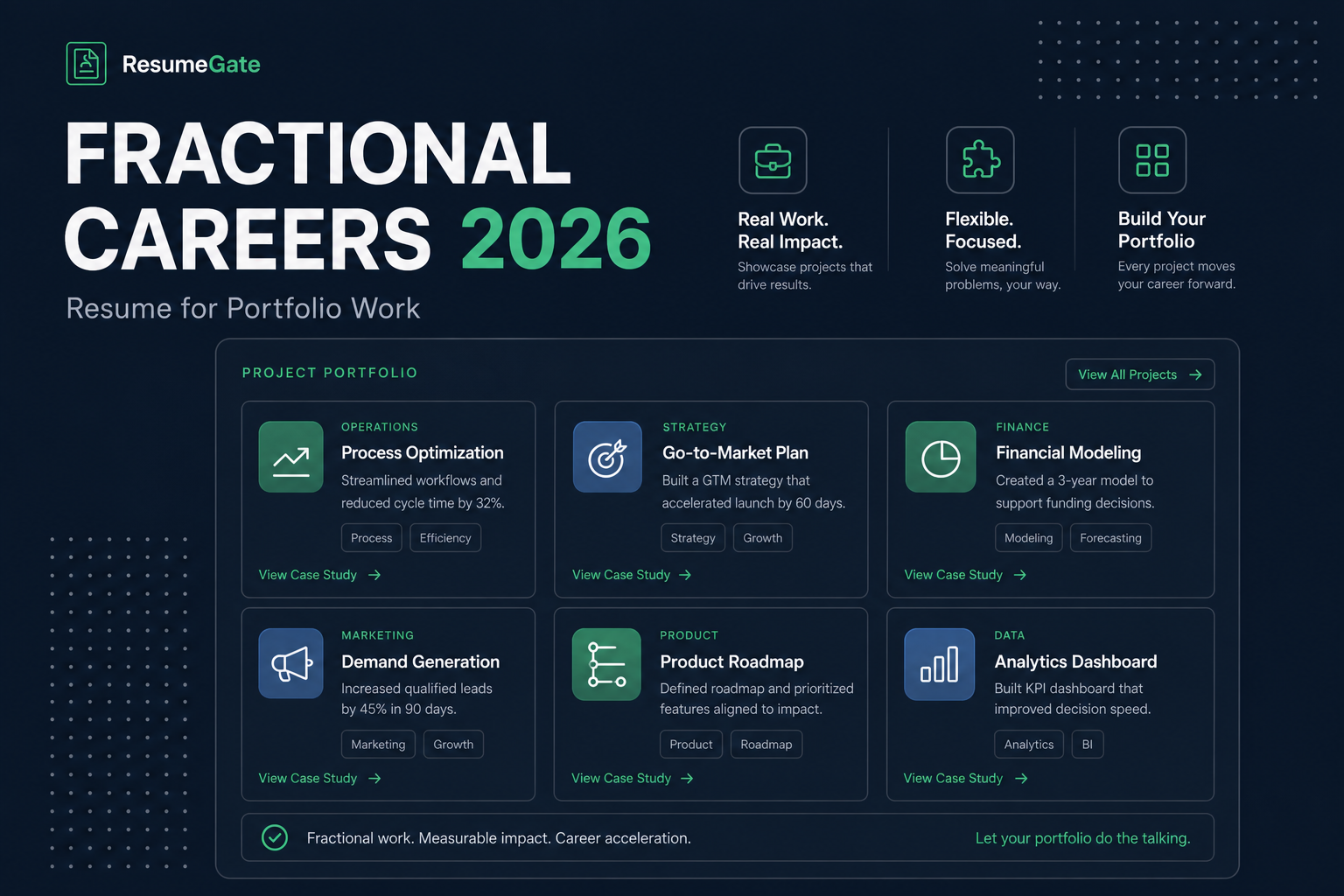
A fractional career resume passes ATS screening in 2026 when overlapping client engagements are grouped under a clear practice heading—with total scale, function title, and explicit "Concurrent" date labels—so Workday and Greenhouse calculate tenure from one continuous senior-level span instead of discarding duplicate-looking entries.
Holding two or three part-time executive clients at once is no longer a niche arrangement. Mid-market companies recruit fractional CMOs, CFOs, and COOs through staffing platforms and direct outreach. The standard resume template—one employer, one title, linear dates—was not built for that reality. When January–December appears three times in the same year, parsers often treat it as a data error, not a portfolio structure.
This guide covers what counts as fractional work, why ATS systems misread overlapping dates, two proven formatting options, how to aggregate impact without inflating claims, and bullet rewrites that parse in corporate portals on hireflow.net.
| Resume problem | What ATS may do | Structural fix |
|---|---|---|
| Three overlapping CMO entries, same year | Counts 8–12 months tenure, drops duplicate rows | One "Fractional CMO Practice" block, 2020–Present |
| Title line says only "Self-Employed" | Misses CMO/CFO keyword filters in Lever | Function + practice: "Fractional CFO | Independent Practice" |
| Vague "various clients" bullets | Low keyword density; human skim dismisses | Anonymized client descriptors + one metric each |
Key Takeaways
- Overlapping dates are the top reason ATS parsers misread fractional resumes
- Group same-function clients under one practice heading; label mixed roles Concurrent
- Summary line with client count, budget, and team size helps parsers and humans
- Aggregate impact honestly—never attribute combined results to one client
- Run an ATS check before submitting to any automated screening portal
What counts as a fractional or portfolio career in 2026
A fractional executive is a senior professional—typically VP or C-suite level—who serves multiple companies concurrently, each engagement covering a defined fraction of the working week. A fractional CMO might allocate twenty hours to a growth-stage e-commerce brand, twelve to a B2B SaaS company, and eight to a nonprofit rebrand. Each client gets executive expertise at a fraction of full-time cost.
Fractional work is distinct from a single freelance project and from sequential staffing assignments through a platform that places you with one client at a time. A true portfolio career involves ongoing concurrent relationships, often with no single client above forty or fifty percent of working hours.
The 2026 landscape also includes data scientists on dual part-time contracts, CHROs running fractional HR practices alongside transition roles, and CFOs combining operating engagements with board seats and adjunct teaching. None of these fit a linear employer-by-employer template—and all need explicit structure rather than disguise.
Research on independent and contingent work from the BLS Contingent Worker Supplement shows alternative arrangements persist across economic cycles. For resume purposes, the implication is simple: format for concurrent work honestly, because more employers and clients now recognize the model.
Common Mistake: listing twelve micro-gigs as twelve full jobs—reads as job-hopping instead of a coherent practice. Bundle and summarize.
Why Workday, Greenhouse, and recruiters struggle with portfolio resumes
Applicant tracking systems model work history as sequential records: start date, end date, title, employer. Recruiters searching "CMO with eight-plus years" rely on tenure calculated from those fields. Portfolio resumes break the model three ways.
Overlapping date ranges are often flagged as errors. Workday's resume parser typically treats each detected range as a distinct sequential job—three overlapping twelve-month engagements can register as one short recent role rather than three years of continuous senior work. Greenhouse's parser similarly sums non-overlapping spans when filtering years-of-experience, undercounting portfolio careers unless dates are presented as one grouped range.
No single canonical employer means parsers may keep only one of three CMO entries, depending on format and order. Listing "Fractional CMO" at three companies without grouping can make recent tenure look like eight months instead of six years across clients.
Human reviewers share the linear default. Three overlapping VP-level entries trigger a pause—is this a typo? A side project? Make concurrent structure obvious in the first ten seconds so evaluation moves to substance.
| Before (parser confusion) | After (parser-friendly) |
|---|---|
| Three "Fractional CMO" entries, Jan 2024–Dec 2024 each; Workday shows 11 months tenure | "Fractional CMO | Client Portfolio" 2021–Present with client bullets nested below |
| Employer field: "Various" — iCIMS keyword search misses industry terms | "Series B fintech (80 employees)" and "PE-backed logistics (500+ FTE)" in bullets |
| No time allocation; reader assumes 20% attention per client | "20 hrs/week" or "~40% FTE" in opening line of each engagement |
Quick Check: upload your resume to an ATS checker and inspect extracted tenure before applying through SuccessFactors or Taleo portals.
Two ways to structure a portfolio resume
Option A — Grouped by function
One heading: "Fractional CFO Engagements, 2022–Present." Two or three representative client bullets underneath—each with scope, hours, and one quantified outcome.
Best for:
- Same function across all clients
- More than eight to ten engagements to summarize
- Pitching a new client in the same function
Option B — Chronological with Concurrent labels
Separate entries in reverse chronological order, each with "(Concurrent)" beside overlapping date ranges. Signals intentional structure to parsers and humans.
Best for:
- Mixed functions—CFO plus board advisor plus teaching
- Distinct engagements that warrant full entries
- Direct human submission where keyword density per client matters
Many fractional professionals use a hybrid: Option A for the core practice, Option B for one or two high-profile engagements—a named board seat, interim full-time appointment, or turnaround with public outcomes. The reader should never wonder if overlapping dates are a typo.
Mid-article check: not sure which structure fits? Run your current file through HireFlow's ATS resume checker and compare extracted tenure before and after reformatting.
Pro Tip: keep a master portfolio resume with all engagements, then cut tailored versions for startup vs PE audiences—same facts, different lead bullets.
How to describe scope and impact across several clients
On a traditional resume, "grew revenue 35%" attaches to one employer header. On a fractional resume, you may have 35% at Client A, 20% cost reduction at Client B, and 50% faster hiring at Client C in the same year. Represent that without inflating any single claim.
Aggregate carefully. "Managed combined marketing budgets totaling ~$2M across three concurrent engagements" is honest summary language. Presenting $2M as if one client generated it is not.
Avoid vague umbrella phrases. "Served various clients" communicates nothing. Under NDA, describe environment: "Series B fintech (~80 employees)," "publicly traded regional bank," or "PE-backed consumer goods, $200–400M revenue range."
Lead with a practice summary. Example: "Fractional CMO practice, 2020–Present. Three to four concurrent B2B SaaS clients; combined team oversight of 12–18 marketers; cumulative pipeline generated across practice exceeds $40M annually." That block gives humans immediate scale and gives ATS a keyword-dense paragraph parsers weight heavily.
| Metric | Where to put it | Specificity level |
|---|---|---|
| Concurrent client count | Practice summary line | Exact or range ("three to five") |
| Combined budget or pipeline | Summary + relevant client bullets | Aggregate dollar figure or range |
| Team size overseen | Individual client bullets | Headcount range acceptable |
| Time allocation | Opening line per engagement | Hours/week or % FTE |
Common Mistake: hiding bandwidth allocation. Transparency about twenty hours per week usually builds more trust than leaving readers to guess.
Before/after fractional resume bullet rewrites
| Before (weak) | After (ATS-friendly) |
|---|---|
| Fractional CMO, Company A, 2024. Fractional CMO, Company B, 2024. Fractional CMO, Company C, 2024. | Fractional CMO | Client Portfolio — 2021–Present. 3 concurrent B2B SaaS clients, ~35 hrs/week combined. Rep: rebuilt demand gen for analytics firm—MQLs +140% in 14 months. |
| Advised various startups on marketing strategy. | Fractional CMO (Concurrent), Series B fintech (~80 FTE), 12 hrs/week—launched ABM program; pipeline from $1.2M to $3.4M in two quarters. |
| Self-Employed Consultant, 2019–Present. | Fractional CFO | Independent Practice — 2019–Present. 4 concurrent clients; $28M combined budget oversight; led 13-week cash improvement at PE-backed manufacturer—DSO 58 to 41 days. |
Key Takeaway: function title + practice framing + one proof metric per representative client beats a laundry list of employer names with overlapping dates.
Tailoring by audience and transitioning back to full-time
Fractional professionals should maintain two or three resume versions—startup, PE, nonprofit, or industry-specific—reordering the same engagements without changing facts. Lead with examples that mirror the reader's environment. Update quarterly as client mix shifts.
Returning to full-time work requires proactive framing. Position fractional years as a deliberate breadth-building choice—not a gap while you sought a "real job." Emphasize continuous seniority, ongoing responsibilities, and that you are now choosing full-time focus where problem scope warrants it.
Related formats for adjacent non-linear work: see how to describe platform and gig work , self-employment break framing , and merging duplicate titles cleanly .
Pro Tip: on LinkedIn, mirror the grouped practice headline from your resume so recruiter boolean searches align with your PDF.
Align your LinkedIn headline with your portfolio resume
Recruiters often see your LinkedIn profile before your PDF. If LinkedIn says "Self-Employed Consultant" while your resume says "Fractional CFO | Independent Practice," boolean searches for CFO may miss you on one surface and find you on the other.
Mirror the function-forward headline from your resume in your LinkedIn title and About section first line. List representative engagements in Featured or Experience using the same anonymized descriptors—Series B fintech, PE-backed logistics—not client names when NDAs apply.
For executive search and inbound recruiter traffic, consistency matters more than keyword density. A recruiter running "fractional CFO" OR "interim CFO" in LinkedIn Recruiter should land on the same seniority signal your resume shows in the first ten seconds.
See LinkedIn's algorithm in 2026 for how recruiters discover candidates—and why a portfolio headline that names your function beats a generic consultant label.
Pro Tip: update LinkedIn the same day you restructure your resume. Mixed signals between platforms extend confusion past the ATS.
Portfolio careers reward clarity over disguise. The client or employer evaluating your resume in 2026 has likely seen fractional arrangements before—they need to understand your structure quickly, not decode overlapping dates. Give them a practice summary, honest scale metrics, and representative proof bullets.
Key Takeaway: make concurrent work obvious in the first ten seconds—then let your outcomes compete on merit.
Fractional resume mistakes that fail US screening
- Listing every micro-engagement separately: eight one-month projects read as job-hopping, not a practice.
- Hiding overlap instead of labeling it: parsers flag unexplained overlaps as errors; humans assume typos.
- Self-Employed without function: drops CMO, CFO, and COO from recruiter boolean searches in Lever and iCIMS.
- Inflated single-client metrics: attributing combined practice results to one engagement fails reference checks.
- Two-column or infographic layouts: Workday may index only the first column of client bullets.
- Same generic file for startup and PE pitches: facts stay; lead examples must change by audience.
Fractional executives applying through executive search firms on SuccessFactors or ADP Recruiting should also confirm whether the firm wants a one-page summary plus a detailed appendix—some partners prefer Option A grouped format in the PDF and a client list in a separate credential sheet. Ask before you submit a twelve-page client laundry list as your only document.
For date formatting that parsers handle consistently, align with resume dates format guidance —Month Year (Jan 2022–Present) typically parses more reliably than numeric-only ranges across overlapping engagements.
Common Mistake: apologizing for portfolio structure in a cover letter while the resume still uses a linear template. Make the format confident and explicit in both places.
Portfolio careers reward clarity over disguise. The hiring manager or client evaluating your resume in 2026 has likely seen fractional arrangements before—they need to understand your structure quickly, not decode overlapping dates. Give them a practice summary, honest scale metrics, and representative proof bullets. The format does the persuasion; the bullets do the selling.
Key Takeaway: make concurrent work obvious in the first ten seconds—then let your outcomes compete on merit.
Pre-submit checklist for fractional professionals
- Function title visible in headline—Fractional CMO/CFO/COO, not Self-Employed alone
- Practice summary with client count, scale, and date span at top of experience block
- Overlapping dates labeled Concurrent or grouped under one practice range
- One quantified outcome per representative client bullet
- Hours per week or % FTE stated where bandwidth matters
- NDA-safe client descriptors instead of "various clients"
- Single-column plain text layout for Workday and Greenhouse uploads
- ATS checker run confirms tenure and titles extract correctly
When pitching through a fractional talent network, ask whether they prefer grouped practice format or a detailed client appendix. Some platforms re-parse your PDF into their own Greenhouse or Lever instance—test your upload there, not only on a generic checker, before you commit to a long client list as your only document.
Not sure how a parser reads your overlapping dates? Run a free check before you submit.
Check my resume on HireFlowQuick Check: copy-paste into Notepad—if practice summary and Fractional title appear in reading order, parsers likely will too.
Frequently asked questions
Bundle smaller engagements in most cases. Eight to twelve separate entries over three years reads fragmented to both ATS parsers and human reviewers. Group them under one practice heading with total scale, then surface one or two named or anonymized client bullets underneath. Reserve full separate entries for distinctive scope—a board seat, a turnaround with strong outcomes, or a well-known company name that carries weight.
Yes—and this matters more for fractional professionals than traditional job seekers. Reorder and re-weight the same factual engagements for different audiences: Series A startup examples lead for early-stage CFO pitches; EBITDA and operational efficiency examples lead for private equity operating-partner searches. Keep two or three tailored versions and refresh quarterly.
It can, if overlapping date ranges cause Workday or Greenhouse to misread tenure—three simultaneous twelve-month engagements may register as twelve months total instead of three years at senior level. The grouped practice format with one date span typically parses more cleanly. Run your finished file through an ATS checker before any automated screening submission.
Describe the client at accurate abstraction: 'a private-equity-backed logistics company with 500+ employees.' Reference budget or function size you managed rather than client revenue when confidential. Aggregated practice figures—combined revenue under management, total headcount overseen, cumulative pipeline—are usually not covered by individual client NDAs. Have counsel review ambiguous NDA language.
Often yes, with nuance. Companies under cost pressure may prefer fractional senior talent over fully loaded executive hires. The same pressure can shrink client budgets and shorten engagement timelines. Net income depends on how many concurrent clients you serve and how quickly you refill slots when one engagement ends early.
Frame the transition proactively. Do not present fractional work as a gap-filler while you looked for a 'real job.' Position it as a deliberate choice that built breadth across business models—and that you are now choosing to bring that expertise into one organization where scope warrants full-time focus. Emphasize continuity of seniority throughout.
Lead with function plus practice framing: 'Fractional CFO | Independent Practice' or 'Portfolio Marketing Executive | Concurrent Client Engagements.' Avoid 'Self-Employed' alone without function—it hides searchable CMO, CFO, or COO keywords recruiters filter on in iCIMS and Lever.
Yes, when accurate. Potential clients and employers worry about bandwidth. Stating '20 hours per week' or 'approximately 40% of working time' in the opening line of each engagement answers that concern before it becomes interview friction. Transparency usually builds more trust than obscuring allocation.