12 min read
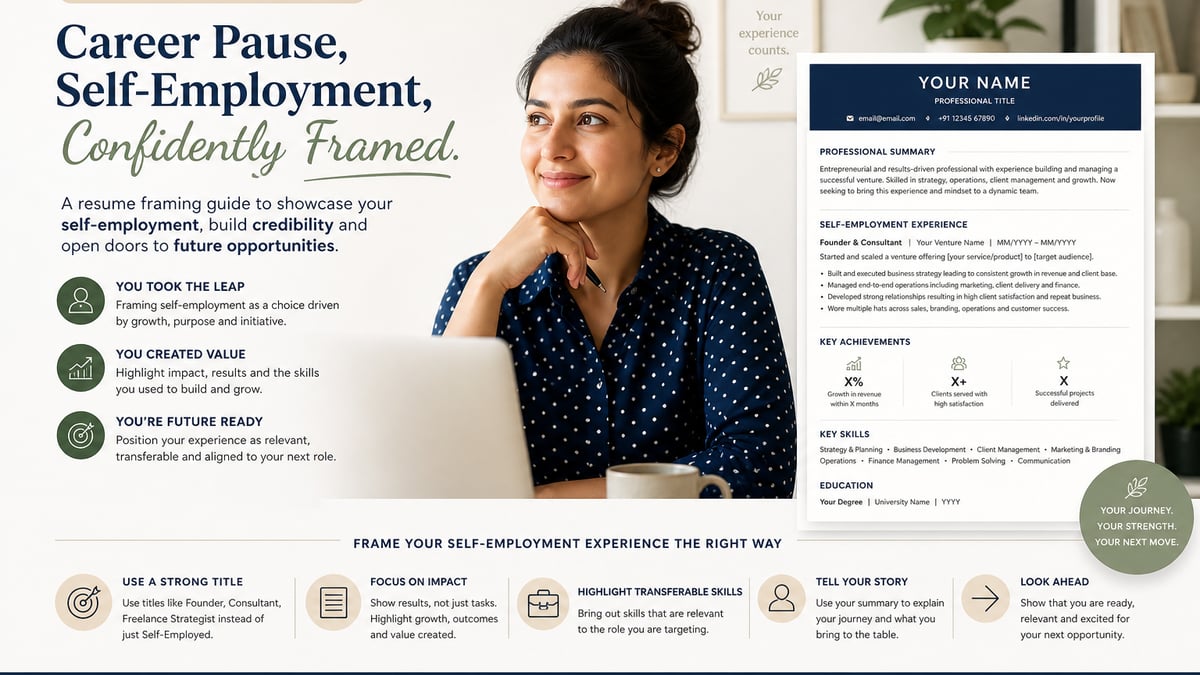
A career pause isn't a hole in your file. It's a row you haven't written yet. Self-employment, consulting between roles, family business work, and caregiving all count as real experience when you give them the same fields a W-2 job gets: employer line, searchable title, Month Year dates, and bullets that prove who paid you and what changed.
Recruiters aren't allergic to breaks. They're allergic to mystery. A line that says freelance with zero detail reads like unemployment with a nicer font. Before you rewrite bullets, check your resume for free against the posting so your self-employment titles and dates land in the right Workday rows.
You don't need a brand story on the resume. You need rows the parser can store and a recruiter can defend in a hiring-manager screen. This page is teardown format: weak lines next to strong ones for five common pause types, then what the weak versions share, then a block you can paste into Word tonight.
Job searching's already slow. You shouldn't lose weeks because Greenhouse stored Digital Wizard as your job title instead of Marketing Consultant. The pairs below fix that without inflating scope you can't back up in a follow-up call.
Quick Wins
- Put solo work in Experience with a market-standard title, not a brand nickname.
- Employer line: LLC name, DBA, or Self-Employed. Never leave it blank.
- Label caregiving in one line with dates. Don't hide the pause.
- Three bullets minimum: who you served, what you delivered, what changed.
What a career pause self employment resume must prove
Workday, Greenhouse, Lever, and iCIMS don't read your gap story. They read fields: Company, Title, Start Date, End Date, Description. A career pause self employment resume passes when every non-traditional stretch fills those fields with language a sourcer can search.
The bar is boring and specific. Independent Consultant beats Creative Ninja. March 2022 to Present beats 2022 to now. A bullet that names Looker, twelve clients, and a retained contract beats I did various projects for startups.
Judge every line against two tests. Parser test: select all, paste to Notepad, confirm employer and title appear on their own lines before bullets. Recruiter test: could someone repeat your scope back on a phone screen without asking you to define freelance?
Edge case: light side income during caregiving still belongs on the timeline. Label the caregiving line first, add a separate part-time consulting row if the work was real and paid. Edge case: family business with no formal title. Use Owner, Operations Manager, or the role you actually performed, not Son/Daughter helping out.
Revenue bands belong in bullets only when your own records support them and the role is sales or business development heavy. For most consulting and caregiving rows, client count, retention, or deliverable cadence proves more than a gross number a recruiter cannot verify on a first pass.
Summary clauses about wanting full-time work now belong in the summary, not buried in the last bullet. One sentence is enough. The Experience section still carries the proof. Hiring managers look for intent in the summary and scope in the bullets.
Read how recruiters interpret job titles when you're choosing between Founder and Product Manager for the same stretch. The searchable title wins even when the founder label feels more honest.
Read common resume parsing errors and how to fix them if your pause row parses under the wrong employer. Format fixes come before keyword tweaks on every file.
Before/after pairs for pauses, consulting, and solo work
Each pair fixes the same failure: vague label, missing employer field, or bullets with no client, tool, or outcome. Swap your dates and nouns. Keep the structure.
Independent marketing consultant
Before: Freelance, 2021 to present. Did social media and branding for various clients.
After: Freelance Marketing Consultant, Self-Employed, March 2021 to Present. Managed paid social for four e-commerce clients on Meta Ads Manager; rebuilt weekly reporting in Google Sheets adopted by two retainer accounts; grew one client's email list 18% during a six-month engagement.
Product designer between full-time roles
Before: Digital Studio LLC. UX work for SaaS companies.
After: Freelance Product Designer, Digital Studio LLC, January 2023 to August 2024. Delivered end-to-end UX for six B2B SaaS clients in Figma; shipped onboarding flows for one client that lifted trial-to-paid conversion during a ninety-day pilot; ran usability tests with eight participants per sprint.
Family caregiving pause
Before: Unexplained gap from June 2022 to March 2024 between two corporate roles.
After: Family Caregiving Leave, Personal Leave, June 2022 to March 2024. Full-time caregiver for an immediate family member; maintained Salesforce admin certification through Trailhead coursework during the pause.
Family business operator
Before: Helped parents with restaurant. 2019 to 2022.
After: General Manager, Rivera Family Restaurant, March 2019 to December 2022. Scheduled twenty-two staff across lunch and dinner shifts; cut food cost 4 points through vendor renegotiation and portion standards; handled payroll and health inspection prep.
IT consulting gap after a layoff
Before: Independent contractor. Various IT projects.
After: Independent IT Consultant, Self-Employed, November 2023 to July 2024. Migrated three mid-size clients from on-prem Exchange to Microsoft 365; documented runbooks for help desk handoff; completed two engagements on retainer with SLA response under four hours.
Returning to full-time after solo years
Before: Summary says creative problem solver. Experience ends with Entrepreneur at My Own Company.
After: Summary opens: Seeking a full-time Customer Success Manager role after four years of independent consulting. Experience lists Independent Customer Success Consultant, Self-Employed, with bullets on book size, tools, and churn outcomes, then prior W-2 roles below in reverse order.
Copy-paste skeleton (swap bracket lines):
Experience
[Market-Standard Title]
[LLC name, DBA, or Self-Employed]
[Month Year] to [Month Year or Present]
- [Who you served: industry, client count, or team size]
- [What you delivered: tool names, deliverable type, cadence]
- [What changed: metric inside the bullet, not a claim about callbacks]
Family Caregiving Leave
Personal Leave
June 2022 to March 2024
- Full-time caregiver for an immediate family member
- [Optional: certification, coursework, or volunteer scope maintained during pause]
[Prior W-2 Title]
[Employer Name]
[Month Year] to [Month Year]
- [Bullet with posting keyword and scope]
Operations analyst who consulted part-time
Before: Career break 2023. Also some consulting.
After: Two stacked rows: Family Caregiving Leave, Personal Leave, January to September 2023, one bullet. Then Independent Operations Consultant, Self-Employed, October 2023 to Present, bullets on SLA dashboards and client count. Both rows sit in Experience above the last W-2 role.
Corporate finance contractor
Before: Self-employed finance professional. Excel and reporting.
After: Independent Financial Analyst, Self-Employed, April 2022 to January 2024. Built thirteen-week cash models for two PE-backed portfolio companies; automated variance commentary in Excel for monthly board packs; closed one nine-month engagement with a written extension.
Registered nurse with per-diem shifts during a move
Before: Took time off to relocate. Picked up some per-diem shifts.
After: Per-Diem Registered Nurse, Mercy Ridge Staffing, September 2023 to February 2024, bullets on unit type, patient load, and charting in Epic. Relocation gap covered by labeled row, not a silent hole between hospitals.
What each pair fixes
Weak versions hide the employer field, use brand names instead of titles recruiters search, or skip dates entirely. Strong versions give Greenhouse a filterable title string and give a hiring manager three proof points without a backstory paragraph.
Edge case: unpaid startup prototype never launched belongs in Projects, not Experience, with prototype in the label. Edge case: one-off gig under ten hours total can stay off the resume unless it names a tool the posting requires.
When a posting asks for employment history covering seven or ten years, labeled pauses satisfy the timeline question better than functional layouts that bury dates. Chronological order with honest labels beats clever rearrangement every time in US corporate screens.
Month Year dates matter on pause rows the same way they matter on W-2 jobs. March 2022 to Present and March 2022 to Now are not interchangeable in every parser. Spell Present. Keep the same date style on every row so tenure math does not show zero months on a consulting stretch you ran for two years.
If you ran a DBA and a separate LLC for different client types, pick one employer line per period or split into two Experience rows with clear date ranges. Stacking two entities on one line without dates confuses both humans and upload previews.
What thin pause and self-employment entries share
Creative titles with no market match. Chief Vision Officer and Brand Alchemist do not map to filters for Product Manager or Marketing Manager. Pair the creative brand in a bullet if you must. Put the searchable title in the title field.
Empty employer lines. Some applicants leave Company blank on self-employed rows. The parser attaches bullets to the wrong job or drops the row. Self-Employed, your LLC, or your DBA is enough.
Gap hiding instead of labeling. Stretching end dates on the job before or after the pause fails background checks and reference calls. A one-line caregiving entry ends the guessing.
Bullets with no nouns. Managed projects and worked with stakeholders could mean anything. Name the CRM, the client industry, the team size, or the deliverable.
Inflated entrepreneur language. Serial founder of multiple ventures without revenue, users, or shipped product reads worse than honest consulting bullets. Scope you can defend on a screen call only.
Segregating solo work below Experience. A Freelance Projects section under Education tells the parser and the recruiter you rank that work lower. Same section, same bullet rules.
Functional resume pivots. Skills-first layouts often scramble dates. Read chronological vs functional resume tradeoffs before you restructure the whole file to hide one gap.
Summary-only explanations. A paragraph about your career journey does not fix missing Experience rows. Put the pause or solo stretch where parsers expect jobs.
Mismatched LinkedIn and resume titles. If LinkedIn still says Founder while the resume says Independent Product Manager for the same dates, recruiters notice. Align the searchable title across both before you batch apply.
Overlong gap explanations in bullets. Three lines of family context in a bullet push scope proof below the fold. One labeled title row plus one optional maintenance bullet is enough.
This will not fix applying to roles you're not qualified for. It stops a qualified candidate from looking unemployed when they were running a real consulting book or caring for family full time.
Test titles and dates before you apply
Run the repaired file through the free ATS resume checker with the job description attached. Confirm your self-employment title string and Month Year dates land before you spend twenty minutes on work-history forms.
Use job match score on the posting to see which three tools or skills belong in your top self-employment bullet. Solo work still needs posting keywords in sentences, not a comma list at the bottom.
If you're rebuilding from a thin freelance line, generate a cover letter that states full-time intent in paragraph one while the resume carries proof bullets. Same contact header on both files so Greenhouse does not merge duplicate profiles.
Re-upload on a test req before you burn a referral. Referrals do not bypass a title field that stored Entrepreneur when the req says Senior Analyst. Fix the row, then apply.
Save exports with a date suffix after you reframe a pause: Lastname_Role_2026-09.docx and the matching PDF. You will not accidentally attach the old version that still shows a blank gap when a coordinator asks for a clean copy.
Track which version you sent in the same spreadsheet as application status. Company, req title, resume file name, date submitted. When silence hits, you will know whether to tweak framing or shift req level instead of rewriting the whole file again.
Tonight's framing order
A career pause self employment resume wins when every non-W-2 stretch looks like a job row, not a confession. Pick market-standard titles. Fill the employer field. Write three bullets with client type, tools, and outcomes.
Label caregiving honestly. Stack part-time consulting as its own row when the work was paid. Add one summary clause if you want full-time employment now. Run the paste test, then upload to one test application and read the preview.
I've screened stacks of these in Workday and Greenhouse, and the file that survives is specific about scope even when the employer name is Self-Employed. Mystery gaps lose to boring rows every time.
Keep one master DOCX and export PDF from it. When you add a client bullet tonight, both files stay aligned. Parsing first. Title match second. Volume third.
Read more
Frequently asked questions
Under Experience, formatted like any W-2 role: employer or DBA line, market-standard title, Month Year dates, and three to five bullets with scope and outcomes. A separate Projects or Freelance section below Experience signals second-class work. Workday and Greenhouse map the Experience block to searchable employer and title fields recruiters filter on.
One honest line in Experience: Family Caregiving Leave as the title, Personal Leave or Self-Employed as the employer line if you need a company field, and accurate Month Year dates. No medical detail required. A labeled pause reads cleaner than a blank gap that forces a recruiter to guess what happened between two jobs.
Name the industry and outcome, not the logo: Built onboarding flows for a mid-market fintech app; cut time-to-first-value during a three-month engagement. Recruiters care about tools, scope, and result. They do not need the client name on a first screen when confidentiality applies.
Not on the resume. Save the why for a cover letter or interview answer where you control tone. On the file, show what you did, who paid you, and what changed. Add one summary clause if you want full-time work now: Seeking a full-time product role after four years of independent consulting.
It hides the pause from humans and often breaks parsing. US corporate ATS flows expect reverse-chronological Experience rows with employer, title, and dates. A skills-first layout can drop timeline logic or stack roles out of order. Label the pause or frame the solo work instead of rearranging the whole file.