7 min read
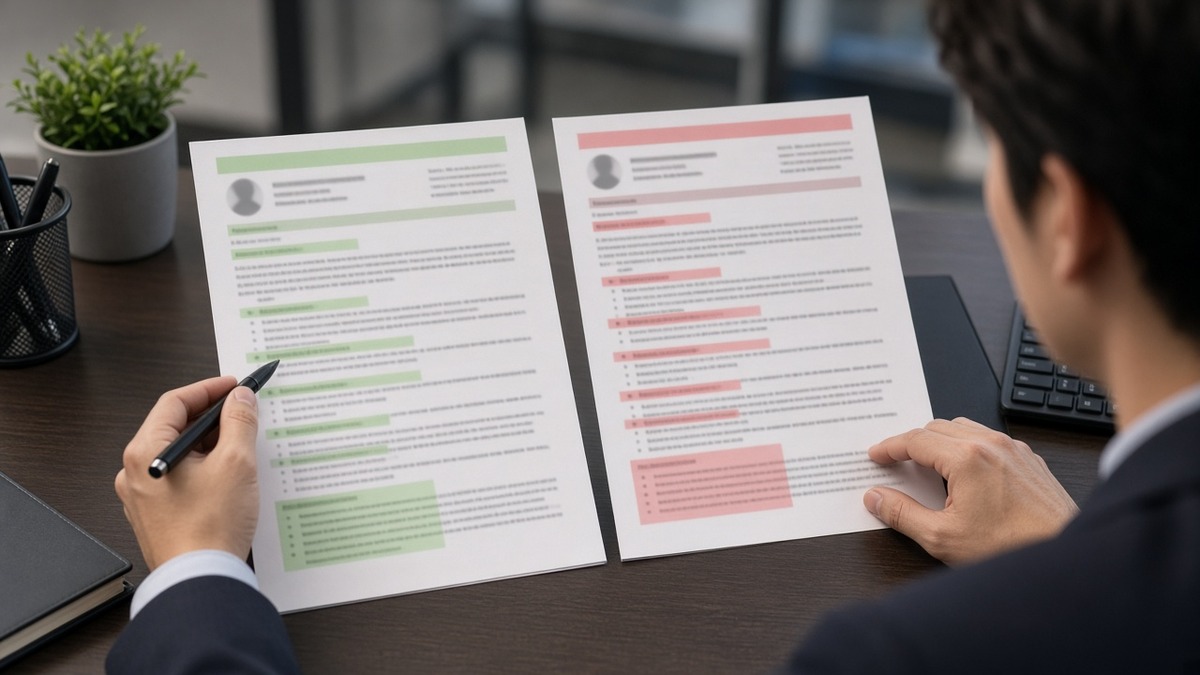
You and a coworker share the same title band, similar tools, and comparable project stories. You both applied to the same corporate req on the same afternoon. They got a screen invite by Friday. You didn't. The files look alike in Word. That gap feels like luck until you open both PDFs as plain text.
Check your resume for free against that posting before you rewrite everything. You'll see whether your bullet one still carries old keywords while theirs mirrors the req language in the first eight words.
Below you'll compare file signals against queue factors to learn why two similar resumes get different results, read a side-by-side table of what parsers weight, get before-and-after pairs from real twin-file patterns, and use a decision rule to tell tailoring gaps from timing you cannot control.
Four signals that split two similar resumes
Parsers do not see design. They see order. Two PDFs can look identical on screen while one exports Skills above Experience and the other keeps job title, company, and bullet one together. Workday, Greenhouse, and Taleo all score from that text stream, not your margins.
Recruiters skim the same weighted lines. Headline, current employer, bullet one. If your coworker's bullet one opens with the posting's core verb and yours opens with a generic duty, their file reads as a fit in six seconds. Yours reads as adjacent experience that needs digging. Digging does not happen in a full queue.
Timing and referral flags matter, but they ride on top of file signals. A referred candidate with a messy parse still gets a human look eventually. A non-referred candidate with clean parse order and posting language in bullet one competes on the document. When both files are plain and neither had a referral, the gap is almost always keyword placement in weighted sections, not a lottery.
For how sorting works after upload, read how ATS systems rank candidates internally . For silence that is not your formatting, see why recruiters never see most applications .
Why two similar resumes get different results: file match vs pipeline luck
| Factor | File you control | Pipeline you partly control | How to tell which won |
|---|---|---|---|
| Bullet one keywords | Rewrite first bullet to mirror posting verbs | No effect if text never reaches a human | Highlight posting terms; count matches in bullet one |
| Parse order | Single column, standard headers, no text boxes | Knockout filters may still drop you | Paste PDF into Notepad; check title before Skills |
| Apply timing | Same file early vs late can rank differently | Req may close or filter tightens after volume spikes | If file passes paste test, retry early on the next open req |
| Referral or internal flag | Cannot fabricate; document still must parse | Referral often bypasses first-pass sort | Ask directly; do not assume luck if they had a warm intro |
| Knockout questions | Honest answers only; resume cannot fix a hard no | Work authorization, clearance, or years gates auto-drop | Compare your portal answers to theirs if outcomes diverged |
When the file difference is real tailoring
Master resumes feel efficient. They also send the same bullet one to every posting. Your coworker may have spent twelve minutes swapping the opening line under their current role while you uploaded unchanged text. On screen the files match. In the parser, theirs maps to the req and yours still maps to your old function.
Before: Bullet one: "Supported cross-functional teams on monthly reporting and stakeholder updates." Posting asks for product launch coordination.
After: Bullet one: "Coordinated product launch timelines across engineering and marketing, shipping three releases on schedule with stakeholder sign-off at each gate." Same person. Posting language in the line parsers weight most.
When the gap looks like luck but is still readable
Apply order matters when recruiters sort by date received and stop at fifty rows. An identical file submitted Tuesday morning can sit above the same file submitted Thursday night. That feels random. It is queue math. Fix the file first, then watch posting age and apply inside the first few days when you can.
Before: You applied day five with a generic bullet one and no referral.
After: Same scope, but you apply day two with bullet one rewritten and a clean single-column PDF. You still might not hear back if knockouts or volume block you. You removed the document excuse.
Copy-paste twin-file audit
Copy-paste audit (Y/N each)
Twin resume check:
[ ] Paste test: contact → summary → current job title → bullet one (in order)
[ ] Bullet one first eight words include a verb from the posting
[ ] Skills line lists three must-have tools from the req, not a sidebar dump
[ ] Month Year dates on every role; no tables or text boxes
[ ] Same PDF you upload is the one you pasted (not an older export)
[ ] Portal knockout answers match what your resume claims
[ ] You know whether the other candidate had a referral (ask before you call it luck)
Decision rule: fix the file, then judge the queue
Run the audit above. If any parse-order line fails, rebuild layout before you reapply. If bullet one lacks two of the posting's top three terms, rewrite it tonight. If both pass and you had no referral while they did, the split was pipeline, not proof. If both pass, neither had a referral, and you applied late on a high-volume req, timing may explain it. Do not call it luck until the file checks clean.
I've screened pairs like this in Lever and Workday where the callback went to the file whose bullet one named the req stack in the first line, even when years of experience matched on paper.
For parsing vs scoring gaps, read why your resume passes parsing but still gets rejected .
Parser traps that make twin files look identical
Two-column exports. Your coworker's plain DOCX keeps Experience intact. Your Canva PDF dumps Skills above the job title. Same content, different parser story. Rebuild yours in one column before you compare outcomes.
Skills repeated only in a sidebar. If their keywords sit inside Experience bullets and yours live in a graphic rail the parser drops, you lose matches on the weighted block. Move tools into bullet one and a comma Skills line.
Summary-only tailoring. Changing the summary while bullet one still describes your old function creates a split file humans distrust and parsers under-score. Match the top third or skip the summary edit.
Assuming luck before a paste test. Job searching is hard enough without guessing. Ten minutes of plain-text paste beats a week of resentment toward a coworker who may have simply rewritten bullet one.
Score your file against the req before you reapply
Upload the PDF you plan to send, not a Word draft you will export later.
Run a free ATS check with the posting pasted in. Confirm must-have terms sit inside Experience, especially bullet one, not only in a summary you wrote at midnight.
Score your job match on the same req to see whether gaps are document fixable or hard knockouts you shouldn't spend another hour chasing.
If a referral gap or timing issue needs context, use the cover letter generator after bullet one is accurate so you're not repeating Skills the parser already scored.
Run the decision rule tonight
Similar backgrounds do not guarantee similar outcomes. Parsers read order and weight recent bullets. Coworkers who get screens often changed bullet one, not their entire career story.
- Paste-test parse order before you blame the queue.
- Mirror posting verbs in bullet one under your current role.
- Separate referral and timing from document gaps you can fix.
Open the posting, run the twin-file audit from the table section, and run the free resume check on the file you will actually upload. That is how you learn whether you lost on tailoring or on factors you cannot see.
Read more
Frequently asked questions
Same PDF, same day, different outcomes can still happen when referral flags, knockout questions, or apply order differ. When the files truly match and neither had a referral, look at parse order and bullet-one keywords against the posting. One file often looks identical on screen but exports text in a different sequence.
Run a file check before you blame luck. Paste your PDF into Notepad. If Skills jump above your current job title, or bullet one lacks the posting's top three terms, the document lost before a human opened the queue. If parse order is clean and keywords sit in Experience, silence may be volume, timing, or a knockout you cannot see.
Tailoring the top third beats sending a master file when both candidates have similar years of experience. Headline, bullet one under the current role, and a Skills line pulled from the posting change what parsers score in weighted sections. A coworker's callback often traces to those three edits, not a secret algorithm.
Early applies can land before a recruiter sets a tighter filter or closes the req. It is not magic. A late apply with a stronger bullet-one match can still beat an early generic file. Treat timing as a tiebreaker after your parse test and posting alignment pass.