11 min read
Resume order matters more than keywords because ATS parsers and recruiters read top-to-bottom. A keyword-stuffed Skills block above thin recent Experience loses to a file with fewer keywords but your current role and metrics on the first screen. That's the answer. The rest covers why order beats density, when Skills still belongs up front, and what to reorder before you upload again.
You're not being told to drop keywords. You're being told where they need to sit so Workday and Greenhouse previews show proof before a comma list. If you've been stuffing Skills because a blog said ATS loves density, that's the habit to break first. Before you move another section, check your resume for free and read which blocks landed above the fold.
Job searching is draining. You don't need another myth about stuffing forty tools into a footer. You need your current title and strongest bullet visible before a recruiter scrolls or closes the preview pane.
When the posting asks for a letter, generate a cover letter that names the same employer and title sitting at the top of Experience. Don't hide the role they're hiring for under a Skills wall.
Quick Wins
- Move Experience directly under a short Summary.
- Put Skills after Education unless you're a new grad.
- Lead the current job with one metric bullet, not duties.
- Paste the export into Notepad and read top to bottom.
Why resume order matters more than keywords in ATS previews
ATS software segments your file into buckets: contact, summary, experience, education, skills. The segmenter reads in document order. What appears first gets attached to the fields recruiters filter on first.
Keywords without order look like noise. Order with proof looks like a match. A Skills block with thirty tools tells a parser you know names. It does not tell a recruiter you used SQL on a live pipeline last quarter. That proof lives in Experience bullets with Month Year dates.
Workday previews often show the first screen of parsed content before a recruiter opens the full file. When Skills fills that screen, your current employer drops below the fold. The req asked for five years in the title on the posting. They never see the title line.
Greenhouse and Lever behave similarly. Sidebars and footers import last or into misc fields. Keywords parked in a footer repeat weakly in search. The same word in the first bullet under your current job hits harder because it carries employer context.
Humans mirror the parser path. A hiring manager with forty files open scans name, current title, first bullet, then maybe Skills. They do not read a forty-line tool list before they know what you do now.
Two-column templates make order worse. Skills in a left rail often imports before Experience or merges into contact. Single-column boring order beats a designed layout that shuffles sections on upload.
Keyword density advice ignores this sequence. Stuffing synonyms into Skills does not move your 2024 role higher in the preview. Reordering does. And when headings are wrong, order breaks twice. Read how resume headings affect ranking if your sections import into unlabeled buckets.
Weak bullets make order matter more. A strong first bullet under the right employer saves a file even with a shorter Skills list. Read why weak bullet points get ignored when the top role reads Responsible for weekly reports.
Edge case: career changers sometimes need a three-line Summary up top that names the target function before Experience. That is still order logic. You're choosing what the first human sentence proves.
Edge case: federal USAJOBS resumes follow their own section sequence. Private-sector order rules do not transfer. Use the template the series requires even when it feels redundant.
Summary blocks create a second order problem. A long narrative before Experience pushes your current title down even when Skills sits in the right place. Keep Summary under six lines so the first employer name still appears on screen one.
Contract-heavy timelines need order inside Experience, not extra headings. List each client in reverse chronological order with Contract in the title line. Do not insert a Projects section between Summary and Experience that shuffles dates.
Most files fail the first screen, not the keyword tally. The parser captured your tools. The recruiter never scrolled to the job that used them.
Reorder your file before the next upload
Open your master resume and list every section in the order it appears today. Anything that pushes Experience below Skills, Education, or a long summary gets moved tonight.
Put contact and a short Summary first
Before: Name, then a half-page Professional Narrative, then Technical Toolbox with forty tools, then Experience starting on page two.
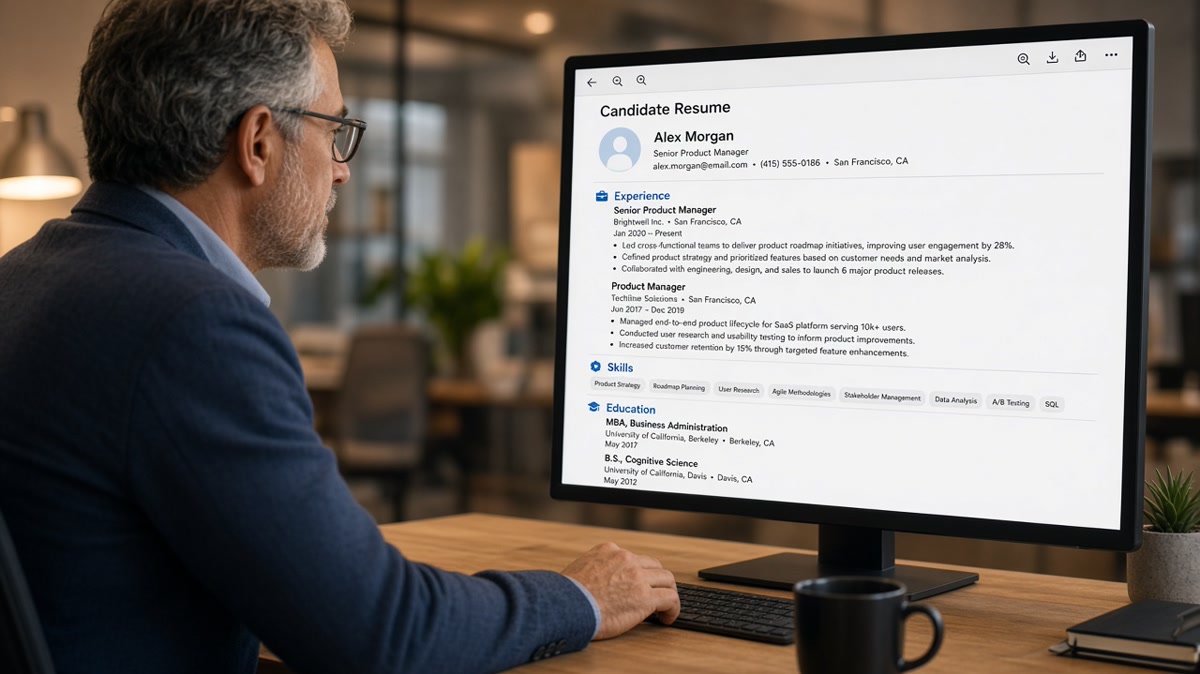
After: Name and contact on line one, three-line Summary, Experience with current role and metric bullet on screen one, Skills after Education.
Lead Experience with the role that matches the posting
Reverse chronological order inside Experience. The job you're applying for should mirror the top block. Rewrite the first bullet so a must-have skill from the req lands in the first eight words with a number attached.
Before: Operations Coordinator, 2022 to Present, first bullet: Managed daily office tasks and supported team projects.
After: Operations Coordinator, 2022 to Present, first bullet: Built weekly capacity dashboards in Looker, cutting reactive tickets 11% in Q3.
Collapse duplicate skill sections into one block after Education
Before: Core Competencies in a sidebar, Technical Skills in a footer, and Skills repeated in the summary.
After: One Skills section after Education with comma-separated tools. Repeat must-haves once in a dated bullet under the current job.
Run the plain-text paste test
Export PDF or DOCX. Copy all text into Notepad. Read top to bottom as a stranger would. Experience should appear before Skills. Your current employer name should show before the third heading. If order scrambles, flatten tables and text boxes.
Copy-paste block: screen-one section order
[Name]
[City, ST] | [phone] | [email]

Professional Summary
[Three lines: target title, years, domain, one outcome]

Experience
[Current Employer], [City]
[Job Title] | [Month Year] to Present
• [Metric bullet with posting keyword in first eight words]
• [Second bullet tied to req]

[Prior Employer]
[Title] | [Month Year] to [Month Year]
• [Bullet]

Education
[Degree], [School], [Year]

Skills
[Tool], [Tool], [Method], [Certification]
Trim Skills to what the posting actually asks for
A shorter Skills list after strong Experience beats a long list above thin roles. Keep eight to twelve tools that match the req. Drop the rest or move proof into bullets. For how many terms to target overall, see how many keywords a resume should have in 2026 .
Re-export single-column PDF or DOCX
Save a fresh export after reordering. Do not resend an old PDF with hidden layers from a design tool. Word and Google Docs produce the cleanest section sequence for most corporate uploads.
Check the file on your phone after export. If you must pinch to zoom before you see an employer name, order still needs work. Screen one on a laptop should show name, title, and at least one metric without scrolling.
Before: Canva template with Skills in a colored left column above a one-line current job.
After: Google Doc, 11-point Calibri, Experience on the main column with two metric bullets visible without scrolling on a laptop screen.
When Skills still belongs up front
Order rules have exceptions. These are narrow. Do not use them to keep a keyword wall above empty Experience.
New grads and current students. When internships and projects are thin, Education and relevant coursework can follow Summary before a short Experience block. Skills still works better after Education than before any dated role.
Skill-heavy contract roles with identical titles. A data engineer with six short contracts might list core stack in Skills right after Summary, then group contracts under Experience. Even then, the first Experience bullet should carry a metric.
Certification-driven fields. Nurses, cloud architects, and safety roles sometimes need Certifications immediately after Summary when the posting filters on active credentials. Keep Experience next. Do not bury ten years of bedside work under cert lines.
Before: Ten-year analyst with Skills and Summary filling page one, current employer on page two.
After: Three-line Summary, current analyst role with two metric bullets on page one, Skills trimmed to eight tools after Education.
Mistake: moving keywords to a footer to save space up top. Footer text parses last and filters weakly. Put must-have tools in Skills after Experience and prove them in the first bullet.
Mistake: stacking micro-sections between Summary and Experience. Awards, hobbies, and volunteer blocks push work history down. Merge relevant volunteer lines into Experience with dates.
Mistake: assuming ATS scores keyword count like a word cloud. Recruiters do not hire word clouds. They hire people whose current job reads like the posting.
Mistake: keeping volunteer work in a separate section above paid Experience when the posting values community leadership. Date relevant volunteer roles under Experience so tenure and order stay intact.
I've screened files where the Skills block was longer than the Experience section. Keyword search found the tools. The preview never showed who paid the candidate last month.
This won't fix applying without the years the posting requires. It stops qualified files from hiding their current role behind a tool list the recruiter never reads.
Confirm order in the preview before Submit
After you reorder sections, upload the single-column PDF or DOCX with the job description to HireFlow's free ATS resume checker and confirm Experience appears before Skills with your current employer still attached to dates.
Then run score your job match on the same pair. You're checking whether keywords now sit under dated roles, not only in a block above thin history.
Do this now: Reorder sections, paste into Notepad, fix sequence, upload once, read the preview before Submit.
What to do now
Resume order matters more than keywords when your current role and metrics need to land on screen one. Move Experience up, trim the Skills wall, and prove must-have tools in dated bullets instead of comma lists alone.
- List every section in today's file order.
- Move Experience directly under a short Summary.
- Rewrite the first bullet under your current job with a metric.
- Place Skills after Education unless you're a new grad.
- Paste into Notepad and upload once with the req attached.
Open the posting you're targeting tonight. Run a free ATS check , confirm your employer shows before Skills, and send one file that leads with proof instead of a keyword pile.
Read more
Frequently asked questions
Often yes for experienced hires. Parsers still capture Skills text, but recruiters and preview panes weight the first screen toward Experience. A long Skills block pushes dated roles and thin bullets below the fold. Put must-have tools in Skills after Experience unless you are a new grad with little work history.
Contact, a short Summary, Experience, Education, then Skills works for most US corporate uploads. Certifications follow Skills when relevant. Reverse chronological order inside Experience. Each heading on its own line in a single column.
No for the first human screen. Keyword lists without dated proof in Experience may pass a loose filter and still lose in preview. Recruiters search Experience first. A file with fewer total keywords but a strong current bullet on line one usually wins the six-second scan.
Export PDF or DOCX, copy all text into Notepad, and read top to bottom. Experience should precede Education and Skills. Upload to HireFlow's checker with the posting and confirm the preview shows your current employer before the Skills block.
Recent grads with limited work history, current students, and some research roles where degree and projects carry more weight than one internship. Everyone else should lead with Experience so tenure and title filters work.