13 min read
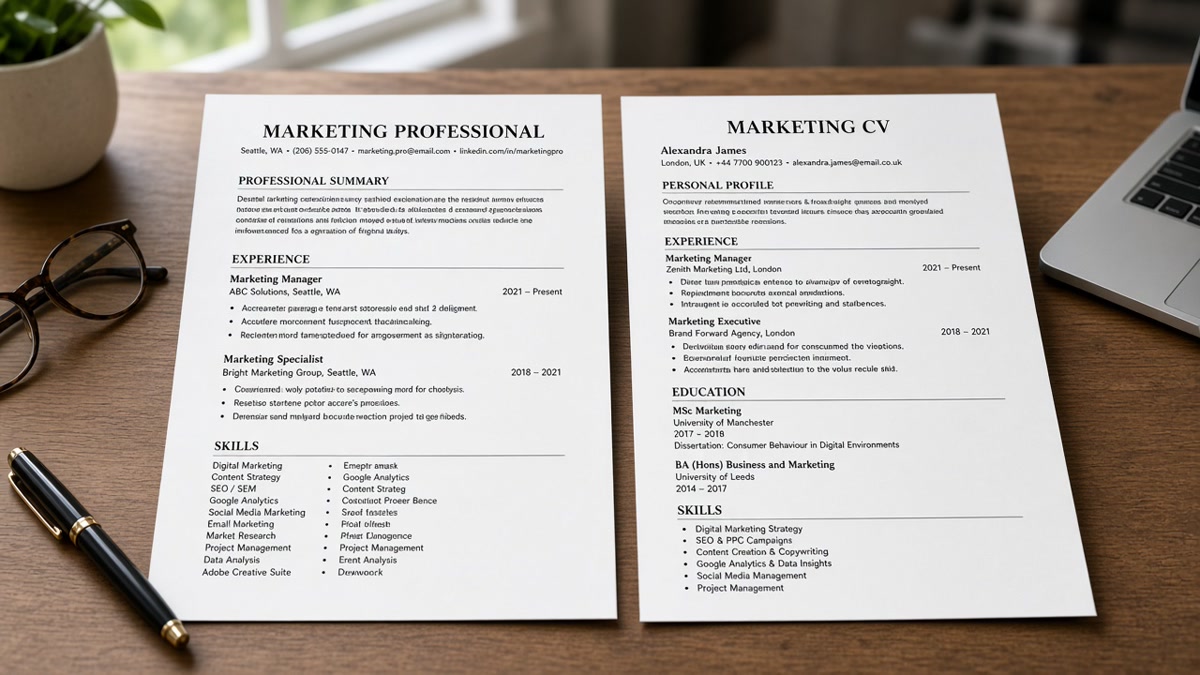
If you're applying to a US marketing employer, don't ship your UK CV shell. Use Summary first, Experience before Education, one tight page, no photo, and Month Year dates inline with each title. If you're applying in the UK, don't compress to a US one-pager. Use a Profile block, spelled-out dates, and two pages when your agency roster needs room. Same campaigns. Different shell. You'll export both from one Word master so metrics stay consistent.
You're not confused because marketing is hard. You're confused because the file that passed Greenhouse in Austin scrambled in Workday when a London brand imported your US sidebar. Before you rewrite bullets again, check your resume for free with the posting pasted in. The checker shows whether your channel tools still read in order after export. If you're applying in the UK tomorrow, you'll want the same pass on the CV shell before you touch the Profile paragraph.
Job hunting across markets is draining. You don't need a lecture on personal branding. You need to know which headings recruiters search in each country and which layout choices make HubSpot vanish from the preview. I've screened marketing files on both sides of the Atlantic, and the split is rarely talent. It's file shape. Candidates who've run solid campaigns still get silence when the US summary lands where a UK Profile was expected.
This page covers the layout decisions that differ, the exceptions when a UK employer wants a short file, and a copy-paste skeleton for each market. Tailor keywords after the shell is right. A scrambled import makes every bullet rewrite pointless. We'll walk through four before-and-after pairs so you can see how the same marketer looks on paper in each market.
You won't need a new design tool tonight. You'll need Word, a duplicate file, and ten quiet minutes. That's enough to stop sending the wrong country's shell to the right job.
Quick Wins
- US: Summary, Experience, Education, Skills. One page when honest.
- UK: Profile, Experience with Month Year lines. Two pages when needed.
- No photos, no skill sidebars, no icon fonts in either market.
- Spell channel tools beside the job that used them.
Why US and UK marketing files fail for different reasons
ATS on both sides reads your upload into fields: employer, title, dates, education, skills, bullet text. US recruiters skim fast. They expect a tight resume where the first bullet under your current role proves channel fit in eight words. UK hiring teams often read a CV with more context: agency clients, campaign types, and a Profile that frames seniority before they scroll to metrics.
The parser penalty is the same; the human expectation is not. A two-page UK CV with clean Month Year lines imports fine in Workday. A US one-pager with a right-column skill rail fails in Austin and in Manchester because the sidebar reads last or never.
Mid-level marketing sits in the awkward middle. You're past coordinator bullet fluff but not yet a one-line executive summary. You have three to six years of channel proof. US employers want density. UK employers want narrative plus metrics. Send the wrong shape and you look junior or scattered even when your ROAS numbers are solid.
Terminology trips people up. Americans say resume. Brits say CV. Many UK portals still label the upload Resume while expecting CV norms. Read the careers site examples before you pick a template. If every sample shows a Profile paragraph, you're not going to win with a US Objective line and half a page of white space.
Personal data is the other split. UK CVs historically carried address lines and sometimes nationality. US resumes drop street address and date of birth to reduce bias. Modern UK practice is moving the same direction, but you'll still see address on older templates. Strip sensitive fields for both markets unless a local recruiter explicitly asks.
Education order differs too. US resumes bury degrees under Experience once you've been working a few years. UK CVs sometimes keep Education higher when your degree is marketing-related or when you're within five years of graduation. That does not mean paste your A-Level essay. It means a plain Education block with degree, school, and year when it helps.
For how parsers match language after layout is clean, see how ATS matches resumes to job descriptions . Shell first. Keywords second.
US vs UK CV formatting for mid-level marketing: build both shells
Start from one Word master with every role, metric, and tool. Duplicate the file. Rename one US-Marketing-Resume and one UK-Marketing-CV. Never maintain two different career stories. Maintain two reading orders.
US digital marketing manager targeting SaaS
Posting wants lifecycle email, HubSpot, and ABM for a Series B firm on Greenhouse in Denver.
Before: UK CV with Profile, Education before Experience, and HubSpot icons in a right rail. Two pages with full address and references line.
After: One-page US resume. Professional Summary: Lifecycle marketing manager with five years in B2B SaaS; HubSpot nurture and ABM across 40k contacts. Experience: Lifecycle Marketing Manager, CloudPath Inc, Denver CO, January 2022 to Present. Owned HubSpot workflows for 28k MQLs; lifted email-to-demo rate from 2.1% to 3.4% in FY 2024. Marketing Specialist, CloudPath Inc, June 2019 to December 2021. Built first ABM pilot on 120 target accounts. Education: BA Marketing, University of Colorado, 2019. Skills: HubSpot, Salesforce, GA4, Marketo.
UK performance marketing executive targeting retail
Posting lists Google Ads, budget ownership, and conversion work for a Leeds retailer on Workday.
Before: US one-pager with Summary only, no city line, and Google Ads mentioned once in Skills with no date anchor.
After: Two-page UK CV. Profile: Performance marketing specialist with six years in retail and D2C; Google Ads, Shopping, and GA4 reporting. Experience: Homestyle Co, Leeds. Performance Marketing Specialist, July 2023 to Present. Managed £180k quarterly Google Ads budget; held ROAS at 4.2x through 2024 promo peaks. Performance Marketing Specialist via RedKite Agency, October 2021 to June 2023. Ran Shopping campaigns for two retail accounts; cut wasted spend 11% after search term audit. Education: BA Business Management, University of Leeds, 2018.
US content marketing lead with agency background
Posting wants SEO content, CMS ownership, and stakeholder management in Chicago.
Before: UK-style Personal Statement with four lines of narrative and WordPress buried in a tag cloud.
After: Professional Summary: Content marketing lead with agency and in-house experience; SEO, WordPress, and editorial calendar ownership. Experience: Northline Health, Chicago IL, April 2022 to Present. Ran WordPress blog cadence of eight posts monthly; grew organic sessions 22% in 2024 after technical SEO cleanup. Content Marketing Consultant, freelance, January 2020 to March 2022. Delivered SEO briefs for four B2B clients; average engagement nine months per client. Skills listed only if tools are not already in bullets.
UK CRM marketing manager after agency move
Posting wants HubSpot, lifecycle email, and stakeholder management in Reading.
Before: US resume compressed to one page by deleting agency client names and merging two titles under one date range.
After: CRM Marketing Manager, CloudLedger Ltd, Reading, January 2023 to Present. Owned HubSpot nurture flows for 28k MQLs; lifted email-to-demo rate from 2.1% to 3.4% in FY 2024. Digital Marketing Executive, CloudLedger Ltd, September 2021 to December 2022. Migrated legacy lists into HubSpot; launched ABM pilot on 120 target accounts. Profile stays under four lines. Month Year on every line.
Contact block and section headers
US contact: Name, city and state, phone, email, LinkedIn URL on plain lines. Skip street address unless the posting is local and asks for it. UK contact: Name, city, phone, email, LinkedIn. Add portfolio URL as plain text if case studies matter: Portfolio: yoursite.com/work. Use Experience, Education, Skills on both files. US adds Professional Summary. UK adds Profile or Personal Profile.
File format: text-selectable PDF or DOCX from Word. Canva exports fail both markets when tables hide dates. Export US version first when the portal caps page count. Export UK version when the employer shows two-page samples on the careers site.
Copy-paste block: dual-market marketing file checklist
MASTER (Word, single column)
[ ] Every role: Title · Company · City · Month Year to Month Year
[ ] Each bullet: channel + action + metric on one line
[ ] Tools spelled in the bullet where you used them

US SHELL
[ ] Professional Summary (3 lines max)
[ ] Experience before Education
[ ] One page if honest; two only with 8+ years
[ ] No photo, no references line

UK SHELL
[ ] Profile (4 lines max, one posting keyword)
[ ] Month Year dates spelled out
[ ] Two pages when agency roster needs room
[ ] Education block when degree is recent or relevant

BOTH
[ ] Paste test in Notepad: current job reads first
[ ] Portal preview before Submit
When you're unsure which shell to send, open the employer's career page and download their sample if they offer one. If every listed employee CV shows a Profile, send the UK shell even when the button says Upload Resume. US tech employers with London hubs sometimes post both styles depending on which entity owns the payroll. The legal employer name in the footer is your tiebreaker.
Skills sections behave the same in both shells: plain text, no icons, no proficiency bars. If a tool appears in three bullets, you can skip repeating it in Skills unless the posting repeats the word in requirements. US recruiters scan Skills in two seconds. UK recruiters often read Profile first and only hit Skills when the posting is tool-heavy.
Length is not a moral test. A honest two-page UK CV beats a one-page US resume stuffed with six-point font. A honest one-page US resume beats a two-page UK CV padded with mission statements. Mid-level marketers usually have enough campaign proof to fill one US page or two UK pages without inventing adjectives.
For file-type questions after you pick a shell, read PDF vs Word resume for ATS . The same rules apply to UK CV uploads even when the label says resume.
When the usual US or UK rules bend
Exceptions matter because marketing culture rewards standing out. Some bends are fine. Others break parsers in both countries.
US employer with UK HQ. A US subsidiary may still want a one-page resume even if the parent brand is British. Check the legal entity on the posting. If the role sits in London, use the UK shell. If it sits in New York with a US payroll, use the US shell.
UK creative agency that asks for a portfolio PDF. Send the plain CV for the ATS upload and attach the visual portfolio separately when the portal allows. Do not embed large image blocks inside the CV file. Recruiters search text, not JPEG grids.
Remote role listed in USD but hiring globally. Default to the employer's registered country for shell choice. If the posting is silent, use the US shell when bullet density is the norm in their sample jobs and the UK shell when Profile paragraphs dominate.
Contract and freelance marketing blocks. Label honestly in both markets. US: Marketing Consultant, freelance, with Month Year dates. UK: Freelance Content Strategist with client types in bullets when NDAs allow. Hidden agency months look like unemployment when the preview strips employer names.
Creative job titles. Growth Lead or Brand Storyteller may be your internal string. Mirror the posting once: Digital Marketing Manager (Growth Lead). Parsers and recruiters both need a recognisable title line.
References available upon request. Drop it in both markets. It eats lines without adding search terms. US recruiters never needed it. UK recruiters ask later if they want names.
This will not fix applying to roles where you lack must-have channel experience. It stops a qualified marketer from looking mismatched because the US summary landed where a UK Profile was expected.
Check your shell before the next upload
Run layout before you chase keyword density. A clean file that misses one required tool still loses. Order matters.
Upload your export and the posting to HireFlow's free ATS resume checker . Confirm Experience still carries distinct Month Year ranges and channel tools sit in readable lines, not a sidebar.
When the role is a stretch but your campaigns are strong, score your job match after the shell pass. Parsing fixes visibility. They do not invent skills the posting lists in bullet one.
If the portal has a cover letter field, draft one with the cover letter generator using the same job description. Repeat employer names and date strings exactly as they appear in Experience so nothing contradicts the parsed file.
Do this now: Duplicate your master, build US and UK shells, paste test both in Notepad, run the checker on the market you're applying to tonight, then submit once.
Pick your shell tonight
US vs UK CV formatting for mid-level marketing is not about memorising etiquette blogs. It's about matching section order and date lines to the employer's market so Workday and Greenhouse import your campaigns before a human reads bullet one.
- One Word master, two exports: US resume shell and UK CV shell.
- Month Year dates on plain lines in both files.
- Channel tools beside the job that used them, not in a sidebar.
- Paste test and portal preview before Submit.
Open the posting you want most. Run a free ATS check on the correct shell, confirm the importer shows your latest title and tools, and send one clean upload.
If you're applying in both markets this week, build both shells once and stop rewriting from scratch each time. Same metrics, different reading order. That's the whole game.
Read more
Frequently asked questions
Only when the posting or recruiter asks for a US-style resume. Most UK mid-level marketing roles expect a CV with a Profile block, Month Year dates on plain lines, and room for two pages when campaigns need context. A compressed US one-pager often drops early agency work recruiters use to judge channel depth. Match the employer's market, not your passport.
No. Photos add parsing risk and bias concerns on both sides of the Atlantic. UK CVs still sometimes carry headshots in creative sectors, but Workday and Greenhouse read them as images, not text. Skip the photo unless a human recruiter explicitly requests one after screening.
Use Month Year everywhere: March 2022 to Present. US portals tolerate MM/YYYY in forms, but CV text with 03/22 confuses UK readers and some parsers. Spell the month in the body even when a web form auto-fills numbers.
Keep one content master in Word with all roles and metrics, then export two shells. US shell: Summary, Experience first, Education last, one page if honest. UK shell: Profile, Experience with Month Year lines, Education when recent, two pages when needed. Same bullets, different section order and contact block.
In Experience bullets beside the job that used them, plus once in a plain Skills list if the posting repeats the tool. Sidebars and icon rows fail in both markets. Parsers map tools from dated roles more reliably than from a decorative skill cloud at the bottom.