12 min read
You're not confused about experience. You're shipping the wrong shape for the country code on the posting. A brilliant UK CV can look overbuilt to a US hiring manager and still parse fine. A lean US resume can look thin to a UK reader while Workday maps every field cleanly.
Check your resume for free on the file you plan to upload. If education lands above your current employer in the parser preview, you've probably got UK order on a US req. Fix structure before you rewrite bullets for keywords.
Job searching across borders is exhausting. You shouldn't have to guess whether a photo or a two-column header killed a qualified application. Below you'll get why the markets diverge, what still works in both parsers, and a header block you can paste into Word tonight. We'll keep it practical because you don't need another etiquette essay.
If you're relocating, you're already juggling visas, time zones, and reference checks. Your resume shouldn't be the piece that's still ambiguous on page two. Pick a market, commit for this upload, and don't let a hybrid file slow you down.
This won't fix applying to roles you're not qualified for. It stops a qualified file from dying because you mixed London CV habits with a Chicago req.
And if you're on a visa timeline, you don't have room for a third rewrite pass. Decide US or UK for this upload, then touch layout once.
You'll know you're ready when the same file preview reads cleanly on both sides of the Atlantic without renaming half the sections.
Quick Wins
- Remove photos and national ID lines before any US upload.
- Stack employer, title, and Month Year dates vertically per role.
- Save US and UK versions as separate DOCX files with clear filenames.
Why US and UK parsers read different signals
Workday, Greenhouse, and Lever do not care what you call the document. They read text order and map chunks into fields: contact, summary, experience, education, skills.
The surprise: UK CVs often put education under page-one eyes. US resumes usually bury degrees after experience once you've been working a few years. Same degree, different field priority. Recruiters filtering on years since graduation may never scroll to your US bottom block if the posting asked for a recent grad signal in the wrong place.
US anti-bias norms also push photos off resumes. UK CVs sometimes still carry a headshot. A photo is not a moral failure. It is a US upload risk because image layers reorder text in some exports.
Spelling splits matter to humans more than robots, but mixed dictionaries signal you didn't tailor. A composite marketing manager might keep colour in a UK master and color in a US master. One file should not switch mid-bullet.
Length is the other myth. US readers often want two pages max for mid-career roles. UK readers tolerate longer CVs when every line earns space. Parsers tolerate length when the column stays single and headers stay standard.
References on request is boilerplate in both markets. Do not waste half a page listing referees unless the form asks. ATS rarely maps reference tables cleanly.
Personal pronouns in summaries differ by taste, not parser law. US summaries often skip I entirely. UK profiles sometimes use first person. Pick one voice per master and keep bullets in past tense for finished work.
Salary history and notice period lines belong in email threads, not resume headers. US forms ask compensation expectations separately. UK CVs sometimes mention notice; keep it one short line if local custom requires it, not a paragraph above Experience.
Professional licenses that gate the job (CPA, PE, RN) can sit under Certifications or Licenses with state and number. Do not bury them inside Education unless the posting treats them as academic credentials.
Volunteer work is optional in both markets. If you include it, use a Volunteer Experience header below paid roles. Mixing unpaid roles inside Employment without labels confuses tenure math in some parsers.
Remote location tags matter for tax and work authorization questions on forms, not for parser mapping. Still list a city recruiters can search. Remote, UK-wide is human-readable; blank location is not.
Layouts that work in both markets
Single-column Word exports parse on both sides of the Atlantic. Tables, text boxes, and Canva sidebars break pairing everywhere, not only in the US.
Month Year to Month Year dates parse in Greenhouse and Workday when they sit on the same line as the title or directly beneath it. 03/2021 style works if every role uses it. Do not mix numeric and spelled months in one file.
Skills listed once at the bottom beat skills rails that read before your employer block. That rule helps a UK IT CV and a US product resume equally.
Edge case: dual citizenship or dual addresses. Pick one contact block per application. Two addresses in a header table often parse as two names.
Edge case: US role with a UK employer on your history. Keep company names as you would on LinkedIn for consistency, but spell locations as City, Country for clarity.
Edge case: career break language. One sentence in Profile beats a timeline graphic. Graphics rarely export to plain text in order.
Edge case: academic CVs applying to industry. Strip publication lists to a link or one line unless the posting asks for research output. Industry ATS maps Experience, not Bibliography.
Edge case: contractor day rates on UK CVs. US employers expect W2 or salaried framing in bullets, not daily rate tables. Move rate discussions to the recruiter call.
Edge case: GCSE and A-Level detail for US readers. One line under Education is enough unless the role requires UK school qualifications. US recruiters rarely filter on A-Level subjects.
Edge case: military service. US roles often want MOS and branch spelled out under Experience with clear dates. UK forces equivalents belong in the same vertical stack pattern, not a separate infographic.
US vs UK CV formatting 2024: build two masters
Work in this order. If you skip market choice, you'll polish bullets on the wrong section stack.
Step 1: Label the target country on the filename
Name files so you never upload the UK CV to a US req by habit. Something dull works: Surname_Resume_US.docx and Surname_CV_UK.docx.
Step 2: Strip US-risk elements from the US master
Remove photo, date of birth, marital status, and full street address if you're applying remotely. City and state or city and country is enough for US forms that autofill location.
I've screened cross-border stacks in Workday where a UK headshot pushed the first employer line to page two in plain text. The candidate looked unemployed at a glance. Photo off, re-export, same story reads fine.
Step 3: Reorder sections for the market
US mid-career: Contact, Summary, Experience, Education, Skills, Certifications. UK early career or local norm: Contact, Profile, Education, Experience, Skills. Do not merge both orders in one upload.
Copy-paste contact and header stack
Copy-paste block: US resume header
[Full Name]
[City, ST] · [phone] · [email]
Professional Summary
Experience
Education
Skills
Before/after: operations analyst crossing markets
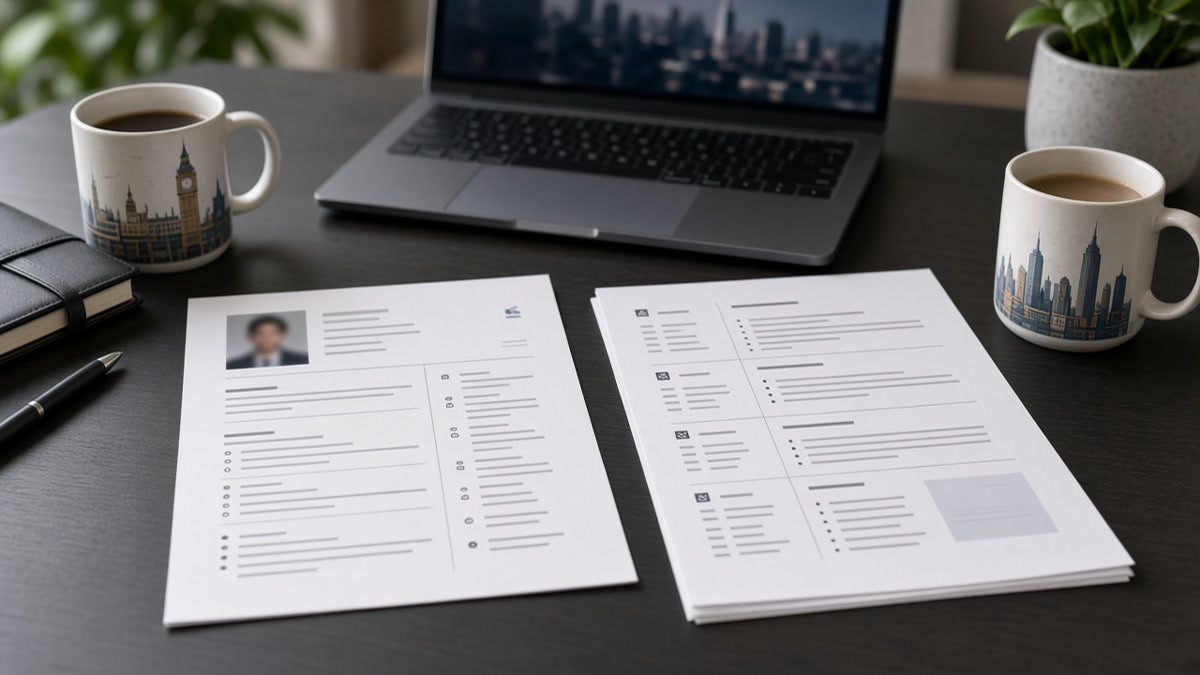
Before: UK CV opens with Education, lists A-Levels and MSc, photo top right, colour throughout, two-column Canva template.
After: US resume opens with Summary, Experience first with Month Year dates, education one block at bottom, American spelling, single-column DOCX, no photo.
Before/after: software engineer
Before: Responsible for platform services and liaised with stakeholders on roadmap priorities.
After: Owned Kubernetes cluster upgrades for payments API; cut deploy failures from 6 per month to 1 in Q2 by pinning Helm charts and adding smoke tests in GitLab CI.
Before/after: UK finance CV on a US req
Before: Personal profile paragraph uses I throughout, references listed with phone numbers, three pages with hobbies.
After: Two-page US resume, summary without I, references removed, hobbies cut, FP&A bullets quantified in dollars for US readers.
Step 4: Paste test both exports
Copy each master into Notepad. If employer names and titles alternate wrong, fix columns before you tailor keywords. US and UK parsers punish the same layout sins.
Step 5: Tailor on the correct master only
Highlight three skills from the posting. Rewrite bullet one under your current role so a required tool lands in the first eight words. Do not tweak spelling on the wrong file.
Where cross-border files usually break
Keeping honours thesis detail on US resumes. One line maximum unless research is the job. US industry recruiters scan for impact bullets, not chapter titles.
Using national insurance or social security hints in headers. Never put government IDs on either master. Forms collect them separately.
Listing every county council role on a US one-pager. Trim early local board seats unless the US role is public sector and relevant.
Exporting PDF from design tools for both markets. Rebuild in Word once, then duplicate into US and UK masters so you are not fighting two different Canva templates.
Mixing dollar and pound metrics without context. Convert for the target reader or label currency on each bullet where amounts appear.
Copy-paste UK CV header variant
Copy-paste block: UK CV header
[Full Name]
[City], [Country] · [phone] · [email]
Profile
Education
Experience
Skills
For deeper parser behaviour, read how resume file type impacts screening . For US section order norms, see what a universal US resume template includes .
Tools after you pick a market
Run the US or UK master through the ATS resume checker before you attach it to a cross-border posting. Confirm education and employer fields match what you see in Word.
When the posting is a stretch, score your job match on the US or UK file separately. Keyword gaps differ when spelling and section order change.
Optional cover letters should cite one proof point from bullet one on the correct master. Use the cover letter generator for structure, then keep the letter under one screen.
Track which master you sent where. A simple spreadsheet column for Country avoids accidental UK uploads to US reqs during a late-night apply session.
Do this now: Duplicate your current file into US and UK masters, paste test both, upload one live req on the matching master.
Your next upload
Open the posting. Note the country. Open the master that matches it. If you only have one blended file, split it before you rewrite another bullet.
US vs UK CV formatting 2024 is not about memorising etiquette trivia. It is about field order, photos, spelling, and length expectations that humans and parsers both use as shortcuts.
Save DOCX. Paste test. Upload one live req tonight on the correct master. Boring and market-specific beats polished and ambiguous every time a recruiter opens preview.
When preview search finds your current employer on the first try, you're ready to tailor bullet one. Until then, keep fixing layout, not adjectives.
Recruiters won't decode two markets in one file for you. They open preview, scan the latest title, and move on when the shape feels foreign. Give them the version they expect for the req country.
Keep a change log on each master: date, posting country, and whether preview search found your current employer. You'll stop re-sending the wrong export when you're batch applying at midnight.
Build your resume from a single-column template if your design file fights you on every export. Starting clean beats fighting a two-column builder for another hour.
Read more
Frequently asked questions
Use a US resume layout even if you call the document a CV at home. One or two pages, no photo, education after experience for most mid-career roles, and Month Year or Month Year to Present on every role. Upload DOCX when the form allows it. A UK two-page CV with education at the top often maps degree fields correctly but pushes your latest employer down in preview search.
Drop the photo for US applications. Parsers and US recruiters expect name and contact only. Photos can shift text order in some PDF exports. Keep a photo-free US master and a UK master if you still use a headshot locally. Never crop the photo out of a PDF without rebuilding the file in Word first.
Match the posting country for spelling in bullets and summary text. Mixing organise and organize in one file looks sloppy to humans and does not help parsers. Pick one dictionary per master file. Skills and product names stay as the vendor spells them.
Only if you strip US-risk items and accept UK length norms. Hybrid files usually keep UK education placement and US summary length, which confuses both markets. Maintain two masters: US resume under two pages, UK CV with education near the top if that is your local norm. Tailor keywords per posting on the correct master.