10 min read
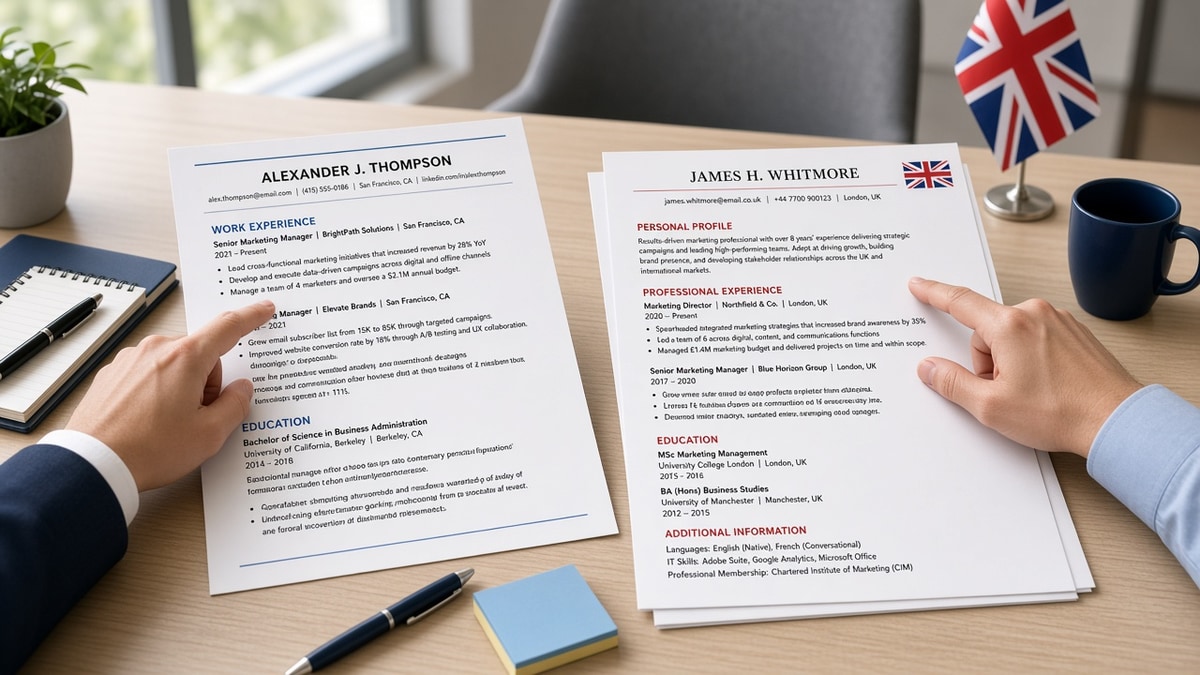
For US vs UK CV resume formats, you'll need two master files, not one translated PDF. US employers want work history first, one or two pages, no photo, and American spellings. UK employers often want a CV label, education higher on page one, British spellings, and two pages at mid-career. It's the same career story with a different section order and wording layer.
You've probably already sent a strong US resume into a London req and heard nothing back. The bullets weren't weak. The file read American before anyone reached bullet three. Job searching across borders is slow enough without fighting format defaults you didn't know existed. This page tells you what to change in the DOCX tonight, and it won't take a full rewrite.
Check your resume for free with the UK or US posting open beside it. You'll see whether your section headings and spellings match what Workday or Greenhouse will parse on that upload.
Quick Wins
- Duplicate your DOCX into US-Resume-Master and UK-CV-Master before you edit either.
- Move education above experience on the UK file only.
- Run British spell-check on the UK master; run US spell-check on the US master.
- Export single-column PDF and confirm headings still read in plain Notepad paste.
Why one resume dies in both Workday queues
Americans say resume. Brits say CV. In corporate hiring both words mean a dated work history with contact details, but the expected shape diverges fast. A US recruiter scanning Greenhouse wants impact in the first three bullets under your current title. A UK hiring manager often glances at qualifications and personal profile before they reach your last role. Send the US shape eastbound and you look like you skipped the local brief.
Length signals seniority differently. One tight US page is normal for analysts with six years of scope. A UK CV with the same career sometimes needs two pages so education, charter progress, or regulated credentials sit where local readers expect them. Trimming to one page for London can look unfinished, not disciplined.
Personal details carry legal weight. US resumes should list name, phone, email, city, and LinkedIn. Photos, age, and nationality stay off. UK practice has shifted the same way for most corporate roles, but older templates still show headshots. Do not import those habits into a US upload. Greenhouse and iCIMS treat image blocks as parse noise.
Spelling is a cheap tell. Organize versus organise, program versus programme, and center versus centre show up in the raw text ATS indexes. You are not failing a grammar test. You are signaling which market you prepared for. I've screened cross-border batches where the candidate was qualified and the file still read exported from a US template without a UK pass.
Read impact-first resume bullets US hiring teams prefer when your US master still opens with duty lines. Fix bullets once, then fork layout per country.
US vs UK CV resume formats: six edits before you upload
Step 1: Split into two master DOCX files
Name them clearly: Firstname-Lastname-US-Resume.docx and Firstname-Lastname-UK-CV.docx. Every future application starts from the right master. You are not rewriting from memory each time. You are adjusting keywords and bullet order against the posting.
Step 2: Reorder sections for the UK file
US order: contact, summary or headline, experience, education, skills. UK order for many corporate roles: contact, personal profile, education, experience, skills. Keep standard headings the parser recognizes. Work Experience beats Career History if the posting uses that phrase.
Before: Education block sits below twelve years of experience on page two of a US resume sent to a UK bank.
After: Education and professional certifications move to page one under a three-line personal profile on the UK CV master.
Step 3: Swap the opening label
US files often use Professional Summary or a headline line. UK files use Personal Profile. Same content can work with light edits. Drop Objective on both sides unless you are a new graduate with no experience block.
Before: Objective: Seeking a challenging finance role where I can use my skills.
After: Personal Profile: ACA-qualified financial analyst with six years in FP&A and month-end close for a 400-person SaaS firm; focused on management reporting and board packs.
Step 4: Run the spelling layer
Open the UK master, set language to English (United Kingdom), and accept organise, programme, and licence where appropriate. Keep the US master on English (United States). Do not rely on auto-correct at export time. One wrong market flip on a shared cloud file has burned more than one dual-search candidate.
Step 5: Set page budget per market
US: one page until roughly eight years of relevant scope, two pages for director-level ownership. UK: two pages is normal at mid-career when qualifications matter. Cut filler, not dated wins. If you need space, shorten older roles to two lines each before you touch your current job bullets.
Copy-paste contact header (both markets)
Firstname Lastname
City, Country · +44 7XXX XXX XXX or +1 XXX-XXX-XXXX
[email protected] · linkedin.com/in/firstnamelastname
No photo line. No date of birth. No full street address unless the posting asks. UK and US corporate screens both prefer city-level location for hybrid roles.
Example 1: Mid-level marketing manager (US to UK)
Before (US resume bullet): Responsible for digital campaigns and social media across channels.
After (UK CV bullet): Led paid social and email programmes for EMEA launch; cut cost per acquisition 18% in two quarters while holding lead volume flat at 2,400 MQLs per month.
Example 2: Software engineer (UK to US)
Before (UK CV bullet): Worked on microservices in an agile team environment.
After (US resume bullet): Built Node.js payment APIs on AWS ECS; reduced checkout latency 240ms to 90ms across 1.2M weekly transactions.
Example 3: Operations lead (dual search)
Before: One two-page US resume with Personal Profile label and British spellings sent to a Chicago manufacturer.
After: US master uses Professional Summary, experience first, American spellings, two pages only because scope includes six sites and $40M P&L ownership. UK master keeps personal profile, education before experience, British spellings, same metrics.
Edge case: US citizen applying remotely to UK from the US
Location line can read Austin, TX, USA while the file follows UK shape. State right-to-work only if the posting asks. Do not add visa commentary to the header unless the employer requests it. Let the cover letter carry relocation timing if needed.
Edge case: UK graduate applying to US campus programs
US campus and early-career programs often want one page, education and projects prominent, GPA if strong. Move UK A-level or degree classification into Education with US-readable labels. Convert degree names when helpful: BSc Economics reads clearer than some local award titles for US readers.
Edge case: Same company, two countries
Multinational employers still run local ATS instances. Apply through the country-specific careers site. A New York req and a London req on the same brand need the matching master file even when the job title matches.
See best resume file name and what to avoid when you export PDFs for cross-border uploads. Filename and format matter as much as section order.
Where cross-border applications still break
Renaming without restructuring. Saving CV.docx as Resume.docx does not move education or swap spellings. Recruiters notice in seconds.
Photos and icons on either file. Canva exports and headshots break parsers in the US and add bias risk in the UK. Plain Calibri or Arial, single column, standard headings.
Mixing date formats. Pick Month YYYY on both masters for consistency. 03/2024 means March in the US and can mean the third day in some UK contexts when parsers misread slashes.
References on the page. Both markets expect references available on request, not full contact details for three managers in the footer. Use one line and save space for bullets.
Identical cover letters with wrong market tone. US letters can name the req ID in line one. UK letters often open with role title and one proof point. Fork the letter when you fork the CV.
Read resume upload mistakes that instantly disqualify you when the portal rejects the file before a human opens it. Format errors hit cross-border candidates twice as often because they reuse the wrong export.
Check parse and match the cover letter
After you fork the US and UK masters, run the version you plan to upload against the same posting text. You are confirming headings survived export and must-have keywords sit in Experience, not only in Skills.
Run a free ATS check on the US or UK file with the job description loaded. If programme appears only in Skills on the UK export, move it into a dated bullet before you submit.
Generate a cover letter for the same req, then edit line one for market tone. US uploads often want req numbers. UK uploads want role title and one metric from bullet one. Keep spellings aligned with the CV or resume you attach.
Save two versions before you apply
US vs UK CV resume formats are not interchangeable labels. They are section order, page budget, spelling, and opening shape. Build two masters from one career story, tailor keywords per posting, and export single-column PDF or DOCX the portal accepts.
Open your current file tonight. Duplicate it. Move education on the UK copy. Run spell-check per market. Paste your strongest bullet into a cover letter draft and run a free ATS check before upload. That is the whole workflow.
This will not fix applying to roles where you lack work authorization or required credentials. It does stop qualified candidates from losing screens because the file still looked like a US export on a UK req.
And if you are juggling both markets this month, calendar a twenty-minute pass after each interview round. Update both masters when you earn a new metric. One win on the US file should land in the UK file the same week with spelling adjusted, not three months later from memory.
Read more
Frequently asked questions
Keep one career story, not one file. US corporate portals in Workday and Greenhouse expect a one- or two-page resume with experience before education, no photo, and American spelling when the employer is US-based. UK employers often expect a CV label, education higher on page one, British spellings, and two pages for mid-career roles. Export two PDFs from two master DOCX files before you upload.
Default to no photo in both markets unless the employer asks. UK hiring has moved away from headshots for bias reasons, and US ATS uploads can reject image-heavy files. Name, phone, email, city, and LinkedIn URL are enough. Nationality, date of birth, and marital status belong off the page in almost every corporate screen.
US resumes for corporate roles usually land at one page under eight years of experience and two pages for senior scope. UK CVs at mid-career often run two pages without apology; a single sparse page can read thin. Do not pad with duties. Add dated achievement bullets with scope instead. If you are early career, one strong UK page beats two pages of filler.
The same vendors appear on both sides of the Atlantic. Workday, Greenhouse, Lever, and Taleo parse single-column DOCX and plain PDFs more reliably than designed templates. UK boards still reward readable structure, but keyword matching and section headings matter just as much. Use standard labels like Work Experience and Education, not icons or text boxes.
Match the posting country. Use organise, programme, and centre for UK employers when those words appear in your bullets. Keep metric units consistent with the ad. A US resume that still says organized and led a program reads like you did not read the req. Run spell-check on the UK master only after you duplicate the file so you do not flip US applications by mistake.