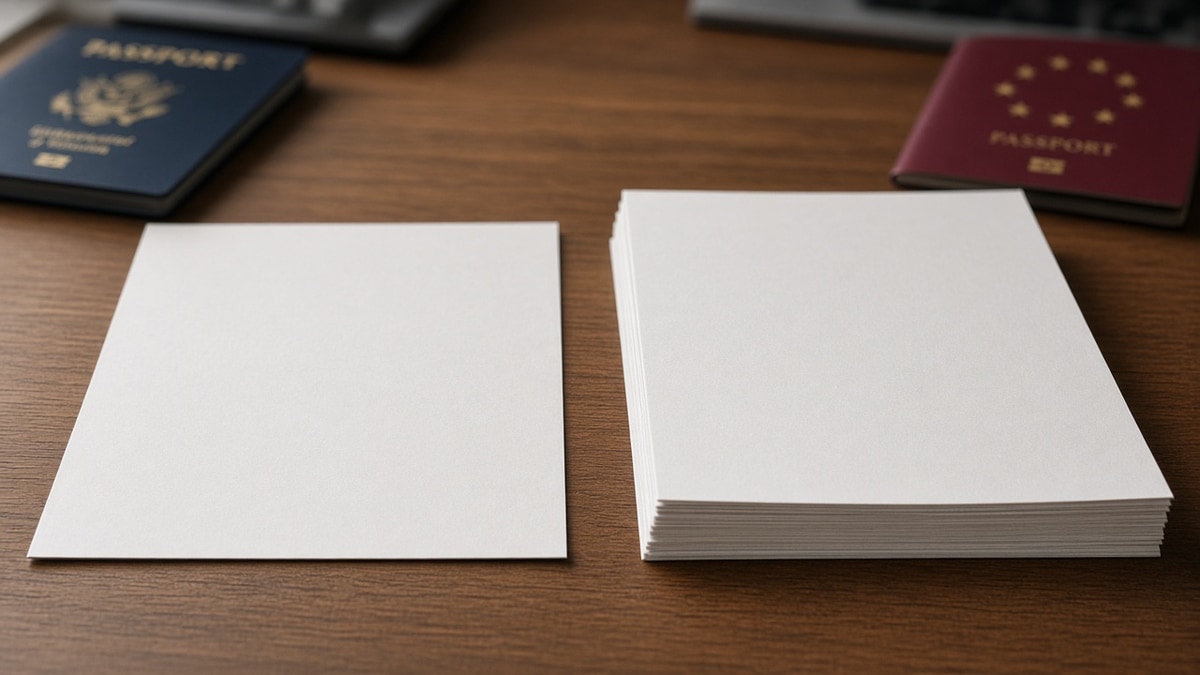
By Peter Miller · Published August 11, 2026 · Last updated: September 15, 2026
10 min read · Corporate resume vs academic CV
A US recruiter opening Workday expects a scannable work history, not your full publication archive. That's the US resume vs CV split in one line. International candidates often ship a CV because that's the word their home market uses for every file. US corporate hiring treats CV as academic full record and resume as role-targeted proof. Wrong label, wrong length, wrong header data, and you're filtered before anyone reads bullet one. It's not that your work didn't happen. It's that the wrong document shape hid it.
Before you export, check your resume for free with the corporate posting pasted in. You're checking one- to two-page density, plain contact lines, and whether tools from the req land in dated Experience bullets. Don't upload the CV file by habit if the widget says resume.
Job searching across borders is exhausting. This page doesn't ask you to memorize HR glossaries. It shows side-by-side pairs you can mirror tonight. When the portal wants a letter for the same req, generate a cover letter that matches the resume length you chose, not a CV summary pasted into paragraph form.
And you don't need two career stories. You need two exports from one master: US-Resume.docx for corporate roles, US-CV.docx for faculty or research posts. Same facts, different section order and length.
US corporate apply tonight
- One to two pages, single column, Month Year dates.
- No photo, birth date, or marital status in the header.
- Contact line: name, phone, email, city and state only.
What US corporate recruiters score against
Workday, Greenhouse, Lever, and iCIMS imports expect a resume-shaped file: Experience and Education in reverse chronological order, Skills or tools inside dated bullets, plain 11-point Calibri or Arial, no sidebar photo. Parsers read top to bottom. Recruiters ctrl-f the posting title and the last employer.
A CV-shaped upload breaks that scan. Page three of publications pushes your current job title below the fold. A photo header can scramble contact fields. Personal data lines recruiters aren't trained to evaluate eat the first screen.
Academic committees want the opposite: full publication lists, grants, committees, and teaching history spelled out. Send them a one-page corporate resume and you look under-documented. Send a corporation your full CV and you look unaware of US norms.
Corporate bullet one shows tool, scope, and outcome. CV line one under Research shows topic, venue, and year. Keep those shapes separate even when the underlying career is the same person.
Federal USAJobs resumes are a third format, longer and task-heavy. This page covers corporate and academic splits. For federal rules, follow the posting's builder instead of either template below.
For one-page discipline when you're trimming, see the universal US resume template . Length here is tied to document type, not preference.
Edge case: industry research labs sometimes accept a two-page resume plus a Selected Publications annex. Ask when the posting is silent. Default to resume length unless they say CV.
Edge case: physicians and fellows often maintain a CV for hospital privileges and a one-page resume for operational roles. Keep both exports, don't merge.
Hybrid uploads confuse both sides. A four-page file with a photo and a publications chapter before Experience fails corporate parsers and still looks thin to a search committee that wanted full grant detail. Splitting exports takes twenty minutes once. Sending the wrong shape costs weeks of silence.
When you're unsure which label the posting wants, search the req text for curriculum vitae, publications required, or submit resume. The first match wins. If both appear, follow the application button label in the portal footer. Greenhouse and Workday usually print resume or CV on the upload widget itself.
US resume vs CV key differences: before and after pairs
Each pair shows the weak hybrid recruiters see, then the US-side fix for corporate apply tonight. Illustrative bullets show shape, not market claims.
Pair 1: Length on a corporate marketing role
Before: Six-page CV with every internship, full coursework, and twelve bullet points per job uploaded to a Greenhouse req that asked for a resume.
After: Two-page resume keeping the last ten years. Four bullets under the current role naming HubSpot, pipeline scope, and campaign outcomes. Older roles trimmed to title, employer, dates.
Pair 2: Photo and personal data header
Before: Headshot, date of birth, marital status, and full home address in a Word header band.
After: Header cleared. Body opens with bold name, then phone · email · Austin, TX on one line. No photo. Visa status answered only on the application form when asked.
Pair 3: Publications on an industry data role
Before: Three pages of journal articles before Experience on a corporate data scientist req.
After: Experience first with Python, SQL, and model impact in bullet one. Optional Selected Publications section with two peer-reviewed items at the bottom when the posting mentions research. Full CV saved for faculty apps only.
Pair 4: Education depth for entry corporate vs PhD track
Before: CV lists every seminar paper, GPA per semester, and thesis chapter titles for a business analyst role.
After: Resume Education block: degree, school, graduation month year, one thesis line if relevant. Coursework dropped unless the posting names a specific class.
Pair 5: Skills placement
Before: CV Skills section lists forty tools with no employer context.
After: Resume carries Tableau and Snowflake inside dated bullets under the employer where you used them. Skills section holds only posting gaps the bullets don't cover.
I've screened stacks of these in Workday and Greenhouse, and the corporate file that moves forward is almost always one to two pages with no photo and impact in bullet one, even when the candidate's academic CV is impressive on paper.
Pair 6: References and personal statements
Before: CV ends with References available upon request and a multi-paragraph personal biography.
After: Resume ends after Education or a compact Certifications block. References handled later. Summary is three lines max, aligned to the posting title.
Copy-paste block: US corporate header vs academic CV header
US CORPORATE RESUME (Workday / Greenhouse)
[YOUR NAME]
[phone] · [email]@[domain] · [City, ST]

SUMMARY (optional, 2 to 3 lines targeting the posting title)
EXPERIENCE (reverse chronological, Month Year dates)
EDUCATION (degree, school, graduation date)
SKILLS (only posting gaps not covered in bullets)

US ACADEMIC CV (faculty / research posting)
[YOUR NAME]
[phone] · [email]@[domain] · [City, ST] · [ORCID or portfolio URL if relevant]

EDUCATION (full detail)
RESEARCH INTERESTS
PUBLICATIONS (full list, consistent citation style)
TEACHING / ADVISING
GRANTS & FUNDING
CONFERENCES & TALKS
SERVICE

RULE: Never put photo, DOB, marital status, or SSN on either US file.
Copy the corporate block into a fresh doc before you trim your CV. Rename the file US-Resume.docx so you don't overwrite the long version.
Edge case: career switch from academia to industry
Before: CV language: supervised lab protocols and authored manuscripts.
After: Resume bullets: led bench workflow for 12-person team; cut sample processing errors 14% in Q2; translated methods into SOP docs stakeholders used in production handoff.
Edge case: posting says CV but employer is a company
Before: You send a one-page resume because the company logo looked corporate.
After: You follow the word CV in the posting. Some R&D houses use CV language for senior scientist roles. Match the label, then keep corporate impact bullets inside Experience.
What weak hybrid files share
These patterns show up when one Word master tries to serve every market. They're fixable in an hour if you split exports first.
Using CV section order on a corporate upload
Before: Publications and grants appear before Experience.
After: Experience leads on the resume. Publications move to an optional short block or stay on the CV file only.
Keeping international personal data
Before: Nationality, marital status, and full street address in the header.
After: City and state only. Sensitive details belong in HR forms after an offer, not in the parser's first pass.
Calling every file a CV in US English
Before: Email to recruiter says attached is my CV for the account manager role.
After: Email says resume when the posting says resume. Label match signals you read the req. If you're attaching both files, you're probably applying to two different audiences with one confused thread.
Read should you include marital status on a CV when you're stripping personal data from a US export. This won't turn a faculty CV into a corporate fit if you're underqualified. It stops a qualified candidate from choosing the wrong document type.
Parse the US resume export
After you split files, paste the corporate posting into HireFlow's free ATS resume checker on the one- to two-page resume only. Confirm Experience extracts before Publications on the CV stays offline for that req.
The short resume is the default upload for US corporate portals.
If you're rebuilding from a long CV, build your resume in a single-column layout, export DOCX, run Notepad paste, then archive the CV under a separate filename for academic reqs.
Pick the right export tonight
Open the posting. If it says resume, duplicate your master into US-Resume.docx, strip photo and personal data, cap at two pages, and lead with Experience. If it says CV, keep the long file for academia and research only.
US resume vs CV key differences come down to length, header rules, and which proof belongs on page one. Corporate apply tonight means the short file. Committees later mean the full record.
When the resume preview still scrambles sections, run a free ATS check on the corporate posting before you upload.
Frequently asked questions
Send a resume unless the posting says CV or curriculum vitae. Most US companies in Workday and Greenhouse expect a one- or two-page work history with impact bullets, not a multi-page publication list. Academic faculty, research fellowships, and some medical training roles are the exceptions where a CV is standard. When the form says resume, a six-page CV looks like you didn't read the req.
No for corporate applications. Photos break some parsers, add bias risk, and signal international template habits recruiters don't expect on US corporate files. Academic CVs in the US also usually skip photos unless a foreign posting explicitly asks. Use the space for a plain contact line and your strongest recent bullet instead.
Most US corporate resumes stay one page through mid-career and two when every line supports the target role. CVs for academia or research can run many pages because committees expect publications, grants, teaching history, and conference lists in full. Length is not about ego. It's which reader and which parser get the right density without burying your current title.
Remove date of birth, marital status, nationality, full street address, photo, and national ID numbers. US resumes use name, phone, email, and city plus state or city plus country. Visa status belongs in an application question when asked, not in the header band. Personal data in headers can confuse parsers and raise fairness concerns.
You can build a resume from CV source material, but a straight cut often leaves credential lists without outcomes. Rewrite bullets for impact, move publications to a short Selected Publications block only when the industry role cares, and drop coursework, old conference posters, and full reference lists. Export a separate US-Resume.docx instead of renaming the CV file.