10 min read
Send a one-to-two-page US resume without photo or date of birth to Greenhouse and Workday. Keep your Europass or long EU CV for European employer portals that ask for those fields. US parsers often drop photos, nationality lines, and sidebar tables, then scramble your Experience order. EU CV format vs US resume format is not about which is better. It is about which portal you are facing today.
Check your resume for free on the file you'll upload to the US employer. If you're relocating or applying across borders, you probably need two master files, not one merged PDF. Below you'll get field-by-field differences, portal rules, before/after layout pairs, and a copy-paste US skeleton.
You don't have to rewrite your career story twice. You've already done the hard part. Strip EU-only fields for US uploads and strip US brevity rules when a German or French portal expects a photo and language table. Mixing conventions in one file is what breaks parsing on both sides.
If you're reading this ten minutes before a US deadline, export a single-column DOCX without photo first. You can polish the Europass version for EU apps later tonight, and you won't need to panic-edit personal fields at midnight.
Quick Wins
- US upload: no photo, no DOB, one to two pages, Month Year dates.
- EU portal: use Europass or employer template when requested.
- Single column for US ATS. No sidebar skills grids.
- Two master files. Do not merge EU and US conventions.
EU CV format vs US resume format in one view
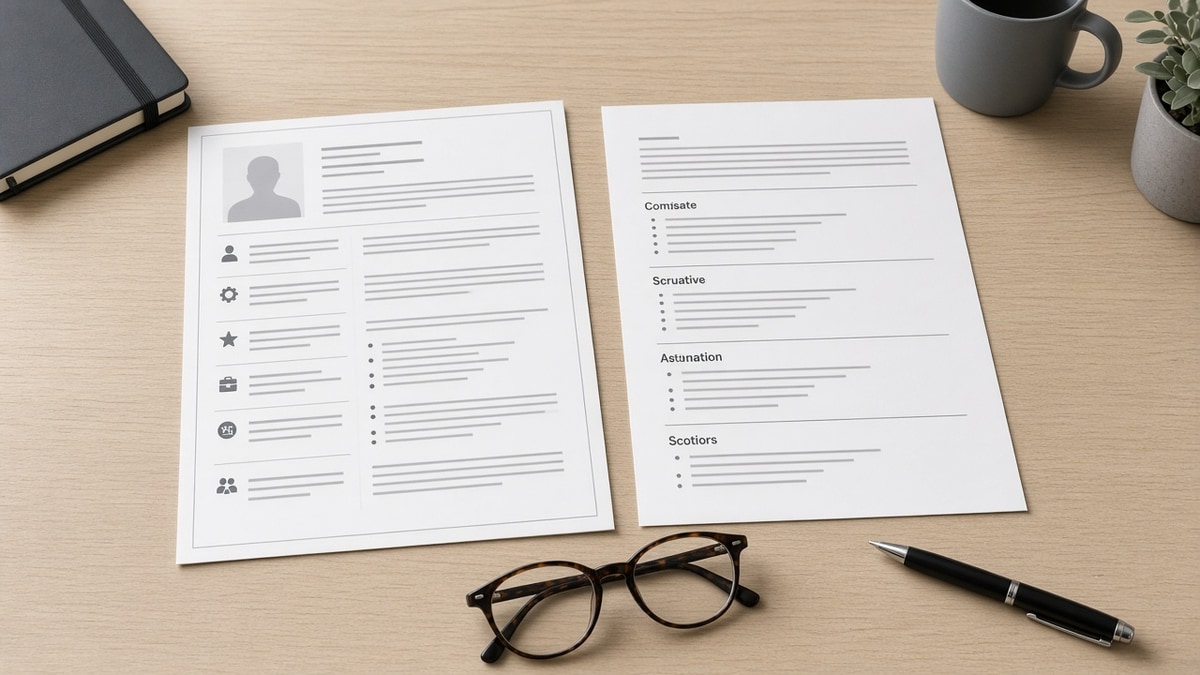
European CVs often include photo, nationality, date of birth, marital status, and multi-page education detail. US resumes skip personal fields, cap length at one to two pages for most corporate roles, and lead with reverse-chronological Experience. Parsers reflect those norms: Greenhouse expects employer-first blocks; Europass portals expect structured EU fields.
Portal rule of thumb: US employer on Greenhouse, Workday, Lever, or iCIMS gets the US resume. EU public-sector site, Europass link, or employer careers page with photo upload gets the EU CV. Multinational with dual listings: read the apply URL domain and the required fields, not your habit from the last country.
The EU CV format vs US resume format debate is not about hiding experience. It is about which metadata each market expects. US parsers treat photo bands and DOB lines as noise. EU forms sometimes require them before you can click submit. Maintaining two files respects both systems without diluting your work history.
Edge case: UK post-Brexit roles. Many UK corporates use US-style one-to-two-page resumes in ATS even though candidates call them CVs. Edge case: US academic medical CVs can run long like EU formats. Follow faculty posting instructions, not this corporate breakdown.
Edge case: remote US job while living in the EU. Location on the US resume is city and country where you sit, not where the employer is. Drop EU personal fields anyway for the US portal.
Field-by-field differences and before/after layouts
Use these pairs to rebuild your US file from an EU master. Illustrative lines show structure, not mandatory content.
Header and personal fields
Before (EU CV header): Photo top left. Name, date of birth, nationality, marital status, full address with postal code.
After (US resume header): Name centered or left. City, ST | phone | email | LinkedIn URL optional. No photo, no DOB, no nationality line.
US screeners rarely use street address. City and state are enough for location match.
Length and section order
Before: Four-page CV with education first, internships detailed, hobbies section, language table on page one.
After: Two-page US resume. Experience first with current role on top. Education one block with degree, school, graduation year. Languages one line or in Skills if posting asks.
Move hobbies and long publication lists off the US file unless the posting is research faculty.
Dates and employer lines
Before: 03/2019 – 06/2022 in a right column table beside employer name.
After: Senior Analyst | Acme Corp | London, UK (remote) | March 2019 to June 2022 with bullets directly below.
Spell months for US parsers. Keep city; drop full postal address on each job line.
Skills and language presentation
Before: CEFR grid: English C2, French B1, German A2 in a colored table.
After: Skills: SQL, Python, Stakeholder reporting, fluent English and conversational French.
US ATS reads comma lists better than CEFR tables unless the employer is EU-based and requests CEFR explicitly.
Education and early career detail
Before: Two-page education section listing gymnasium, bachelor's thesis title, Erasmus semester, and six bullet modules.
After: B.S. Economics, University of Amsterdam, 2018. Thesis available on request.
US corporate screeners want degree, school, year. Deep module lists belong on EU academic CVs or faculty applications, not on a US product manager upload.
New grads may keep relevant internships in Experience with Month Year dates. Ten-year professionals should drop high school entirely on the US file unless the posting is education-heavy.
References and personal statements
Before: References available upon request with three names, phone numbers, and titles at page bottom.
After: No references section. US employers collect references later in the process.
Personal mission paragraphs at the top of EU CVs often become orphan text in US parsers. Use a two-line summary only when you have ten-plus years and a clear specialty match.
Greenhouse vs Europass upload choice
Before: Same Europass PDF uploaded to a US startup Greenhouse link.
After: US DOCX with single-column Experience uploaded to Greenhouse; Europass PDF saved for EU applications only.
Run the text-select test on both files. If the US export pastes clean to Notepad and Europass does not, you know which to attach where. Save that US DOCX as the default for every American employer until the posting explicitly asks for Europass.
Copy-paste US resume skeleton from an EU CV
Copy-paste after you remove EU-only personal fields:
[First Last]
[City, ST or Remote] | [phone] | [email]
EXPERIENCE
[Title] | [Employer] | [City or Remote] | [Month Year] to [Month Year or Present]
• [Outcome bullet with number and year].
• [Tool or method from posting].
EDUCATION
[Degree], [University], [Graduation year]
SKILLS
[Comma-separated tools and languages in plain text]
For deeper US Experience rules, read ATS-friendly templates for European career changers when you're adapting EU content for US roles.
For Workday-specific formatting, read Workday resume optimization for European sales CVs before you upload a converted file to a US multinational.
Where EU CV habits break US parsers
Photo in header. Greenhouse may skip the image band and miss your name alignment. Remove photo for US uploads.
Date of birth and nationality. US employers do not want bias fields. Parsers may dump them into Skills garbage text.
Four-page length. US recruiters may never scroll to your current role on page three.
Europass tables. Two-column Europass layouts scramble in US ATS. Rebuild Experience as plain lines.
Education-first order. US corporate screeners want recent job on top unless you are a new grad.
Listing every short course. Move micro-credentials to one line or drop them on the US one-pager.
Marital status and dependent counts. Common on EU forms, inappropriate on US resumes. Delete entirely.
Full street address per job. US resumes use city or Remote only. EU address blocks confuse location filters.
Signature scans and stamps. Graphic elements at the bottom parse as garbage lines above Skills.
Mixing British and American English spellings randomly. Pick one spelling set per US file for tool names and degree titles.
Translating job titles literally. Lead Engineer beats Responsible for technical team in US keyword search.
Leaving salary history on EU CV. US norms exclude salary on the resume unless the portal asks explicitly.
Edge case: US employer with EU office. Apply through the US careers link with US format even if the team sits in Dublin. Edge case: EU employer with US subsidiary. Read which entity owns the req; US entity usually wants US resume.
Edge case: visa sponsorship language. US cover letter or optional field carries sponsorship need. Do not bury visa status in a DOB block on a US resume.
I've seen strong EU candidates filtered in US Greenhouse because Europass put internships above director roles after parse. The fix is a US master file, not arguing format preference with the portal.
This won't fix qualification gaps. It stops cross-border applicants from looking junior because the parser read their CV backwards.
Build the US file and parse-check
Strip photo and DOB from your EU master, then build your resume in single-column US layout. Download DOCX before Greenhouse upload.
Paste the US posting into the free ATS resume checker with that DOCX. Low continuity scores usually mean table or date fixes, not adding EU personal fields back in.
Pick the file that matches today's portal
EU CV format vs US resume format comes down to employer location and ATS type, not pride in your home template. Greenhouse and Workday want a short US resume without photo or DOB. Europass and many EU career sites want the longer CV with structured personal fields.
Duplicate your master tonight. Save EU-CV-Photo.pdf and US-Resume-NoPhoto.docx in separate folders. Before every apply, check the URL and required fields, then attach the matching file. One hour building two masters beats a month wondering why US parsers scrambled your Europass upload.
When the US posting allows a cover letter, generate a cover letter that states work authorization in plain text if needed. Keep visa discussion out of the resume header on both EU and US files unless the form has a dedicated field.
Review both files quarterly. Add new roles to the US resume first if you are targeting American employers. Sync the EU CV when you apply to Europass portals. Divergent dates between files create background-check friction later. Label filenames with country codes so you never attach CV-EU.pdf to a Chicago Greenhouse link by mistake.
This will not fix visa or work-authorization gaps employers flag in screening. It stops qualified international candidates from looking misformatted when the wrong convention met the wrong portal.
Read more
Frequently asked questions
No for most US corporate employers on Greenhouse, Workday, or Lever. Photos often sit in headers parsers skip, and US hiring norms treat photos as unnecessary bias risk. Keep your Europass photo version for EU portals that request it. Build a separate US resume without photo, date of birth, or marital status fields.
Target one to two pages for US private-sector roles unless you are in academia or federal contracting with explicit length rules. Move publications, board memberships, and early career detail to a link or optional addendum only when the portal allows a second file. US recruiters expect the newest role on page one, not page three.
You can, but parsers frequently scramble section order and drop Europass tables. Export a single-column US DOCX with Month Year dates and upload that instead. Keep Europass for EU employer portals and public-sector forms that require the template. Match the file to the portal country norm, not your home country habit.
Maintain two masters: a US resume without photo or DOB for American ATS portals, and a fuller EU CV for Europass or employer sites that ask for nationality, language levels, or photo. Never merge them into one PDF with both conventions. Recruiters in each market expect the local format.