By Peter Miller · Published March 24, 2026 · Last updated: October 4, 2026
7 min read
You've got one career and two audiences. London hiring managers skim a CV expecting context. US recruiters want a one-page proof stack they can forward without reformatting.
Before you tweak keywords, check your resume for free on the exact PDF you'll upload. You're checking whether dates imported in the right order and whether personal lines you should've deleted are still sitting in the header.
If you're not sure which file to send, don't guess from a blog headline. Match the employer's country and portal. Below is a side-by-side on length, personal details, tone, and file type, plus how to split one master document into two market-ready versions tonight.
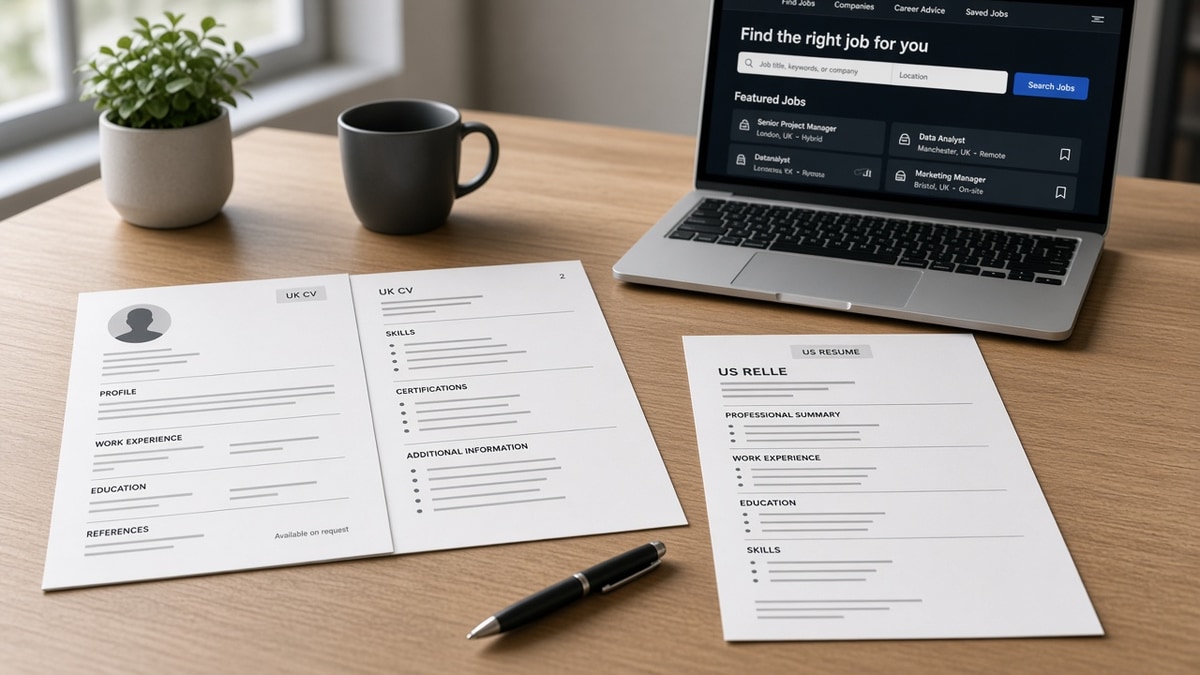
UK CV vs US resume at a glance
The wrong market reads as lazy research, not a formatting quirk. A three-page CV to a US tech req feels unfocused. A one-page US export to a UK civil-service style role can look thin before anyone reads a bullet.
| Topic | Typical UK CV | Typical US resume |
|---|---|---|
| Length | Often 2 pages; senior roles may use more | 1 page common; 2 for deep experience |
| Photo / birth date | Still seen; shrinking at large employers | Leave off; protected-class fields |
| Opening block | Personal profile, fuller sentences | Short summary or jump to experience |
| Bullet style | Mix of duty and outcome | Outcome-first, tight verbs |
| References | Sometimes listed or named on request | Omit names; provide later if asked |
Multinationals may accept either shape if the posting is US-based but you're in the UK. When the legal entity and payroll sit in one country, mirror that country's norms unless the ad shows a sample file.
Remote roles add noise. If the job ad lists a US salary band and US benefits, ship the US resume even when you live abroad. If the contract mentions UK right-to-work checks only, bias toward the UK CV shape.
Page count expectations
US screening moves fast. Recruiters want the last role, the numbers, and the tools on page one. Padding with every early-career duty pushes the proof below the fold on print and on a laptop preview pane.
UK readers often expect the arc: profile, career history, education, training, sometimes interests tied to the role. That extra page is not vanity; it's where certifications and board roles live without crowding the latest job.
I've opened US req queues where a two-page UK CV got deprioritized before skills were read because the file looked like the candidate never edited for the market.
Trim US versions by collapsing older roles to one line each. Expand UK versions by keeping fuller role descriptions where the posting stresses governance or stakeholder management.
Personal details and photos
US employers train hiring teams to avoid age, nationality, and marital status signals on the resume itself. A photo or full birth date on a US upload can trigger an immediate discard, not because the work is weak but because compliance teams do not want that data in the packet.
UK practice is mixed. Traditional CVs still carry nationality or date of birth lines. Modern UK corporates mirroring US ATS stacks increasingly want the same stripped header you'd send to New York.
Default rule: if the portal is Workday, Greenhouse, or Lever with a US parent, ship the US header even when you're applying from Manchester.
City and country are enough for location. Skip full street address in both markets unless a government form asks separately.
Dates, education, and tone
Numeric dates are where cross-border applications break. 03/05/2022 might be March or May depending on who parses it. Spell months or use a consistent Jan 2022 pattern inside each file version.
US resumes often bury education under experience once you've got a few years in role. UK CVs keep education visible longer, especially when the degree title matches a regulated profession.
Tone differs too. US bullets start with verbs and numbers. UK lines sometimes read like mini paragraphs that explain scope before the metric. Rewrite, do not just paste the same bullet into both files.
For parser hygiene shared by both markets, see what makes a resume ATS-friendly in 2026 before you argue about British vs American spelling on software names.
Where hybrid files fail
One-and-a-half pages with a photo tries to please everyone and often fails US compliance and UK depth at once.
References on the US page waste lines recruiters will not call until late stage, while UK employers might still want names ready in a separate attachment.
Mixed spelling (organisation vs organization) is fine if consistent per file. Switching mid-line looks sloppy in either market.
Tables and icons in a "global" template can scramble employer order in Taleo or iCIMS importers. Keep a plain single-column body for anything you upload.
Build two files from one master
Step 1: Dump everything into a master
Roles, education, certs, volunteering, publications. You will not send this file; it is the warehouse.
Step 2: Clone and label
Name them clearly: Surname Resume US.pdf and Surname CV UK.pdf. Future-you will not guess which is which at 11 p.m.
Step 3: Cut or expand
Before: one two-page CV with a photo, full birth date, and every early job spelled out.
After: US one-pager with photo and birth date removed; UK two-pager keeps the profile paragraph and education block.
Before: bullets that open with "Responsible for" and bury the metric at the end.
After: US lines lead with the verb and number; UK lines keep one clause of scope, then the outcome.
Copy-paste: header contact lines
US header: Name · City, ST · email · phone · LinkedIn URL
UK header: Name · City, UK · email · phone · LinkedIn URL · (optional profile line)
Step 4: Match the upload field
PDF when the site locks format. Word when the UK employer explicitly requests editable files. Never swap without reading the error message on retry.
When a US company asks for a cover letter, keep employer names aligned with the resume dates in the cover letter generator so nothing contradicts the experience block you just trimmed.
Parse-check before you pick a market
Upload the US PDF and confirm employers imported with Month Year intact. Repeat with the UK file if you're shopping both markets this week.
Run the ATS checker on each version separately. A layout that works on the two-page CV might break when you compress to one US page.
Build a clean US layout if your UK CV is fighting a single-column export. Start from a simple template, then paste UK content back only where length allows.
Pick the market, then the format
UK CV format vs US resume format comes down to length, personal lines, and how much story sits above the fold. Two polished files beat one clever hybrid when parsers and recruiters both expect local norms.
Read more on how resume file type impacts screening when the portal rejects your upload, and on common ATS rejection reasons if the right format still vanishes after submit.
Frequently asked questions
A middle-ground file usually underperforms in both markets. US teams expect a tight one-page story without photos or birth dates. UK teams often want a fuller career narrative across two pages. Keep a master file, then export two versions with different length, section order, and personal-detail rules.
Large UK employers and ATS-heavy portals increasingly treat photos as optional. Creative and client-facing roles still see headshots. For US roles, leave the photo off entirely. If the posting is silent, default to no photo when the company uses Workday or Greenhouse.
Spell out the month for cross-border applications: 15 January 2023 or Jan 2023. Numeric dates like 03/05/2022 flip meaning between DD/MM and MM/DD. Use the same pattern on every role line in the version you submit.
US corporate postings usually ask for PDF so layout stays fixed. UK postings sometimes request Word so recruiters can redact or annotate. Read the upload field. If it says PDF only, do not send .docx even when a UK friend told you Word is standard.