11 min read
You're qualified. You've got the right title history. You hit apply in Boston or Manchester and hear nothing. The mismatch usually isn't whether you typed resume or CV. It's whether your file follows the market that's reading it.
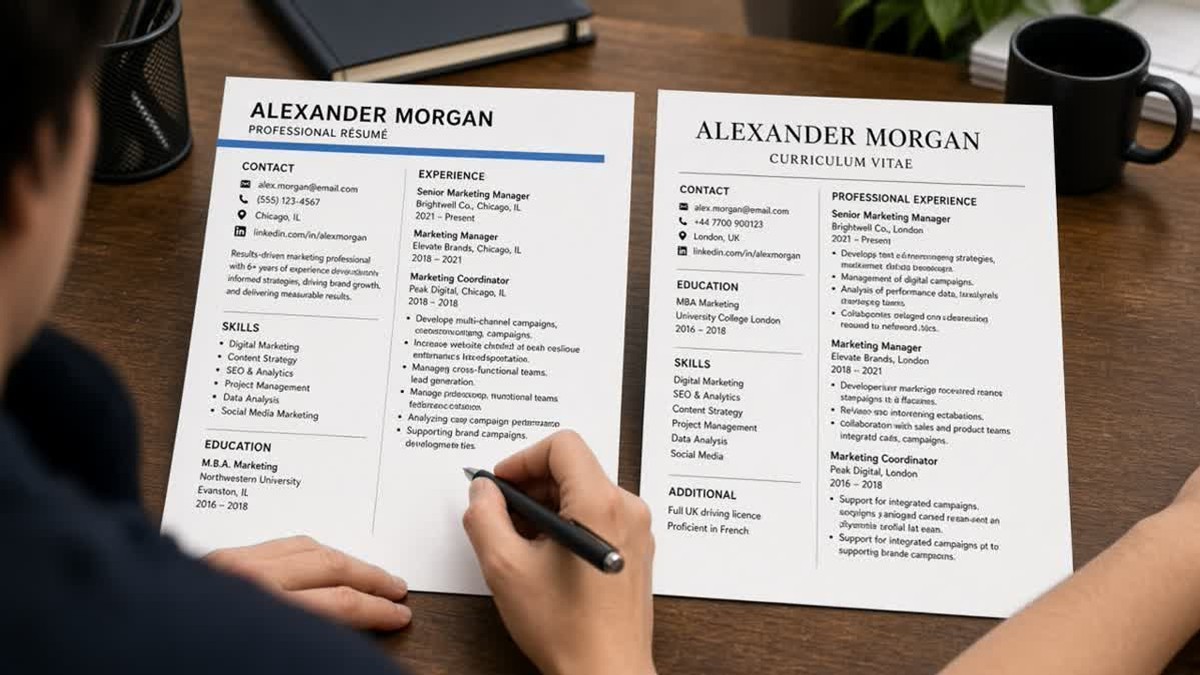
US vs UK CV formats look similar on LinkedIn advice posts. In Workday and Greenhouse they're not. A UK three-pager truncates on a US req. A US one-pager looks thin to a UK hiring manager who expects A-levels and a fuller education block. Personal data lines and date formatting cause quiet parser errors neither side warns you about.
Before you rename the file, check your resume for free with the posting pasted in. You're checking whether length, header fields, and dates survive extraction, not whether British spelling slipped through.
Below: the symptom when the wrong regional norm kills an otherwise strong application, three causes I see weekly, how to tell which one is yours, and fixes you can run tonight. Job searching across borders is draining enough without a format rule you didn't know existed.
Quick Wins
- US apply: one to two pages, no photo, no DOB, Month Year dates.
- UK apply: two pages with education detail, city only in contact, no NI number.
- Paste PDF into Notepad. Latest job must appear before page two noise.
- Keep two exports: Resume-US.pdf and CV-UK.pdf. Upload the right one.
The symptom: your CV looks fine, the portal reads the wrong market
A composite operations lead in Manchester builds a solid two-and-a-half-page CV: photo top right, full address, GCSE and A-level grades, roles back to 2012. They apply to a US SaaS company on Greenhouse. The PDF is polished. The parsed profile shows education blocks where Experience should be and truncates before the 2023 role because the parser burned page budget on header tables.
Flip it. A US product manager sends a tight one-page resume to a UK fintech. Human readers call it thin. The hiring manager ctrl-f A-level and finds nothing. They assume incomplete disclosure, not US norm. Both candidates were qualified. Both lost on format signals before bullet quality got judged.
The pattern: international guides obsess over resume vs CV spelling. Recruiters and parsers react to length, personal data lines, and date order first. Spelling colour vs color rarely kills a file. A three-page UK layout on a US req does.
Read how to shorten a US resume without losing impact when Cause 1 below is yours. Read Workday parsing fixes for UK IT CVs when you're staying in the UK but the portal scrambles order.
Edge case: dual citizen applying both ways the same week. You need two files, not one compromise. Edge case two: US employer with a London office posting in GBP. Read the req location and hiring manager country, not just the currency line.
US vs UK CV formats: three causes when your file fights the posting
Cause 1: Length norms that truncate or look thin
US corporate recruiters expect one page for most roles under director level, two pages when scope is genuinely large. UK hiring managers tolerate two pages for mid-level and three when every line carries technical or academic detail. Parsers often weight page-one text heavier. A UK third page full of early-career detail can push your current title off the first extraction pass on a US upload.
Before: UK marketing manager CV, three pages, roles back to 2009 with full paragraph duties on page three.
After: US resume, two pages max, last fifteen years in reverse chronological bullets, early roles one line each or dropped.
How to tell: Open the US posting. If it's individual contributor or first-line manager and your file exceeds two pages, length is likely hurting. Paste into Notepad. If your 2024 title appears after a wall of 2011 text, the parser probably saw the same order.
Fix: Cut pre-2015 detail for US applies. Keep metrics in the first eight words of each bullet. Move older roles to a short Earlier Experience block with one line per employer or drop them. For UK applies, expand Education with qualifications and dates instead of shrinking Experience to fit US one-page culture.
Cause 2: Personal data lines recruiters filter on differently
UK templates still ship with address blocks, marital status, date of birth, and sometimes National Insurance numbers in the header. US templates strip those fields because EEOC-aware employers don't want them. US files missing city and state look incomplete. UK files with full postcodes and DOB look non-compliant to US reviewers even when the parser accepts the text.
Before: Header reads Name, DOB 12/08/1990, Married, 14 Oak Lane, SW1A, NI AB123456C, phone, email.
After (US): Name, Austin TX, phone, email, linkedin.com/in/name. No DOB, no marital line, no NI.
After (UK): Name, Manchester, phone, email. No DOB, no NI, no full postcode unless the posting asks.
How to tell: Scan your header. If DOB, marital status, or NI appears and the req is US corporate, Cause 2 is active. If you're UK-only but still listing NI, strip it before any upload. Recruiters don't need it at application stage.
Fix: Build two header blocks. US: city and state or Remote, phone, email, optional LinkedIn. UK: city, phone, email, optional LinkedIn. Move visa status to one line in the body only when the posting requires work authorization detail.
Cause 3: Photo and date formatting the parser misreads
UK CVs sometimes include a headshot in the margin. US corporate ATS uploads should skip photos unless asked. Image layers can push text extraction out of order. Date formatting splits markets too: DD/MM/YYYY on a US portal may parse 04/03/2021 as April 3 or March 4 depending on engine. Month Year removes the guesswork.
Before: Photo top right, employment dates as 04/03/2021 to 18/11/2023 throughout.
After: No photo for US upload. Dates as Mar 2021 to Nov 2023 on every role line.
How to tell: Export PDF and paste into Notepad. If dates appear as numbers only without month names and you're applying US-side, switch format. If a grey headshot box sits in the top margin, build a no-photo version for US portals even if you keep a photo CV for UK networking.
Fix: Replace numeric-only dates with Jan 2022 to Mar 2024 style. Remove photo and decorative sidebar for US files. For UK files, photo optional by sector; finance and law often skip photos too. When in doubt, plain text wins.
Copy-paste header blocks by market:
US HEADER
YOUR FULL NAME
City, ST (or Remote)
phone · [email protected] · linkedin.com/in/you

UK HEADER
YOUR FULL NAME
City, UK
phone · [email protected] · linkedin.com/in/you

DATES (both markets)
Company Name | Job Title
Mar 2021 to Nov 2023
• First bullet with metric in the first eight words
Edge case: returning to the UK after US years. Keep US employer bullets metric-heavy, add A-levels and degree classification in Education even if US resumes skipped grades. Edge case two: US military converting to UK civilian CV. Translate MOS to civilian title in the body, not in a footer stamp parsers drop.
Which cause is yours? Run a sixty-second triage. Count pages first. If US req and file is three pages, start with Cause 1. Scan the header for DOB or NI next. If either appears on a US apply, Cause 2 is active. Paste dates into Notepad. If you see DD/MM only or a headshot margin on a US upload, Cause 3 wins. Most cross-border files hit two causes at once. Fix length and header before you tweak bullet verbs.
Nurses and allied health candidates: UK NMC pin in the header is fine as one line in the body for UK roles. US state license belongs in the body under contact, not beside a photo. Engineers and data roles: UK CVs often list every module from a MSc. US resumes list degree and thesis title only unless the posting asks for coursework. Sales roles: UK CVs sometimes list full commission history in prose. US resumes want quota and attainment in the first bullet under the employer line.
Cross-border traps that still look professional on PDF
One file for every country. A compromise two-and-a-half-pager satisfies neither market. Maintain Resume-US.pdf and CV-UK.pdf and upload the matching one.
Renaming without restructuring. Changing CV.docx to Resume.docx while keeping UK header fields doesn't fool parsers or recruiters.
References on page two. UK candidates sometimes list referees upfront. US resumes omit them. For US uploads, drop named referees unless asked; use one line References available on request if space allows.
I've screened US files in Workday where a UK photo and address block imported cleanly but pushed the latest job title to page two in the parsed view. Recruiter never opened the PDF.
Education depth mismatch. US resumes list degree, school, year. UK CVs often need A-levels, classification, and relevant modules for grad schemes. Sending US-short Education to a UK grad program looks evasive, not efficient.
Spelling as the main edit. Switching organise to organize helps human readers but won't fix a three-page layout sent to a US req. Fix structure first, spelling second.
Canva two-column templates marketed global. Columns read sideways in many parsers. Rebuild US and UK versions as single-column body text. See PDF vs DOCX for ATS after layout is flat.
Hobbies section overload. UK CVs sometimes run long Interests blocks. US resumes keep them short or omit. For US applies, cut hobbies unless they prove a job-relevant skill.
Listing every UK qualification acronym on a US resume Skills box. NVQ and BTEC mean little to a US parser matching Salesforce and SQL. Translate to outcome bullets under Experience instead.
Verify the market version before you upload
Run the file you're actually attaching, not the version you wish you'd built. Paste the req text. Check warnings on length, contact placement, and date order.
Run a free ATS check on Resume-US.pdf for US postings and on CV-UK.pdf for UK postings. Warnings differ when header rules differ.
If you're rebuilding from scratch, build your resume as a single-column export first, then fork a UK copy with expanded Education before you add photo or qualification tables.
Need a US cover letter after the resume is flat? Generate a cover letter with the same contact lines as the US header so names and phones match across documents.
Pick a market version tonight, not a label debate
Open your current file. If the req is US: cut to two pages max, strip photo and DOB, fix Month Year dates, city and state in the header. If the req is UK: allow two pages, expand Education, drop NI and full postcode, keep bullets outcome-heavy.
US vs UK CV formats differ in what recruiters expect to see in the first screen, not in what you call the attachment. Length norms, personal data lines, and photo/date formatting break more applications than resume vs CV ever did.
Save two PDFs in a folder named by market. Upload the matching one. Paste into Notepad once per version. When your latest role shows first and contact lines are clean, you're ready to apply again without guessing which country's rules you accidentally mixed.
Batch five US applies only after Resume-US.pdf passes a plain-text paste test. Same for UK with CV-UK.pdf. Cross-border searching is hard enough without sending Manchester header rules to Boston parsers.
When a friend asks if they should Britishise spelling, tell them to fix page count and header fields first. Spelling is polish. Structure is whether anyone reads page one.
Copy-paste tonight checklist:
[ ] Req country picked: US or UK (not both in one file)
[ ] Page count matches market (US 1-2, UK 2-3 max)
[ ] Header has no DOB, NI, or marital status
[ ] US file has no photo unless employer asked
[ ] All dates use Month Year, not DD/MM only
[ ] Notepad paste shows latest job before old roles
[ ] Correct PDF attached: Resume-US or CV-UK
Keep both versions in sync monthly. When you add a new role, update both files the same night so you don't ship stale UK education to a US req or a one-page US snapshot to a UK hiring manager who needed your classification line.
If you're unsure which version to send, open the careers page domain. A .com HQ with USD comp bands usually wants the US file. A .co.uk entity listing Right to Work UK language wants the UK file.
Read more
Frequently asked questions
Rarely. Workday and Greenhouse do not reject you for the word CV in a filename if the text parses. What breaks applications is a three-page UK layout sent to a US req, or a US one-pager missing A-level lines a UK hiring manager expects. Fix length, header fields, and Month Year dates before you worry about the label on the file.
Yes for corporate US ATS uploads unless the employer asks for a photo. Photos add no keyword value and some US parsers treat image layers as noise. Keep a photo version for UK networking if you want one, but attach a plain single-column PDF without a headshot to US portals.
Date of birth, marital status, full home address, and National Insurance number should stay off. UK recruiters expect city and phone, not a full demographic block. US recruiters expect city and state or Remote, phone, and email. Neither market wants NI or SSN digits in the header.
US corporate roles: one page up to about ten years, two pages max for senior scope. UK roles: two pages common for mid-level, three only when every line earns space. Sending a UK three-pager to a US startup often means the parser never reaches your latest role on page one.
Month Year everywhere: Jan 2022 to Mar 2024 or January 2022 to March 2024. Avoid DD/MM/YYYY-only lines on US uploads because parsers may read 03/04/2022 as March 4 or April 3. Spell the month or use a three-letter abbreviation so order stays unambiguous in Greenhouse and Workday.