By Peter Miller · Published February 14, 2026 · Last updated: September 15, 2026
11 min read
You've sent forty connection requests this month. Three people accepted. None replied to your follow-up. The notes weren't rude, and you didn't spam anyone. They opened with "I'd love to pick your brain" and never named the project sitting on bullet one of your resume.
Before you paste another template, check your resume for free on the same PDF you uploaded to Greenhouse or Workday. Recruiters click your profile, open the file, and compare it to what you wrote. If the repo isn't on the resume, the message dies on the second line.
Job searching fresh out of school or a bootcamp is draining. You don't need a networking course or a paid template pack. You need five steps, scripts you can paste tonight, and two edge cases entry-level hires hit when the posting stack doesn't match their capstone.
If the application portal asked for a cover letter, don't recycle your Skills block. Generate a cover letter that names the same project you'll cite in line two, then stop editing. Tonight's work is the outreach note, not a new essay.
Quick wins
- Pull one repo or capstone name from bullet one on your resume.
- Keep connection notes under three hundred characters with one specific ask.
- Match script type to recruiter, hiring manager, engineer, or alumni.
- Follow up once after acceptance with a question tied to the posting req.
Why line two with a repo beats a brain-pick opener
Most entry-level templates tell you to sound eager and ask for advice. Recruiters and engineers on LinkedIn aren't sitting down to mentor strangers. They're scanning inbox threads between meetings. A note that opens with "pick your brain" gives them nothing to evaluate in five seconds.
The contrast that changes reply rates: line two names a project already on your resume with one concrete detail. The reader can click the repo, skim a README, or ask one follow-up question. You did the work of proving you build things. They didn't have to guess.
A composite new grad targeting backend roles kept sending generic connection notes to tech recruiters. After rewriting line two to mention a Go inventory API with Postgres and Docker on Render, two of five recruiters replied within a week. Same people, same companies. Different hook.
Edge case: your capstone used a stack the posting doesn't list. Cite the project anyway, but line three asks how the team handles the gap between classroom tools and production stack. That reads honest, not apologetic.
Edge case: you don't have a public repo. Name the internship project or lab assignment on your resume and describe one constraint you solved. "Built a React dashboard for clinic wait times with mocked FHIR data" works when there's no GitHub link.
Read why weak bullet points get ignored if bullet one on your resume still reads like a course title with no outcome line.
LinkedIn networking scripts for US entry-level software engineers: five steps
Run these steps in order before you send another connection request. Each one takes minutes once your resume bullet is specific enough to copy into line two.
Step 1: Pull one proof project from bullet one
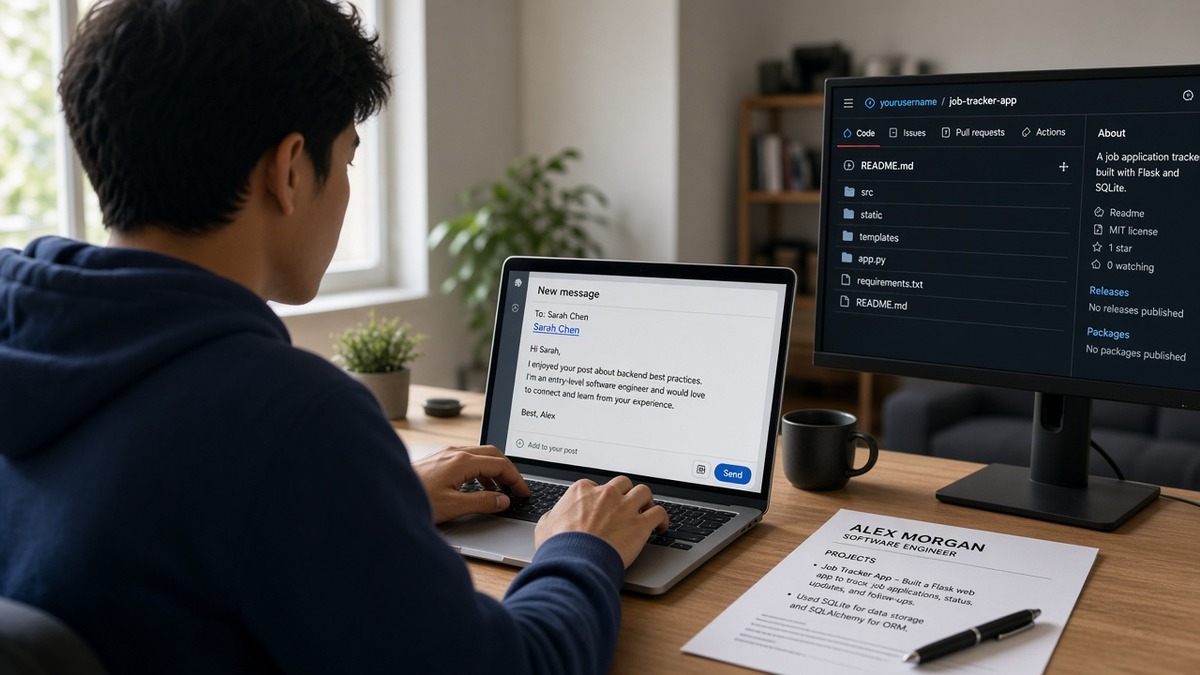
Open your resume PDF. Read the first bullet under Projects or Experience. That line must name a repo, app, or system plus one outcome or tech constraint. If it doesn't, rewrite it tonight before you network. The project name in your message must match the file word for word.
Illustrative bullet only: Built a Flask REST API for campus event RSVPs, handling 200 concurrent users in load tests. That number describes a fictional resume line, not a market stat. It gives you "Flask REST API" and "200 concurrent users" for line two.
Before: Composite bootcamp grad listed "Full-stack capstone project" with no stack or outcome; connection notes had nothing specific to cite.
After: Rewrote bullet to "React and Node bookstore app with Stripe checkout"; pasted the exact title into line two of every recruiter note.
Step 2: Map the recipient before you pick a script
Recruiters want req ID and applied status. Hiring managers want proof you understand their team's problem space. Engineers and alumni respond to one narrow technical question, not a job ask on the first touch. Pick the template that matches who you're messaging, not whoever has the most connections.
Before: Composite CS grad sent the same "seeking opportunities" note to recruiters and senior engineers; zero replies from engineers who saw a job ask with no context.
After: Used recruiter script with req ID after applying; used engineer script with one question about their CI pipeline after researching the team's public talks.
Step 3: Write line two with the repo, not a compliment
Line one states who you are and the role or team. Line two names the project from your resume plus one detail a reader can verify. Line three is one ask: whether they're the right contact for req 1842, or whether your JWT approach matches how their team handles auth.
I've screened entry-level files in Greenhouse where the candidate's LinkedIn note mentioned a repo that never appeared in the uploaded PDF, and the recruiter closed the thread before scheduling a screen.
Before: "I'm passionate about software and would love to pick your brain about your career path."
After: "I shipped a Go inventory API with Postgres on Render (link on my resume). Are you the right contact for the backend new-grad req R-4419 I applied to yesterday?"
Step 4: Send the connection note under three hundred characters
LinkedIn truncates long connection requests. Count characters before you send. Drop adjectives before you drop the project name. If you need a link, put it on your profile Featured section and reference "link on my resume" instead of pasting a URL in the note.
A composite intern targeting fintech roles cut a draft from four hundred ten characters to two hundred sixty by removing "passionate" and "excited" and keeping the Stripe integration detail. The shorter version fit the mobile preview recruiters actually see.
Edge case: the recipient already accepted your request without a note. Skip a second connection attempt. Send one InMail or message using the follow-up script within forty-eight hours while the acceptance is still fresh.
Step 5: Follow up once with a posting-specific question
After they accept, wait one business day. Send four sentences max. Thank them, restate the project in one line, reference the posting or team stack, ask one question they can answer in a sentence. Do not send a second follow-up if they don't reply. Move to the next company row on your spreadsheet.
Read how to build a US application funnel when you need a tracker for outreach, applications, and follow-up dates in one place.
Copy-paste scripts by recipient
Recruiter (after applying):
Hi [Name], I applied to [Role] req [ID] yesterday. I built [Project] in [Stack] with [one outcome]. Are you the right contact for that req?
Engineer on the team:
Hi [Name], I saw your post on [specific topic]. I shipped [Project] using [one tech from their stack]. Quick question: does your team run [CI tool] on every PR?
Alumni:
Hi [Name], fellow [School] grad here. I built [Project] for my capstone. One question: how did you frame internship projects when you were applying to [Company]?
Where entry-level outreach still breaks
You open with brain-picking or flattery. Compliments without a project hook read like mass outreach. Lead with proof.
Line two cites a project not on your resume. Recruiters check the PDF. Mismatches kill trust faster than a slow reply.
You send the same script to recruiters and engineers. Recruiters need req IDs. Engineers need one technical question. Mixing the two looks lazy.
Your connection note is a paragraph. Long notes don't get read on mobile. Cut to three lines and one ask.
You follow up three times in one week. One polite bump is fine. Repeated pings after silence read as desperation, not persistence.
You network before the resume parses cleanly. A two-column layout or broken date format means the proof you cite in line two isn't what Workday stored. Fix the file first.
You ask for a referral on the first touch. Referrals come after someone has seen your work or your file. Lead with the project, earn the conversation, then ask if they'd feel comfortable flagging your application.
Align the file before you send
Paste the posting into the job match score tool before you write line two. If must-have stack terms only appear in your Skills list and not in the project bullet you plan to cite, rewrite the bullet before you message anyone.
Run the free resume checker on the labeled export you reference in outreach. Headers, date format, and column layout drift when you edit fast. A parser break means the project name in your note is not what the recruiter sees in Greenhouse.
Tools don't write your scripts. They make sure the proof in line two matches the file attached to every application you already submitted.
Send one note tonight
LinkedIn networking scripts for US entry-level software engineers aren't about sounding polished. They're about giving the reader one verifiable project in line two instead of asking them to mentor you from scratch.
Open your resume. Copy the project name from bullet one. Pick one recruiter or engineer at a company on your list. Paste the recruiter script, swap three fields, and send. One note beats forty drafts sitting in your outbox.
Job searching is hard enough without guessing why nobody replies. Fix line two. Send once. Move to the next row.
Read more
Frequently asked questions
Stay under three hundred characters for the connection request. Line one names the role or team. Line two cites one repo or project from your resume with a concrete detail. Line three is one specific ask. Longer messages get skipped because recruiters read them on mobile between screens.
Message the recruiter who owns the req when you already applied through Greenhouse or Workday. Message the hiring manager only after you have a proof project that maps to their team's stack. Alumni and engineers on the team are fair game before you apply if you ask one narrow question, not for a job outright.
Reuse the structure, not the words. Swap the repo name, posting req ID, and one stack term from each job description. A template that still says Python when the posting wants Go reads like spam. Keep a spreadsheet row per company with the project you plan to cite in line two.
Name the project on your resume and one outcome or constraint. Example pattern: I shipped a React expense tracker with JWT auth and deployed it on Render. That gives the reader something to click or ask about. Brain-picking openers put the work on them with no hook.
Yes. Recruiters open the PDF you uploaded before they reply. If the repo is not on your resume or the bullet is vague, the message falls apart. Run an ATS check on the same file, then paste the exact project name from bullet one into line two of your note.