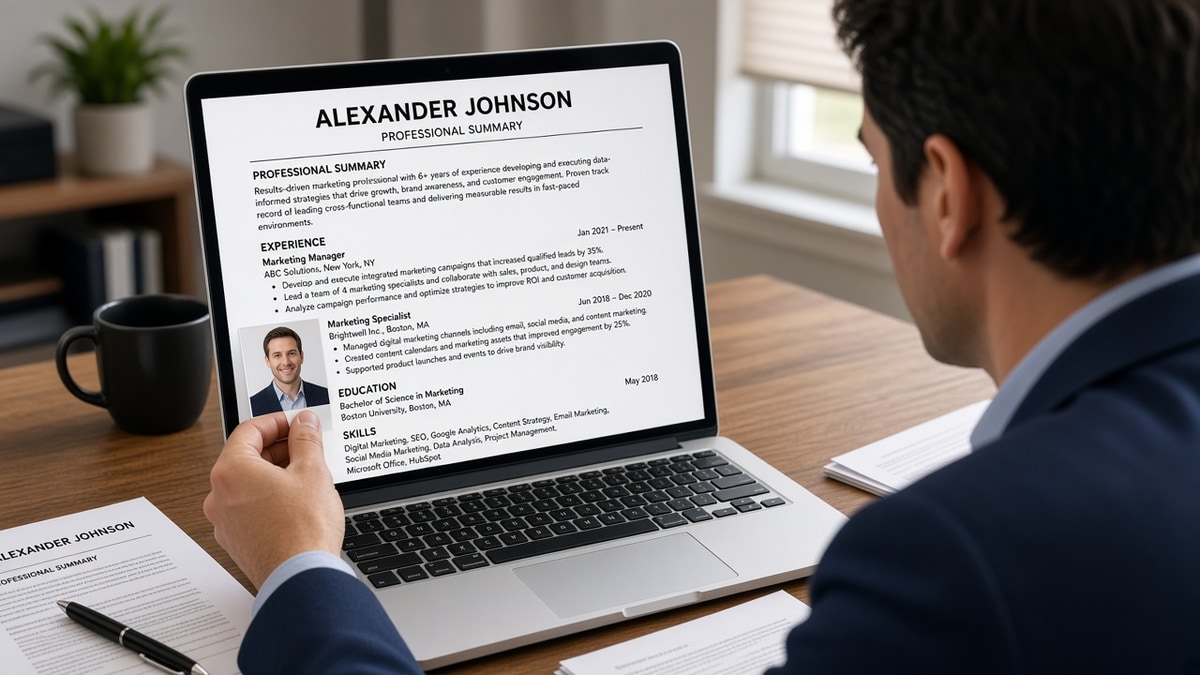
5 min read · US application norms
In Germany or France, a CV photo is normal. In US corporate hiring, it's the opposite. Recruiters expect a text-first PDF with no portrait, and many teams won't pass files with headshots to hiring managers.
Before you submit tonight, check your resume for free after you delete the photo block. You'll see faster whether contact lines and your summary still parse in order.
This page answers should you include a photo on a US resume with the narrow yes cases, what breaks in ATS imports, and a short checklist if you're adapting a CV from abroad. For format forks, read UK CV vs US resume adaptation if you're crossing markets.
Job searching across borders is already confusing. You don't need a portrait fighting your bullets for space on page one. When a posting asks for a letter, draft one with the cover letter generator after the resume is text-only.
Quick Wins
- Delete the headshot and any icon row from the template.
- Keep contact info as typed text in the body, not graphics.
- Save a US version without photo; keep a local CV if your market expects one.
- Paste-test the export before you batch apply.
Should you include a photo on a US resume? The US norm
US corporate screening is built around text fields: title, employer, dates, skills proved in bullets. A photo does not fill any of those fields. It only adds information employers try to keep out of early screens.
The shift: professionalism here is structure and proof, not likeness. A sharp summary beats a polished headshot for every role outside narrow performance work.
Compliance teams train recruiters to avoid bias signals in initial review. A portrait makes that harder, so many recruiters remove it or deprioritize the file rather than risk a messy trail.
Before: "CV with photo, date of birth, and full address at the top."
After: "US resume: city and state only, no photo, summary leads with scope the posting repeats."
Exceptions and what to do tonight
The yes list is short. If you are not in one of these buckets, remove the photo before export.
When a photo might be acceptable
Acting, modeling, on-camera hosting, and brand ambassador roles when the posting requests a headshot or reel link. Attach what they ask for. Keep the resume body text-only unless the ad embeds the photo inside the PDF spec.
Creative portfolios are different from ATS uploads. Submit the plain resume in the portal and link a visual portfolio only when the posting allows attachments beyond the resume field.
Copy-paste block: remove photo and fix layout
Copy-paste checklist (US upload)
{`[ ] Delete headshot, logo badges, and background images
[ ] Move phone and email from icons to typed text lines
[ ] Single column; no sidebar reserved for photo
[ ] City and state only in contact block (no full street address)
[ ] Paste test: summary and first bullet appear before skills
[ ] Save as US_Resume_NoPhoto.pdf for tonight's applications`}
What to do now for international applicants
Duplicate your file. Strip personal details US employers do not expect. Remove the photo from the US version even if your home market uses one.
Before: "Same Europass-style CV uploaded to a US Fortune 500 Workday req."
After: "US-tailored one-column PDF, no photo, bullets rewritten to match the posting's first three must-haves."
For layout rules that pair with this fix, see the safest resume layout for US ATS . Photo templates usually break those rules on the first row.
Photo choices that backfire in US screening
Keeping the photo because it looks professional: US recruiters read polish as clean type and scoped bullets, not a portrait.
Using a design template with a built-in headshot circle: deleting the image but keeping the sidebar still wastes lines and can scramble import order.
Uploading the same file to US and non-US roles: you either look unfamiliar abroad or risky in the US. Maintain two exports.
I've screened resumes in Workday where the photo header pushed the job title into the skills field on import, and the candidate spent a week rewriting keywords instead of deleting the image block.
Clean the file before you upload
After you remove the photo, run the same checks you would for any US upload. Order matters more than design.
Run the free ATS checker on the no-photo export. Confirm contact lines and your summary land where a recruiter expects them.
If the template still fights you, build your resume in a plain single-column layout and paste your bullets without the portrait row.
Do this now: Paste-test your file. If your name and title are not the first readable lines, delete the header graphic before you apply again.
Submit without the photo
Should you include a photo on a US resume? Not for typical corporate roles. Remove it, paste-test the export, and lead with proof on page one.
Keep a separate international CV if your home market expects a portrait. For US uploads tonight, text-only wins over habit every time.
Read more
Frequently asked questions
No. It is not illegal for you to include one. Many US employers still prefer resumes without photos because photos introduce bias risk in screening. Corporate recruiters often strip images before the hiring manager sees the file. Follow the norm for the market you are applying into, not the country you came from.
Acting, modeling, on-camera hosting, and some brand ambassador postings when the job ad asks for a headshot or portfolio. Even then, keep the resume text clean and attach the photo only when the posting requests it. Default corporate roles in finance, tech, healthcare, and operations expect no photo.
Yes. Images in headers and sidebars can push contact lines out of order or leave blank fields in Workday and iCIMS imports. Parsers read text streams, not portraits. A photo can also shrink the space left for your summary and first bullet, which hurts the human skim more than the image helps.
Remove it for US uploads. Keep a separate international CV with photo for markets that expect it. Mixing formats signals you did not tailor the file. Recruiters notice when a US application still carries EU personal details and a portrait.
On your professional profile recruiters already check after the resume, not inside the PDF you upload to an ATS. Your resume should carry proof: titles, tools, outcomes. The photo does not change whether you can do the job.