11 min read
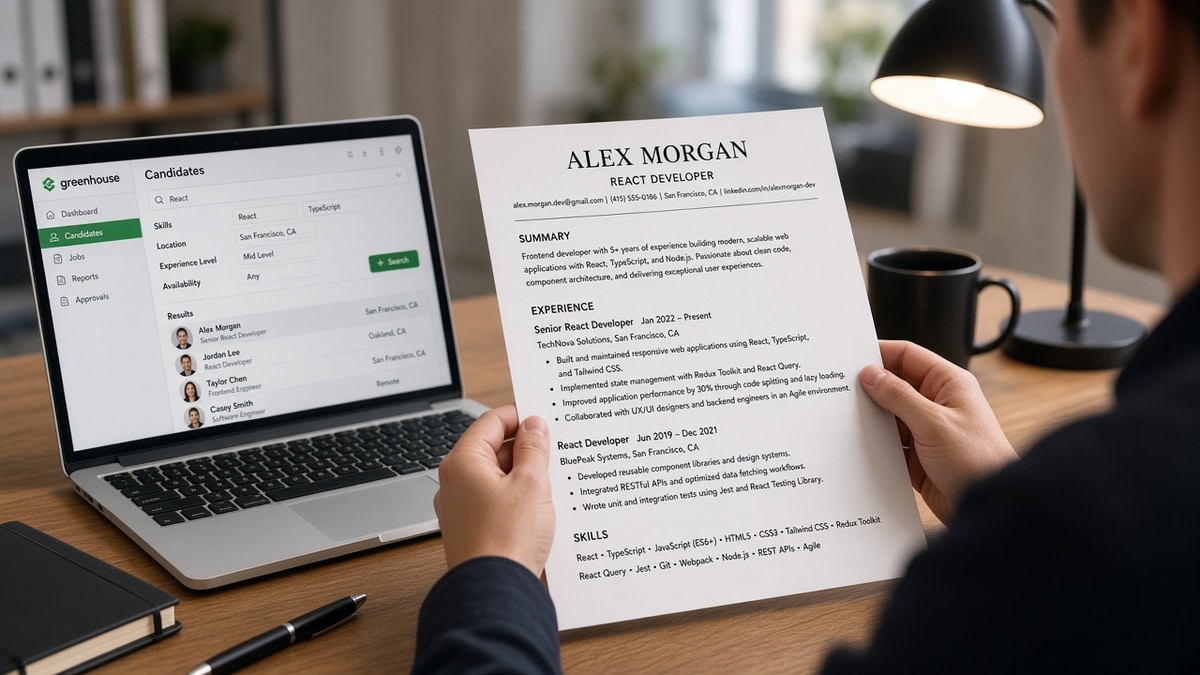
React developer resume keywords only pass recruiter filters when they sit inside dated Experience bullets with component and test proof. A Skills cloud of hooks and Redux without a shipping story gets skipped in Greenhouse search and on a human skim. You're not losing screens because you lack buzzwords. You're losing them because TypeScript lives in a sidebar while your bullets still say worked on web apps.
Open the React req you're targeting tonight. Before you rewrite a single line, check your resume for free with the posting pasted in. You're confirming the file parses and that React, hooks, and your test stack landed in extracted text, not debating whether keywords matter.
Job searching while you're still employed is draining enough. You shouldn't get sorted out because Jest never attached to a shipping bullet. Below you'll see what US hiring managers actually judge React keywords against, before/after pairs across junior, mid, and career-change tracks, what weak versions share, and a copy-paste block you can adapt in one sitting.
And if the posting asks for a short note, generate a cover letter after your bullets name the same stack. A letter that repeats Next.js without a resume line to back it up still feels thin in review.
Quick Wins
- Move the posting's top React tool into the first eight words of your current-role bullet.
- Keep Month Year dates on every frontend role so keywords attach to the right employer.
- Delete duplicate skill lines that repeat hooks six times without a component name.
- Run one plain-text paste test before you export the PDF.
React developer resume keywords US recruiters filter for in Workday and Greenhouse
Hiring managers for React roles rarely want a framework glossary. They want proof you shipped UI with the stack they already run. Postings repeat a short list: React and TypeScript, state management, testing libraries, API integration, and how you worked on a team. Keywords earn their place when they answer three questions in one bullet.
Question one: what did you build? Checkout flow, admin dashboard, design system, mobile web shell. Name the product surface, not the department.
Question two: with which React stack? React and TypeScript, hooks, Redux Toolkit or Context, React Query, Jest and React Testing Library. Tools belong in the same sentence as the feature.
Question three: at what scope? Weekly active users, bundle size cut, test coverage added, accessibility fixes shipped. Illustrative numbers inside your bullet are fine. They show what a strong line looks like, not a claim about the market.
ATS portals in Workday and Greenhouse search extracted text for those terms after the file imports. They do not read your Canva sidebar. A Skills paragraph that lists React, Redux, GraphQL, and Storybook without a component bullet is invisible to keyword filters and to humans skimming forty files.
Frontend leads screening your resume look for the same pattern faster. They ctrl-f the posting's top three tools. If those words only appear under SKILLS, they assume you touched the stack in a tutorial, not in production.
Postings also hide synonyms. Frontend engineer might mean heavy React with some Node. UI engineer might mean design-system work, not greenfield product features. Read the whole requirements block, not just the title, before you pick which bullet to rewrite.
Certifications help only when paired with use. A frontend bootcamp certificate belongs near education if you hold it. It does not replace a bullet that says what you built last quarter with React and TypeScript.
I've screened React batches in Greenhouse where profiles stall because they list twelve libraries and never say which app shipped. The ones that advance pair one posting keyword with scope in line one.
US tech hiring still runs through corporate ATS even when the team reviews pull requests in Slack. Your PDF is the artifact that gets searched. Treat keywords as searchable proof tied to dates, not decoration in a tag cloud.
For layout problems that hide your stack line, read how to write an ATS-friendly resume . Parser order still beats keyword count when the template eats page one.
React developer resume keywords: before and after across roles
Swap one bullet per role tonight. Keep employers and Month Year dates. Change verbs, tools, and scope to mirror the posting language.
Junior React developer, first production role
Before: Worked on frontend features with React and JavaScript for the customer portal under senior guidance.
After: Built React checkout components with hooks and Context API for a fintech onboarding flow, added Jest and React Testing Library coverage at 78%, and fixed WCAG AA form errors flagged in QA before release.
Mid-level React and TypeScript, product team
Before: Developed responsive UIs using React, TypeScript, and Redux on multiple web applications.
After: Shipped React and TypeScript account settings used by 18k weekly active users, migrated class components to hooks with Redux Toolkit slices, and cut initial bundle size 22% through route-level code splitting and lazy loading.
Career changer, bootcamp to first React job
Before: Completed full-stack bootcamp projects in React and Node.js. Passionate about modern frontend development.
After: Capstone (Month Year): delivered a React and TypeScript inventory dashboard with REST API integration, React Router navigation, and 64% Jest coverage; deployed on Vercel with GitHub Actions CI for demo reviews with hiring partners.
React Native crossover, shared component work
Before: Experience with React Native and mobile development alongside web projects.
After: Shared React design tokens between web and React Native apps, rebuilt authentication screens with shared validation logic, and reduced duplicate UI code across platforms so mobile releases shipped on the same sprint cadence as web.
Senior React, design systems and performance
Before: Led frontend initiatives and improved performance for React applications across the organization.
After: Owned a React and TypeScript design system with Storybook docs adopted by six product squads, added React.memo and virtualization on data tables serving 40k rows, and documented accessibility patterns the support team still references after handoff.
Contract React developer, short greenfield build
Before: Contract frontend developer on various React projects for different clients.
After: Three-month contract: rebuilt a B2B pricing configurator in React and TypeScript with React Query for server state, wired Stripe Elements checkout, and handed off runbooks so the client's internal team maintained releases without agency support.
Copy-paste React keyword bullet skeleton
Employer Name, City ST
Frontend Engineer | Month Year to Present

• [Verb] [feature/surface] in React + [TypeScript/state tool], [scope metric], [outcome for users/team/perf]
• [Verb] [posting keyword] with [testing/deploy tool], [accessibility/perf detail], [qualitative or numeric outcome]
• Partnered with [design/PM/backend] to [ship/fix/migrate] [component], using [API layer] and [CI tool]

SKILLS (after bullets prove them)
Frameworks: React, [match posting spellings]
State/Data: [Redux Toolkit, React Query, Context API]
Testing: [Jest, React Testing Library, Cypress]
Paste that under your current employer. Pick the posting's exact spellings. If the req says React.js, do not only write frontend unless both are honest on the same project.
Run this pass on your most recent role first. Older jobs can carry one lighter bullet unless the posting cares about a migration you led years ago. Two sharp lines beat six vague ones every time.
Edge case: you only touched a component in code review, not as primary owner. Say supported or contributed instead of built. Honest scope beats a keyword you cannot defend on a live coding screen.
Edge case: short contract on a greenfield React app. One bullet with dates, stack, and handoff doc beats hiding the project because it was three months. Contract frontend work is normal in US hiring.
What weak React keyword versions share
Four patterns show up on almost every React resume that never gets a phone screen. Fix these before you add another library name.
Mistake 1: skills without components or products. React appears six times but you never say which app, which team, or which quarter it shipped. Recruiters cannot tell intern from senior.
Mistake 2: responsibilities instead of verbs. Responsible for UI development is not a skill. Built, migrated, tested, and optimized is.
Mistake 3: hiding keywords in graphics. A component diagram in a PDF still fails text search. Type the feature name and what you changed.
Mistake 4: mismatched posting language. The req says React Query. Your resume only says fetch from 2019. Add an honest line about the data layer you own now or mirror the term they budget for.
Before: SKILLS: React, JavaScript, HTML, CSS, Redux, hooks, REST APIs, Git, Agile, Jest, responsive design, problem solving, teamwork.
After: SKILLS: React, TypeScript, Redux Toolkit, Jest (proven in bullets above). Then two Experience bullets that name a checkout flow and a tested component library with dates attached.
Weak versions also dump every tutorial stack you ever followed. Keep the skills line short and let Experience carry depth. Hiring managers know you can learn a second state library. They need proof you shipped in the first one.
Another tell: keywords floating in a summary with no dates. Summary lines are optional for React roles. If you use one, tie it to years of experience and the same tools your first bullet proves. Otherwise delete the summary and give the space to Experience.
Edge case: bootcamp graduate with thin paid work. Project bullets count when they're dated and specific. One capstone line that names React, Express, and deployed on Render reads better than twelve tools with no deployment story.
Edge case: agency client with confidential product names. Use role-relative scope: built React admin tools for healthcare clients, owned on-call for checkout UI. Specificity without leaking names still beats vague frontend work.
Edge case: staff engineer applying to hands-on React roles. Lead with the components you still write. Keywords tied to architecture docs alone read managerial when the req wants someone in the repo weekly.
Before you add keywords, open your last export in a plain text editor. If React Testing Library appears after your education block, your template order is fighting you. Reorder sections so stack proof sits on page one in a single column.
This will not fix applying to roles where your stack genuinely does not match. It stops a qualified file from dying because the parser never attached React to your current job title.
For bullets that still read flat after keyword swaps, see why weak bullet points get ignored . Verbs and scope matter as much as the framework name you moved forward.
Match and parse before the next application
You need parsing feedback and a match check against the req, not another generic keyword highlighter.
Run the ATS checker after you rewrite your top two bullets. Confirm React, TypeScript, or whatever the posting repeats landed in extracted text, not in a header graphic.
Score your job match on the React role you want tonight. See which terms the posting repeats three times and whether your new bullets cover them without stuffing the skills line.
Do this now: Highlight six terms from the req, rewrite one bullet under your current job so React lands in the first eight words, then test the upload once before Submit.
Tonight's React keyword pass
Open the posting. Highlight the three React tools that appear twice in the requirements. Rewrite one bullet under your current job so the first tool lands in the first eight words with scope attached.
React developer resume keywords US recruiters filter for are not magic tokens. They're proof you shipped UI with a stack a team already runs. Put that proof in dated bullets, test the upload once, then send the application.
- Move posting keywords from Skills into Experience tonight.
- Keep Month Year dates on every React role.
- Delete duplicate framework names that repeat without context.
- Run a plain-text paste before export.
- Confirm extracted text shows your top three tools beside the right employer.
When you're ready to test on a live portal, read how to test your resume on Greenhouse before applying in the US . Preview text still beats guessing after you hit Submit.
Read more
Frequently asked questions
Both, but bullets carry the screen. A Skills line helps keyword search after the file parses. The callback usually comes from a dated bullet that names React, the state layer, and what shipped. A comma list of hooks, Redux, and Jest without a product name reads like every other applicant.
Mirror the posting, not a master glossary. Highlight six to ten required terms from the req and place each inside a bullet you can defend in a technical screen. Repeating React eight times without context looks like stuffing. Two strong bullets per recent role beat a paragraph of framework names.
They search extracted text for terms typed into filters. Density is not a score you can game. A two-column template that buries TypeScript in a sidebar hurts more than missing one synonym. Fix layout first, then put React developer resume keywords in the first eight words of relevant bullets.
Yes on the tools you actually used. If the req says React.js, write React.js in your top bullet, not frontend alone. If it says TypeScript, spell it out once before abbreviating to TS in a skills line. Do not paste Next.js or GraphQL just because they appear in the requirements block.
Internships, contract gigs, capstone projects, and open-source contributions count when they're dated and specific. One bullet that names React, React Testing Library, and a repo with coverage beats five tutorials listed as skills. Label academic work honestly and keep Month Year dates on every line.