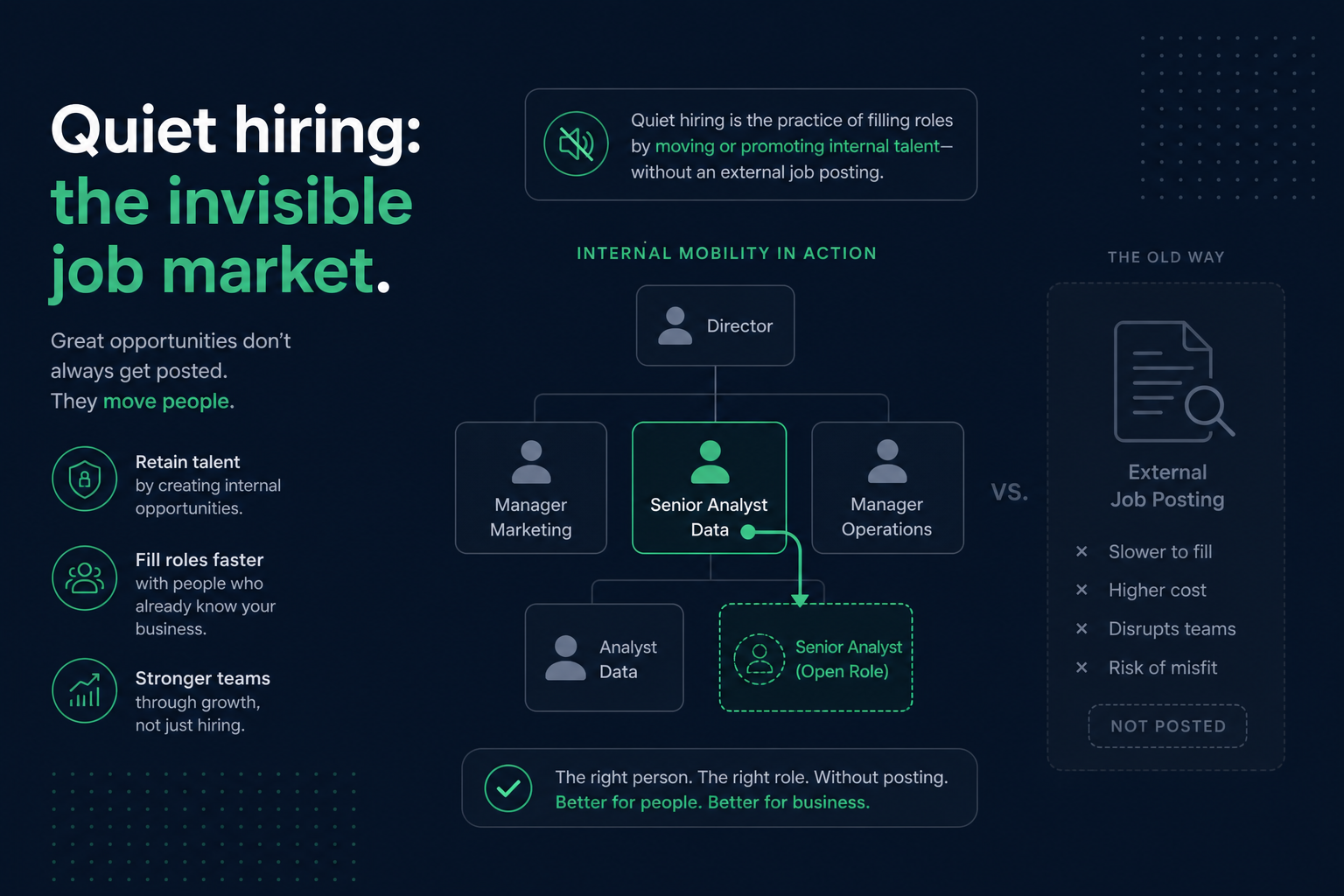
Quiet hiring is the practice of filling a skills or headcount gap without opening a brand-new external req—through internal transfers, stretch assignments, temporary contractors, or reshuffled responsibilities on an existing team. It is the hiring-side mirror of "quiet quitting," and it has become a bigger part of how companies operate in 2026 as hiring budgets stay tighter and internal mobility tooling gets better.
For job seekers, this matters in two very different ways depending on which side of it you are on. If you are already inside a company, quiet hiring is often an opportunity—a chance to move roles without a formal external hire. If you are searching externally, it is part of why fewer net-new postings show up even when companies are, in a real sense, still hiring. This guide covers both angles.
Key Takeaways
- What quiet hiring actually looks like inside a company
- Why it means fewer visible external postings even in a healthy market
- How to position yourself for an internal move if you are already employed
- How to counter it as an external candidate
- A resume framing shift that works for both situations, and still parses cleanly through ATS platforms like Workday and Greenhouse
What quiet hiring actually looks like
It rarely has a name or an announcement—that is the "quiet" part. In practice, it shows up as:
- A manager asking an existing employee to "pick up some of this" for a role that is not being backfilled externally
- An internal job board posting that never gets mirrored to external boards, filled entirely through internal applicants
- A short-term contractor or agency hire brought in to cover a gap while a permanent decision is deferred
- A "lateral stretch" where someone moves sideways into a growing area of the business without a formal promotion or new title yet
None of these produce a LinkedIn post or an external job listing, which is exactly why they are invisible from outside the company—and why relying purely on visible external postings undercounts how much hiring activity is genuinely happening.
Key Takeaway: Quiet hiring rarely produces a visible job listing, so a job board search alone will miss most of it.
Why this means fewer visible postings, even in a healthy market
From an external candidate's seat, quiet hiring is one of the reasons a healthy-feeling economy can still produce a thin external job board. A company can be actively solving headcount and skills gaps and simply not be doing it through the channel you can see. This is a separate phenomenon from ghost jobs , where a listing exists but is not real—here, the hiring is real, it is just happening through a channel with no public listing at all.
Practically, this shifts where your search time is best spent: a market with more quiet hiring rewards referrals and direct outreach to hiring managers relatively more than blind board applications, since a real but invisible need is exactly the kind of gap a direct conversation can surface before it ever becomes a public posting.
Key Takeaway: A thin external job board does not always mean thin hiring — it can mean more of it is happening through channels you cannot see.
If you are already inside the company: positioning for an internal move
Quiet hiring often favors whoever is visible and ready when the gap opens, not necessarily whoever is most qualified on paper. A few concrete moves increase your odds:
- Keep an internal-facing resume or profile current. Many companies use an internal talent marketplace tool—treat your profile there with the same care as an external resume, since it is often the first thing a hiring manager checks before opening an external req.
- Say the quiet part out loud, occasionally. Managers cannot consider you for a stretch assignment they do not know you want—a direct, low-pressure conversation ("I'd like more exposure to X") does more than a strong resume sitting unseen in a system.
- Volunteer for the unglamorous version first. Quiet hiring frequently starts as an unofficial stretch task before it becomes a formal title change—taking it on visibly is often the actual application process, even though it does not look like one.
- Document the stretch work as you do it. When the informal responsibility eventually becomes a formal move, you will need the same quantified language any resume needs—track the scope and outcome from day one rather than trying to reconstruct it later.
Key Takeaway: Internal moves usually go to whoever was visible and ready, not whoever was most qualified on paper — so an up-to-date internal profile matters as much as a resume.
If you are searching externally: how to counter it
You cannot apply to a req that was never posted, so the counter-strategy is to get in front of the need before it becomes public, or make yourself visible enough that you are considered alongside internal candidates:
- Increase the share of your search time spent on direct outreach to hiring managers and referrals relative to cold board applications—this is the closest external equivalent to being "in the room" when a gap surfaces internally.
- Follow companies' internal-mobility and "we're growing" signals (team expansions, new leadership hires) as leading indicators of upcoming external need, even before a formal posting appears.
- When you do reach a hiring manager directly, lead with the specific gap you believe exists rather than a generic "open to opportunities" message—quiet hiring situations often start from a manager's unspoken pain point, not a job description.
Key Takeaway: You cannot apply to a req that was never posted, so direct outreach and referrals matter more in a quiet-hiring market than in a market with a full job board.
Whichever side of quiet hiring you're on, make sure your resume actually reads well once it hits an ATS. Run it through HireFlow's free ATS checker on hireflow.net — no signup required.
A resume framing shift that works either way
Whether you are angling for an internal move or countering quiet hiring from outside, the same framing shift helps: lead with the specific capability or gap you can fill, not just your current job title. A quiet hiring decision is usually made to solve one concrete problem—frame your summary and top bullets around the problems you have solved that most resemble it, rather than a generic career narrative.
Example shift
Generic: "Marketing manager with 6 years of experience in digital campaigns."
Gap-specific: "Marketing manager who has stood up a lifecycle email program from zero in two prior roles—relevant if a team needs that capability built rather than maintained."
Key Takeaway: Lead with the specific gap you can fill, not just your job title — quiet-hiring decisions are almost always made to solve one concrete problem.
Signals a company is quiet hiring (and how to spot them from outside)
Quiet hiring is almost by definition not announced — but it leaves visible footprints in public data if you know what to look for. Before you apply to a company, or before you follow up on a cold outreach, scan for these signals:
- Job postings that bundle two or three unrelated skill sets into one req. A listing titled "Sales Enablement and Revenue Operations Analyst" that also asks for content writing experience is not poorly written — it is a company trying to cover two half-headcount gaps with one hire. The role is real but the budget was approved for one person, not two.
- Vague or hyphenated hybrid titles. Titles like "Marketing Operations and Growth Lead," "Finance and Strategy Analyst," or "Customer Success and Onboarding Manager" are a tell. In a well-staffed org these functions sit in separate roles. When they are merged into one title on an external posting, it usually means the company is stretching one hire to cover a larger footprint than the title implies.
- A publicly announced slowdown followed by a handful of "critical" postings. If a company's press releases or earnings calls mention headcount discipline, but their careers page shows five open roles, those five roles survived a deliberate filter. That is a quiet-hiring signal: only the gaps they cannot fill internally are making it to external boards.
- A wave of layoff announcements, then a burst of internal promotions. Watch a company's LinkedIn activity for a few weeks after a reduction in force. If you see a cluster of internal promotion announcements — especially into roles that lost people — the company is quiet hiring from within rather than replacing externally. This is a strong signal that any external role they do post will be fiercely competitive, or that the real need has already been resolved internally.
- Headcount growing in one function, shrinking in another, with no corresponding external postings. Browsing employee profiles or using LinkedIn analytics can show you that a company's engineering team grew from 40 to 55 people over six months while its marketing team shrank from 12 to 8, with no external marketing roles ever posted. That pattern points to internal redeployment or quiet-hired contractors at work.
- Job descriptions that emphasize "wearing multiple hats" or "thriving in ambiguity." These phrases are not just culture-fit language. In a quiet-hiring context they are functional requirements: the company knows the role is broader than the title and is signaling it in the only place they can, which is the job description itself.
None of these signals alone confirms quiet hiring, but two or three together — especially a public slowdown combined with internal promotion activity and hybrid role postings — form a reliable pattern. Use it to calibrate how much time to invest in direct outreach versus board applications for that specific company.
Key Takeaway: Hybrid job titles, a public slowdown paired with a handful of "critical" postings, and internal promotions after layoffs are the clearest outside signals of quiet hiring.
Before and after: rewriting a bullet for a quiet-hiring market
Quiet-hiring employers — even when the job title looks narrow — are screening for candidates who can flex across adjacent functions and do more with less. A resume bullet that highlights a single-function win can be reframed to show cross-functional range and resourcefulness without changing the underlying accomplishment. Here are two concrete examples.
This matters for parsing, too. Workday's recruiting module indexes bullets as flat text blocks and weights the verbs and nouns near the front of each line more heavily in keyword matching, so burying "cross-functional coordination" at the end of a bullet is a wasted signal. Greenhouse's parser instead builds a structured work-history object from your bullets and surfaces the first line of each role prominently to recruiters — which is exactly why the rewrites below front-load the broadest, most flexible capability first.
Operations role
Before
"Reduced warehouse pick-and-pack cycle time by 18% by renegotiating the shift scheduling model with the operations supervisor."
After
"Cut warehouse cycle time 18% by diagnosing a scheduling bottleneck, proposing a shift restructuring to ops leadership, and coordinating the rollout across a three-person team — without adding headcount or external consultants."
The underlying fact is the same. The rewrite adds three things a quiet-hiring reader is scanning for: independent problem diagnosis (you did not wait to be assigned), cross-functional coordination (ops leadership, a small team), and explicit resourcefulness framing ("without adding headcount"). Each of those is a signal that you operate well in a stretched-resource environment.
Marketing role
Before
"Managed the company blog, publishing 12 posts per month and growing organic traffic 35% year over year."
After
"Ran the full content operation solo — editorial calendar, writer briefs, SEO strategy, and distribution — growing organic traffic 35% year over year on a budget that covered one freelance writer; also owned the monthly reporting deck presented to the VP of Marketing."
Again, the result is identical. What changed is the scope signal: "ran the full content operation solo" tells a quiet-hiring reader that you covered a function that might otherwise require two or three people. "Also owned the monthly reporting deck" shows an upward stakeholder relationship — exactly the context a hiring manager needs when weighing someone for a merged role that requires both execution and upward communication.
Both rewrites follow the same template: open with an independent-action verb, name the functions touched, quantify the outcome, and include a "doing more with less" frame — constrained budget, small team, solo ownership, or no additional headcount. Use HireFlow's job match score tool to check whether your rewritten bullets are registering on the signals a specific job description is actually screening for.
Key Takeaway: Keep the underlying facts identical and add independent-action verbs, named cross-functional context, and a "doing more with less" frame — that combination is what a quiet-hiring reader is scanning for.
Positioning yourself for internal-mobility-style roles as an external candidate
Internal candidates in a quiet-hiring market have a structural advantage over external applicants: they are known quantities, they require no ramp-up budget line item, and their cultural fit is already proven. You cannot erase that gap entirely, but you can narrow it by addressing it directly rather than pretending it does not exist.
The three things an internal candidate implicitly signals — and that you need to signal explicitly — are ramp-up speed, cross-functional adaptability, and willingness to own ambiguous scope.
- Ramp-up speed. Quantify how quickly you came up to speed in prior roles. "Contributing to production within two weeks" or "led first cross-team project in month three" tells a hiring manager that the onboarding cost of bringing you in is lower than it might appear. This is especially compelling when the manager is weighing you against an internal candidate who would need zero ramp time.
- Cross-functional adaptability evidence. Name the adjacent functions you have worked in or alongside, not just your primary function. If you are a data analyst who regularly presented findings to marketing and sales leadership and helped shape campaign strategy, say so explicitly. The ability to operate across function lines is precisely what a hybrid-role posting selects for, even when the job description does not say it in those words.
- Willingness to own ambiguous scope. Use the cover letter or your summary section to address this directly. Not "I am comfortable with change" (generic) but something more specific: "I have moved into two roles where the scope was partially undefined and have a habit of writing down the actual job description as I learn it — which tends to be useful for whoever hires into the function next." This shows self-awareness, organizational value, and no fear of undefined territory.
A note on the overqualified concern: in a quiet-hiring market, hiring managers are often more worried about a senior external candidate getting bored and leaving after six months than they are about skills fit. If your experience level is above the stated grade, address it head-on in your cover letter: "I am applying for the associate-level role because I want to build depth in this specific domain, not because I could not get a senior role elsewhere." One honest sentence is more credible than hoping they will not notice the seniority gap.
Conversely, if the role appears designed for a more senior person than its title suggests — common in quiet-hiring postings — you can use the cover letter to acknowledge the hidden scope: "I noticed this role combines X and Y — I have done both in a prior position and am comfortable with that breadth." This signals you read the req carefully and are not expecting a narrower job than they are actually offering.
The best place to lead with these signals is the resume summary section — two to four lines at the top of the document. That is the first thing a hiring manager reads, and in a quiet-hiring context the decision about whether to move forward often happens before they reach the experience bullets. A sharp, specific summary that names the exact capability the role needs — not a generic objective statement — is the closest analog to the "known quantity" advantage an internal candidate already carries into the process. If you need help structuring that summary, the free resume builder walks through the summary section as part of the build flow.
Key Takeaway: As an external candidate, explicitly signal ramp-up speed, cross-functional range, and comfort with ambiguous scope — the three things an internal candidate gets for free.
Where to take this next
Whichever side of quiet hiring you are working, a resume built around specific, quantified capability statements performs better than a generic career summary—the same principle covered in our guide to how AI resume screening agents score trajectory and skill adjacency . Use HireFlow's free resume builder to keep a sharp, capability-led version ready for the moment a quiet opportunity—internal or external—actually surfaces.
Frequently asked questions
No — they are related but distinct. A hiring freeze means no new external headcount is being approved at all. Quiet hiring is what happens inside or alongside a freeze: the company still has skills gaps and fills them by moving people internally, extending contractor engagements, or approving a small number of highly prioritized external roles. A company can be in a quiet-hiring mode with no freeze in place at all — it is a practice, not a policy.
Mostly different ones. The total number of roles being filled does not necessarily shrink — it is the channel mix that shifts. Fewer roles go to external public postings; more are filled internally or through direct outreach and referrals. For a job seeker, this means the posted job board undercounts real hiring activity, and strategies that rely entirely on board applications will underperform compared to strategies that include direct outreach and referral networks.
Generally yes, with caveats. Hybrid roles in a quiet-hiring context were often written to describe two partial gaps merged into one req — meaning no single internal candidate fully matched it either. If you meet roughly 60 to 70 percent of the stated requirements and your strongest skills cover the more critical half of the role, apply and address the gap directly in your cover letter. Silence about a missing skill reads as either ignorance or avoidance; a brief honest acknowledgment paired with a credible plan to develop it reads as self-awareness.
Look for the cluster of signals described earlier in this article: hybrid or merged job titles, public statements about headcount discipline combined with a small number of live postings, and LinkedIn activity showing internal promotions following layoffs or departures. You can also ask a recruiter or hiring manager directly — "Is this role being considered internally as well?" is a reasonable question that signals you understand how hiring actually works, and a good recruiter will give you an honest answer.
Entry-level candidates are less affected by the internal-mobility dynamic because companies cannot usually quiet-hire a first-time employee — there is no internal pool of junior candidates to redeploy. However, entry-level candidates still feel the downstream effects: the roles that do get posted skew toward candidates with demonstrated flexibility and early evidence of cross-functional range. Internship experience that touched multiple disciplines, side projects bridging two functions, or coursework combining technical and communication skills are worth surfacing explicitly on an entry-level resume in this market.
The conditions driving quiet hiring — tighter headcount budgets, better internal mobility tooling, and AI automating enough routine work to make hybrid roles feasible for one person — are structural rather than cyclical. Internal talent marketplaces at large companies were already growing before 2024, and the cost of hiring externally relative to redeploying internally has not narrowed. The intensity may fluctuate with economic conditions, but the underlying direction — companies preferring to fill gaps without opening net-new external reqs where possible — is likely to persist well past 2026.