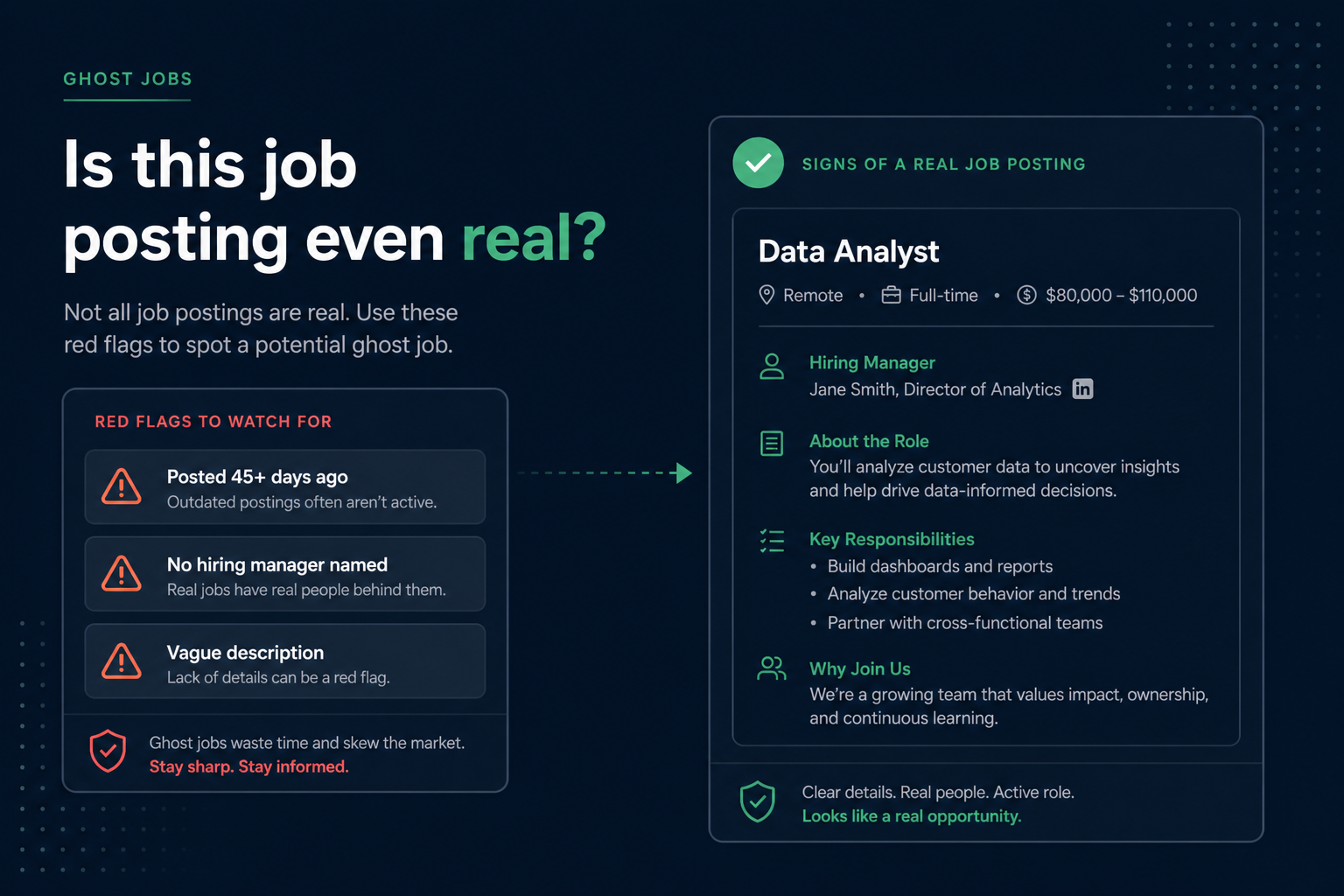
A ghost job is a listing that stays posted—sometimes for months—for a role the company is not actively trying to fill. No one is reviewing applications, no interviews are scheduled, and the "Apply Now" button leads into a queue that never moves. Various labor-market surveys and recruiter reports in 2026 suggest a meaningful share of postings on major boards fit this pattern, though estimates vary widely by source, platform, and industry, and no single authoritative figure exists.
That uncertainty still changes how you should spend your time. If even a sizable minority of postings on a board are not real, blasting your resume at every listing that matches your title is not a numbers game you can win — it is a numbers game stacked against you before you even start. This guide covers why ghost jobs exist, the concrete signals that separate a real opening from a fake one, and what to do differently once you can tell them apart.
Key Takeaways
- No single signal proves a listing is fake — look for three or more together before deprioritizing it.
- Posting age past 45 days, vague duties, and an unusually wide salary band are among the more reliable red flags.
- A quick search for "[company] layoffs" or "[company] hiring freeze" often resolves the question in under a minute.
- Ghost jobs are not illegal in most places, so the burden of filtering falls on the candidate, not on any enforcement mechanism.
- Exclude confirmed ghost-job applications from your own response-rate tracking so your numbers reflect real opportunities.
- Why companies post jobs they are not filling
- Eight signals a listing is a ghost job, ranked by reliability
- How long a real posting usually stays up, by platform
- A 60-second check you can run before every application
- What to do if you already applied and got silence
Why companies post jobs they are not hiring for
Key Takeaway
Most ghost jobs are not malicious — they result from pipeline hoarding, procedural posting requirements, or a closed req that nobody remembered to take down.
Ghost jobs are not usually malicious—they are mostly a side effect of how hiring pipelines are managed in 2026. Understanding the motive helps you spot the pattern faster:
- Pipeline building. Some companies keep evergreen postings live year-round for competitive roles (sales, engineering) so they always have a warm pool of resumes on file, regardless of whether a seat is open right now.
- Internal candidate already selected. Many roles are legally or procedurally required to post externally even after an internal transfer or referral has effectively been chosen.
- Signaling growth to investors or the market. A large open-roles page can be used as a growth signal, even when a slower hiring freeze is quietly in effect internally.
- Budget approval fell through after posting. The req was opened, then frozen, but nobody took the listing down.
- Recruiter or agency inventory. Staffing agencies sometimes keep high-demand titles posted continuously to farm resumes for future, unrelated openings.
None of these excuse the practice from a candidate's perspective—you still lose the time you spent tailoring an application. But knowing the motive helps you predict which listings are riskiest: postings with no closing date, generic req numbers, and titles that appear on the same board every quarter are the ones worth the most scrutiny.
Eight signals a listing is a ghost job
Key Takeaway
Posting age, repeated reposting, and a hiring freeze in the news are the most reliable individual signals; treat weaker signals as supporting evidence only.
No single signal is proof on its own. Two or three together is a strong reason to deprioritize the application in favor of something more likely to convert.
| Signal | What to check | Reliability |
|---|---|---|
| Posting age | Live 45+ days with no reposting or edit date | High |
| Repeats every quarter | Same title reappears on the careers page every few months | High |
| No hiring manager named | Posting only lists "the team" or a generic recruiter alias | Medium |
| Vague, copy-paste description | Same boilerplate duties appear across multiple unrelated listings from the company | Medium |
| Salary range spans huge | A range like $60K–$140K suggests the role was never fully scoped | Medium |
| No response after 3+ weeks | Not proof alone, but combined with the above it is a strong tell | Medium |
| Company has a hiring freeze in the news | Search "[company] layoffs" or "[company] hiring freeze" before applying | High |
| Identical posting on 5+ boards, no ATS confirmation email | You never receive an automated "we received your application" reply | Low–Medium |
A missing confirmation email is the weakest signal on its own—some companies genuinely have slow or broken auto-replies—but paired with a 45-day-old posting and a vague description, it rounds out a pretty clear picture.
How long a real posting usually stays live
Key Takeaway
A real posting usually closes or gets edited within 10-30 days; entry-level and high-volume roles are the main exception since they backfill continuously.
This varies by platform and role level, but as a rough benchmark for 2026:
Typically real
- Posted and filled or closed within 10–30 days
- Has a specific hiring manager or team name
- Sends an automated confirmation within minutes
- Description mentions a specific project or team need
- Salary range spans less than $25K
Worth questioning
- Live 45+ days with the same posted date, never edited
- Reappears every quarter under a slightly different req ID
- Generic "growing team" language with no specifics
- No response after three or more weeks with other red flags present
- Company recently announced layoffs or a freeze in the same function
Entry-level and high-volume roles (retail, call center, some sales) tend to stay posted longer even when genuinely hiring, since companies backfill turnover continuously—so apply the checklist with some judgment for those categories rather than treating "posted 45 days" as automatic disqualification.
A 60-second check before you apply
Key Takeaway
Checking the posted date, searching for a hiring freeze, and looking for a named hiring manager takes under a minute and resolves most ambiguity before you apply.
Run this before spending 20+ minutes tailoring a resume and cover letter to a listing:
- Check the posted date. If the board shows it, and it is 45+ days old with no edits, treat it as lower priority—not automatically fake, but worth deprioritizing.
- Search the exact job title plus the company name. If the identical listing shows up from six months ago on a cached page or Wayback Machine snapshot, that is close to confirmation.
- Search "[company] layoffs" or "[company] hiring freeze." A recent freeze in the same department is a strong signal the listing is stale even if it looks fresh.
- Look for a named hiring manager or team on LinkedIn. If you can find the actual manager and see they have hired for adjacent roles recently, that is a good sign the req is live.
- Note whether the salary range is unusually wide. A $50K span usually means the role was never precisely scoped internally.
None of this should stop you from applying to a listing that raises one mild flag—plenty of real jobs have a slightly wide salary band or a slow recruiter. Reserve the skip decision for listings that trip three or more signals at once, and spend the time you save tailoring a stronger application to a listing that passes the check.
While you're vetting listings, make sure the applications you do send are as strong as possible.
Run a free ATS check on HireFlowWhat to do if you already applied to a ghost job
Key Takeaway
Send one polite follow-up, then move on — do not keep tailoring new versions of your resume to a listing that shows multiple ghost-job signals.
Silence after applying does not automatically mean the listing was fake— slow hiring is common in 2026 even for real roles. But if it has been three or more weeks with zero contact, and the listing shows other ghost signals, it is reasonable to stop waiting on it and act:
- Send one polite follow-up to the recruiter or hiring manager if you can find a name, then move on regardless of the reply.
- Do not keep tailoring new versions of your resume to the same listing— that time is better spent on a fresh, verified-active posting.
- Log it and stop counting it toward your "applications sent" total when you evaluate your response rate—it is skewing your data if you leave it in.
If ghost jobs are eating a large share of your applications, the fix is upstream: spend more of your search time on referrals and direct outreach to hiring managers, where a listing being real is never in question, and reserve board applications for postings that pass the checklist above.
Ghost jobs by industry and platform in 2026
Key Takeaway
Tech, finance, and large free-to-post platforms like LinkedIn and Indeed appear to carry higher ghost-job risk; niche, moderated boards tend to carry less.
Ghost jobs are not distributed evenly across the labor market. Some industries and some platforms appear to be worse offenders than others based on recruiter reports and candidate anecdotes—and understanding the general pattern can help you calibrate how much scrutiny to apply before you hit submit. Treat the relative rankings below as directional, not as precise measured figures.
The broadest pattern is this: the higher the competition for a role and the lower the cost of posting, the more ghost listings tend to accumulate. Tech roles attract enormous applicant volume, which makes keeping a pipeline open nearly free in terms of recruiter effort. Government and regulated healthcare roles sit closer to the other end—external posting requirements are often legal mandates, so even a role that was filled internally must stay visible for a defined period. The tables below summarize the general pattern by industry and by platform.
| Industry | Relative Ghost Job Risk | Why |
|---|---|---|
| Tech / Software | Higher | Pipeline hoarding for scarce skills; hiring freezes that never cleared the board |
| Finance / Fintech | Moderate to higher | Regulatory postings for roles already filled internally; competitive talent signaling |
| Healthcare (clinical) | Lower | High backfill urgency and licensing requirements make ghost postings less useful |
| Retail / Hospitality | Highly variable | Continuous turnover makes "always open" postings genuinely appropriate for some roles, blurring the line |
| Government / Public sector | Moderate to higher | Mandatory public posting windows mean some roles close before the listing does |
Platform matters nearly as much as industry. The economics of posting on each channel create very different incentive structures for keeping stale listings live:
| Platform | Relative Ghost Job Risk | Why |
|---|---|---|
| Higher | Posting is cheap, applicants are plentiful, and removal requires deliberate manual action | |
| Indeed | Higher | Free-tier postings never expire automatically; ATS integrations often re-sync stale reqs |
| Company career pages | Moderate | Direct listings but ATS systems require human action to close; budget freezes get missed |
| Staffing agency boards | Higher | Agencies post generic titles to farm resumes for future placements, not current openings |
| Niche / industry job boards | Lower | Paid listings and active moderation create stronger incentives to remove closed roles |
The practical upshot: niche boards with paid listings and active moderation tend to have far fewer ghosts than the large free-to-post platforms. If you are job hunting in a field that has a respected vertical board—engineering, design, legal, healthcare, data science—it is worth weighting applications there more heavily than on LinkedIn or Indeed, where the economics of posting actively encourage stale listings to persist indefinitely. When you do use the big platforms, treat them as a starting point for research and verification, not as a reliable catalog of active openings.
What ghost job listings actually look like — annotated examples
Key Takeaway
Ghost job language is almost always plausible-sounding — watch for vagueness, undefined scope, and "always looking" or "talent community" phrasing.
Knowing the red flags in the abstract is useful. Seeing them in realistic listing language is more useful. The three excerpts below are composite examples—not from any specific company—but each phrase was drawn from the patterns that appear most often in ghost postings. After each excerpt, the annotation identifies the specific tell and why it matters.
Note that none of these examples look obviously fraudulent. That is the point. Ghost job language is almost always plausible-sounding—the signals are in the vagueness, the scope, and the absence of specifics that a real active req would include.
"We are always looking for talented engineers to join our growing team. This role may be based in New York, Austin, or remote depending on business needs. Compensation is commensurate with experience."
The tell: "Always looking" is the signature phrase of a permanently open pipeline posting. A real active req has a defined location decided before the listing went live—"depending on business needs" signals that no one has actually made that decision, because the seat may not be genuinely approved. "Compensation commensurate with experience" with no range attached is the written equivalent of a placeholder salary field.
"Acme Corp is seeking a Senior Product Manager to support our product organization. The ideal candidate will have 5 to 10 years of experience across a range of industries. Responsibilities include owning the roadmap, collaborating with stakeholders, and driving go-to-market strategy."
The tell: The 5-to-10-year experience band is unusually wide, and "a range of industries" adds another layer of vagueness. The listed duties—roadmap, stakeholders, go-to-market—describe the job title itself, not a specific seat. Real active postings tend to mention a product name, a team, a business problem, or a specific gap the hire will address. When a description could be copy-pasted onto any PM role at any company, the role was likely never precisely scoped internally.
"Due to high application volume, we are unable to respond to every applicant. Only candidates selected for an interview will be contacted. We are actively building our talent community for upcoming opportunities."
The tell: "Actively building our talent community for upcoming opportunities" is the staffing-agency version of a ghost job stated almost outright. The opening you applied to does not exist in its current form—your resume is being stored for something else at an undetermined time. This is not inherently harmful, but you should not count this application in your active pipeline, plan follow-ups around it, or expect it to convert on any predictable timeline.
Real listings are rarely perfect—they can be vague in places and still be genuine. The pattern to watch for is a combination: vague duties, no team or project context, a wide or absent salary band, and a posting age that does not match the urgency the language implies. One imprecise phrase is noise; three of them together is a signal.
Could companies fix this? Why most don't
Key Takeaway
Closing a stale listing is technically easy but rarely incentivized — recruiter pipeline metrics and platform inventory goals both favor leaving it up.
It would be technically straightforward for companies to eliminate most ghost job postings. Auto-expiration rules already exist in every major applicant tracking system—a hiring team could set a role to expire after 30 days with a single checkbox. Major job boards could require quarterly confirmation that a role is still accepting applications before continuing to display it. None of this is happening at scale, and it will not any time soon. The reason is not technical; it is structural.
Recruiter incentives favor pipeline over precision. Many corporate talent acquisition teams are measured partly on the size and quality of their candidate pipeline—the number of qualified resumes on file, the number of candidates at various funnel stages. Keeping a posting live costs nothing and adds names to that pipeline. Taking it down ends the inflow. A recruiter whose performance review includes "talent pipeline coverage" has almost no incentive to close postings quickly, even when a seat has been filled. The metric that matters to the recruiter is pipeline volume; the accuracy of the listings driving that volume is not scored.
Legal and procedural cover for internal hires. Many organizations—particularly larger corporations, universities, and any government-adjacent entity—have official policies requiring external postings for roles even when an internal candidate is already the intended hire. The posting is compliance theater, not a real search. From the inside this is routine; from the outside it is indistinguishable from a genuine opening. The listing stays live for the required duration, applications flow in, and most of them are never reviewed by anyone.
There is no cost to the employer. If you apply to a ghost job and hear nothing, you have lost time; the company has lost nothing. Job boards charge for sponsored placements and premium visibility, not for unreviewed applications. The economic harm falls entirely on the candidate side. Until that asymmetry changes—through regulation, binding platform policy, or reputational pressure significant enough to affect employer brand—companies have no financial reason to clean up their listings after the fact.
Applicant tracking systems make removal easy to skip. Most ATS platforms require a deliberate close action: someone has to log in, find the req, and mark it filled or cancelled. In Workday, that means a recruiter manually moving the requisition to a "Closed" status; in Greenhouse, it means archiving the job and confirming any synced external postings update accordingly. When a hiring manager accepts an internal transfer over a phone call on a Tuesday afternoon, closing the req in either system is not on anyone's task list. The posting stays open by default, and the effort required to close it is nonzero—so it frequently goes undone for weeks or months, by which point it has been re-indexed by job boards and continues collecting applications.
Platform incentives cut the same direction. LinkedIn, Indeed, and similar boards benefit from appearing to have large, robust listing catalogs. More listings mean more user engagement, more page views, and more justification for their recruiter-side subscription revenue. Aggressively pruning ghost listings would shrink their apparent inventory and could reduce a key engagement metric. That is not a problem these platforms are motivated to solve through their own initiative.
The realistic near-term trajectory is that ghost job prevalence stays elevated or increases modestly as job boards continue to grow and hiring becomes more globally distributed. Some newer paid-listing platforms have better incentives, and the emergence of AI-powered job-search tools may eventually surface ghost-job signals at scale and allow candidates to filter them automatically before applying. But for now, the problem sits squarely with the candidate to manage, one application at a time. That is not a reason for frustration—it is a reason to adjust your process to account for the market as it actually operates rather than as it should.
Before and after (ATS-safe wording)
Key Takeaway: keep the same fact, add the tool name and a number.
| Before | After |
|---|---|
| Responsible for reports and team support. | Built weekly Workday headcount reports that cut manager follow-ups by 30%. |
| Used office software and helped customers. | Processed 40+ Greenhouse tickets/week in Zendesk with 96% CSAT. |
| Improved processes across the department. | Mapped the Taleo requisition workflow and cut time-to-post from 5 days to 2. |
Where to take this next
Filtering out ghost jobs protects your time, but it only helps if the applications you do send are strong. Once you have a shortlist of verified-active postings, run your resume against the specific job description with HireFlow's Job Match Score to see how well it aligns before you submit, and make sure the file itself parses cleanly with a free scan on HireFlow . If you are also getting silence on postings you have confirmed are real, that usually points to the resume itself rather than the listing—our guides on quality applications versus mass applying and how to track your job search conversion rate walk through the most common causes.
Frequently asked questions
In most jurisdictions, no. There is no general law in the United States or the European Union that requires a company to take down a job posting once a role has been filled or frozen. Some government and government-adjacent positions have mandatory posting and closing procedures tied to procurement rules, but private-sector employers face no equivalent requirement. A handful of state-level pay-transparency laws touch on posting accuracy, but enforcement is limited and none specifically target ghost postings as a defined category of violation.
Applying to a ghost job does not leave any negative mark on your candidacy with that employer—there is simply no one actively reviewing your materials to form an opinion. The harm is entirely opportunity cost: the time you spent tailoring an application could have gone to a real opening. If you are tracking your own metrics—applications sent, response rate, interviews booked—exclude ghost-job applications when you calculate your response rate, or the denominator will be inflated and the resulting number will be misleadingly low.
One mild signal is not enough to skip an application, especially if the role is a strong fit. A slightly wide salary band or a posting that has been live for five or six weeks is not confirmation of anything on its own. The threshold worth acting on is three or more signals appearing together—posting age past 45 days, a vague description with no team or project context, a salary range spanning more than $50K, repeated quarterly reposting, and company news of a hiring freeze in the same function. That combination is worth deprioritizing. A single flag is worth noting but not worth walking away from a genuinely strong opportunity.
If the posting names a recruiter or links a LinkedIn profile, you can check a few signals: look at whether the recruiter has recently shared or commented on hiring-related content, whether their employer on LinkedIn matches the company posting the role, and whether other roles they have posted have recently been filled based on LinkedIn's "a hire has been made" notifications. A recruiter with a dormant profile and no visible hiring activity in the last 90 days is a weaker signal of an active search than one who is visibly engaging with candidates on the platform.
Many labor-market researchers believe so, though the exact magnitude is debated. Government job-openings surveys ask employers to self-report open positions, and there is no standard for excluding roles that have been effectively closed but never formally taken down in the ATS. If a meaningful share of reported openings are ghost listings, headline job-openings figures may overstate true labor demand, though the precise scale of that effect is not something HireFlow can verify or quantify.
There is no single verified figure, and the share varies widely by industry, seniority, and platform. What is consistent across observers is the direction: if you are applying primarily through large, free-to-post boards without any pre-screening, a meaningful portion of your applications are likely going to listings that are not actively reviewed. Running even a 60-second pre-check before each application can reduce that fraction and improve your overall response rate by concentrating your effort on listings more likely to convert. Use HireFlow's Job Match Score to make sure those better-vetted applications are as strong as possible before you send them.