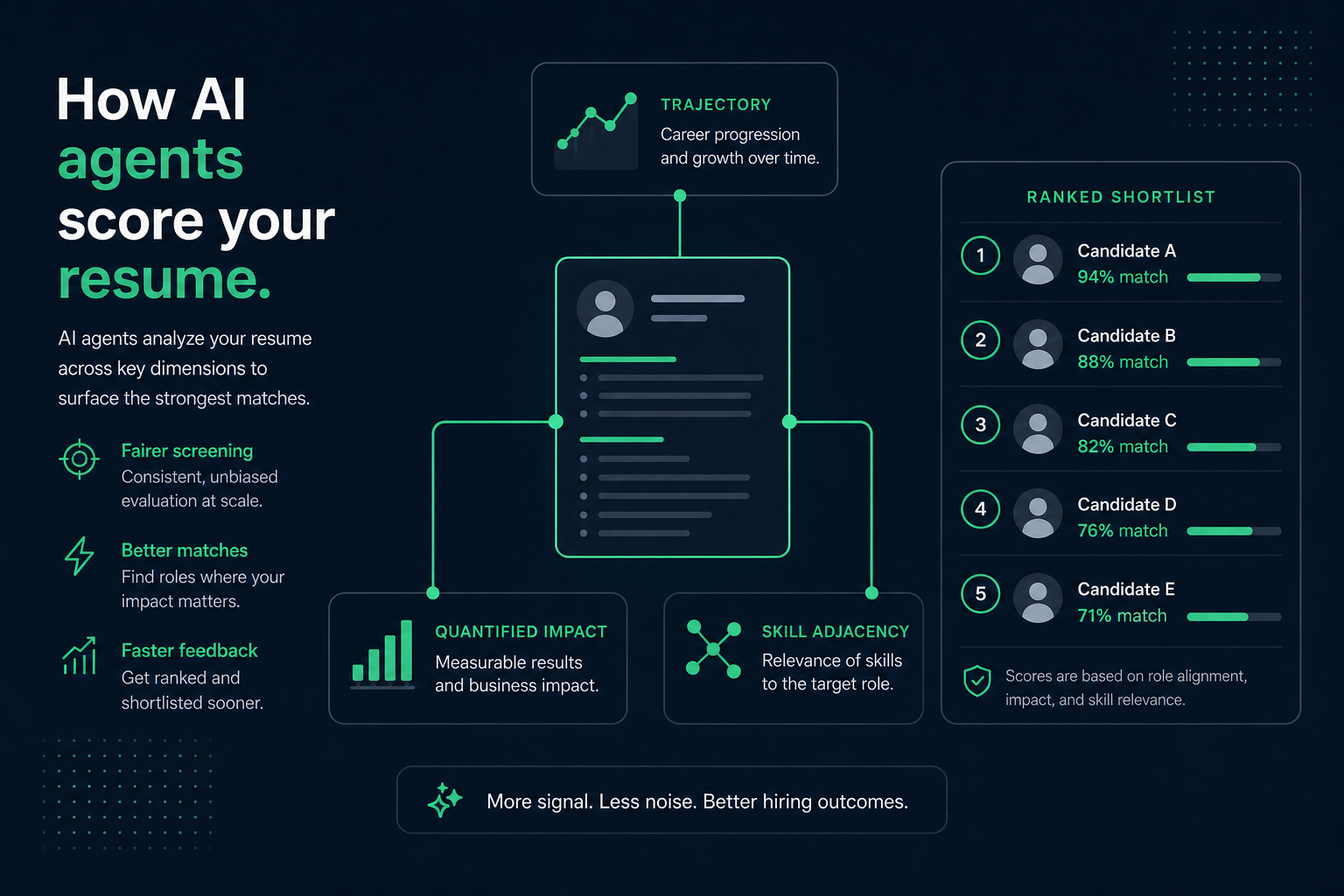
Most people still picture "the ATS" as a keyword-matching filter from a decade ago. In 2026, the majority of mid-size and large employers layer an AI screening agent on top of that ATS—a separate system that reads your resume more like a person would, then hands the recruiter a ranked shortlist and a written rationale. Surveys put AI use specifically for resume screening at over 80% of companies that use AI anywhere in hiring, making it the single most common HR use case for the technology.
That is a meaningfully different filter than the old rule of "match the keywords." This guide breaks down what these agents actually do step by step, the five signals they weigh most heavily, and the specific changes that help a resume score well without you having to guess at a system you cannot see.
Key Takeaways
- What an AI screening agent does that a classic ATS parser does not
- The four-step pipeline most agents run before a human sees anything
- The five signals these systems weigh most heavily
- "Skill adjacency"—how the AI credits skills you never listed
- A practical checklist to score well without gaming the system
AI screening agent vs. classic ATS: what is the difference?
Key Takeaway
A classic ATS stores and searches your application; a separate AI agent ranks it—clean parsing and a high AI score are two different hurdles you have to clear.
A classic ATS (Workday, Greenhouse, Taleo, iCIMS, and similar platforms) is mainly a database and a parser: it extracts your text into fields—name, title, dates, skills—and lets a recruiter search and filter that database. The parsing quality matters, but the "intelligence" historically stopped there.
An AI screening agent sits on top of that data and adds a scoring and reasoning layer. Instead of just indexing your resume, it:
Classic ATS does
- Parses text into structured fields
- Lets recruiters run keyword/boolean searches
- Flags missing required fields (visa status, location)
- Stores your application in a searchable database
AI screening agent adds
- Ranks candidates by predicted fit, not just keyword count
- Infers skills you have but did not explicitly list
- Evaluates career trajectory and role progression
- Writes a short rationale a recruiter can skim in seconds
In practice this often means both systems are running at once: the ATS handles storage and compliance, and the AI agent handles ranking. That is why a resume can parse cleanly into every field and still land near the bottom of a shortlist—clean parsing and a high AI score are two separate hurdles.
The four-step pipeline behind most AI screening agents
Key Takeaway
Extraction, trajectory comparison, skill inference, and a written rationale run in sequence—a failure in any early step degrades every step after it.
Vendors differ in the details, but the underlying pipeline is remarkably consistent across platforms like Eightfold, HireVue's screening tools, and similar recruiting-AI products:
- Structured extraction. Work history, education, and listed skills get parsed into a normalized profile—this step is where a messy layout or unusual fonts can still cause real damage.
- Trajectory comparison. The agent compares your career path—title changes, scope increases, tenure patterns—against the progression the job description implies, not just a single snapshot of your current title.
- Skill adjacency inference. Based on your actual bullets and job titles, the model infers skills you almost certainly have even if you never typed the exact word—more on this below.
- Ranking and rationale. The agent produces a score and a short, human-readable explanation ("Strong trajectory match; 4 of 5 core skills present; missing direct budget-ownership language") that a recruiter reads before deciding whether to open the full resume.
That last step is the one most candidates do not realize exists. The rationale text the recruiter reads is often generated from the same language patterns your bullets use—vague bullets produce a vague, less convincing rationale even if the underlying experience is strong.
The five signals these systems weigh most heavily
Key Takeaway
None of the five top signals is exact keyword count—trajectory, quantified outcomes, and seniority match now carry more weight than matching words.
| Signal | What it means for your resume |
|---|---|
| Trajectory and scope | Does your role progression show increasing scope, or a flat line of similar titles? |
| Quantified outcomes | Bullets with a number, percentage, or dollar figure rank consistently higher than task lists |
| Title/seniority match | Does your described scope match the seniority language of the target role, not just the job title? |
| Skill adjacency | Do your bullets imply skills the job needs, even ones not explicitly listed in your skills section? |
| Recency and tenure pattern | Is your most relevant experience recent, and is your tenure pattern consistent with the role level? |
Notice that none of these five is "exact keyword count." That single shift is the biggest change from the ATS advice era of the late 2010s and early 2020s, and it is why keyword-stuffing a resume in 2026 can actively hurt your ranking rather than help it.
Skill adjacency: how the AI gives you credit you did not ask for
Key Takeaway
Specific bullets let the model infer skills you never typed; vague bullets give it nothing to credit.
"Skill adjacency" is the term for a specific inference the model makes: if your bullets describe work that almost certainly required a skill, the agent credits you for that skill even if the word never appears on the page. For example, a bullet describing "migrated the reporting pipeline from spreadsheets to a BI dashboard used by three departments" strongly implies data modeling and stakeholder communication skills, even without those exact words present.
This cuts both ways. It means you do not need to cram every possible synonym into your skills section—the model can often infer competence from a well-written bullet. But it also means a vague bullet gives the model nothing to infer from, which is a second, quieter reason generic phrasing underperforms specific phrasing in AI-scored systems.
Example: same skill, two bullets
Weak: "Responsible for stakeholder communication across departments."
Strong: "Presented weekly forecasting updates to finance, ops, and executive stakeholders across 3 departments, aligning budget assumptions before quarterly close."
The second version gives the model concrete nouns to anchor an adjacency inference to—departments, cadence, a business process—while the first gives it almost nothing beyond the phrase itself.
A practical checklist for scoring well without gaming the system
Key Takeaway
Optimize for the underlying signals—scope, outcomes, seniority match—rather than trying to reverse-engineer any single vendor's model.
Trying to reverse-engineer a specific vendor's model is a losing game— these systems update constantly and none of them publish their weights. Optimizing for the underlying signals they consistently reward is a more durable strategy:
- Order your experience so scope visibly increases over time, not just titles changing
- Put a number, percentage, or concrete outcome in at least half your bullets
- Match the seniority language of the target role, not just its job title
- Write bullets specific enough that a skill can be inferred from context, not just claimed
- Keep your file format simple (single column, standard headings) so extraction does not fail before scoring even starts
That last point still matters even in an AI-heavy pipeline—garbled extraction from a complex layout means the trajectory and adjacency analysis is working from broken data, which tends to produce a lower score than a plain layout with slightly less polish.
Not sure whether your current layout parses cleanly for either kind of system?
Run it through HireFlow's free ATS resume checker — no signup required — before you spend time rewriting bullets.
How the scoring actually works, step by step
Key Takeaway
Scoring is five sequential steps, not one calculation—clean extraction has to happen before semantic matching and sub-scoring can work correctly.
The high-level pipeline described earlier still leaves many job seekers asking the same question: what is the agent actually computing at each stage, and how does a number appear out of the other end? Walking through a realistic technical sequence makes the logic far easier to reason about— and much easier to write toward.
Here is how a typical enterprise-grade AI screening agent processes a single application, from the moment your PDF lands in the ATS to the moment the recruiter sees a ranked card:
- Document parsing and field normalization. The agent converts your resume file into plain text, then maps that text into a structured schema: job titles, employers, date ranges, education, listed skills, and free-text bullets. This step uses a combination of layout heuristics and a specialized extraction model. A two-column layout, heavy use of tables, or text embedded inside graphics can all cause the extraction to fragment or lose information entirely—before any intelligence layer even runs.
- Embedding generation and semantic matching. Both your resume profile and the job description are converted into dense numerical vectors using a large language model. The distance between those two vectors in embedding space is the agent's first, coarse signal of overall relevance. Importantly, this is semantic similarity, not literal string overlap—a bullet about "growing attributed revenue by optimizing paid channels" lands close to a job requirement that says "experience driving pipeline through performance marketing," even though not a single word is shared.
- Criteria decomposition and weighted sub-scoring. The agent breaks the job description into discrete requirements—must-have skills, nice-to-have skills, seniority level, industry background, scope of ownership—and scores your resume against each requirement separately. These sub-scores are then combined with weights that the platform (or the employer's own configuration) sets. A role marked as requiring budget ownership might weight that single criterion at three times the value of a listed tool competency. You never see these weights, but they are why two candidates with similar-looking resumes can land 30 points apart on the final score.
- Trajectory and progression analysis. A reasoning pass examines how your titles, team sizes, and scope descriptors evolved over time. The agent is asking whether your arc points toward the target role or away from it. A candidate moving from coordinator to manager to director scores differently on a senior-IC role than the same raw experience reordered or presented as flat. The model is pattern-matching against thousands of career paths it was trained on, inferring whether your trajectory is a plausible fit for the seniority implied by the job.
- Rationale synthesis and shortlist assembly. After scoring, the agent generates a short natural-language summary—usually two to five sentences—explaining the score in terms a recruiter can act on: which criteria were strong, which were weak or absent, and whether there are any flags worth investigating. This summary is often the first thing a recruiter reads. It is generated from the language patterns in your own bullets, which means vague bullets produce vague rationale, and a recruiter reading "limited evidence of cross-functional scope" is unlikely to dig further into the full document.
| Stage | What can go wrong | What you can control |
|---|---|---|
| Parsing | Multi-column layout fragments bullets across fields | Use a single-column, text-based format |
| Semantic matching | Generic phrasing scores as irrelevant even if the work is relevant | Write outcome-specific bullets that use the vocabulary of the work |
| Sub-scoring | High-weight criteria (budget, P&L, headcount) go unmentioned | Surface scope explicitly in bullets, not just in a job title |
| Trajectory | Scope increases buried in long paragraphs the model does not parse | Lead bullets with scope before tasks |
| Rationale | Recruiter reads a weak summary and does not open the full file | Write bullets that generate a concrete, specific rationale |
The most important insight from this pipeline is that a score is not computed once—it is the cumulative result of five sequential steps, and a failure at any early step degrades every step that follows. Clean extraction is the prerequisite for accurate semantic matching, which is the prerequisite for reliable sub-scoring, and so on. You can write exceptional bullets and still receive a low score if the parser mangled your layout before the intelligence layer ever saw your content.
A worked example: the same resume, two different job descriptions
Key Takeaway
There is no single score attached to a resume—only a score relative to a specific job description, which is why the same file can rank very differently for two roles.
One of the most counterintuitive properties of AI screening agents is that there is no single score attached to a resume—only a score relative to a specific job description. The same document can land in the top quartile for one role and the bottom half for another posted the same week at the same company. This example makes that concrete.
Meet Jordan, a mid-level marketing professional with six years of experience. Jordan's resume highlights:
- Most recent role: Senior Marketing Manager at a direct-to-consumer e-commerce brand, two years
- Managed a combined paid social and paid search budget of roughly 1.2M annually
- Grew ROAS from 2.1 to 3.4 over four quarters by restructuring campaign taxonomy and bidding strategy
- Collaborated with the brand creative team on campaign concepts, but did not own creative briefing or brand guidelines
- Led one product launch campaign that included PR outreach and an influencer seeding program
- Prior role: Marketing Specialist at a B2B SaaS company, three years, with a mix of content and demand-gen work
Jordan applies to two open roles at two separate employers:
Role A: Performance Marketing Manager
The job description emphasizes paid channel ownership, ROAS and CAC targets, attribution modeling, and experience managing six-figure monthly ad budgets across Meta and Google. It lists brand affinity as a nice-to-have but not a core requirement.
Agent summary (illustrative):
"Strong match. Candidate demonstrates direct ownership of paid social and search spend at relevant scale, with quantified ROAS improvement across four quarters. Attribution and bidding strategy experience inferred from restructuring language. Brand and PR exposure present but weighted low for this role. Recommend for first-round review."
Estimated score: high — top 15% of applicant pool
Role B: Brand Marketing Manager
The job description centers on brand positioning, creative briefing, agency management, integrated campaign strategy, and consumer insight work. It lists paid media fluency as a plus but not a core requirement. The seniority signals imply ownership of a brand playbook, not a performance dashboard.
Agent summary (illustrative):
"Partial match. Candidate has performance marketing depth that is adjacent but not central to the role's core requirements. Brand campaign exposure is present (product launch, influencer seeding) but evidence of owning brand strategy, creative briefing, or agency relationships is limited. Paid-media background may complement an otherwise brand-focused team. Borderline for first-round review."
Estimated score: mid-range — borderline shortlist
Jordan's resume did not change between these two applications. The job descriptions did. The agent dynamically re-weighted which bullets mattered and which were peripheral, then generated a different qualitative judgment for a recruiter to act on. This is what "semantic matching against the job description" actually looks like in practice—it is not one score attached to a person, it is a relevance calculation rerun from scratch for every opening.
The practical takeaway for Jordan: for Role B, the resume would score higher if the product launch bullet were expanded to describe the brand strategy rationale behind it, and if any agency or creative collaboration were surfaced explicitly—not because those things would fool the agent, but because the agent genuinely cannot credit experience it cannot see. Tailoring is not gaming the system; it is giving the system the evidence it needs to make an accurate assessment.
What this means for how you should write your resume
Key Takeaway
Write outcome-based bullets an agent can reason about, surface seniority early, and skip literal keyword-density tricks—they read the same way to a human, too.
Most AI resume advice recycles the old ATS playbook: find the keywords in the job description, mirror them in your resume, repeat. That advice was always reductive and is now actively counterproductive for the systems doing most of the screening in 2026. Here is guidance that is specific to how these agents actually reason.
Write outcome-based bullets an agent can reason about, not just match
Semantic matching means the agent is looking for meaning, not exact strings. A bullet that reads "Managed SEO strategy" gives the model a label. A bullet that reads "Rebuilt internal linking architecture and consolidated duplicate content across 400 pages, lifting organic sessions by 38% in six months" gives the model a series of verifiable actions with a scope and a result. The second version allows the agent to infer competencies—technical SEO, content auditing, analytics interpretation—that the first version only claims at a surface level. Write so that a reader who has never met you could reconstruct what you actually did and at what scale.
Do not bury your seniority signals
One of the agent's highest-weighted sub-scores is seniority fit. It infers seniority from scope language in your bullets—team size, budget size, number of stakeholders, the level of decision-making authority you describe. If your title says "Manager" but your bullets describe execution tasks without any ownership language, the agent will resolve that contradiction by scoring your seniority lower. Conversely, if your title is modest but your bullets show you owned a cross-functional program with executive visibility, the agent will often credit that upward. Surface scope first in each bullet, before the task itself: "Led a six-person team to redesign..." beats "Redesigned..., managing a team of six" because the scope appears before the model has to decide how to weight the bullet.
Keep one clear title and scope statement near the top
Many agents anchor their seniority inference on the first substantive block of text they encounter after your name. A brief profile summary or headline—one to two sentences that name your current function, seniority level, and a defining quantified outcome—seeds the agent's understanding before it reaches your work history. This is not about keyword density; it is about giving the model a coherent starting point so that its trajectory analysis begins from a well-understood baseline. Without it, the agent has to infer your seniority entirely from your first listed role, which may not be the strongest signal if you have changed functions or industries.
Do not over-optimize for literal keyword density
Modern screening agents are trained on millions of resumes and are specifically sensitive to keyword stuffing patterns. A skills section that lists 40 tools, a summary that mirrors the job description sentence-by-sentence, or bullets that feel assembled from a job posting rather than lived experience all produce signals the model has seen before and has learned to discount. More than that, bloated keyword lists dilute the semantic specificity that earns high sub-scores on individual criteria—each claim you make draws from a shared pool of credibility, and spreading that pool across dozens of minimally supported claims weakens every one of them.
Quick reference: agent-friendly vs. agent-penalized patterns
Patterns agents reward
- Outcome bullets with a number and a timeframe
- Scope language near the start of each bullet
- One clear title and function in the summary
- Skills implied through specific actions, not just listed
- Progressive scope across roles
Patterns agents discount
- Responsibilities-only bullets with no outcome
- Skills sections with more than 20 to 25 items
- Summary text that mirrors the job description verbatim
- Flat title progression with no scope growth
- Generic action verbs with no concrete object
None of this requires you to write differently for each individual agent vendor. The underlying signals—scope, outcomes, specificity, trajectory—are consistent across platforms because they are consistent with what makes a resume readable and credible to a human too. Writing toward these signals produces a resume that works well for AI screening and works well for every human who opens it afterward.
Before and after (ATS-safe wording)
Key Takeaway: keep the same fact, add the tool name and a number.
| Before | After |
|---|---|
| Responsible for reports and team support. | Built weekly Workday headcount reports that cut manager follow-ups by 30%. |
| Used office software and helped customers. | Processed 40+ Greenhouse tickets/week in Zendesk with 96% CSAT. |
| Improved processes across the department. | Mapped the Taleo requisition workflow and cut time-to-post from 5 days to 2. |
Where to take this next
Key Takeaway
Fix parsing and formatting first, then write toward scope and outcomes—both layers of the screening pipeline reward the same habits.
The underlying mechanics here overlap heavily with how modern ATS platforms do semantic keyword matching—our companion guide on semantic matching in ATS goes deeper on that specific layer. Once your bullets are quantified and scope-forward, check how your resume actually parses and scores against a real job description with HireFlow's Job Match Score , run a free structure scan on HireFlow , or build a clean, single-column version from scratch with HireFlow's free resume builder so extraction never becomes the reason a strong background gets missed.
Frequently asked questions
No, though the two systems are often used together. An applicant tracking system (ATS) is primarily a database and workflow tool: it stores applications, manages candidate stages, and lets recruiters search and filter. An AI screening agent is a separate scoring and reasoning layer that sits on top of the ATS data and produces a ranked shortlist with written rationale. Many employers now run both— the ATS handles compliance and storage, and the agent handles intelligent ranking. Passing the ATS parse step does not guarantee a high agent score, because they measure different things.
Reliably, no. Hidden text tricks (white text on a white background, text behind images) are detected and flagged by modern ATS parsers before the agent even runs—many platforms treat them as automatic disqualifiers. Keyword stuffing is subtler but still counterproductive: agents trained on large resume corpora are sensitive to unnatural keyword density and tend to score over-optimized resumes lower on authenticity signals. The short answer is that these systems have seen every manipulation pattern that circulates online, and they are specifically calibrated to discount them.
Not all, but the majority of mid-size and large employers do for roles with significant applicant volume. Smaller companies, many nonprofits, and employers hiring for highly specialized or senior roles through direct referral networks often still rely on human-first review. As a general rule of thumb: if a job posting is on a large job board and the employer is a company with more than 200 employees, there is a high probability an AI screening step is in the pipeline before a recruiter manually reviews your file.
Yes, at least nominally—in virtually all implementations currently deployed, a human recruiter makes the final call on who advances to a phone screen. The agent narrows and ranks the pool and generates a rationale, but the recruiter reviews the shortlist. Where this matters practically is that the recruiter is often reading the agent's summary before, or instead of, reading your full resume. So in practice, the agent's written rationale is the first impression you make on a human, even though the human technically sees the document.
You can ask, and in several jurisdictions you now have a legal basis for doing so. New York City's Local Law 144 (in effect since 2023) requires employers to conduct annual bias audits of automated employment decision tools and disclose their use. Similar disclosure requirements have been adopted or are pending in Illinois, Colorado, and several EU member states under the AI Act framework. Even where no specific law applies, a direct and professional question—"Is there an AI screening step in this process?"—is entirely reasonable to ask during a recruiter call, and most recruiters will answer honestly.
Increasingly, yes. Several enterprise screening platforms now include a consistency-checking layer that flags anomalies: employment dates that overlap implausibly, job titles that do not match the seniority implied by the company and year listed, or bullet language that reads as AI-generated rather than personal experience. These flags are not automatic rejections—they surface for a human to investigate. But they are a meaningful reason to ensure your resume accurately represents your experience rather than inflating it, since inconsistencies that a human might overlook in a quick scan are exactly the kind of pattern these systems are tuned to catch.