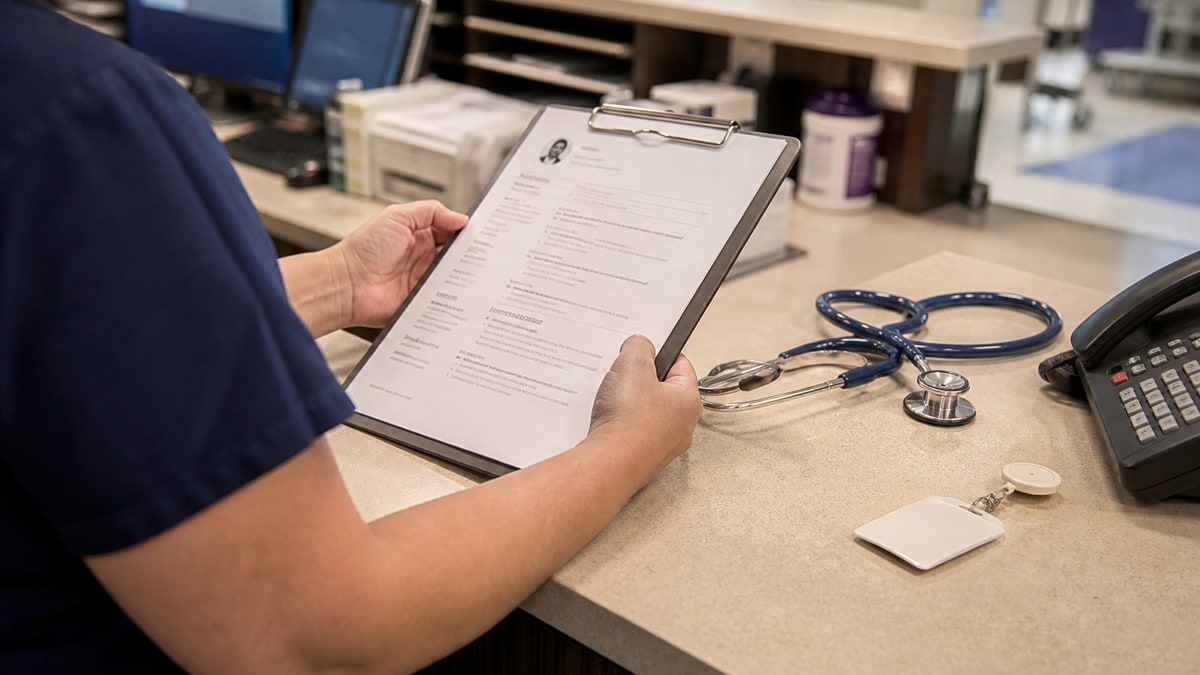
A strong nurse resume example pairs a plain-text licensure line with quantified bullets naming your unit, patient ratio, and a measurable outcome. It lists certifications like BLS, ACLS, or PALS in a dedicated section and uses a single-column layout that hospital ATS platforms parse without dropping fields.
Most nursing resume advice stops at keyword lists—words to sprinkle in so a screening tool flags a match. That helps with search, but recruiters and unit managers still read the bullets underneath those keywords, and generic phrasing like "provided patient care" tells them nothing about your acuity level or scope. This guide shows worked examples instead: real bullet rewrites for New Grad RN, Med-Surg, ICU/Critical Care, ER/Trauma, and a nurse switching specialties, plus a licensure block, an EMR skills list, and formatting notes specific to hospital hiring portals. If you want the underlying keyword research first, see our companion posts on nurse resume keywords ATS filters for and nurse resume keywords ATS searches for .
Key Takeaways
- Quantify patient ratios, unit bed count, and outcomes—not just task lists
- Match bullet language to specialty: ICU drips and vents, ER triage and door-to-doc time
- List RN license, state, and certifications (BLS, ACLS, PALS, TNCC) in one dedicated block
- Name your EMR systems explicitly—Epic, Cerner, Meditech—rather than saying "EMR"
- Use a single-column format so Workday, Taleo, and iCIMS parse dates and licensure correctly
New Grad RN resume example: clinical rotations and NCLEX status
New grad RNs often assume a thin resume is unavoidable without hospital employment history. It is not. Clinical rotation hours, preceptorship feedback, and simulation lab results all count as clinical exposure when they are written with numbers instead of course titles.
Before
Completed clinical rotations in various hospital units as part of nursing school program.
After
- Completed 640 supervised clinical hours across Med-Surg, L&D, and ICU rotations at a 300-bed teaching hospital; managed 2-3 patients per shift under preceptor supervision by final rotation.
- Administered medications, performed head-to-toe assessments, and documented in Epic for a caseload averaging 4 patients during senior practicum, with zero medication errors logged.
- Earned BLS and ACLS certification prior to graduation; completed 40-hour critical care simulation lab covering rapid response and code blue protocols.
- Worked 18 months as a Patient Care Technician on a 32-bed telemetry unit while completing nursing coursework, monitoring vitals for up to 8 patients per shift.
Note the shift from "completed rotations" to specific hours, unit type, hospital size, and patient counts. If you passed NCLEX-RN before applying, state it plainly near your licensure line: "RN, [State], NCLEX-RN passed [month/year]." If you are applying pre-boards, write "NCLEX-RN scheduled [month/year]" so recruiters and hospital ATS platforms like Workday know your status without guessing.
Key Takeaway: new grad resumes win on specificity, not length—640 clinical hours with a patient count beats a paragraph describing nursing school.
Med-Surg RN resume example: patient load and discharge outcomes
Medical-surgical postings screen for patient volume tolerance and discharge coordination. Vague bullets about "providing quality care" do not signal whether you can safely manage a 5:1 or 6:1 ratio during a busy shift.
Before
Responsible for caring for patients on a medical-surgical floor and helping with discharge paperwork.
After
- Managed a 5:1 patient ratio on a 40-bed Med-Surg unit, completing hourly rounding and full assessments within 30 minutes of shift start for 95% of shifts.
- Coordinated discharge planning with case management for an average of 6 patients per shift, reducing same-day readmission callbacks by documenting teach-back comprehension in Cerner.
- Precepted 3 new graduate nurses over 12 months, each cleared to independent practice within the unit's standard 8-week orientation window.
- Served as charge nurse 2 shifts per week, reassigning staff across a 40-bed unit and triaging admissions during average daily census of 34 patients.
Common Mistake: listing "strong communication skills" instead of naming the actual coordination work—case management handoffs, teach-back documentation, and charge duties are what a hiring manager wants to see.
ICU / Critical Care RN resume example: vents, drips, and acuity
ICU postings expect specific clinical vocabulary: ventilator management, titrated vasoactive drips, hemodynamic monitoring, and continuous renal replacement therapy if your unit runs it. Generic "critical care experience" phrasing reads as unverified to a unit manager who screens dozens of applications a week.
Before
Worked in the ICU taking care of critically ill patients and monitoring their conditions.
After
- Managed 2:1 patient assignments in a 24-bed medical ICU, titrating vasoactive drips (norepinephrine, propofol, precedex) per protocol under continuous hemodynamic monitoring.
- Cared for ventilated patients requiring ARDSnet protocol adherence, including sedation vacations and daily spontaneous breathing trials documented in Epic.
- Responded to an average of 3 rapid response and code blue events per month as primary or secondary responder across a 24-bed unit.
- Maintained CCRN certification and completed CRRT competency for continuous renal replacement therapy on a 6-bed cardiovascular ICU step-down.
For ICU roles, certifications carry as much weight as bullets. Hold BLS and ACLS at minimum; CCRN signals specialization to recruiters screening dozens of applicants per opening at large hospital systems.
Pro Tip: name the actual drips, protocols, and equipment you used (ARDSnet, CRRT, arterial lines) rather than saying "advanced critical care skills"—specificity is what separates interview-ready ICU resumes.
ER / Trauma RN resume example: triage speed and volume
Emergency department hiring managers care about triage accuracy, throughput, and trauma response under a Level I, II, or III designation. Volume numbers matter more here than almost any other specialty because ED staffing models are built around patient-per-hour benchmarks.
Before
Triaged patients in a busy emergency room and assisted physicians with procedures.
After
- Triaged an average of 12-15 patients per shift using ESI 5-level acuity scale in a Level II trauma center averaging 220 ED visits daily.
- Served on trauma response team for 40+ Level I activations over 12 months, initiating rapid assessment, IV access, and blood product administration within protocol time windows.
- Reduced average door-to-triage time from 18 to 11 minutes during peak shifts by restructuring intake flow with charge nurse and registration staff.
- Maintained TNCC and PALS certification; managed pediatric resuscitations in a combined adult/pediatric ED seeing 25 pediatric visits per week.
Common Mistake: omitting your trauma center level and daily visit volume—ED hiring managers use those numbers to gauge whether your pace matches their department before reading further.
Specialty switch resume example: Med-Surg to ICU transition
Nurses changing specialties face a specific problem: the resume needs to prove transferable skill without overstating experience you have not logged yet. A short transition summary line plus honest framing of cross-training beats padding bullets with unit-specific tools you have only observed.
Before
Med-Surg nurse looking to move into ICU nursing, interested in critical care.
After
- Med-Surg RN with 3 years managing 5:1 patient ratios, pursuing transition into critical care; completed 80-hour ICU float pool orientation covering telemetry interpretation and titrated drip administration.
- Cross-trained on a 12-bed cardiac step-down unit for 6 months, managing 3:1 ratios with continuous cardiac monitoring and post-op recovery protocols.
- Earned ACLS and completed employer-sponsored critical care course (120 hours) ahead of formal ICU unit transfer.
- Responded to 15+ rapid response events as float pool support, assisting primary ICU RN with assessment and documentation.
If your target unit requires a certification you do not yet hold, name your enrollment date rather than leaving a gap: "CCRN exam scheduled [month/year]" shows initiative without misrepresenting your current credentials.
Quick Check: if you are switching specialties, confirm your top three bullets show overlap with the new unit before adding anything about your prior specialty's unique tools.
Specialty-by-specialty comparison: what to emphasize
Use this table as a quick reference when reordering bullets for a specific posting. Keep your work history intact; adjust which achievements sit at the top of each role.
| Specialty | Lead with | Core certifications | Key metric to quantify |
|---|---|---|---|
| New Grad | Clinical rotation hours, preceptor feedback | BLS, NCLEX status | Rotation hours, patient counts under supervision |
| Med-Surg | Patient load, discharge coordination | BLS, ACLS (unit-dependent) | Ratio, unit bed count, census |
| ICU / Critical Care | Vent management, titrated drips, response events | BLS, ACLS, CCRN | Ratio, response events per month |
| ER / Trauma | Triage volume, trauma response, throughput | BLS, ACLS, PALS, TNCC | Patients per shift, trauma level, door-to-triage time |
| Specialty switch | Transferable skills, cross-training hours | Target unit's core certification (in progress if needed) | Float/orientation hours, overlap-skill volume |
Pro Tip: the bullets at the top of each job entry get the most attention during a 6-8 second recruiter scan—put your best specialty-matching metric first, not your most recent duty chronologically.
Licensure and certifications section: formatting example
Hospital recruiters and ATS keyword scans both look for licensure information in a predictable, labeled location—not buried inside a paragraph. Use a dedicated section directly under your contact info or summary.
Example licensure & certifications block
RN License: Texas, active, #123456 (multistate compact)
BLS — American Heart Association, current through 2027
ACLS — American Heart Association, current through 2027
PALS — American Heart Association, current through 2026
CCRN — AACN, active
EMR systems: Epic, Cerner (Oracle Health)
Write license numbers in plain text, never inside a text box, icon graphic, or table cell—those elements frequently fail to extract in Workday and Taleo, which means a recruiter searching by license status may never see your credential at all. Our Workday resume format guide covers the layout rules in more depth if you are applying to a large health system.
If your license is a multistate compact license , say so—it signals mobility to systems hiring for travel or float positions across state lines without extra verification steps.
Common Mistake: letting certifications expire on the resume without updating the "current through" date—an expired certification listed as active can disqualify you during credential verification after an offer.
Formatting nurse resumes for hospital ATS portals
Large hospital systems commonly run applicant tracking on Workday, Taleo, or iCIMS, with some networks using Greenhouse, Lever, or SuccessFactors for corporate and administrative nursing roles. Each parses differently, but the safest baseline format works across all of them.
- Single-column layout—no tables, text boxes, or multi-column sections.
- Standard section headers: Summary, Licensure & Certifications, Experience, Education, Skills.
- Dates in a consistent format (Month Year – Month Year) outside of tables.
- Contact info in the document body, not a header or footer field.
- Save as DOCX when the posting allows uploads, or a text-selectable PDF otherwise.
File format choice affects parsing too. See PDF vs DOCX for ATS for when each wins on hospital portals specifically. Before you submit, run your exported file through HireFlow's free ATS checker to confirm your licensure line, certifications, and dates extract cleanly—the same layout that looks fine on screen can still scramble in an ATS field mapping.
Key Takeaway: format for the parser first, the visual design second—a nurse resume that looks plain but parses cleanly beats a styled template that drops your certification dates.
Pre-submit checklist for nurse resumes
- Every bullet names a patient ratio, unit size, or measurable outcome.
- Licensure and certifications sit in one labeled section, not scattered in bullets.
- Certification "current through" dates are accurate and not expired.
- EMR systems are named explicitly (Epic, Cerner, Meditech) rather than "EMR software."
- Top bullets under each role match the specialty of the posting you are applying to.
- No tables, text boxes, or multi-column sections anywhere in the file.
- Dates use a consistent Month Year format across all entries.
- Contact information is plain text in the document body.
- File saved as DOCX or a text-selectable PDF, not a scanned image.
- Exported file tested in an ATS checker before you upload it to Workday, Taleo, or iCIMS.
Quick Check: if item 10 turns up a parsing error, fix the layout before you submit—a strong bullet is wasted if the field it belongs in never populates on the recruiter's screen.
Why quantified nursing resumes matter more in a competitive hiring market
Registered nursing remains one of the largest healthcare occupations in the country, and hospital systems continue to post high volumes of RN openings across specialties each year. The Bureau of Labor Statistics Occupational Outlook for Registered Nurses tracks employment trends and typical qualifications for the role, which is useful context when you are deciding how much detail to include about licensure and specialty training.
High posting volume does not mean low competition for the specific units nurses want most—ICU, ER, and specialty programs at well-regarded hospital systems still draw large applicant pools. A resume built from quantified, specialty-matched examples gives a screener a faster, clearer read than a generic duty list, which matters when a recruiter is moving through dozens of applications for one opening.
Before you apply broadly, build one strong base resume using the examples above, then adjust the top bullets per posting rather than rewriting from scratch each time. Start from HireFlow's free ATS resume checker to confirm your base file parses cleanly before you begin tailoring copies for individual units.
Pro Tip: keep a master document with every quantified bullet you've written across specialties, then copy the most relevant 3-5 into each tailored version instead of drafting new bullets under deadline pressure.
Frequently asked questions
A strong nurse resume example pairs a plain-text licensure line (RN, state, license number optional) with quantified bullets that name your unit, patient ratio, and a measurable outcome—not just duties. It also lists certifications like BLS, ACLS, or PALS separately from work history and uses a single-column layout that hospital ATS platforms like Workday or Taleo can parse without dropping fields.
Three to five bullets per role is typical. Your most recent or most relevant position can carry five or six if you have strong quantified outcomes; older or shorter assignments can drop to two or three. Prioritize bullets that show patient volume, unit acuity, or a specific clinical or process result over generic duty statements.
Yes, at least in emphasis. ICU and critical care postings expect ventilator management, titrated drips, and hemodynamic monitoring language, while Med-Surg postings weight patient load, discharge planning, and multidisciplinary rounding. Keep your core work history intact but reorder bullets and swap keywords so the top of each job entry mirrors the posting you are targeting.
New grad RNs lean on clinical rotation hours, preceptorship details, simulation lab outcomes, and NCLEX status instead of paid nursing history. Quantify rotation hours per unit, list your BLS and any specialty certifications earned during school, and include CNA, tech, or unit secretary work if it involved direct patient contact—those roles still demonstrate clinical exposure to a hiring manager.
List your RN license and state, BLS at minimum, and then role-specific certifications: ACLS and PALS for ICU or ER, TNCC for trauma, CCRN for critical care specialists, and NIHSS for stroke units. Place certifications in their own labeled section near the top so both a human recruiter and an ATS keyword scan can find them in under five seconds.
Lead with transferable clinical skills that overlap both units—assessment frequency, medication administration volume, or code response—before specialty-specific tools. Add a brief summary line stating the transition goal, list any cross-training shifts or float pool experience, and pursue the target unit's core certification if you don't already hold it, since some employers screen for it before reviewing the resume.
New grads and nurses with under five years of experience should aim for one page. Nurses with five or more years across multiple units, charge nurse responsibilities, or precepting history can extend to two pages, but every bullet still needs to earn its place with a quantified result rather than restating the job description.
List the electronic medical record systems you've used hands-on, such as Epic, Cerner (Oracle Health), Meditech, or Allscripts, in your skills section. Hospitals often screen for specific EMR familiarity because retraining time affects onboarding cost, so naming the exact system—not just "EMR documentation"—helps both recruiters and keyword-matching software.