11 min read
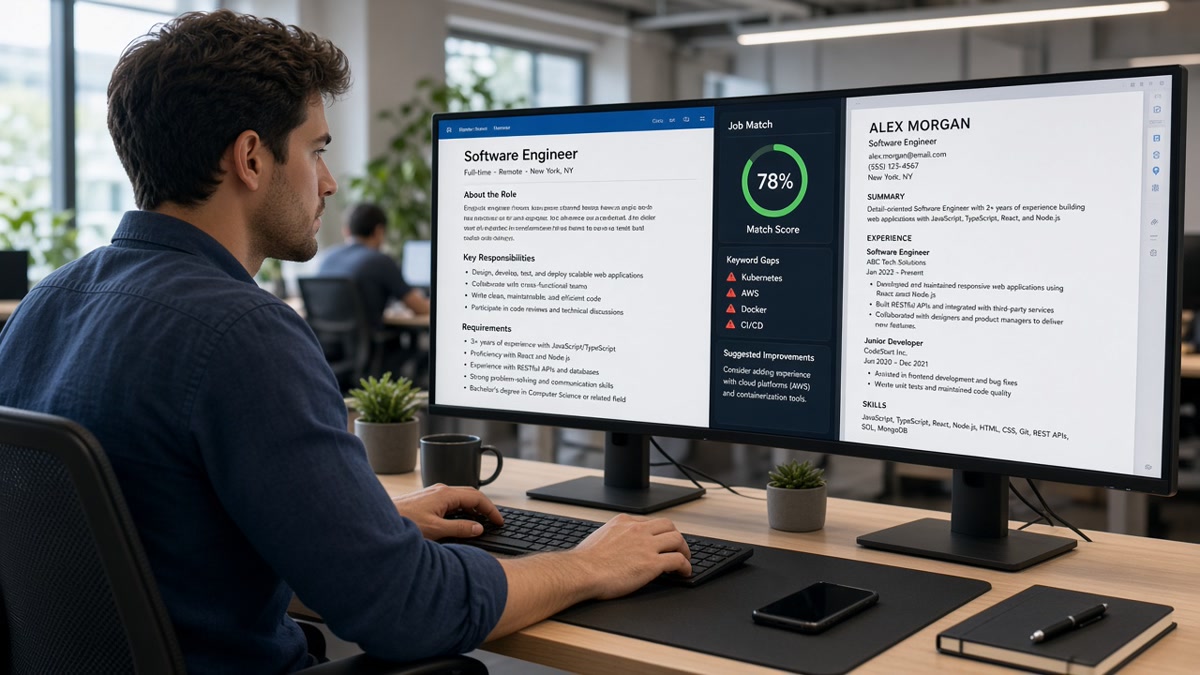
You ran the match tool, pasted twelve keywords into Skills, and the score barely moved. That's normal when your internship bullets still read like class notes and the posting's must-haves never landed in a dated Experience line. Entry-level tech reqs in Greenhouse and Workday still score the file the parser can read. The gap list is useful only when you know which lines on the page actually move the number.
Before you rewrite anything, check your resume for free against the posting you care about. You'll see whether React and SQL show up only in Skills or inside a project bullet with a Month Year date the ATS can pair to an employer block.
Job searching right out of school is draining when you're sending files that look fine to you. You're not failing because you lack projects. You're often failing because the parser scored a skills cloud while your best build sat three sections down with no stack in the first eight words. This teardown walks through five entry-level lanes, what weak versions share, and a copy-paste block you can run tonight on one req.
Quick Wins
- Paste the posting first. Score the master file before you edit.
- Move must-haves from Skills into dated project or internship bullets.
- Put the stack name in the first eight words of bullet one.
- Rescore after each bullet pass, not after a Skills dump.
What entry-level tech match scores treat as proof
A job match score compares your plain-text resume to the posting and flags missing terms, light sections, and sometimes format breaks. It does not hire you. It tells you where the parser and the req language diverge from your file. For US entry-level software, support, data, and QA lanes, the terms that move scores fastest usually already appear somewhere on your page. They're just in the wrong section.
Skills columns score keywords. Dated bullets score keywords with context. When the posting says REST APIs, Python, and Git, a Skills line helps once. The same words inside Software Engineering Intern, May 2024 to Aug 2024, with a bullet that starts Built REST endpoints in Python using FastAPI usually register twice: as a term match and as experience-shaped text parsers weight higher.
Judge every example below against three rules recruiters still use after the score looks good. One: Month Year dates on every internship and capstone you want scored. Two: stack names in the first eight words of the bullet that proves you used them. Three: single-column DOCX or a PDF exported from Word, not a Canva two-column layout that scrambles employer blocks in Workday.
Edge case one: you're targeting three lanes (backend, data, IT support) from one master file. Keep one spine per lane. Run the match score against the posting for each spine before you merge bullets from different stories into one application. Edge case two: the posting lists a tool you touched once in a lab. One honest mention in a dated project beats five repeats in Skills. If you cannot write a defensible bullet, the gap is real and the score is telling you not to apply yet.
When format is clean but terms still feel thin, read how ATS matches resumes to job descriptions after your first bullet pass. Structure and date alignment come before keyword density.
How to tailor your resume using job match scores: before and after pairs
Each pair below is the same candidate story, rewritten for one posting family. Swap the stack names for your req. Run your version through Score your job match after every pair you fix, not after you finish all five.
Junior software engineer (backend or full stack)
Posting must-haves: Python, REST APIs, SQL, Git, Agile.
Before: Software Engineering Intern | Tech startup | Summer 2024
Assisted with backend tasks and collaborated on team projects using various technologies.
After: Software Engineering Intern | Tech startup | May 2024 to Aug 2024
Built REST API endpoints in Python and FastAPI for user auth, cutting login errors 18% across 2,400 test accounts in QA.
Second bullet after pass: Wrote SQL migrations in PostgreSQL for order tables and tracked tasks in Jira during two-week Agile sprints with four engineers.
IT support and help desk
Posting must-haves: Windows, Active Directory, ticketing, remote support, customer service.
Before: IT Support Assistant | University help desk | 2023
Helped students with computer problems and answered questions at the front desk.
After: IT Support Assistant | University help desk | Sep 2023 to May 2024
Resolved 40+ Windows and Active Directory tickets weekly in ServiceNow, closing password resets and VPN failures with a 94% same-day rate.
Second bullet after pass: Delivered remote desktop support for lab machines during peak registration, documenting fixes in Confluence for the next shift.
Entry-level data analyst
Posting must-haves: SQL, Python, Excel, data visualization, stakeholder reporting.
Before: Data Analytics Capstone | State University | 2024
Analyzed data for a class project and presented findings to the professor.
After: Data Analytics Capstone | State University | Jan 2024 to Apr 2024
Queried 180k retail rows in SQL and Python to flag churn drivers, then built Tableau dashboards ops managers used in weekly standups.
Second bullet after pass: Automated Excel refresh scripts for store-level KPIs, cutting manual report prep from six hours to ninety minutes per cycle.
QA engineer and SDET intern
Posting must-haves: test automation, Selenium or Playwright, bug tracking, regression testing.
Before: QA Intern | SaaS company | 2024
Tested features and reported bugs to developers.
After: QA Engineering Intern | SaaS company | Jun 2024 to Dec 2024
Wrote Playwright test suites for checkout flows, catching 23 regression defects before release across three sprint cycles.
Second bullet after pass: Logged repro steps and severity in Jira for 50+ tickets, pairing with devs on root-cause fixes during daily standups.
Frontend developer intern
Posting must-haves: React, TypeScript, responsive UI, Git, REST consumption.
Before: Web Development Intern | Digital agency | Summer
Worked on client websites and learned modern frameworks.
After: Frontend Developer Intern | Digital agency | May 2024 to Aug 2024
Rebuilt client checkout in React and TypeScript, pulling cart data from REST endpoints and cutting mobile load time from 4.2s to 2.4s.
Second bullet after pass: Shipped responsive UI components in Git feature branches with peer review, aligning breakpoints to design specs in Figma.
Copy-paste block: one gap from the match report
POSTING MUST-HAVE: [e.g. REST APIs]
WHERE IT LIVES NOW: Skills only / missing / buried in paragraph

BULLET SKELETON (dated row required):
• [Stack] + [scope] + [illustrative outcome inside the project]
  Example: Built REST endpoints in Python (FastAPI) for [feature];
  [metric or scope count] across [time window].

CHECK BEFORE RESCORE:
[ ] Month Year on the employer or project line
[ ] Stack in first eight words of bullet one
[ ] Same term not repeated five times in Skills only
[ ] Single-column DOCX exported and re-uploaded
I've screened entry-level stacks where the match report lit up green on Skills and the Experience block still read like a course catalog. The file that moved was boring: dated rows, stack in line one, one metric inside the project.
Edge case: career fair req with no internship yet. Use a capstone or open-source row with honest dates. Label it Projects only when the posting accepts equivalent work. When the req says two years paid production experience, tailoring cannot close that gap. Edge case: bootcamp grad with three client builds. Pick the two closest to the posting and date each build. Do not list six identical MERN stacks with different adjectives.
What weak entry-level match-score passes still share
Skills dump after one low score. You added Docker, AWS, and CI/CD to Skills without a dated bullet. The score may tick up. Recruiters still see an empty proof line. Fix: move each tool into the project where you used it once.
Generic internship bullets. Assisted with, helped with, and worked on do not parse as stack proof. Fix: start with the verb and tool: Built, Wrote, Deployed, Queried.
Year-only dates. 2024 alone confuses tenure math next to postings that ask for six months of production exposure. Fix: May 2024 to Aug 2024 on every row you want scored.
Best project buried below coursework. Parsers and humans both weigh top-of-page content. Fix: reorder so the closest match to the posting sits directly under Education or your current internship.
Two-column or icon-heavy PDFs. Greenhouse imports can split employer names from titles. Fix: Word single column, plain bullets, export, then test import before you trust the score.
Chasing the score past honest gaps. If the posting requires cleared work or a stack you have never touched in a dated line, no synonym swap fixes that. Apply where your master file already has proof, or build one dated project before you spend another evening on keywords.
For internship-specific structure when your Experience section is thin, see internship resume that actually gets interviews after you fix the pairs above.
Score the file, fix bullets, score again
Paste the posting and your master DOCX into HireFlow's job match score tool . Note the top five missing terms. Rewrite one dated bullet per term using the copy-paste skeleton in the teardown section. Upload the same file format you'll send on the application.
After bullets change, run HireFlow's free ATS resume checker on the export. Confirm employer titles stayed paired and bullets did not drop during import. A high match score on a scrambled parse is still a loss in Workday.
When a referral asks for a short note with the upload, use the cover letter generator with the same posting. Mention one dated project bullet by stack, not a generic availability paragraph.
Do this now: Pick one entry-level posting, score your master file, rewrite two bullets on your strongest project, rescore, then apply with the exact DOCX you tested.
Run one posting tonight
Learning how to tailor your resume using job match scores for US entry-level tech roles is mostly about placement, not volume. Score the master file, move must-haves into dated bullets with stack names up front, and stop when honest gaps remain.
- Score before you edit. Fix format before Skills.
- Rewrite two bullets on your closest project or internship.
- Rescore with the same DOCX you'll upload.
- Apply only when the dated lines prove the posting's must-haves.
Open the req you want most. Run a free ATS check , confirm your internship imported as a dated employer block, and send the file you already scored.
Read more
Frequently asked questions
Treat the number as a gap list, not a pass grade. A strong entry-level file usually clears obvious missing terms like React, SQL, or REST after one bullet pass on your top project or internship, then stalls when the posting asks for a stack you never used. If the checker flags format errors, fix single-column layout before you chase keywords. A qualified new grad with a scrambled Greenhouse parse will still lose to a weaker file that imported cleanly.
No. Keep one master file with every internship, class project, and club build. For each req, rewrite the summary, reorder projects so the closest match sits first, and edit two bullets under your most relevant role. Entry-level hiring managers read the last twelve to eighteen months, not every line from freshman year. Paste the posting into a match tool, fix the top five gaps, and stop when the score stops moving for honest reasons.
Scores reward keyword presence. They do not know whether you owned the API design or only watched a demo. They cannot tell if your Python line belongs under a paid internship or a bootcamp capstone. After the score plateaus, read the posting for years-of-experience language, clearance requirements, and on-site versus remote rules. Those lines decide screens more than a fourth mention of Agile in Skills.
You can, and Workday will read them. Recruiters often do not. A Skills rail full of Docker, Kubernetes, and CI/CD with no matching bullet under a dated project reads like stuffing. Put each tool inside the Experience or Projects block where you used it. The score may jump either way. The human screen only moves when the dated line proves the term.
Yes when the posting accepts equivalent project work and you date the build. Label the row honestly: Capstone Project, Software Engineering Bootcamp, Mar 2025 to Jun 2025. Two bullets with stack in the first eight words beat hiding the work under a generic Projects header with no Month Year range. If the req demands two years of paid production experience, no amount of keyword matching fixes that gap.