10 min read

How to Put Research on a Resume (2026 ATS Guide)

HireFlow Editorial Team
August 7, 2026

List research on your resume with the right section title, bullet format, and publication details ATS can parse. Examples for undergrad, grad, lab, and industry R&D roles.

Reviewed by a certified professional resume writer (CPRW) with US corporate recruiting and ATS screening experience

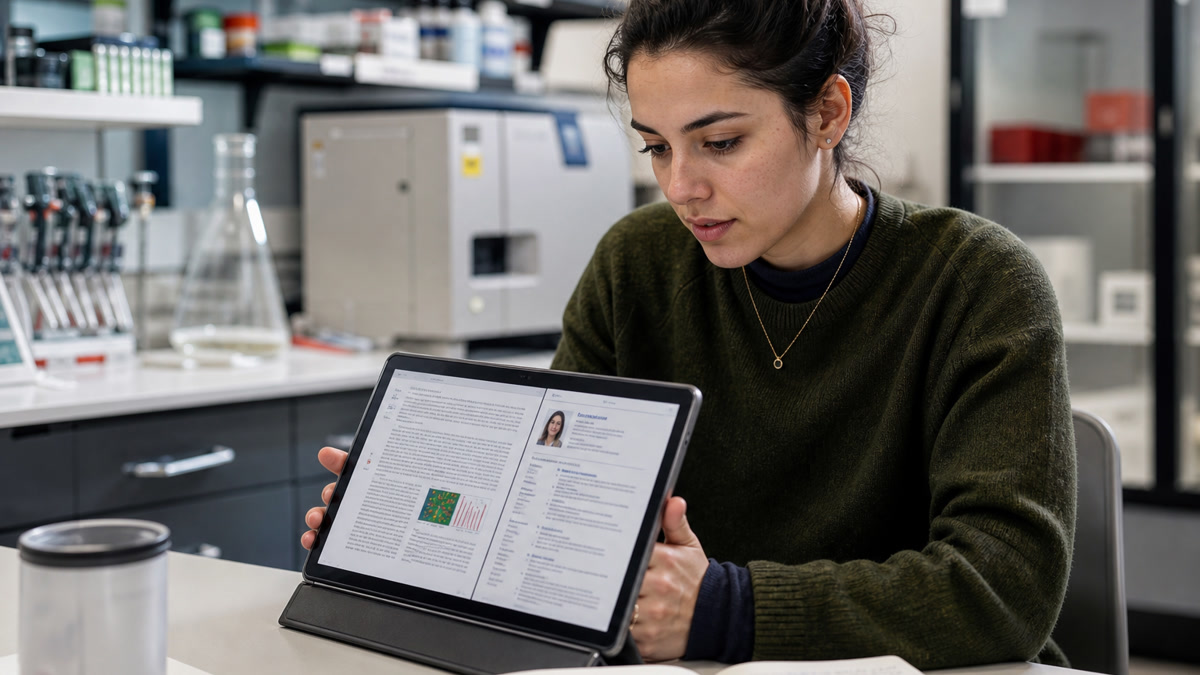
Graduate researcher in a university lab reviewing a research paper and resume draft on a tablet

Put research on your resume in a dedicated Research Experience section—or under Experience when paid—with each entry showing institution, role title, dates, methods, tools, and outcomes in bullet form. ATS platforms like Workday, Greenhouse, and iCIMS parse research like any other job when you use standard headers and avoid academic CV walls of text on a one-page corporate resume.

Candidates from labs, thesis programs, and hospital research units often paste abstracts or publication lists without translating skills for industry readers. That hurts both human scan time and keyword matching. This guide covers section placement, bullet formulas, publication lines, and before-and-after examples for undergrad through postdoc transitions.

Key Takeaways

  • Use Research Experience or Experience with clear lab/university employer names
  • 3–5 bullets per role: method + tool + scale + result
  • Publications get their own section when applying to R&D, biotech, or academia
  • Translate jargon for corporate roles while keeping ATS keywords
  • One-page resume for industry; multi-page CV only when employers expect it

Where to put research on your resume

Placement depends on whether research is your primary qualification or supporting evidence:

Candidate profile Section Position on page
Undergrad / new grad seeking lab or analyst role Research Experience After Education, before Skills
PhD moving to industry R&D Experience + Publications Research roles under Experience; pubs below
Professional with one research rotation Experience (single entry) Chronological with other jobs
Clinical research coordinator Experience Emphasize trials, IRB, patient enrollment metrics

NIH and university career offices recommend leading with evidence of skills—on a resume, that means bullets, not citation dumps. See NIH career resources for academic CV norms; corporate ATS workflows still favor the one-page structured format described in Workday resume format guidance .

Key Takeaway: match section choice to your target—research-first candidates get a Research block; everyone else integrates one entry into Experience.

How to format each research entry

Every research line should parse like a job block:

  • Role title: Research Assistant, Graduate Researcher, Lab Technician
  • Organization: University Department, Hospital Lab, or Company R&D unit
  • Location: City, State
  • Dates: Jan 2024 – May 2025 (consistent format throughout)
  • Optional supervisor line: PI: Dr. Name (fine for academic roles; skip for dense one-page industry resumes)

Example header block:

Research Assistant, Neuroscience Lab — State University, Columbus, OH
Jan 2023 – Present

Key Takeaway: if Workday can map employer, title, and dates, your research entry is formatted correctly.

Research bullet formula that passes ATS and impresses recruiters

Use: Action + method/tool + scale + outcome

  • Action: Designed, Analyzed, Cultured, Programmed, Co-authored
  • Method/tool: CRISPR, R, SQL, flow cytometry, Western blot, Python pandas
  • Scale: 200 samples, 3 cohorts, 18-month longitudinal study
  • Outcome: identified biomarker, presented at conference, reduced error rate 30%

Pair with skills guidance from how many skills to list on your resume so techniques appear in both bullets and Skills without redundant stuffing.

Key Takeaway: one bullet should let a non-specialist understand what you did and why it mattered.

Before-and-after research bullet rewrites

Biology undergrad lab

  • Helped with experiments in professor's lab
  • Cultured mammalian cell lines and ran Western blots for 40+ samples; results supported poster presented at regional undergraduate research symposium

Social science thesis

  • Thesis on urban policy using surveys
  • Surveyed 350 residents in R and Stata; regression models informed policy recommendations adopted in capstone report to city planning office

Computer science research assistant

  • Worked on machine learning research project
  • Trained PyTorch models on 15K-image medical imaging dataset; improved F1 score 8% over baseline for peer-reviewed workshop submission

Key Takeaway: replace vague help-with phrasing with methods, scale, and a concrete deliverable.

How to list publications on a resume

Corporate resumes: 2–4 most relevant citations or one summary line. Academic or biotech targets: full Publications section with standard citation format.

Include when possible:

  • Author list (bold your name if convention allows)
  • Article title
  • Journal, year, volume/issue
  • DOI or URL on a second line if space allows

For certifications adjacent to research credentials, see where to put certifications on a resume . Peer-reviewed pubs usually stay separate from cert lines.

Industry tip: if you have six publications applying to a product manager role, write Publications: 6 peer-reviewed articles in computational biology (available on request) instead of filling half a page.

Translating academic research for industry ATS

Recruiters in Greenhouse and Lever may not read journal names—they search skills. Map research to employer language:

  • Statistical analysis → business intelligence, experimentation, A/B testing
  • Grant writing → proposal development, stakeholder funding requests
  • Lab management → project coordination, SOP documentation, compliance
  • Conference presentations → executive communication, cross-team briefings

The AAAS science career framework emphasizes transferable competencies—your resume should show both technical depth and readable impact.

Research resume checklist

  • Section title parsers recognize: Research Experience or Experience
  • Each entry has organization, title, location, dates
  • 3–5 bullets with methods, tools, scale, outcomes
  • Publications section only when relevant to target role
  • Jargon translated for non-academic readers
  • Skills section lists lab software and analysis tools
  • One-page limit for corporate unless CV requested
  • ATS check run before Workday or iCIMS upload

Mid-article: verify parsing with HireFlow's free ATS resume checker before you apply—research PDFs from academic templates often hide tables that scramble dates in Taleo.

Key Takeaway: keep technical keywords for ATS; add plain-language impact for the human recruiter who reads after the filter.

Clinical research vs bench science: different resume emphasis

Not all research roles look alike to recruiters. Tailor emphasis while keeping the same structural rules:

Track Lead bullets with Keywords for ATS
Bench / wet lab Assays, instrumentation, protocols, safety compliance PCR, ELISA, cell culture, GLP, SOP documentation
Clinical research Trial phase, enrollment, monitoring, regulatory docs IRB, GCP, EDC, patient recruitment, CRF
Computational Datasets, models, pipelines, reproducibility Python, R, SQL, machine learning, bioinformatics
Social science Survey design, sampling, analysis, policy impact Stata, SPSS, qualitative coding, mixed methods

Applying from academia to CROs or hospital systems? Mirror the employer's language from the posting—clinical coordinators care about enrollment metrics; biotech R&D cares about assay validation. One research history can produce multiple tailored resumes with adjusted bullet emphasis.

Key Takeaway: same research entries, different keyword emphasis— match the track you are applying to.

Explaining gaps between research appointments

Academic hiring cycles create gaps between grants, postdocs, or thesis completion and the next role. On a resume—not a CV—address gaps briefly:

  • One-line label: Research gap — family caregiving, 2024–2025 (optional if brief)
  • Or fold gap months into dates of overlapping part-time teaching or consulting
  • Never fabricate employment—verify dates in background checks
  • Use summary to refocus on skills current to the target role

Industry recruiters in iCIMS care less about gap length than about whether your techniques are current. A gap year with online certification in clinical data management beats silence. List the certification in Skills and Education, not a defensive paragraph in the summary.

Need a baseline resume before adding research? Confirm requirements in do I need a resume to apply for a job —research-heavy candidates still upload for corporate biotech roles.

Key Takeaway: honest short labels plus current skills beat long explanations that eat bullet space.

Undergraduate vs graduate research: different resume strategies

Undergraduate research assistants should emphasize techniques learned, faculty mentorship, and deliverables—posters, lab reports, co-authored submissions. Graduate students and postdocs should emphasize independent project design, grant support, mentoring junior students, and publication pipeline progress.

Undergraduates applying to industry analyst or technician roles: keep research to one section with three bullets max unless it is your only experience. PhD candidates targeting scientist II roles: research may occupy half the page with a publications line block.

Both groups must avoid copying abstract language from thesis proposals. Recruiters in SuccessFactors keyword-search for tools and regulated environments—GLP, GCP, ISO—when relevant, not theoretical framework names unless applying to research faculty positions.

Key Takeaway: undergrad resumes prove learning; graduate resumes prove independent output—adjust depth accordingly.

Final review checklist before uploading a research resume

Research candidates often rush uploads after grant deadlines. Slow down for five minutes:

  1. Confirm every lab role has start and end months, not seasons only
  2. Search PDF for your email and each technique keyword from the posting
  3. Remove thesis abstract paragraphs longer than two lines
  4. Verify publication author order matches your actual contribution
  5. Ask a colleague outside your field to read the summary aloud—confusion signals jargon

Upload to the employer portal, then open the candidate preview if available. Some biotech firms let you see parsed fields before final submit—use that view to catch employer names truncated to department acronyms parsers misread from university letterhead templates.

Store a master research resume with all techniques and a trimmed industry resume with targeted emphasis. Maintaining both prevents you from deleting niche methods you will need again for the next R&D posting while keeping any single upload under one page.

When a posting asks for a CV and resume, send both only if requested—duplicating the same content in two formats annoys reviewers. The resume should be the scannable one-page summary; the CV holds full publication lists and invited talks for search committees evaluating academic fit.

Key Takeaway: five-minute review beats reapplying after a parsing failure wastes a referral introduction.

Posters, talks, and grants: what to include without cluttering the page

Conference presentations and poster sessions belong on research-heavy resumes when they demonstrate communication skills and subject mastery. Format them compactly:

  • Poster: Smith, J., [Your Name], et al. "Title." Annual Meeting of [Society], [City], [Year].
  • Invited talk: [Your Name]. "Title." [Seminar series], [Institution], [Month Year].
  • Grant support: Research supported by [Agency] Grant #[number] (PI: [Name]) — one line under the relevant research entry.

For industry applications, one bullet under the research role beats a full presentation list: Presented findings at 2 regional conferences to audiences of 50+ researchers and industry partners. Save detailed talk titles for your CV or LinkedIn featured section.

Key Takeaway: show you communicate science; do not list every poster unless you are applying to a research faculty role.

PhD and postdoc to industry: compress without hiding impact

Academic CVs run five to ten pages; corporate resumes must compress years of lab work into one page plus an optional publications addendum. Strategy:

  1. Lead summary with industry title you are targeting—computational biologist, data scientist, process engineer—not only ABD or postdoctoral fellow.
  2. Merge related projects under one graduate research entry with strongest techniques and outcomes.
  3. Quantify scale—datasets, samples, budget, team size, throughput.
  4. Publications: selected 3–5 or summary count for non-R&D roles.
  5. Teaching and service: one line unless applying to training-heavy industry roles.

Biotech and pharma recruiters in Greenhouse often keyword-search for assay development, GLP, IND-enabling studies, or clinical trial support—translate dissertation work into those phrases when accurate. Pair with summary writing guidance to keep the top of the page industry-facing.

Key Takeaway: industry resumes sell transferable output, not dissertation chapter titles.

Confidential research and NDAs on your resume

Industry and government lab work often falls under non-disclosure agreements. You can still list the employer, role, dates, and sanitized outcomes:

  • Describe methods and scale without proprietary compound or product names
  • Use public technology categories: small-molecule screening, not codename projects
  • Note cleared or ITAR environments when relevant and you are authorized to disclose
  • Offer detail in interviews under NDA rather than on the public resume PDF

Recruiters in defense and biotech understand redacted bullets better than missing employment gaps. A line reading Conducted validated assays on classified materials in secure facility; details available upon interview under NDA beats silence that looks like unemployment.

Academic preprints and public conference abstracts remain fair game—cite them in Publications when they do not reveal restricted data. When unsure, ask your PI or compliance officer which outcomes are cleared for external resumes before you upload to Greenhouse or company portals.

Compliance note: never paste export-controlled technical data into a resume file stored on personal cloud drives without employer approval.

Frequently asked questions

Use a section titled Research Experience, Research, or Relevant Research—placed after Education for students or within Experience for industry R&D roles. Each entry should include lab or institution, role title, dates, PI or supervisor, methods, and outcomes. Publications can sit in a separate Publications section below.

Write 3–5 bullets per role using action verbs, methods, sample sizes or datasets, tools, and results. Example: Conducted PCR assays on 120 tissue samples; validated protocol that cut processing time 25%. Avoid jargon without context when applying outside academia.

Yes when applying to research, healthcare, biotech, or advanced degree roles. List peer-reviewed articles with authors, title, journal, year, and DOI if space allows. For corporate non-research jobs, one line noting publication count may suffice—save full citations for a CV or LinkedIn.

Title the role Research Assistant or Undergraduate Researcher, name the department and university, include semester dates, and credit your faculty mentor. Bullets should show techniques learned, data collected, posters presented, and any co-authorship.

Yes. Paid or credit-based research assistantships parse as experience in Workday and Greenhouse when formatted with employer (university/lab), title, dates, and bullets. Unpaid thesis work still belongs on the resume with honest labels.

Include a thesis line under Education or as a Research entry with title, advisor, and one bullet on methods/findings when relevant to the target job. Do not paste the abstract—recruiters want scope and skills, not chapter summaries.

Three to five strong bullets per research role. Prioritize techniques and outcomes that match the job posting. Older unrelated lab work can shrink to two bullets or move off the one-page resume if you have industry experience.

Translate methods into business language: data analysis instead of only statistical test names, cross-functional collaboration instead of only committee service, compliance with protocols instead of only IRB numbers—while keeping honest technical keywords for ATS.

Done for you

Turn this advice into an interview-ready resume

Professional writers rebuild your resume for ATS + recruiters — unlimited revisions, interview guarantee.

Job match tool·Free builder

Tags

how to put research on resumeresearch experience resumepublications on resumelab experience resumeundergraduate research resumegraduate research assistant resumeATS research sectionresearch bullet pointsacademic resume 2026Greenhouse research resumeiCIMS academic CVresearch assistant job application