7 min read
Most summaries fail for a boring reason. They describe personality while the posting asks for tools, scope, and outcomes.
You don't need a paragraph of buzzwords. You need three sentences that match what Greenhouse or Workday already extracted from the job description.
That's why you're here. You want a summary that reads like you on a good day, not like a template that could belong to any applicant in the queue.
If you're staring at a blank box, open the posting and highlight the job title string, three repeated nouns, and one duty that mentions volume or speed. Those four highlights become your outline.
Check your resume for free after you paste a draft summary so you can see whether the title line imported before you tailor bullet one to match.
You won't win an interview on the summary alone, but you can lose one when it fights the experience section below.
Job searching is draining enough without rewriting the whole file. Start with the summary block, then let experience carry the rest of the posting nouns.
If the portal asks for a short note, generate a cover letter after the summary matches bullet one so you're not telling two different stories.
Quick Wins
- Sentence one: target title plus years plus industry from the posting.
- Sentence two: one metric copied from your strongest dated bullet.
- Sentence three: one posting noun you will repeat in bullet one below.
What the summary does that skills lists cannot
The summary sits above experience in most single-column files. Parsers often treat it as continuous text with your contact header, so the first words matter for title alignment.
Humans use it as a headline for the rest of the skim. If line one says Operations Manager but bullet one under your latest job still reads like coordinator work, trust drops fast.
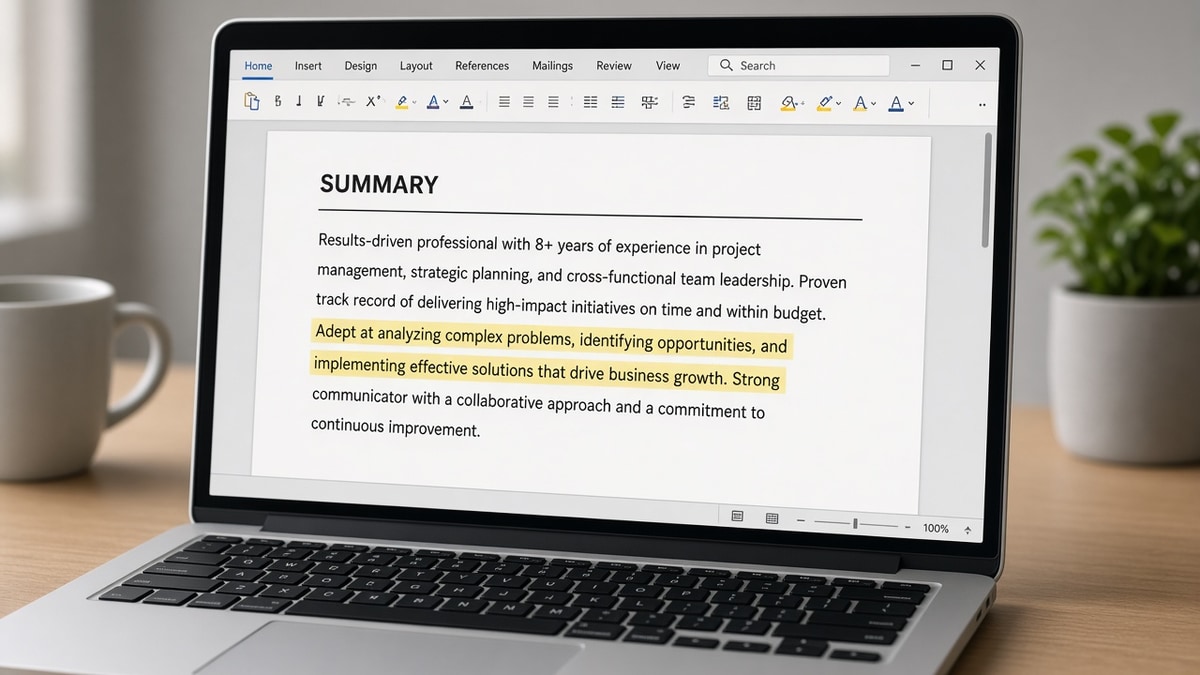
Before: Results-driven professional with excellent communication skills seeking a challenging role in a dynamic organization.
After: Operations manager with seven years in logistics and warehouse systems. Cut dock-to-stock time 14% by rebuilding shift handoffs in WMS. Applying posting focus on Lean and cross-site inventory control.
The after version is not poetry. It is searchable and defensible because the 14% line can appear again under the same employer with Month Year dates.
Length guidance lives in how long should a summary be on a resume . This page is samples and swaps, not theory.
And if you are wondering whether you need a summary at all, read what is a resume summary for when to skip the block entirely.
Students and early-career applicants should still use the three-line shape when the portal allows it. Lead with the degree, internship employer, and one tool from the posting instead of a generic eager-to-learn line.
Senior contributors can name scope in sentence two with budget size, team size, or geography when those details appear in the req. Keep numbers inside illustrations tied to bullets you can point to under the same employer row.
How to write a resume summary that passes ATS and sounds human (examples)
Swap employer names, metrics, and posting nouns. Keep 11-point Calibri or Arial, left aligned, no text boxes.
Customer support lead
Before: Friendly team player passionate about helping customers and learning new tools.
After: Customer support lead with five years in SaaS billing and Zendesk queues. Raised CSAT from 91% to 96% while owning WFM schedules for twelve agents. Targeting roles that mention Salesforce Service Cloud and escalation routing.
Data analyst
Before: Detail-oriented analyst skilled in Excel, SQL, Python, Tableau, Power BI, and stakeholder management.
After: Data analyst with four years building pipeline dashboards in SQL and Looker for finance partners. Automated weekly revenue close packs, saving 6 hours per cycle in Q4. Aligns to postings that require dbt models and Snowflake warehouses.
Registered nurse (clinical)
Before: Compassionate RN dedicated to quality patient care and teamwork on busy units.
After: Registered nurse with three years on a 32-bed med-surg unit and Epic documentation daily. Precepted four orientees while maintaining patient loads of 5 to 6 with on-time med passes. Seeking step-down roles that list ACLS and ventilator experience.
Copy-paste skeleton (fill brackets from the posting):
[Target title from posting] with [X] years in [industry or stack from posting].
[One metric from your top bullet, with tool name if the req names it].
Applying focus on [posting noun 1], [posting noun 2], and [scope phrase from duties section].
I've screened stacks of summaries in Lever where line one was perfect and line two was empty fluff. The files that moved had a number tied to a tool the req already mentioned.
Before: Marketing generalist eager to contribute to brand growth and social campaigns.
After: Demand generation manager with six years in B2B SaaS email and paid search. Grew MQL volume 22% after rebuilding nurture tracks in HubSpot. Matches postings that list ABM lists and Salesforce campaign influence.
Career changers: name the target title even if your last job title differed, then cite one bridge outcome.
Before: Retail store manager looking to break into tech sales.
After: Account executive candidate with eight years owning quota in big-box retail and CRM hygiene in Salesforce. Grew key account revenue 18% year over year through consultative upsells. Pivoting to SaaS roles that list pipeline creation and MEDDPICC-style discovery.
Project manager (construction)
Before: Hardworking PM with strong leadership and communication across teams.
After: Construction project manager with nine years on commercial builds and Procore daily logs. Delivered a 120,000 sq ft tenant improvement 3 weeks ahead of schedule at 2% under budget. Targeting postings that name OSHA site walks and subcontractor RFI volume.
Financial analyst
Before: Motivated analyst with advanced Excel skills and attention to detail.
After: Financial analyst with five years in FP&A for manufacturing plants. Built rolling forecast models in Excel and Anaplan that cut variance to plan from 8% to 3% in two quarters. Aligns to reqs mentioning SAP actuals and plant-level P&L ownership.
Edge case: if the posting forbids a summary, follow the upload instructions and move the same three lines into bullet one under your current role instead of fighting the template.
Edge case: executives sometimes use a short overview block plus a longer CV elsewhere. Corporate portals still want the PDF within upload limits, so keep the summary under 70 words even when the full career story is longer.
Summary lines that fail parsers and humans together
- Keyword dumps without a title in the first eight words.
- Soft skill lists with no metric or scope anchor.
- Objective language about growth while the req asks for delivery proof.
- Second-person fluff that repeats the company mission from the posting.
- Summary claims that contradict dates or titles in experience below.
Formatting traps that break the block appear in resume formatting errors that break ATS parsing . Fix layout before you polish adjectives.
Keep pronouns out of the summary when you can. Write about scope and tools, not about how passionate you are. Passion is not searchable. Posting nouns are.
When you reuse a summary across similar reqs, change sentence three only. Sentence one and two should still match the employer and title band you are targeting tonight.
Export and match the posting
Paste your summary into a plain text export. If the title line disappears or merges with contact info, move the summary below the header rule or simplify formatting.
Run the ATS check on the PDF you plan to upload. Confirm the summary text appears once and in reading order.
Score your job match after you swap three posting nouns into sentence three. Use the score as a alignment nudge, not an excuse to keyword stuff sentence two.
Send the summary that matches bullet one
When you write a resume summary that passes ATS and sounds human, you are really aligning three lines with the posting and your dated proof below. If you would not say it out loud to a hiring manager, rewrite it before you upload.
Keep the block short. Let experience carry repetition. Run one export, then apply with the version where title, metric, and dates all agree.
Read more
Frequently asked questions
No. Pull three nouns the req repeats and prove one in a metric that already lives in your experience bullets. Parsers read the summary as text, but humans trust the summary only when bullet two on your current job backs it up.
An objective states what you want. A summary states what you bring in title, scope, and proof. Objectives rarely carry posting keywords in the first eight words. Summaries should mirror the role title from the posting when you are qualified for that band.
Aim for two or three sentences, roughly 40 to 70 words. Longer blocks import as one paragraph in some parsers and bury your title line under filler. If you need more proof, move it to bullet one under your current employer instead of padding the summary.
Yes. Lead with the target title you are applying for, then one bridge metric from work that maps to the new field. Do not open with your old industry label unless the posting asks for that crossover. Keep the same Month Year dates in experience so the summary does not fight the timeline.