12 min read
You ran your notes through a chat tool, pasted six clean lines, and still hear nothing back. The file parses. Keywords land. Something still reads off on a six-second skim, and you're not sure what to change without starting over. You're not alone if the draft sounds polished and still feels hollow.
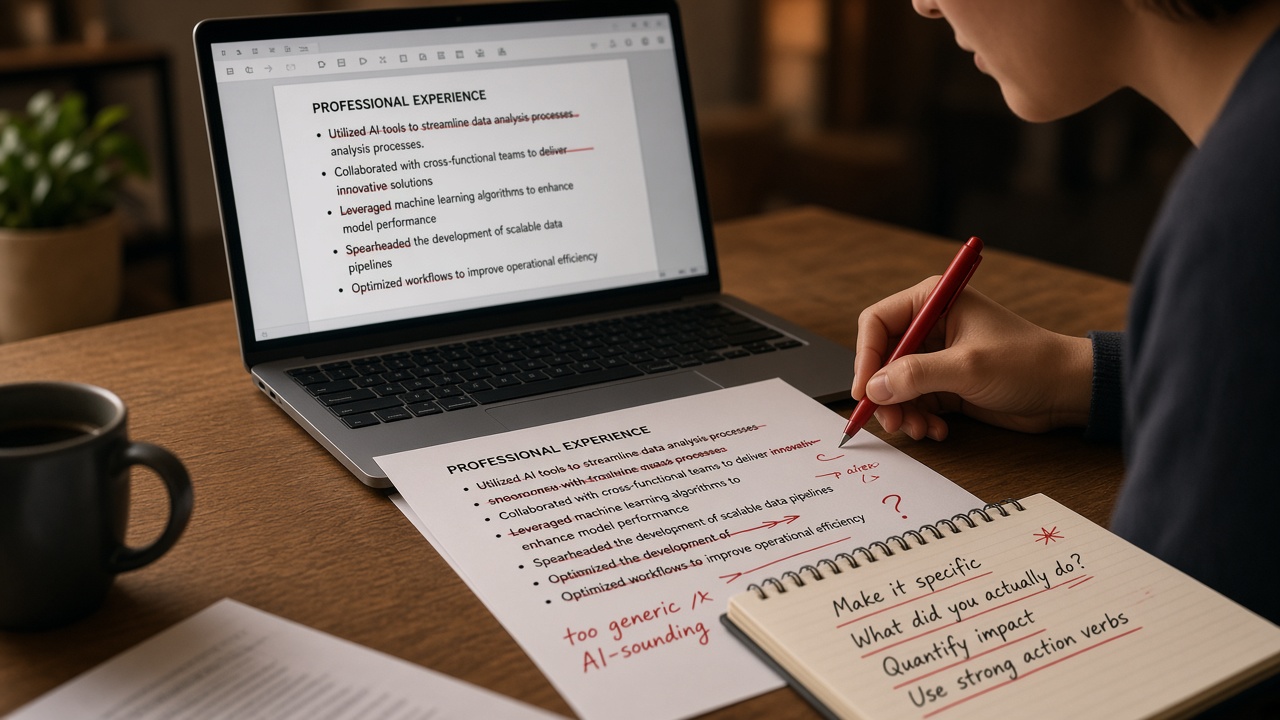
That's usually rhythm, not vocabulary. AI resume copy loves parallel bullets, hollow adjectives, and round numbers with no baseline. Human lines vary length, name a constraint, and attach one imperfect metric to a dated employer. You don't need a new career story. You need to rewrite the voice. And you'll know you're close when a bullet sounds like something you'd say on a phone screen, not like a brochure.
Before you swap verbs for the fourth time, check your resume for free with the PDF you'll upload tonight. Confirm Experience parsed as plain text in a single column. Then use the pairs below to make your US resume sound human, not AI-shaped.
Quick Wins
- Read bullets aloud. If they share the same beat, rewrite two by hand.
- Add one constraint per role: legacy system, tight deadline, partial rollout.
- Replace round percentages with a baseline and quarter when you have one.
- Cut adjectives that don't name a tool, team, or customer segment.
How to make your US resume sound human (not AI): the standard your bullets are judged against
Human proof sounds like someone who was in the room. It names the system you touched, the team size or customer count, and what changed after you shipped, even when the change was messy. AI defaults skip the room. They describe duties in the same sentence shape six times in a row.
Recruiters on Greenhouse and Workday don't run an AI detector. They pattern-match in the first eight words of each bullet under a Month Year employer line. Uniform rhythm reads like a template. Varied rhythm with one specific noun reads like memory. I've skimmed stacks of these files after a posting closes, and the ones that feel human almost always mix one short line with one longer proof line per role.
A mid-level project coordinator whose every bullet starts with Successfully and ends with stakeholders still looks qualified on paper. It also looks like nobody edited the chat output. The same person with one short line on a two-week vendor slip and one long line on a Salesforce rollout reads like someone who lived the job.
The contrast that matters: AI copy optimizes for polish. Human copy optimizes for verifiable detail. You can use AI to list tasks from memory. You still have to add the footnote only someone on that team would know.
Read resume buzzwords to avoid with better alternatives when your file sounds like a word cloud. This page is the teardown: what human lines look like on a US corporate PDF before you tailor for one req.
Edge case: early career with thin history. One honest internship bullet with stack and mentor context beats five AI-inflated senior lines. Cut volume before you chase voice.
Edge case: career changer. Human voice means admitting the pivot in plain language on the summary, then proving transferable tools in bullets with dates that match your background form. Don't let AI invent a title you never held.
Before/after pairs: make each line sound like you were there
Each pair below is AI-shaped copy recruiters skim past, then a human rewrite you can paste against your own employers. Illustrative titles and numbers appear only inside the samples.
Pair 1: Project manager, parallel polish
Before: Successfully managed cross-functional projects to deliver results on time.
After: Ran weekly standups for a 14-person hybrid team migrating Jira workflows; shipped phase one two weeks late after a vendor API change, then cut backlog grooming time from 90 minutes to 40 minutes by splitting epics by service owner.
Pair 2: Registered nurse, adjective stack
Before: Provided compassionate, high-quality patient care in a fast-paced environment.
After: Covered a 32-bed med-surg unit on Epic; precepted four orientees on fall-prevention bundles and kept HCAHPS pain-communication scores above unit baseline through Q3 2025 despite a 12% higher admission rate than the prior year.
Pair 3: Financial analyst, round metric
Before: Improved reporting accuracy by 25% through data analysis.
After: Rebuilt month-end variance pack in Excel and NetSuite for a 9-entity rollup; cut manual tie-out errors from 18 per close to 7 in two quarters while finance still ran on a shared drive folder structure from 2019.
Pair 4: HR coordinator, duty list
Before: Assisted with onboarding and employee engagement initiatives.
After: Owned Greenhouse onboarding packets for 220 annual hires; trimmed day-one IT ticket volume 11% by moving laptop imaging steps into a shared checklist recruiters and IT both used.
Pair 5: Account executive, vanity pipeline line
Before: Drove revenue growth by building strong client relationships.
After: Carried a $1.4M SaaS quota across 38 mid-market accounts in Salesforce; added $410K net new ARR in FY2024 by focusing on two verticals where our SOC 2 report actually matched their security questionnaire.
Pair 6: Graphic designer, tool name without proof
Before: Created visually appealing designs using Adobe Creative Suite.
After: Redesigned 24 retail endcaps in InDesign for a regional grocer; A/B tested shelf talkers that lifted promo SKU sales 9% in four stores before the chain rolled the layout to 120 locations.
Pair 7: Warehouse supervisor, safety line without context
Before: Ensured workplace safety and compliance with company policies.
After: Led weekly OSHA walkthroughs on a 180,000 sq ft floor; cut recordable incidents from 7 to 3 in 2024 after retraining forklift lanes and adding photo checklists supervisors actually signed on shift change.
Safety duty language without site size, incident count, or the change you made reads like a policy manual. Name the floor, the count, and the habit you fixed.
Pair 8: Teacher moving to instructional design, inflated scope
Before: Designed innovative curriculum to enhance student engagement and learning outcomes.
After: Built 12-week Algebra I modules in Google Classroom for 140 ninth graders; piloted short video checks that cut re-teach requests 15% in spring 2025 while keeping state pacing guide deadlines.
Innovative curriculum without grade band, platform, and class size sounds AI-generated. Career changers win when the classroom detail is too specific to fake.
Copy-paste: human voice rewrite block
Run this on every AI draft bullet before export:
1. Delete Successfully, dynamic, and results-driven openers.
2. Name one system, customer segment, or site count in the first clause.
3. Add a constraint: legacy tool, vendor slip, budget cap, or staffing gap.
4. End with one metric plus timeframe; use 11% not 10% when 11% is true.
5. Vary length: one short bullet, one long bullet, one medium per role.
6. Read aloud. If two lines share the same rhythm, rewrite one by hand.
7. Move stack nouns from Skills into the bullet under the job where you used them.
8. Export single-column PDF; paste test into Notepad before upload.
Composite: customer support lead with identical rhythm
Before: Six bullets, each 22 words, each opening with Delivered exceptional customer experiences.
After: Mixed lines: a short Zendesk queue stat, a long Salesforce escalation story, one line admitting a holiday staffing gap you covered with a temp playbook.
Composite: data analyst summary still AI-shaped
Before: Summary: Results-oriented data professional passionate about leveraging analytics to drive business value.
After: Summary: Analytics analyst, four years in B2B SaaS. SQL and Looker on a 40-seat sales org; built churn flags product actually used in QBRs.
Edge case: returning after a gap
Human voice means one plain gap line in the summary or a contract bullet with real dates, not AI filler that implies continuous employment. Proof from 2024 beats polished fiction from 2026.
Edge case: executive with a personal brand writer
Even polished executive files need one imperfect detail per role: a divestiture, a union negotiation, a platform migration that slipped a quarter. All shine reads like marketing copy, not operating history.
Edge case: contractor with overlapping clients. Human voice means naming contract length and client industry without implying fake W-2 employment. One dated line per client beats a single AI paragraph that blurs who paid you.
Read chronological vs functional resume when your human rewrite needs a clearer date spine before you add voice.
What AI-shaped US resumes still share after a grammar pass
Every bullet the same length. Humans vary pace. AI loves parallel structure because it scores well in chat, not in a recruiter skim.
Adjectives with no object. Innovative, strategic, and passionate without a system name or customer count is still a template.
Round percentages with no baseline. Improved efficiency by 30% tells nobody what moved. Cut manual tie-outs from 18 to 7 does.
Skills cloud doing the proof job. Twelve tools in Skills and six duty bullets in Experience still reads AI-shaped. Move two tools into dated lines.
Summary that mirrors the posting adjectives. Tailoring isn't pasting the req's tone into three lines. Mirror title and two skills; keep your own clause rhythm.
No constraint anywhere. Real work has vendor slips, legacy tools, and staffing gaps. One honest friction point per role signals memory.
Shipping the first chat draft unchanged. The fastest fix is a handwritten pass with your calendar open, not a seventh synonym swap.
Cover letter that repeats the same AI summary. When the note mirrors the resume's polished paragraph word for word, both surfaces sound machine-written. Pull one project detail into the letter that never fit in a bullet.
Ignoring the summary block. AI summaries often carry the worst adjective stack. Fix bullet rhythm first, then rewrite three summary lines with the same constraint rule you used below.
Read formatting mistakes that kill your resume with AI when the file parses but still looks templated after a voice pass.
Parse the file, then rewrite the voice
Human-sounding lines still die in a two-column PDF. Run a free ATS resume check on the export you'll upload. Fix layout first, then run the copy-paste block on bullet one under your current employer.
When the posting asks for a short note, generate a cover letter from your rewritten bullets so the note carries the same specific nouns, not the AI summary you deleted.
Ten-minute pass to make your US resume sound human not AI
Open your current role. Pick the three bullets that still feel chat-polished. Run the copy-paste block. Read them aloud next to an old email you wrote at that job. If the email sounds warmer, steal its rhythm.
You don't need to hide that you used AI to jog memory. You do need to edit like someone who was in the meeting. One constraint, one system name, one imperfect metric per line beats six parallel triumphs.
Export a single-column PDF. Run the parse check. Submit when bullet one under your current employer sounds like you, not like a template that could belong to anyone on the req.
Job searching is draining enough without guessing whether silence means fit or voice. Fix voice on the file you control tonight. Tailor title strings tomorrow.
Keep a scratch doc of real project notes: vendor names, ticket counts, quarter slips, team sizes. Paste that into chat if you want a draft, then delete every line that didn't come from your notes. The goal isn't to hide AI. It's to sound like the person who lived the quarter.
- Vary bullet length under each employer.
- Name one system and one constraint per role.
- Replace round metrics with baselines you can defend.
- Run parse check, then read aloud before upload.
Read more
Frequently asked questions
They rarely flag a single line. They notice clusters: every bullet the same length, the same opener shape, adjectives with no object, and round percentages with no baseline. A file that sounds human varies rhythm, names constraints, and puts one imperfect metric on a dated employer line instead of repeating polished duty language.
Use AI as a rough outline, not a final voice. Paste your old project notes, then rewrite every line with your stack, team size, and one outcome you can defend on a call. If three bullets in a row start with the same verb or share identical word count, rewrite two of them by hand. The risk is shipping the first draft unchanged.
Uniform rhythm is the fastest tell. AI defaults to parallel sentences: same length, same structure, no named system, no tradeoff. Human lines mix short and long clauses, name the ERP or EHR you touched, and admit a constraint like a tight deadline, a messy legacy tool, or a partial rollout.
No when keywords sit inside dated Experience bullets. Parsers in Greenhouse and Workday read plain text under employer headers. A human-sounding line that names Salesforce and a 14% pipeline lift beats a keyword-stuffed Skills cloud with no proof. Sounding human is about proof density, not hiding tools.