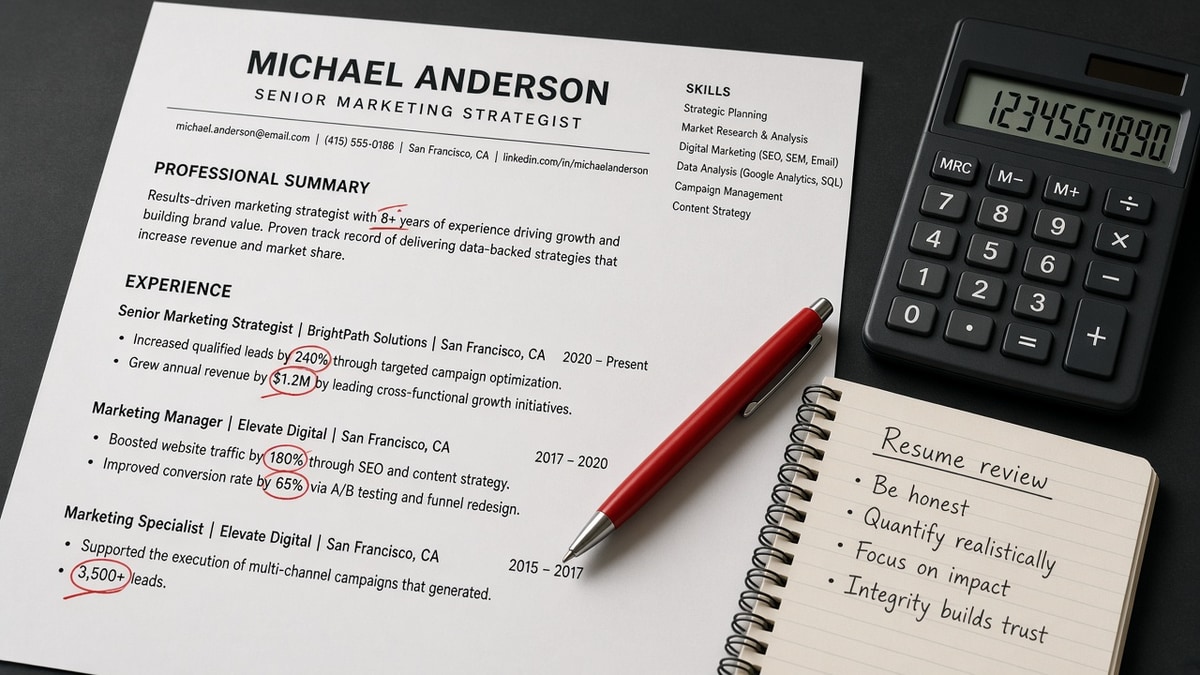
9 min read
That 300% efficiency line looked great in a blog template. In a recruiter queue it reads like you multiplied two small wins and hoped nobody asked. You're not dishonest. You're just editing in the wrong order, polishing wording before you can point to where the number lived.
Hiring teams in Workday and Greenhouse don't run a lie detector on percentages. They pattern-match. Round huge gains on junior titles, company-wide revenue on individual contributor lines, and metrics with no baseline feel invented even when the work was real. If you can't name the report, don't ship the percent yet.
Tonight you'll follow a short sequence: inventory, source, scope, soften, test. Check your resume for free after Step 5 so keyword matches still sit inside dated Experience lines, not only in a Skills row.
This won't fix applying to roles you're not qualified for. It stops a qualified file from dying on a phone screen when someone asks which dashboard proved that 40% drop.
Quick wins
- Highlight every digit on your PDF before you rewrite a single verb.
- Add from X to Y and a month range beside each percentage.
- Split team wins into your slice instead of whole-company credit.
What recruiters hear as fake on metric lines
Credibility is not about avoiding numbers. It's about whether the line sounds like something your manager would nod at in a reference check. A mid-level analyst whose top bullet still reads improved efficiency with no baseline gets skipped for a file that names ticket volume, timeframe, and team scope in one sentence.
The smell test: can you name the system, the before value, the after value, and who owned the outcome? If any piece is missing, the percentage is decoration.
Before: Increased revenue by $2M.
After: Generated $210K in new enterprise bookings personally on a 10-person sales pod; team total $2M in FY2025 per Salesforce reports.
Before: Improved system performance by 500%.
After: Cut average API response time from 820ms to 310ms on checkout endpoints over two quarters by indexing three Postgres tables and caching catalog reads in Redis.
Before: Transformed customer engagement across the organization.
After: Raised email click-through from 2.1% to 3.4% on the lifecycle program for 240K active users; A/B tests ran in Iterable across six months.
Parsers in Lever and iCIMS still score keyword overlap when those tools appear in dated bullets. Humans score whether you'd survive a five-minute drill on the math. Both matter on US corporate reqs.
Pair this pass with impact-first resume bullets US hiring teams prefer so your strongest sourced number lands in bullet one, not bullet four.
Timeline for how to avoid fake-sounding metrics tonight
Work in order. Skipping a step is how pretty percentages show up before you have a folder path to defend them.
- Step 1 (15 minutes): Export a single-column PDF. Highlight every digit, dollar sign, and percent symbol. Do not edit yet. You're building an inventory, not a rewrite.
- Step 2 (20 minutes): For each highlight, write one note: where the number lives. Dashboard name, quarterly review slide, Jira export, Zendesk report, or spreadsheet you still have. No source yet means the line waits.
- Step 3 (25 minutes): Add baseline, scope, and months. Team size, region, product surface, or ticket queue. Replace improved with from X to Y between Month Year and Month Year.
- Step 4 (15 minutes): Soften or split what you cannot prove. Use ranges, estimated, or contributed to on shared wins. Drop lines you cannot explain in thirty seconds.
- Step 5 (10 minutes): Read each metric bullet aloud once. If you hedge or ramble, rewrite or remove. Recruiters hear that hesitation on a screen too.
- Step 6 (10 minutes): Paste plain text into Notepad. Confirm employer lines and dates survived export, then run a parse preview on the same file you'd attach in Greenhouse.
Between Step 1 and 2, do not: add new percentages because the posting asked for data-driven. Source what you have first.
Between Step 3 and 4, do not: round up to impress. A believable 11% beats a shaky 47%.
Copy-paste metric bullet skeleton:
[Verb] [scope: team, region, customers, or tickets] from [baseline] to [result] over [months or quarters] by [specific change you owned].
Sample fill inside a fictional bullet: Reduced tier-1 support backlog from 1,400 to 920 open tickets in Q2 to Q3 2025 by redesigning macro routing in Zendesk for the payments queue.
I've screened stacks of these in Workday, and the line I trust names the queue or product, shows a before and after, and matches the title on the page. The line I skip is a round triple-digit percent with no months attached.
Short tenure? Keep metrics small and local. Three months in role can still carry one scoped win on a project you finished, not a department transformation.
No access to old systems? Use saved reviews, release notes you authored, or redacted screenshots you kept. Honest ranges beat precise fiction.
Between-step traps that recreate fake-sounding metrics
- Polishing verbs before sourcing: stronger action words on a number you cannot trace still fail on the phone screen.
- Whole-company credit: org-wide revenue or headcount on an individual contributor line without a personal slice.
- Marketing adjectives instead of units: skyrocketed engagement without clicks, opens, or tickets measured.
- False precision: 23.7% when you only know roughly twenty to twenty-five percent.
- Metric stuffing: every bullet quantified so the file reads like a random number generator.
- Skills-only proof: tools listed with no dated outcome underneath in Experience.
When finance blocks dollar figures, shift to time saved, defect counts, or volume handled. See how to write resume bullets with no metrics for proxies that still sound grounded.
Parse check before upload
After Step 6, run the same PDF against the req on your screen. You're checking that sourced numbers still sit under the employer and dates parsers read first, not in a sidebar or text box.
Run a free ATS check with the job description pasted. If must-have tools only appear in Skills, move one honest outcome line into Experience before you apply.
Rebuilding structure after the metric pass? Build your resume in a single-column layout, then paste your audited bullets back in date order.
Source first, polish last
How to avoid fake-sounding metrics on your resume is mostly sequencing. Inventory digits, attach sources, add baselines and months, soften what you cannot defend, then test aloud. Pretty wording on a hollow number still collapses in the first interview question.
Job searching is hard enough without defending math you cannot explain. A smaller honest line beats a heroic one you'd have to walk back.
When the file is ready, generate a cover letter that repeats one sourced outcome from bullet one, not a second set of round percentages.
Read more
Frequently asked questions
Round triple-digit percentages, company-wide revenue claims on a coordinator title, and numbers with no baseline or timeframe read invented. Recruiters flag lines they cannot map to a plausible data source. Scope the win to your team, region, or tool surface, and name the period you measured.
Yes, when you label them honestly. Write estimated savings of roughly 8 to 12 hours per week based on ticket volume after the workflow change instead of a precise dollar figure you cannot pull from finance. Ranges and words like approximately signal you are not inventing audit-grade precision.
No. Mix three to four quantified outcomes per role with plain responsibility lines that still name tools and scale. A file where every bullet ends in 99% or 10x reads like a template, not a person. Put your strongest defensible number in bullet one under your current job.
Parsers do not judge truth. They match keywords and read employer blocks first. Fake-sounding metrics still hurt you when a human reads the same line in Greenhouse or Lever and asks you to explain a figure you cannot source. Fix credibility for the screen, not for the parser alone.