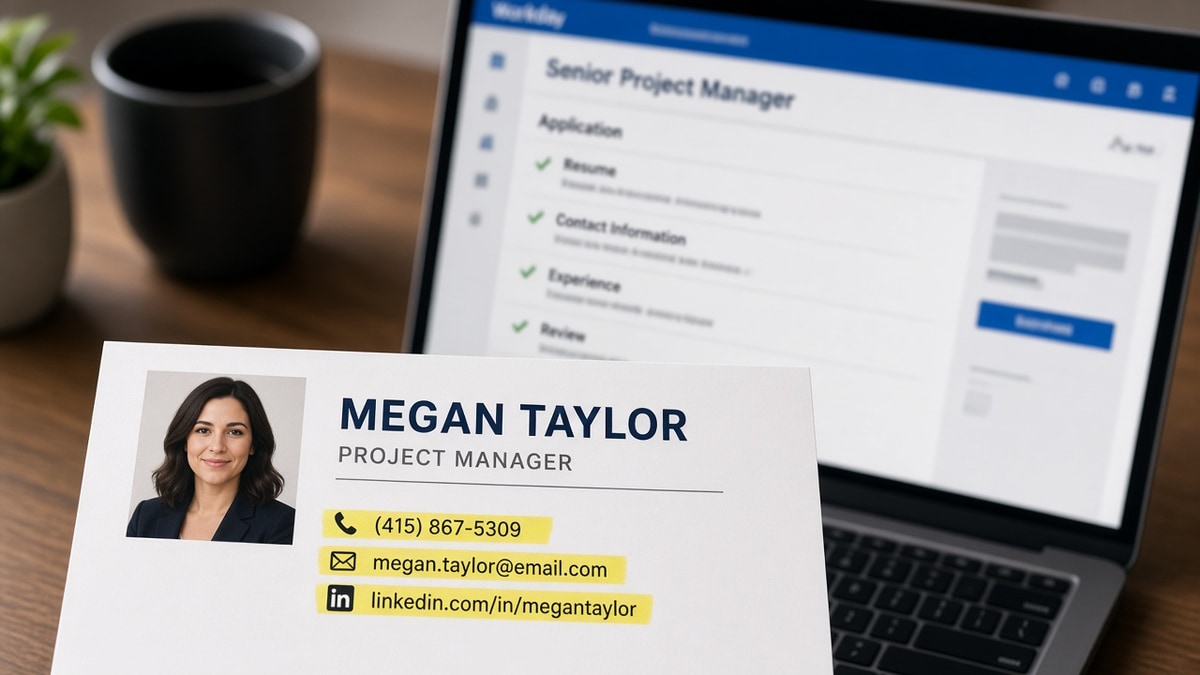
12 min read
When Workday shows a blank phone field even though you've uploaded a PDF that looks flawless, the parser usually read your contact block out of order: icons in a footer row, digits split across table cells, or lines trapped outside the body text it scans top to bottom. That's not a mystery rejection. You won't fix it with keywords. It's a layout import problem you can fix in ten minutes without rewriting experience bullets.
You're not crazy if the preview lied. Word and Canva render contact rows as one clean band. Workday, Greenhouse, and Taleo flatten the file into a character stream first. What lands in the phone field is whatever contiguous digits survived that flattening. Before you tweak keywords, check your resume for free with the posting pasted in and confirm name, email, phone, and city all imported.
Job searching while bills stack up is hard enough. Missing phone shouldn't be why a recruiter can't schedule a screen. I've screened files where the attachment showed a full header and the candidate record had name plus city only. Nobody called to ask for the number.
Below you'll see the symptom recruiters react to, three causes behind blank or scrambled contact fields, how to tell which one's yours, and the fix for each. When the portal wants a cover letter too, generate a cover letter that repeats the same plain contact lines so nothing contradicts on upload.
Quick Wins
- Move contact into the body on page one. Close header and footer editing.
- One field per line: name, email, phone, city. No icon fonts.
- Flatten two-column contact tables to a single column.
- Paste the export into Notepad and read top to bottom once.
The symptom: blank phone or email in the Workday preview
Recruiters open the candidate preview before they read bullet one. The pattern is familiar: your name imports, city sometimes imports, and phone or email stays empty. Or phone lands inside the summary field while your current job title sits under Education.
The PDF is not the record. The attachment can look perfect while the parsed profile is missing reachability data. Scheduling automation, knockout forms, and recruiter mail merges pull from parsed fields. No phone in the record means no text reminder even when someone wanted to move you forward.
How ATS reads contact info is simpler than most guides pretend. Importers walk the body text in reading order, top to bottom, left to right within each line. They pattern-match strings that look like email, digit clusters that look like phone, and city tokens near the top of the file. They do not "see" your design. They inherit whatever order the export produced.
That is why email sitting in footer icons or a phone number split across table cells produces a blank field in Workday while the PDF still looks fine. The visual layer preserved the layout. The character stream did not.
Humans who open the PDF can still find you. Many workflows never get that far. The preview is the first screen in Workday and Greenhouse. When contact fails there, the file reads incomplete before anyone judges your bullets.
For email-specific mailto failures, read why ATS can't read your email sometimes . This page covers the full contact block and the read order that drives every field.
Candidates often blame spam filters or ghosting. Recruiters assume the applicant used a throwaway number or opted out of texts. Neither side checks the preview against the PDF until weeks pass. The fix is mechanical: put plain characters where the top-down reader expects them.
You are not rewriting your career story. You are reordering six lines at the top of page one. That is why this failure feels insulting on an otherwise strong file.
How ATS reads contact info after upload (and where it breaks)
Cause 1: contact trapped in headers, footers, or margin zones
How to tell: double-click the top or bottom margin in Word and your phone appears outside the body. Plain-text paste lists your summary before any digits.
Before: Operations manager template with name in the body and phone plus email in a Word footer on every page.
After: Jordan Ellis on line one of the body. [email protected] on line two. (312) 555-0142 on line three. Chicago, IL on line four. Empty footer.
The fix: insert contact directly under the name inside the body. Close header and footer view. Re-run the paste test until phone appears above Professional Summary in Notepad.
Cause 2: icon fonts and table cells splitting email or phone
How to tell: the resume looks polished with envelope and handset glyphs. Paste test shows squares, pipes, or area code on one line and the last four digits on the next.
Before: Two-column Canva header table. Email in the left cell with an envelope icon. Phone in the right cell split from the area code by a narrow column width.
After: Single column. Four plain lines with no symbols. Each value typed as continuous characters.
The fix: delete every icon from the contact zone. Remove the table wrapper. Retype phone as one string even if Word wants to wrap it visually. Zoom to 200 percent and confirm no hidden break sits inside the number.
Cause 3: two-column layouts that reorder the contact block
How to tell: sidebar skills or photo column parses before your contact lines. Preview shows competencies where phone should be.
Before: Marketing coordinator resume with a left sidebar for skills and contact stacked in the right column beside a headshot placeholder.
After: Same candidate targeting program manager roles. Contact block full width on page one. Skills moved below summary in one column.
The fix: flatten to one column for corporate uploads. Read Workday: why your resume looks different after upload when the whole preview scrambles, not just phone. Layout order fixes come before field-level tweaks.
How to tell which cause is yours in under three minutes
Run the plain-text paste test first. Copy the entire document into Notepad or TextEdit plain mode. Read top to bottom once. That sequence is what the importer approximates.
If phone or email is missing in Notepad, you have a header, footer, or hyperlink trap. If digits appear as fragments on separate lines, you have a table or wrap break. If skills or summary text appears before your phone line, you have column order to fix.
Upload only after Notepad shows name, then email, then phone, then city in that order. Open the portal preview and compare field by field. Trust the preview over the PDF attachment.
Copy-paste block: ATS-safe contact header
Jordan Ellis
[email protected]
(312) 555-0142
Chicago, IL

Professional Summary
Two lines max. Plain text only.
Government and university portals sometimes cap contact fields differently. For state reqs with strict form boxes, read state government resume tips for US ATS and HR review after you flatten the master file. Corporate uploads and USAJOBS-style forms follow different rules.
Edge case: international numbers with country codes parse fine when typed as one continuous string. Do not insert spaces inside the country code if your paste test breaks the cluster.
Edge case: veterans who keep a civilian email on line one and a .mil address on line five should expect only the top block to map reliably. Pick one primary line per application.
Do not add a second phone row in the footer as backup. Footers import inconsistently. Line one through four in the body is the record. Footer repeats are optional redundancy, not a fix for a missing header phone.
Where contact lines still vanish after a flatten pass
Plain text on page one solves most imports. These exceptions explain why a corrected file can still show empty contact fields after upload.
Combined contact strings on one line. Phone pipe email pipe city sometimes maps entirely into the phone field in SAP builds. Split to separate lines even when space feels tight.
Mailto links on email. Hyperlinked addresses export as field codes without visible characters. Phone may parse while email stays blank. Remove hyperlinks and retype both fields.
Text boxes floating beside the margin. Designer templates hide contact inside a shape. Shapes do not export as body text. Type contact in the main flow.
Scanned PDF exports. A scan of a printed resume has no selectable phone even when you see it visually. Export DOCX or a text-based PDF from the source file.
Repeated contact on page two only. Some Taleo builds read page-one body contact only. If you moved everything to a footer on page two during edits, the preview stays blank.
Before: Data analyst resume with Font Awesome icons, mailto email, phone in a right-column table cell, and city in the document header.
After: Same candidate, four plain lines at top of page one, no tables, no links, Calibri 11 pt, single column through Experience.
Recruiters rarely hunt through footers when the preview already shows a gap. They assume the file is incomplete or the candidate prefers email only. You will not get a courtesy call to ask for the missing number.
This will not fix applying to roles you are not qualified for. It stops a reachable phone and email from disappearing because the parser never received contiguous characters in reading order.
And if you changed numbers mid-search, update line three on every version you upload. Old digits in a footer point recruiters at a disconnected voicemail while the preview still looks "fine" on PDF.
Keep LinkedIn on its own line below city when you include it. URLs typed plainly without fancy anchor text import more reliably than buttons labeled Profile.
But do not wait for a perfect template before you fix contact. A boring header with four plain lines beats a designed header that drops your phone every time. Recruiters forgive plain. They cannot text a blank field.
Verify every contact field before the next application
Upload your flattened file and the posting to HireFlow's free ATS resume checker . Confirm phone and email populated and match your line-two and line-three strings character for character.
When you're rebuilding from a template-heavy file, build your resume with a plain contact block baked in so you do not reintroduce icon rows on the next edit.
Do this now: Move contact into the body, delete icons, flatten tables, paste into Notepad to confirm read order, upload once, read every contact field in the preview before Submit.
What to do now
How ATS reads contact info comes down to top-down body text, not the PDF you designed. Email in footer icons or phone split across table cells is why Workday shows blank fields even when the attachment looks perfect. Put plain characters on page one in reading order and trust the preview.
- Move contact out of headers, footers, and sidebars.
- Delete icon fonts and flatten contact tables.
- One value per line: name, email, phone, city.
- Run a plain-text paste test before export.
- Confirm every contact field in the portal preview before Submit.
Open the req you are targeting. Run a free ATS check , fix any blank contact fields, and submit one clean upload.
Read more
Frequently asked questions
Most corporate parsers prioritize the document body and read top to bottom. Headers and footers often import late, out of order, or not at all. Phone and email sitting in a margin zone may never attach to the candidate record even when they look perfect on the PDF. Move every contact line into the body under your name on page one.
Digits split across table cells, icon fonts beside the number, or phone trapped in a footer export as fragments the mapper cannot join. The preview field stays empty while the visual PDF still renders the row. Flatten to single-column plain text, one phone string per line, and run a paste test before upload.
Labels help humans more than parsers. What parsers need is contiguous characters on their own lines: digits for phone, letters and @ for email. If your template already uses plain labels everywhere, keep them. Otherwise put the value alone on the line. Icons and mailto links cause more failures than missing labels.
Many US reqs use location for knockout or recruiter filtering. City and state on one plain line after phone is enough. Full street address is optional and sometimes discouraged. Do not put location only in a sidebar table cell. It should follow phone in reading order on page one.
Parsers sometimes map a combined pipe-separated line entirely into the phone field and drop email. Give each item its own line: name, email, phone, city, then LinkedIn URL typed plainly without hyperlink styling. That order survives Greenhouse and Workday imports more often than a single crowded row.