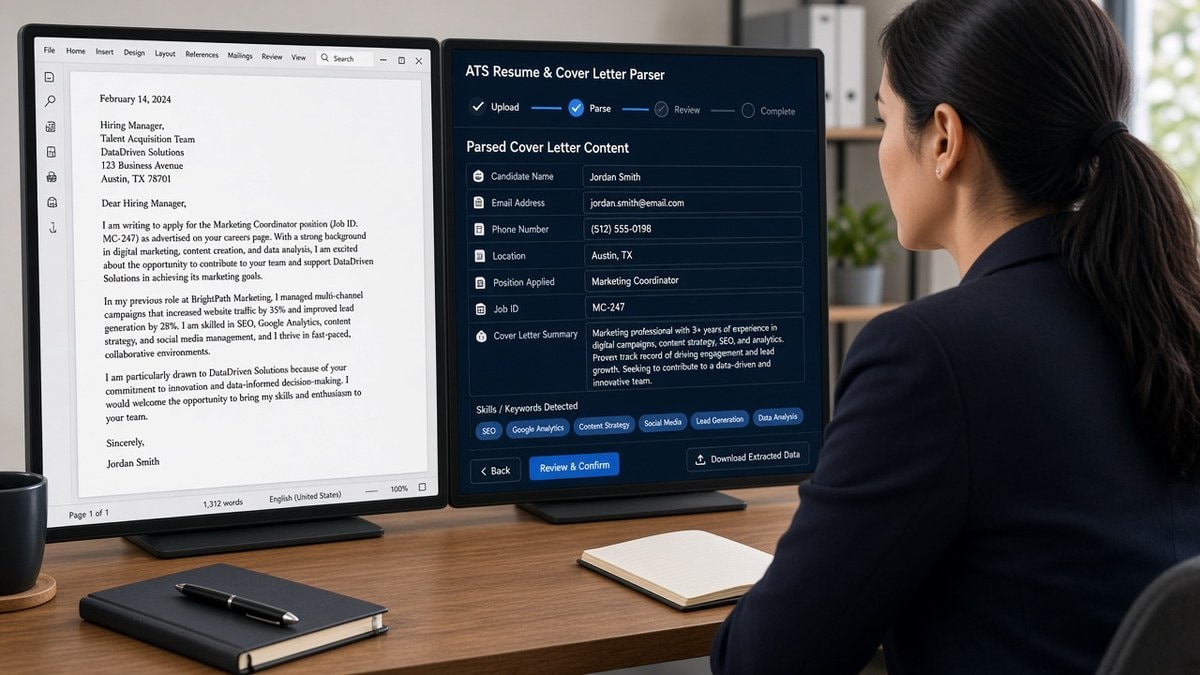
Most job seekers assume cover letters bypass Applicant Tracking Systems (ATS) entirely. They don't. How ATS processes cover letters is a critical but misunderstood part of the job application pipeline. Unlike resumes, which are parsed for specific data points, cover letters are evaluated differently—and understanding this difference can improve your odds of reaching a human recruiter.
When you submit a job application, the ATS doesn't just extract your resume. It also reads, analyzes, and scores your cover letter using keyword matching, relevance detection, and sometimes sentiment analysis. The system flags cover letters that align with job requirements, signal genuine interest, and demonstrate cultural fit. But many applicants write cover letters that ATS systems either ignore or penalize.
In this guide, you'll learn:
- How ATS systems technically process and evaluate cover letters
- Which cover letter elements ATS actually reads and prioritizes
- Common mistakes that cause ATS to downrank your application
- Best practices to optimize your cover letter for both ATS and human readers
- When cover letters genuinely improve your screening chances
Understanding How ATS Processes Cover Letters
ATS systems handle cover letters differently than resumes because cover letters lack standardized structure. Resumes follow predictable formats: contact info, summary, experience, skills, education. Cover letters are narrative-driven and less formulaic, which makes automated parsing more challenging.
Most modern ATS platforms use natural language processing (NLP) to extract meaning from cover letter text rather than relying on rigid parsing rules. The system scans for job-relevant keywords, evaluates how closely your background matches the role, and measures the relevance of your stated motivation. Some systems also assess tone and language patterns to infer cultural alignment.
The critical distinction: while ATS extracts structured data from your resume (job titles, dates, skills), it analyzes the content and context of your cover letter. This means generic, template-heavy cover letters often score lower because the ATS detects weak keyword alignment and lack of specificity to the role.
Key Elements ATS Reads in Cover Letters
Job-Relevant Keywords and Phrases
ATS systems perform keyword matching on cover letter text just as they do with resumes. If the job description emphasizes "project management," "agile methodology," or "stakeholder communication," the ATS flags cover letters that mention these terms in relevant context. The system doesn't require exact phrase matches—it recognizes synonyms and related terminology.
However, keyword density matters less in cover letters than in resumes. Stuffing keywords into cover letter prose looks unnatural and can actually lower your score because ATS detects forced language patterns. Instead, weave job-relevant terms naturally into your narrative about why you're interested in the role and how your experience applies.
Specific Company and Role References
Cover letters that reference the specific company name, role title, or department signal genuine interest. ATS systems recognize this and score such applications higher. Generic cover letters that could apply to any job—or worse, that reference a different company—receive lower scores or may be flagged as low-effort applications.
When you mention the company by name and reference specific aspects of the role or organization, the ATS detects alignment between your stated motivation and the actual job. This is one of the few places where personalization directly impacts ATS scoring.
Quantifiable Achievements and Results
ATS systems recognize numbers and metrics in cover letters as indicators of impact and credibility. Phrases like "increased revenue by 35%," "managed a team of 12," or "reduced processing time by 40%" are weighted more heavily than vague claims like "strong performer" or "team player." These specific metrics create stronger keyword matches when the job description emphasizes results-driven performance.
Alignment with Job Requirements
The ATS evaluates how well your stated qualifications align with the job's core requirements. If the posting lists five key responsibilities, a strong cover letter addresses at least three of them explicitly. The system measures this alignment by comparing your experience statements to the job description language and assigning relevance scores.
Common Cover Letter Mistakes That Hurt ATS Scores
- Using a generic template: Cover letters that could apply to any job receive lower relevance scores. ATS detects when you haven't customized content for the specific role, and your score drops accordingly.
- Ignoring the job description: Failing to reference key requirements or responsibilities means missing keyword opportunities. The ATS compares your cover letter to the job posting and flags weak alignment.
- Formatting that breaks ATS parsing: Complex formatting, graphics, headers, or footers can cause parsing errors. Stick to plain text or simple formatting to ensure the ATS reads your entire cover letter accurately.
- Excessive length: Cover letters longer than 400 words dilute keyword density and may be partially skipped by ATS systems. Concise, targeted cover letters score better than rambling narratives.
- Spelling and grammar errors: Some ATS systems flag applications with multiple errors as lower quality. Poor writing also suggests carelessness, which impacts how recruiters perceive the application after screening.
- Submitting when it's optional: If the job posting says "cover letter optional," many ATS systems don't weight it heavily in scoring. However, submitting a weak cover letter can hurt more than not submitting one at all.
Best Practices to Optimize Your Cover Letter for ATS
- Customize for each role: Reference the specific company, role title, and 2-3 key job requirements. This directly improves ATS relevance scoring and signals genuine interest to both the system and recruiters.
- Mirror job description language: Use terminology from the job posting naturally throughout your cover letter. If the posting emphasizes "cross-functional collaboration," mention your experience collaborating across teams. This increases keyword match scores.
- Lead with your strongest match: Put your most relevant qualification in the opening paragraph. ATS systems weight early content more heavily, so frontload the information that best aligns with the role.
- Include specific metrics and results: Quantify your achievements. Instead of "improved efficiency," write "reduced processing time from 8 hours to 3 hours." Specific numbers improve both ATS matching and human readability.
- Keep formatting simple: Use standard fonts, avoid graphics or tables, and stick to plain text or minimal formatting. Complex designs break ATS parsing and may result in incomplete data extraction.
- Maintain appropriate length: Aim for 250-400 words. This length is long enough to demonstrate genuine interest and include relevant details, but short enough that ATS systems process it fully and recruiters actually read it.
- Address the hiring manager by name when possible: Research the hiring manager's name on LinkedIn or the company website. Personalizing the salutation signals effort and improves perceived application quality, though ATS doesn't directly score this.
- Close with a clear call to action: End with a statement like "I'd welcome the opportunity to discuss how my experience aligns with your team's goals." This reinforces your genuine interest and gives recruiters a clear next step.
Step-by-Step Guide: Writing an ATS-Optimized Cover Letter
- Step 1: Analyze the job description. Identify 5-7 key requirements, responsibilities, and desired qualifications. Highlight keywords and phrases that appear multiple times.
- Step 2: Research the company and role. Learn about the company's mission, recent news, and the specific team you'd join. This research informs personalized references that ATS systems recognize as genuine interest.
- Step 3: Draft your opening. State the specific role you're applying for and mention one key reason you're interested in this company or role. Include a relevant keyword from the job description naturally.
- Step 4: Map your experience to requirements. In 2-3 body paragraphs, address the job's core requirements. For each, explain how your background qualifies you, using language from the job posting where appropriate.
- Step 5: Include a concrete achievement. Provide one specific example with metrics that demonstrates your ability to deliver results in an area the job emphasizes.
- Step 6: Reinforce cultural alignment. Briefly explain why the company's mission or values resonate with you. This signals fit beyond just skills.
- Step 7: Proofread and format. Check for spelling and grammar errors. Use a simple font, single spacing, and plain text format. Test that your formatting displays correctly when pasted into online forms.
When Cover Letters Actually Improve Your ATS Score
Not all cover letters move the needle. ATS systems weight cover letters differently depending on the company, role level, and application volume. For high-volume positions (customer service, entry-level roles), cover letters may receive minimal ATS weight. For specialized or leadership roles, a strong cover letter can significantly improve your screening chances.
Cover letters matter most when they address a gap or concern a recruiter might have. If you're changing careers, have a gap in employment, or are relocating, a cover letter that explains these situations directly can prevent automatic rejection. Similarly, if your resume doesn't clearly show why you're interested in this specific role, a personalized cover letter bridges that gap and improves relevance scoring.
Cover letters also serve as a tiebreaker. When two candidates have similar resume scores, ATS systems often use cover letter quality and relevance to rank one above the other. A cover letter that demonstrates genuine interest and specific knowledge of the role can be the difference between reaching a recruiter and being filtered out.
Conclusion: Make Your Cover Letter Work With ATS, Not Against It
How ATS processes cover letters is no longer a mystery. Modern systems use natural language processing to evaluate keyword relevance, job alignment, and genuine interest signals. Your cover letter won't bypass the ATS—it will be analyzed, scored, and used to rank your application against other candidates.
The key to success is treating your cover letter as a strategic document, not a formality. Customize it for each role, reference specific job requirements, include quantifiable achievements, and maintain simple formatting. When done well, a strong cover letter improves your ATS score and signals to recruiters that you've invested genuine effort in your application.
Remember: a weak cover letter hurts more than no cover letter at all. If you can't write a personalized, relevant letter quickly, skip it. But if you have time to customize your message and align it with the job description, submit it. That extra effort can be the difference between being filtered out and reaching a human recruiter who actually reads your application.
Frequently asked questions
Modern ATS systems do read and analyze cover letters, but they process them differently than resumes. Instead of extracting structured data, ATS uses natural language processing to evaluate keyword relevance, alignment with job requirements, and sometimes tone. However, weight varies by system and role. For high-volume positions, cover letters may receive minimal scoring weight. For specialized roles, they can significantly impact your screening chances. The safest approach is to always submit a customized cover letter when given the option, as a weak one hurts more than no letter at all.
Submitting an optional cover letter is beneficial only if it's strong and customized. A generic, template-heavy cover letter can actually lower your overall application score because ATS detects weak relevance. If you're short on time or can't write a personalized letter, skip it entirely. But if you can quickly customize a cover letter with specific role references and relevant keywords, submit it. The ATS will recognize the effort and relevance, which can boost your screening chances even when the letter is technically optional.
Resume relevance typically carries more weight in ATS scoring because it contains structured, verifiable data (job titles, dates, skills). Cover letters are weighted as a secondary signal. However, a cover letter can amplify or diminish your overall application score. A highly relevant cover letter that addresses specific job requirements can boost a borderline resume score into the screening range. Conversely, a generic cover letter can't compensate for a weak resume. Think of your cover letter as a relevance multiplier—it strengthens a solid resume but can't fix fundamental misalignment.
No. Resume keyword optimization involves strategic placement and density because ATS extracts resume data algorithmically. Cover letters should include job-relevant keywords naturally within your narrative. Keyword stuffing in a cover letter reads as forced and unnatural, which ATS systems detect and penalize. Instead, weave keywords into sentences that explain why you're qualified and interested. For example, instead of "Project management, agile, stakeholder communication," write "I've led cross-functional teams using agile methodologies to deliver projects on time while maintaining strong stakeholder communication." This approach improves both ATS relevance and human readability.
Yes. Complex formatting, graphics, tables, headers, footers, and colored text can break ATS parsing. When the system can't read your cover letter correctly, it may skip sections or extract incomplete data, lowering your relevance score. Additionally, many online application portals strip formatting when you paste text, so a beautifully designed cover letter becomes plain text anyway. Use simple formatting: standard font, single spacing, plain text, and minimal line breaks. This ensures the ATS reads your entire letter and displays correctly across all platforms.
Aim for 250-400 words. Shorter letters may not provide enough detail for ATS to assess relevance and your genuine interest. Longer letters dilute keyword density and may be partially skipped by ATS systems that prioritize the first 300-400 words. A well-structured, concise cover letter that addresses key job requirements and includes specific examples performs best in both ATS scoring and human review. Quality and relevance matter far more than length.