7 min read
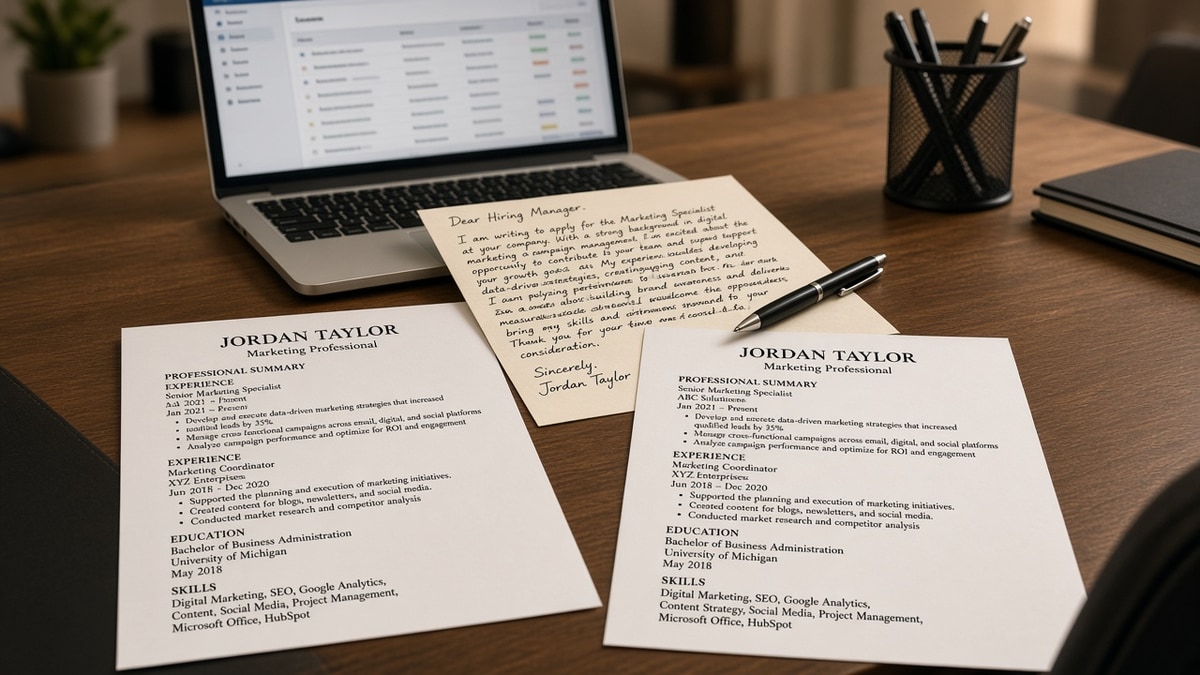
Same title stack. Same employer names. Same degree line. You're not imagining it when your file looks like four others in the folder.
Check your resume for free before you draft tiebreaker prose. Parsers still rank on import fields first, and a scrambled profile won't reach the moment where a letter matters.
The sections below spell out when hiring teams actually open the attachment tab, what they scan for in a tied stack, and what to write when you can't out-keyword the other files.
Job searching is exhausting when silence feels random. Tonight you'll only need a clear rule for whether this application earns a letter or just a sharper bullet one.
Quick wins
- Mirror the posting job title in line one of the letter.
- Add one scoped win that is not copied from resume bullet one.
- Name a product, customer, or duty from this company, not a generic mission.
- Skip the optional upload when you would repeat the summary block.
What counts as a resume tie in hiring tools?
A tie is not a literal duplicate file. It is a cluster of profiles that pass the same filters in Workday, Greenhouse, Lever, or iCIMS with similar titles, tenure, and keyword hits.
Recruiters sort that grid by employer, years, and must-have skills. When three rows look interchangeable, the coordinator opens notes or attachments to break the logjam.
That is different from losing on volume. If you never clear the first filter, no letter saves you. For parser behavior on attachments, read do cover letters still matter for ATS after you confirm import fields.
Ties show up late: phone screen scheduling, hiring manager review, or a req with one open seat and five qualified rows. That is the window where cover letters break resume ties if they carry new proof.
When do cover letters break resume ties?
Required uploads get skimmed even on busy reqs. Optional uploads get opened when the resume raises a question you cannot answer in a bullet line.
Common triggers: career pivot titles, relocation, contract-heavy background, return after caregiving leave, or two parallel reqs at one company where the coordinator needs to know which location you want.
I've opened tie letters in Greenhouse when two analysts shared the same title stack and the hiring manager needed one sentence on why one candidate left consulting for in-house ops.
Writing-heavy roles and small teams read more often because prose is part of the job. High-volume hourly reqs rarely use letters for ranking. Match effort to the req type so you do not miss a deadline crafting paragraphs nobody opens.
Which letter details actually move a tied stack?
Hiring teams look for three signals: genuine interest in this employer, clear writing, and one fact the resume grid hides.
Before: Dear Hiring Manager, passionate about your innovative culture.
After: Team for the Revenue Operations Analyst req: Built the renewal forecast model your posting describes for subscription lines.
Tie the opening to a duty from the posting. Tie the middle to a scoped outcome with tools, not adjectives. Close with availability, not a plea.
Illustrative proof inside the letter can look like a resume bullet without being a copy-paste: Built weekly churn dashboards in Looker, cutting reactive tickets 11% in Q3. That number lives in your story, not as a claim about all candidates.
If your letter could swap company names and still read fine, it will not move anyone. Specificity is the whole tiebreaker.
Write a tiebreaker letter in four moves
- Confirm the resume import shows the posting title and clean employer dates.
- Pull one duty line from the req into your opening sentence.
- Add one scoped win that is not resume bullet one.
- Close with two lines on availability and thanks.
Copy-paste skeleton
[Your name]
[City], [State] | [phone] | [email]

Re: [Exact job title from posting] at [Company name]

Paragraph 1: One sentence on why this team, tied to a product, customer, or duty from the req.
Paragraph 2: One scoped win with tools and outcome (not copied from resume bullet 1).
Paragraph 3: Close with availability and thanks in two lines max.
Before: You restate every resume bullet in paragraph form.
After: You explain why you are applying from another city and cite one project that maps to their roadmap.
Export plain DOCX or PDF with no tables, text boxes, or header graphics. Same boring fonts as your resume file so preview panes do not garble the paste box.
When overload slows replies, see how recruiters handle application overload so you know where your file sits in the queue before you add another attachment.
Tiebreaker traps that push the other candidate ahead
- Uploading a template because you heard letters always help on tied stacks.
- Repeating the summary block without new scope or context.
- Wrong company name or stale req title from a copied file.
- Paste boxes that collapse into a wall of text with broken line breaks.
Before: You attach a letter to every optional field tonight.
After: You skip when you cannot name the product line and spend the hour on headline match instead.
Skipping is triage, not laziness, when the resume already mirrors the posting. A missing optional letter rarely hurts as much as a careless one.
Draft after the resume can compete
Tiebreaker letters are easier when bullet one already hits a must-have skill and employer dates import cleanly.
Generate a cover letter from the same job description you used to tailor bullets, then delete every sentence that repeats the resume grid.
Score your job match on the resume first so you are not polishing prose on top of a file that still fails basic gates.
Use the letter as tiebreaker proof, not a second resume
How cover letters break resume ties is simple in practice: they answer questions identical rows leave open. They do not replace missing qualifications or fix a parser error.
Fix the profile, decide in one minute whether you have a company-specific story, then write three tight paragraphs or submit without the optional file. That beats guilt over an empty upload box on a strong match.
Read more
Frequently asked questions
They can when you are already in a finalist pool and the letter adds one scoped fact or risk answer the grid cannot show. They cannot when you are missing a must-have license, degree, or years gate. Fix resume match first, then use the letter for motive, relocation, or a pivot story.
Three short paragraphs on one page. Open with the exact job title and one reason tied to this team, add one proof example with tools and scope, close with availability in two lines. If you are rewriting every bullet from the resume, you are duplicating the file that already tied.
Submit when you can name this employer in sentence one and you carry a question the resume raises, such as a title change or distant location. Skip when you would paste a template or repeat bullet one. An empty optional box beats noise on a strong match.
Yes. A generic opener, wrong company name, or sloppy paste box formatting can push a coordinator toward the other file. If you cannot write something specific tonight, do not attach a letter just because you heard tiebreakers matter.