11 min read
The template didn't fail you because it looked plain. It failed because the parser imported your old industry title first while your pivot proof sat in a sidebar it never scored. That's what the best resume templates for career switchers fix: one column, real dates, and bullets that lead with the work the new posting asks for.
Before you rebuild, check your resume for free with the target posting pasted in. You'll see whether Experience imports in order and whether your headline lands above ancient roles.
Career pivots are stressful enough without guessing which Canva layout Greenhouse can read. You don't need a design award. You'll need contrast: weak switcher files beside fixed ones you can paste into a plain DOCX tonight.
The pairs below cover six common pivots. Each one shows what a pretty template breaks and what a boring single-column file fixes. Swap in your tools. Keep the structure.
Quick Wins
- Single-column DOCX. No sidebar Skills grid.
- Two-line target headline naming the role you want, not the one you left.
- First bullet under each job uses a tool from the new posting.
- Bootcamp or cert block with Month Year dates, not a floating icon row.
What recruiters and parsers compare your switcher file against
A career-change upload gets the same ten-second skim as any other file. The recruiter checks three things: does the current block look like the posting, do dates make sense, and can the parser prove you did the work you claim. Fancy templates often pass the eye test on PDF and fail the export test in Workday.
The bar is a hybrid layout without the design debt. Target headline up top. Skills as a single plain line. Experience in reverse chronological order with reframed bullets. Education or certifications that support the pivot, dated honestly. No functional format that hides employers. No icon row that becomes gibberish in text view.
Think of the template as import order, not aesthetics. If your instructional design portfolio bullet imports after your student-teaching semester from 2014, the ATS thinks you're still in the classroom. If your supply chain proof sits in a left column the parser skips, the recruiter never sees forecasting work under a retail title.
Edge case one: you're pivoting after a bootcamp. Put the program on its own dated line with three project bullets, not inside a colored text box. Edge case two: you're military to civilian. Translate acronyms in the bullet, keep the official MOS on the employer line. Edge case three: you're returning after caregiving. One Career Break label line, then pivot bullets on the job before the gap. All three show up in the pairs below.
For format debates after you flatten columns, read chronological vs functional resume in 2026 . Hybrid beats pure functional for most online portals. Parsing first, keyword mirroring second.
Best resume templates for career switchers: before/after pairs
Each pair targets one template trap. Copy the After shape into a blank single-column DOCX. Replace tools and metrics with yours.
Teacher to instructional designer: sidebar hides pivot bullets
Posting wants Articulate Storyline, LMS admin, and adult learning design for a corporate L&D team on Greenhouse.
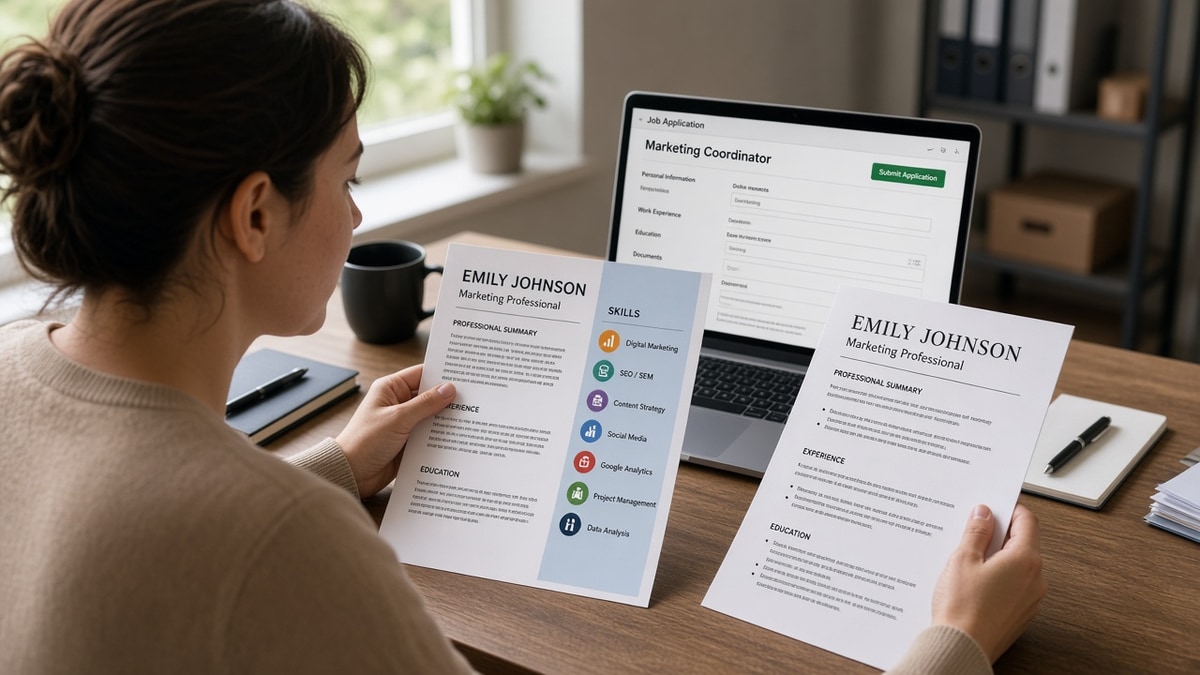
Before: Canva two-column template. Left sidebar lists "Instructional Design, Storyline, Adult Learning" with icons. Right column leads with High School English Teacher, 2016 to Present. Parser exports sidebar skills last; recruiter sees only classroom duties in the first screen.
After: Plain header. Target: Instructional Designer | Corporate L&D. Skills: Articulate Storyline 360, Canvas LMS, SCORM, adult learning theory. Curriculum Developer (contract), BrightPath Learning | January 2024 to Present. Built twelve Storyline modules for compliance training; cut seat time 18% while holding post-test scores at 92%. High School English Teacher, Westridge ISD, Austin, TX | August 2016 to December 2023. Designed unit plans mapped to state standards; mentored two student teachers on feedback cycles transferable to facilitator guides.
Retail manager to supply chain coordinator: old title still leads
Posting lists demand planning, vendor scorecards, and Excel forecasting for a regional distributor parsed in Workday.
Before: Chronological template with no headline. Store Manager, BigBox Retail, 2019 to Present sits on line one. Bullets mention "team leadership" and "customer service" with no inventory or vendor language.
After: Target: Supply Chain Coordinator | Inventory and Vendor Operations. Store Manager, BigBox Retail, Columbus, OH | March 2019 to Present. Ran weekly demand forecasts in Excel for 220 SKUs; cut stockouts 14% in FY 2024. Owned vendor scorecards for twelve suppliers; negotiated lead-time reductions that saved $48K in rush freight. Assistant Manager | June 2016 to February 2019. Managed receiving dock schedules for 1,200-pallet weekly volume; trained four hires on RF scanner counts.
Registered nurse to clinical research coordinator: pure functional template
Posting wants protocol adherence, IRB documentation, and patient recruitment for a Phase II trial on iCIMS.
Before: Functional template with a three-page Skills summary and a short employer list without dates. Recruiter cannot tell which hospital years map to which trial skills. Parser drops undated blocks.
After: Target: Clinical Research Coordinator | Oncology Trials. RN, Lakeside Oncology, Minneapolis, MN | July 2021 to Present. Screened 38 patients monthly against inclusion criteria; maintained IRB binders with zero audit findings in 2024. Coordinated specimen logistics with central lab; held protocol deviation rate under 2% across four studies. Staff Nurse, Med-Surg, North Star Health | May 2018 to June 2021. Managed Epic flowsheets for six-patient assignment; precepted three orientees on documentation standards.
Military logistics to project manager: acronym wall in a header graphic
Posting wants cross-functional delivery, risk logs, and Microsoft Project for a defense contractor role.
Before: Template with a banner graphic and a Skills cloud reading "Leadership, Discipline, SOP 600-4, METL." Experience shows Staff Sergeant with bullets full of acronyms and no civilian translation.
After: Target: Project Manager | Defense Logistics Programs. Logistics NCO, US Army, Fort Cavazos, TX | June 2018 to June 2024 (Honorable Discharge). Led twelve-person team moving $2.3M in equipment monthly; maintained 99% on-time dispatch across CONUS rotations. Built risk registers and weekly status decks for battalion leadership; cut customs delays 11% after broker workflow rewrite. Project Coordinator (contract), Sentinel Defense, Austin, TX | September 2024 to Present. Own Microsoft Project schedules for three subcontractor workstreams; hold milestone variance under 5% through Q2 2025.
Accountant to data analyst: designed PDF with tables
Posting repeats SQL, Tableau, and stakeholder reporting for a finance analytics seat on Taleo.
Before: Designed PDF with table cells for Skills and a photo header. Parser merges cells; Tableau and SQL land in footer text. Staff Accountant title leads with reconciliation duties only.
After: Single-column DOCX. Target: Data Analyst | Finance and Risk Reporting. Senior Staff Accountant, FinServe, Chicago, IL | January 2020 to Present. Built Tableau dashboards for loss reserves; flagged $1.8M exposure before charge-off in 2023. Wrote SQL in Snowflake for weekly variance reports consumed by FP&A leads. Staff Accountant | July 2017 to December 2019. Automated reconciliation workflows in Excel; cut month-close adjustments 9% in FY 2019.
Journalist to content marketing manager: summary eats the fold
Posting wants SEO content strategy, HubSpot, and pipeline metrics for a B2B SaaS team.
Before: Hybrid template with a six-line career narrative about passion and storytelling. Reporter role buried below Skills icons. No metrics, no CRM tools.
After: Target: Content Marketing Manager | B2B SaaS. Skills: HubSpot, SEO, Google Analytics, content strategy. Content Strategist (freelance), CloudServe, Remote | March 2024 to Present. Produced twelve SEO pillar pages; lifted organic demo requests 22% in H1 2025. Staff Reporter, Metro Daily, Denver, CO | June 2018 to February 2024. Published 140+ enterprise features; grew newsletter open rate from 19% to 28% through subject-line testing cadence.
Edge case: bootcamp grad with no pivot employer yet
Before: Bootcamp projects listed under a decorative Projects section with no dates. Previous barista job leads Experience.
After: Target: Junior Software Engineer | Full-Stack Web. Software Engineering Certificate, CodeForge Bootcamp | January 2025 to April 2025. Built React and Node capstone for inventory app with 94% test coverage; presented to three hiring partners. Barista Team Lead, Roast House, Portland, OR | June 2021 to December 2024. Trained six hires on POS workflows; maintained 4.9 average customer rating while scheduling 20 weekly shifts.
Copy-paste block: career switcher single-column skeleton
FULL NAME · City, ST · Phone · [email protected]

TARGET HEADLINE (role you want | specialty)
Skills: tool, tool, tool from posting (plain comma list)

MOST RELEVANT ROLE OR CONTRACT | Month Year to Present
• Verb + posting tool in first eight words + scope + outcome
• Second bullet proving a different posting requirement

PRIOR ROLE (official title stays honest) | Month Year to Month Year
• Reframed bullet toward target field, not old industry jargon
• Bullet with metric from old job that translates

CERTIFICATION OR BOOTCAMP (if pivot training) | Month Year to Month Year
• Project or credential bullet with tool proof

FORMATTING
• 11pt Calibri · one column · Month Year dates · no sidebars or icons
Run the skeleton top to bottom, then export to text. If your target headline appears below jobs you do not want, the template is still wrong. I've screened career-change files in Workday where the sidebar imported perfectly on PDF and scrambled completely on upload.
When you need to rename bullets without inventing titles, see how to map experience to a new job title . Honest employer lines, reframed first bullets.
What weak career-switcher templates share
Pivot proof lives in a sidebar. Skills icons and competency bars look modern on screen. Parsers often read them last or skip them. Fix: plain Skills line under the headline, then prove each term in Experience bullets.
The old title still leads. Store Manager or Staff Nurse on line one tells the recruiter you have not decided what you want. Fix: two-line target headline, then reframe bullet one under the real title toward the new posting.
Functional format hides dates. Skills-first layouts feel safe when history does not match. Recruiters assume you are masking gaps. Fix: reverse chronological Experience with honest Month Year ranges on every block.
Bootcamp or cert blocks float without dates. Undated training reads like a hobby section. Fix: Month Year on the program line plus two project bullets with tools from the posting.
Career narratives replace bullets. Six lines about passion push proof below the fold on a laptop screen. Fix: drop the essay. Let bullet one carry the pivot story with a tool and outcome.
Designed PDFs use tables for alignment. Table cells merge on import and scramble keyword order. Fix: single-column DOCX with left-aligned text only. Run a free parser check before you trust the PDF view.
Exception: creative pivots into design or UX sometimes need a portfolio link in a plain URL field when the portal allows a second upload. Keep the screening resume boring. Put visual work elsewhere.
Check import order after you pick a template
Upload your rebuilt DOCX and the target posting to HireFlow's free ATS resume checker . Confirm Experience imports with your pivot bullets near the top and your headline above unrelated history.
When the role is a stretch but the file is clean, score your job match after the layout pass. Template fixes earn the skim. They do not invent qualifications the posting lists as must-haves.
Do this now: Flatten to one column, write a two-line target headline, reframe the first bullet under your current job with a posting tool, then run the checker before the next upload.
Rebuild order tonight
The best resume templates for career switchers are not the prettiest downloads. They are single-column files where your target headline, dated employers, and reframed bullets import in the order a recruiter expects.
- Drop sidebars, icon rows, and table layouts.
- Write a two-line target headline naming the role you want.
- Reframe bullet one under your current job with a posting tool.
- Date bootcamp or cert blocks with Month Year ranges.
- Run the checker after export, not before you touch import order.
Open the posting you want most. Run a free ATS check , confirm your pivot bullets land above unrelated history, and send one clean file.
When the portal accepts a cover letter, use the free cover letter generator with the same job description. Repeat employer names and date strings exactly as they appear in Experience.
Read more
Frequently asked questions
Rarely for online applications. Functional templates push skills up front but often hide dates and employer names in ways Workday and Greenhouse still read as gaps or missing roles. A single-column hybrid works better: two-line target headline, then Experience with reframed bullets under real employers. The parser sees dates; the recruiter sees proof.
In bullets under the employer where you used them, not only in a sidebar the parser skips. Put a short Skills line after the headline for scan terms from the posting. Then prove each skill once in Experience with a tool, scope, and outcome. Sidebars look tidy on screen and import last in many ATS exports.
Keep the official title on the employer line for honesty. Reframe the first bullet toward the target role. Example: Retail Store Manager stays as the title, but bullet one leads with inventory forecasting and vendor scorecards when you are applying to supply chain roles. Do not invent a new title the background check cannot confirm.
Most are not. Graphics, icon fonts, and two-column grids scramble import order so your strongest pivot bullet lands below unrelated internships. Export to plain text before you upload. If your target headline appears after your high school job, rebuild as a single-column DOCX with Calibri near 11 point.
One page if you have under eight years of work. Two pages if you are senior and every line supports the pivot. Cut pre-pivot duties that do not translate. A labeled bootcamp or certification block beats a third page of unrelated history. Parsers and recruiters both reward focus over volume.