11 min read
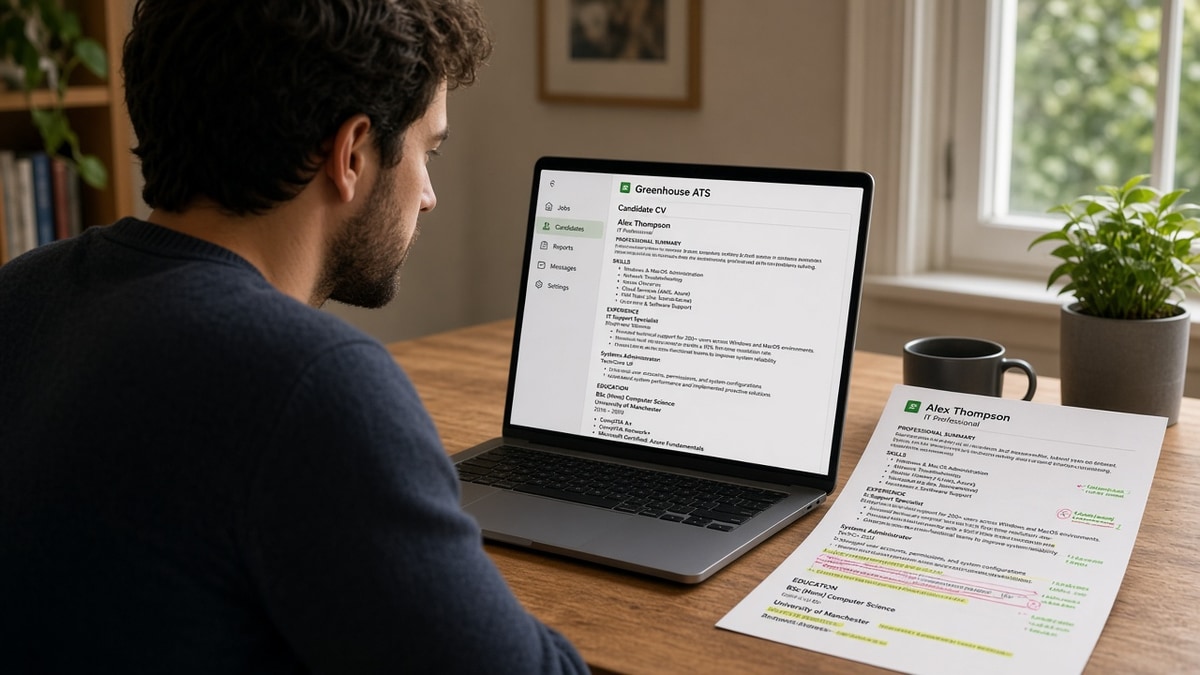
Your stack table looks sharp. Greenhouse shows one paragraph where four roles should be. That's not a keyword gap, and it's not because you've forgotten Terraform in a footer. UK IT CVs on Greenhouse usually break on tech stack grids, DD/MM dates the parser reads as US month/day, and contact lines stuffed into a Word header beside your GitHub link. Recruiters still open your PDF, but the parsed view they ctrl-f through has scrambled employers and missing AWS lines. You're losing searchability, not proof.
Check your resume for free with the posting pasted in after you paste your export into Notepad. If employer names merged into one block or your Kubernetes row vanished, fix structure before you add another skills column. Parsers read text order, not your margin design. You won't rescue a blank Experience field with more Python terms in a table footer.
You've probably blamed Greenhouse for ignoring your platform stint. Often the stint never arrived as a dated employer line because the stack grid flattened, and that's fixable tonight. Job searching through UK tech portals is already opaque. Below you'll get five steps with before/after pairs for software, DevOps, and data roles, two edge cases for contractors and career changers, where candidates still break parsing, and a copy-paste export rule you can run in ten minutes.
Don't assume the recruiter'll open your attachment when the parsed view looks empty. Many coordinators skim Greenhouse first. If your microservices bullet sits inside a skills table cell that imported as one block, they won't hunt for it. You'll fix more screens by rebuilding dates and tables than by stuffing Kubernetes into a sidebar.
When the portal asks for a cover letter after upload, don't paste a block that repeats the same scrambled lines. Generate a cover letter from the corrected CV text so the note matches the employer order you fixed in Word.
Quick Wins
- Replace stack tables with one plain bullet per tool under the right employer.
- Spell every date as Month Year (March 2019), not 03/2019.
- Move phone, email, and GitHub to plain rows under your name.
- Paste export into Notepad and confirm each employer starts on its own line.
What UK IT CVs lose when Greenhouse parses the file
Greenhouse attaches your upload to a candidate profile recruiters skim inside the platform. They see parsed text alongside or instead of your original PDF. UK IT CVs depend on dated employer lines, stack names recruiters ctrl-f, and scope in bullet one. When import scrambles them, every search for Python, AWS, or platform engineering fails even though your PDF looks fine.
The bar your file must clear: each role shows Employer, City, Month Year to Month Year, then three to five bullets where stack and outcome appear inside the sentence that used them, not only in a shaded skills matrix.
A composite backend engineer whose PDF shows a neat three-column stack table but Greenhouse imports one block reading duties and responsibilities loses to the same facts with each tool inside a plain bullet under the correct employer. Same career. Different search surface.
I've screened Greenhouse stacks for UK fintechs where a mid-level candidate's top bullet held a latency win buried in a stack table cell because the designer CV template exported Experience as a grid. The recruiter never reached the number because the parsed view showed duties prose with no employer boundary.
Edge case: contractor with three overlapping client gigs all marked Present. Greenhouse tenure filters can show impossible overlap. Use Month Year end dates or label Contract consecutively so each client line stands alone with spelled dates.
Edge case: career changer from teaching or retail into junior dev. A skills-first layout with bootcamp projects up front still parses top to bottom. Put a dated contract or internship line before the skills block so parsers attach React and Node to a real employer, not a floating list.
Read resume rejected by ATS for the wider filter story. This page is the Greenhouse upload view and what to change in Word before export.
Avoid ATS errors Greenhouse UK IT CVs: five export steps
Work top to bottom. Run the Notepad paste test after each step so you catch flattening before you tailor keywords for the posting.
Step 1: Run the Notepad paste test before you edit wording
Export your current CV as DOCX or PDF from Word. Select all. Paste into Notepad. If stack rows, employer names, and dates appear as one paragraph, structure broke before a human opened the file. Note which section merged. That's your edit order for steps 2 through 4.
Before: Pasting Experience shows one line: Monzo London 01/06/2018 Senior Engineer stack table duties.
After: Each employer on its own line with Month Year dates and stack bullets separated by line breaks.
Step 2: Flatten tech stack tables into plain bullets
Backend, DevOps, and data CVs love a stack grid: Languages, Cloud, Tools with twenty cells. Greenhouse often imports the whole grid as one cell or drops columns. Recruiters ctrl-f Terraform and Kubernetes inside Experience, not inside a table that never mapped.
Before: Three-column stack table with Python, AWS, and Kubernetes in separate cells under one employer heading.
After: Plain bullets under the employer: Built Python ETL on AWS handling 2M daily events; cut batch runtime from 45 minutes to 12 using Kubernetes autoscaling on GKE. Repeat one bullet per material stack win. Cap at four bullets per role unless the posting asks for a full stack list.
Put tool name, scope, and outcome in the same sentence. Write migrated 14 microservices to Kubernetes on EKS, not a table cell with K8s in row three. Parsers and recruiters both read left to right in a single line faster than they reconstruct a grid.
Step 3: Convert every DD/MM date to Month Year
UK CVs often use 03/09/2019. US-leaning parsers read that as 9 March or 3 September inconsistently. Some drop the line entirely. Recruiters filtering by tenure see a gap you did not have.
Before: Deliveroo, London 01/06/2018 to 30/11/2021
After: Deliveroo, London · June 2018 to November 2021
Spell every range as Month Year on the same line as the employer. Never mix slash dates with spelled dates on the same CV. Education dates follow the same rule: September 2014 to June 2018, not 09/2014.
Step 4: Move contact, GitHub, and right-to-work lines to the body
Phone, email, city, and github.com/handle in a Word header look polished. Parsers read headers unpredictably. Your mobile number sometimes imports after your skills footer or vanishes while your summary shifts below Education.
Before: Name in left header cell, phone and GitHub in right header cell inside a table.
After: Priya Sharma · London · +44 7700 900123 · [email protected] · github.com/psharma · Right to work: UK citizen. No tables in the contact block.
Step 5: Rebuild skills, export, and verify before upload
Delete shaded skills matrices and icon rails. Rebuild Skills as a plain bullet list: Python, Terraform, AWS, PostgreSQL. Repeat must-have terms inside bullet one under the employer where you used them. Save DOCX when Greenhouse allows choice. Otherwise PDF from Word only, never from Canva or a graphics export.
Before: Skills grid lists SQL, Python, and Docker in three columns with icons.
After: Bullet under current role: Built SQL pipeline for daily P&L across 9-product book; shortened month-end close from 5 days to 2. Docker and CI/CD named in the same bullet where you owned them.
Re-run the Notepad paste test. Upload only when each employer, stack bullet, and contact line stands alone.
Copy-paste Greenhouse UK IT export rule
Copy-paste before every Greenhouse apply:
1. Paste export into Notepad; note merged sections
2. Delete stack tables; one plain bullet per tool under the right employer
3. Convert every date to Month Year (March 2019)
4. Move phone, email, GitHub to plain rows under your name
5. Rebuild Skills as plain bullets; repeat stack terms in Experience
6. Save DOCX; PDF from Word if required; re-paste into Notepad
Read how ATS reads headers and footers when your GitHub link or right-to-work line vanishes on import and you need to know why the header table failed.
Where stack tables and DD/MM dates still break UK tech uploads
Pair 1: Backend engineer (fintech)
Before: Stack table with 12 rows, GitHub badge in header table, dates as 06/2019.
After: Plain header line with github.com/handle. Employer: Monzo, London · June 2019 to August 2022. Bullet: Built event-driven payment service in Go on Kubernetes; cut p99 latency from 420ms to 180ms across 3M daily transactions.
Pair 2: DevOps engineer (SaaS)
Before: Skills grid lists Terraform, AWS, and Helm in three columns.
After: Bullet under Sage: Migrated 22 services to Terraform on AWS EKS; reduced deploy time from 40 minutes to 8 using Helm and GitHub Actions.
Pair 3: Data engineer (retail)
Before: Spark and Airflow in a text box beside the name, pipeline metrics only in a table footer.
After: Name line with city and phone. Bullet: Built Spark and Airflow pipeline ingesting 800GB daily retail sales; held SLA at 99.7% through peak Q4 2024.
Pair 4: Junior developer (bootcamp grad)
Before: Project list in a two-column Canva layout with no employer dates.
After: Plain bullets under Contract Developer: Shipped React and Node inventory app for retail client; integrated Stripe checkout and cut cart abandonment 9% in pilot.
Designed Canva CVs. Pretty PDF, scrambled import. Rebuild in Word for Greenhouse uploads.
Stuffing keywords into a sidebar after a failed upload. More text in the wrong column makes parse order worse, not better. Flatten first, then tailor bullets.
Assuming keyword density fixes structure. Stuffing Terraform in Skills while Experience stays in a stack table changes nothing in the recruiter skim view.
Uploading a scan of a printed CV. OCR guesses characters. Employer names and stack terms are the first casualties.
Skipping the parsed view because you're applying on mobile. Wait until you can open the desktop profile once. A scrambled upload is harder to fix after submit on some reqs.
Leaving section headers creative or cute. My Journey and Code Life don't map to Experience and Education in most parsers. Standard labels are boring on purpose.
Greenhouse is not punishing your content. It is reading the file you gave it. When UK tech teams scale hiring, they rarely customize parser settings per req. Your export either survives the default import or it does not. Plain structure is the lowest-friction path through a default pipeline used by hundreds of employers.
Coordinators forwarding candidates to hiring managers often paste parsed text into Slack or email. If your stack line and employer dates flattened, the forward shows a paragraph your champion cannot skim. Fix line breaks and Month Year spelling and your internal advocate can quote bullet one without retyping your wins.
Parse check before you reapply
After you rebuild the CV, run a free ATS check with the job description pasted in. Confirm must-have stack terms still appear inside parsed Experience lines, not only in a Skills footer that imported cleanly while employers scrambled.
Then score your job match on the same plain-text order. Keywords only help after Greenhouse can attach them to the right job line. A high match on a scrambled file still loses to a readable lower score.
Rebuild the CV before the next Greenhouse apply
Learning how to avoid ATS errors Greenhouse UK IT CVs hit on upload comes down to import structure, not a secret keyword penalty. Stack tables, DD/MM dates, and contact lines in header grids merge the boundaries recruiters depend on. Plain Word lists, Month Year spelling, and a Notepad paste test fix most UK tech uploads without touching your achievements.
Open your master CV tonight. Clear formatting on Experience. Remove stack tables. Rebuild bullets. Paste into Notepad. Upload when each employer line stands alone with Month Year dates. This will not fix applying to roles you are not qualified for. It stops strong engineering bullets from dying as a paragraph nobody skimmed.
Keep a Greenhouse-safe master and a designed copy if you need both. Label them in your folder so you do not upload the wrong one at midnight. Boring filename Greenhouse_UK_IT_Master.docx next to Designed_Networking.pdf saves you from repeating the same flattening mistake on every apply.
Read more
Frequently asked questions
Greenhouse extracts text into candidate profile fields recruiters skim before they open your attachment. Tech stack tables, two-column templates, and DD/MM dates often import out of order. Your Kubernetes bullet can land under Education while a skills grid becomes your fake first employer. Stripped fonts are normal. Reordered employers and missing stack lines are a screening risk.
Upload whichever format the portal accepts, then check how the profile imported if Greenhouse shows parsed fields. Text-based PDFs from a single-column Word source usually parse cleanly. Scanned PDFs and Canva exports often fail. If employer lines scramble on PDF, try DOCX from the same flattened file. Never assume the designed attachment is what the recruiter reads first.
Spell every range as Month Year on the same line as the employer: June 2019 to March 2022. UK CVs often use 03/09/2019. Parsers read that as 9 March or 3 September inconsistently, and some drop the line. Recruiters filtering by years of experience see a gap you did not have. Never mix slash dates with spelled dates on the same file.
Inside Experience bullets under the employer where you used each tool, not only in a three-column skills table. Write: Built Python ETL on AWS for 2M daily events at FinTechCo, not a grid cell with Python in row two and AWS in row four. Parsers flatten tables into one run-on line. Recruiters ctrl-f stack names inside dated roles, not inside a sidebar that parsed first.
Yes if the portal lets you update the file or if talent asks for a corrected copy. Rebuild the CV, paste into Notepad to confirm line breaks and dates, re-upload or email the PDF with the req title in the subject. Note in one sentence that you fixed formatting so the CV parses cleanly. Do not resubmit five versions without a material change.