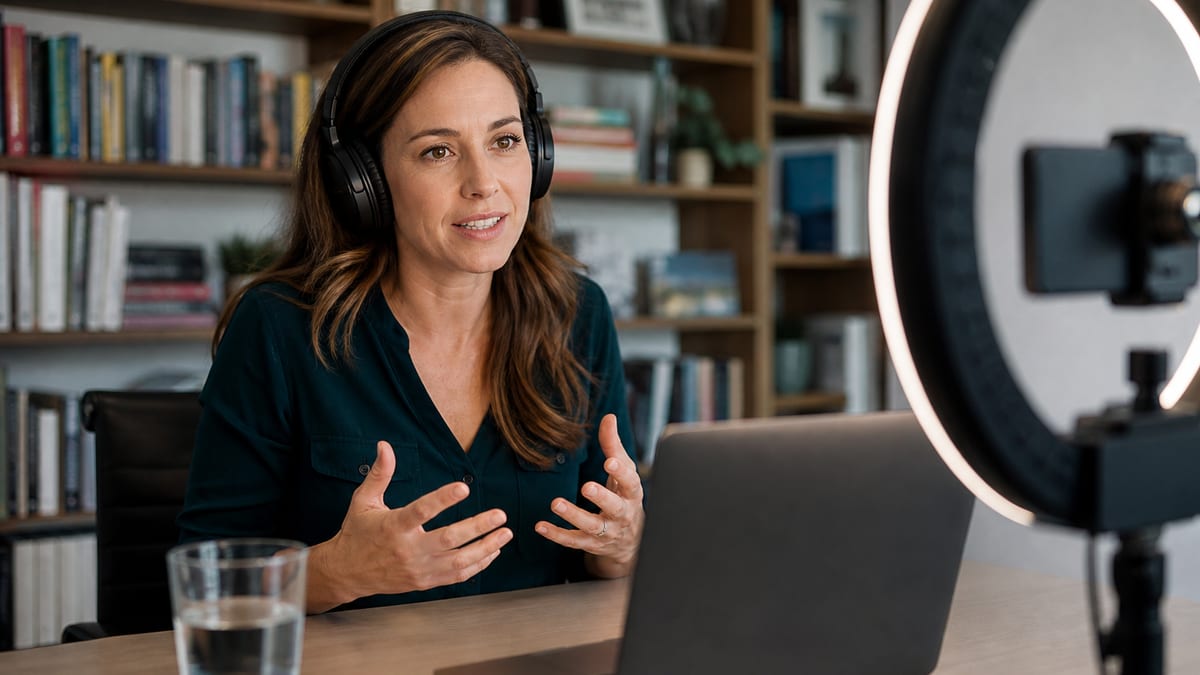
Fix audio first, light second, and stop there — nobody has lost a job over a plain background. Then prepare for the questions remote roles actually ask, which are about working without supervision, not about your enthusiasm for flexibility.
Most remote interview advice is a shopping list of equipment. That is the easy part and the part that matters least. What decides these interviews is whether you have credible answers about self-direction and written communication, and whether you stay composed when something goes wrong — which it will, and which is itself a small live test of remote working.
Below: the setup details worth fixing and the ones that are noise, what remote roles genuinely screen for, a playbook for technical failure, before-and-after answers, how one-way recorded interviews differ, panel calls over video, and edge cases from shared homes to hostile time zones.
Key Takeaways
- Why audio outranks every other setup decision
- The three questions remote interviews always reach
- A two-minute playbook for when the connection drops
- Why one-way recorded interviews are a different format
- Using on-screen notes without sounding like you are reading
The setup, ranked by what actually matters
Start Here
Interviewers forgive a plain room and a soft webcam. They do not forget having to ask you to repeat yourself three times.
| Element | Priority | What to do |
|---|---|---|
| Audio | Critical | Wired headphones with a mic; test on the actual platform |
| Light | High | Face a window or lamp; never sit with one behind you |
| Camera height | Medium | At eye level — stack books under the laptop |
| Connection | Medium | Wired if possible; close everything else |
| Background | Low | Tidy and real beats virtual; blur if unsure |
| Webcam quality | Lowest | The built-in one is fine; spend nothing |
Two details people miss. Move the interviewer's video window to the top of your screen, directly under the camera, so your natural gaze sits close to the lens. And turn off your own self-view once the call starts — watching yourself is distracting and makes people perform rather than converse.
Test on the platform being used, not a different one. Zoom, Teams, and Google Meet handle microphones, virtual backgrounds, and screen sharing differently, and discovering that in the first minute of the call is a bad time to find out.
What remote interviews are really screening for
Key Takeaway
The unspoken question is whether you will still be productive when nobody can see you. Answer it with specifics, because everyone offers assurances.
Remote hires fail for a narrow set of reasons — people who need ambient structure, people who go quiet when blocked, and people who cannot write clearly enough to work across time zones. Interviews are built to test exactly those three, usually through questions that sound casual.
- "How do you structure your day?" They want a real routine, not a claim of discipline. Name the actual mechanism — blocked focus time, a written daily plan, a fixed finish.
- "What do you do when you are blocked and nobody is online?" The correct answer includes a time limit and a fallback: how long you try alone, then what you write down and to whom.
- "Tell me about working across time zones." Name the spread and what you changed because of it — a handover document, a rotating meeting, a decision log.
- "How do you keep your manager informed?" A cadence, not a sentiment. "A written update Monday and Thursday" answers it; "I over-communicate" does not.
Notice what is not on that list: how much you enjoy working from home. That is assumed and answers nothing. The candidates who do well here talk about artifacts and routines, because those are the things that survive a follow-up question.
When the technology fails
Do This Next
Something will go wrong eventually. How you recover is a live demonstration of the exact composure remote roles are hiring for.
- Before the call, save two fallbacks. The recruiter's phone number and email in your phone, not only in your inbox — which you may not be able to reach.
- If audio breaks, switch immediately. Say "I am going to switch to my phone, one moment" rather than troubleshooting live for three minutes.
- If you drop, rejoin without narrating. Come back with "sorry about that — you were asking about the migration" and carry on. A long apology spends more of the interview than the outage did.
- If you cannot rejoin within two minutes, message them. A single line by email or text keeps the slot alive and shows you have a fallback plan, which is itself the point.
- Do not offer to reschedule immediately. Most interviewers would rather continue on audio. Offer to switch formats before offering to abandon the conversation.
A useful reframe: the interviewer is not judging your broadband. They are watching whether a small unplanned problem derails you, because that is precisely what happens weekly on a distributed team.
Before and after: remote-specific answers
Quick Win
Every weak answer here is a claim about character. Every strong one is a routine or an artifact somebody else could verify.
"How do you stay productive at home?"
Before: I am very self-motivated and disciplined, so I have never really struggled with working from home.
After: I plan the next day in ten minutes before I finish, so I start with three written priorities. I keep two ninety-minute blocks free of meetings, and I stop at six — the hard stop is what makes the blocks hold.
"How do you handle being blocked?"
Before: I would just reach out to whoever I needed and make sure I kept communication open until it was resolved.
After: I give it thirty minutes alone, then post what I have tried and what I need in the team channel and move to something else. On the payments project that pattern meant a US colleague picked things up overnight, so blockers cost hours instead of a day.
"Tell me about working across time zones"
Before: I have worked with distributed teams before and I am comfortable being flexible with my hours when needed.
After: I was the only engineer in UTC+1 on a US-based team of five. I wrote the design docs and runbooks so reviews could happen without me awake, and we moved from two standing calls a week to one rotating one.
Not reaching the interview stage? Remote postings pull hundreds of applicants, so the resume screen is tighter. Check what an applicant tracking system extracts from your file — free, no signup.
Run a free ATS resume check →One-way recorded interviews are a different format
Watch Out
There is no interviewer to read, no follow-up question, and often a hard time limit. Structure has to carry everything that rapport normally would.
You record answers to prompts with no human present, sometimes with limited retakes and a countdown. Everything that normally helps — reading a reaction, adjusting mid-answer, being asked to clarify — is unavailable.
What works: give the direct answer in your first sentence rather than building to it, because there is no interviewer to wait patiently. Aim for about three-quarters of the time limit, since being cut off mid-sentence is worse than finishing early. Look at the lens, not at your own image. And use the practice question almost every platform offers — most candidates skip it.
Where an automated system scores or ranks the recording, several US jurisdictions now require disclosure, consent, or bias auditing when such tools materially inform hiring decisions, and similar rules are expanding elsewhere. You are entitled to ask what is being used and how — reputable employers answer, and the question itself is reasonable rather than awkward.
One practical note: do these in the morning if you can choose. Energy reads differently on camera than in person, and a recording made at the end of a long day looks exactly like one.
Edge cases: shared homes, bad signal, hostile time zones
Reality Check
Most remote interview advice assumes a private room and reliable broadband. Four common situations need naming rather than hiding.
No private space
Say it at the start in one sentence — "I am at home with family around, so apologies for any background noise" — and then stop worrying about it. Interviewers accept this immediately and it is far less distracting than visible tension every time a door closes. Headphones with a microphone solve most of the actual audio problem.
Unreliable connection
Offer audio-only proactively rather than fighting a freezing video feed. "My connection is not great today — would you mind if I turn my camera off so the audio stays clean?" is a completely normal request and produces a much better conversation than twenty minutes of stuttering video.
Scheduled at a hostile hour
If the only slot offered is 11pm your time, ask once for an alternative. It is a reasonable request and how they respond tells you something about how the team treats time zones day to day. If no alternative exists, take it — and treat the answer as data about the role rather than an insult.
Panel calls over video
Reading a room is much harder when it is a grid of faces. Write down each name as they introduce themselves, address answers to whoever asked by name, and pause slightly longer than feels natural before answering — video latency means people talk over each other otherwise. Ending with a question directed at a specific person is a small thing that lands well.
What happens either side of the call
Pro Tip
Remote processes run almost entirely in writing around the interview itself. That correspondence is part of the assessment whether anyone says so or not.
Before. Confirm the slot in one line, in the recipient's time zone as well as yours — "Thursday 15:00 UTC, 10:00 your time" — because time-zone confusion is the single most common cause of missed remote interviews. Check the calendar invitation actually contains a working link rather than assuming, and open it once the day before.
During. Ask one question about how the team works asynchronously. "How much of your decision-making happens in writing versus in meetings?" is genuinely useful to you and signals that you have thought about distributed work as a practice rather than a perk.
After. Send the thank-you the same day, referencing one specific thing. In a remote process this carries slightly more weight than it does on-site, because written correspondence is most of what the team will have to judge you on.
One thing worth knowing about what the interviewer is looking at: it is frequently not your PDF. Workday and Greenhouse both build a candidate profile from the extracted text of your upload, and that profile is what appears on screen during the call — Lever and iCIMS work the same way. If your dates parsed badly or a job title merged into the line above it, you may be asked to clarify something your resume states perfectly clearly. Checking the extracted version with a free ATS resume check removes that surprise before it happens.
Bottom line
Final Word
Good audio, light on your face, notes under the camera, three specific answers about self-direction, and a fallback number saved in your phone.
The equipment questions get all the attention because they are easy to answer and easy to buy your way out of. The thing that actually separates candidates is having concrete, verifiable answers about how you work when nobody is watching — and those cannot be bought, only prepared.
Before your next one, do three things: test your microphone on the platform they are using, save the recruiter's number in your phone, and write one specific example for each of the three self-direction questions. Twenty minutes, and it covers almost everything on this page.
Get past the screen that comes first
Remote roles draw hundreds of applicants, and most are filtered before any interview. See exactly what an applicant tracking system reads from your resume — free, no signup.
Run the Free ATS Resume CheckAlso useful: ATS tips for remote jobs · common interview questions
Frequently asked questions
Audio, then light, then everything else. Interviewers tolerate a plain background and a mediocre webcam; they cannot tolerate having to ask you to repeat things. Wired headphones with a microphone beat laptop speakers, and a window or lamp in front of you beats any camera upgrade.
Look at the lens when you are making a key point and at the screen the rest of the time. Staring at the lens for a full hour is uncomfortable to do and slightly unsettling to watch. Move the interviewer's video window to the top of your screen so your gaze naturally sits near the camera.
Evidence you can work without supervision and communicate in writing. Expect questions about how you organize your day, how you handle being blocked when nobody is online, and how you have worked across time zones. Have specific examples ready rather than assurances.
Rejoin immediately without apologizing at length, and if you cannot, call the number in the invitation or email the recruiter within two minutes. Interviewers are entirely used to this. What they notice is how calmly you recover, which is a legitimate signal about remote working.
A plain one is fine and a blurred real background is usually better, since virtual backgrounds create visual artifacts around your head and edges every time you move. Whatever you choose, test it on the actual platform beforehand — performance varies significantly between Zoom, Teams, and Meet.
There is no interviewer to read, so structure carries everything. Give the direct answer in your first sentence, keep to the time limit with a margin, and look at the lens rather than your own image. Practise with the platform's test question, since most allow it and almost nobody uses it.
Yes, and it is one of the genuine advantages of the format. Keep them to bullet prompts rather than a script — reading full sentences is audible. Put them directly beneath your camera so glancing at them does not look like you are looking away.
Say so briefly at the start rather than hoping nothing happens: "I am at home with family around, so apologies in advance for any background noise." Interviewers accept this readily. Headphones with a microphone, a closed door where possible, and a scheduled time when the space is quietest handle most of it.