9 min read
You don't need a new career story. You need four sentence patterns and the nerve to delete responsible for lines that never survived a phone screen. US corporate hiring still runs on PDF uploads and six-second skims, and the file that wins isn't longer. It's louder in the first bullet under the job title recruiters care about tonight, and that's the line you'll rewrite before you touch anything else.
If you're not sure whether your experience section reads like proof or like a job description paste, check your resume for free against the posting. You'll see whether must-have tools sit inside dated roles or only in a skills footer parsers treat as secondary.
This page isn't a thesaurus dump. It's a set of achievement bullet formulas you can paste, swap nouns, and defend in a reference check without inventing scope you didn't hold. You won't need every formula on one resume; pick the two that match the posting's verbs and leave the rest for the next application.
Quick Wins
- Pick one formula below and rewrite bullet one under your target role only.
- Replace assisted with and responsible for with Built, Led, or Cut when true.
- Add one scale marker: team size, accounts, units, or percent change you can explain.
- Export plain text after save; if tools vanish from Experience, fix layout before reapply.
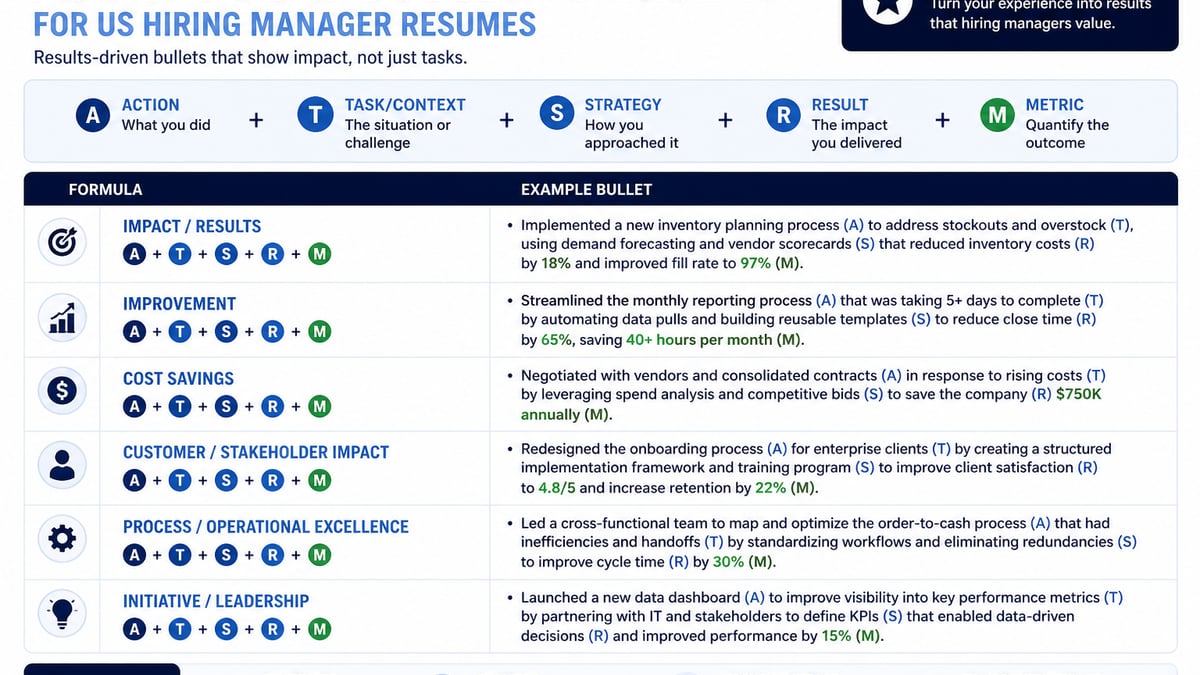
Four achievement bullet formulas US recruiters recognize
Duty bullets describe your calendar. Achievement bullets describe a change someone else felt: fewer escalations, faster close, cleaner audit, happier queue. The difference isn't tone. It's structure. Each formula below keeps posting language inside Experience so parsers tie keywords to an employer and date range.
| Formula | Skeleton | When to use it |
|---|---|---|
| Build / ship | [Verb] [tool] for [scope], [outcome]. | Engineering, ops, analytics launches |
| Improve / cut | [Verb] [process] by [method], [metric delta]. | Efficiency, quality, cost, cycle time |
| Lead / coordinate | [Verb] [team size] on [project], [stakeholder result]. | Non-manager scope, cross-functional work |
| Support / retain | [Verb] [volume] [customers/users], [CSAT or SLA marker]. | Support, success, clinical, retail ops |
Before: Responsible for Salesforce cases and email tickets; worked with sales on issues.
After: Closed 45 to 60 enterprise Salesforce cases weekly, holding first-response SLA at 94% for six months.
Before: Helped with month-end reporting and Excel files for leadership.
After: Built Excel and Looker month-end pack for 12-state retail ops, cutting close prep from three days to one.
The first pair keeps you invisible. The second names tool, volume, and a number a hiring manager can repeat without guessing. That's what achievement bullet formulas are for: repeatable shape, unique facts.
Pair these patterns with why resume keywords alone don't work when your skills block is perfect but Experience still reads generic. Location beats repetition.
Numbers in the examples above illustrate bullet shape, not market outcomes. Swap in your real stack, stakeholder, and scale. If you cannot share revenue, use team size, ticket count, or geography instead of inventing a percent you cannot defend on a reference call.
Early-career candidates can use the same formulas on internships and campus jobs. The verb stays honest, the scope shrinks to what you owned on a shift or sprint, and the outcome can be speed, accuracy, or volume instead of revenue. A thin file with three defensible achievement lines beats a long file of club memberships recruiters never read.
Rewrite three bullets with these achievement bullet formulas
- Open the posting and highlight five tools or methods you truly used in the last three years.
- Pick the employer line that best matches the req level. Rewrite bullet one with the build/ship or improve/cut skeleton.
- Draft bullets two and three with lead/coordinate or support/retain only if that work happened in the same role.
- Read each line aloud. If you cannot name who cared about the outcome, add a stakeholder or cut the line.
- Paste plain text into Notepad. Confirm each must-have keyword appears next to a company name, not only in Skills.
Copy-paste block (achievement bullet formulas):
[Verb] [tool/method] for [team/product/region], [metric or scale].
Example: Automated Workday onboarding tasks for 180 hires per quarter, removing 12 manual steps from HR coordinator queue.

[Verb] [process] by [change], [delta].
Example: Cut invoice exceptions 14% by standardizing three-way match rules in NetSuite for AP team of six.
Before: Managed projects and communicated with stakeholders using Agile.
After: Ran two-week Agile sprints for payments API with five engineers, shipping three releases on schedule for compliance audit.
Before: Provided customer support via phone and chat; maintained good satisfaction.
After: Handled 70+ Zendesk chats daily for SaaS tier-2 queue, keeping CSAT at 96% across four product lines.
I've cleared Greenhouse queues where bullet one was still a job posting copied into Word. The callback file uses one of these four shapes and drops the fifth duty line recruiters never finish reading.
For project-heavy roles, steal structure from project bullets that show impact and nest the deliverable under the employer that owned the deadline, not a orphan Projects header parsers skip.
Lines that still fail US screens
- Verb soup without object: optimized processes and drove results with no tool, team, or customer named.
- Metrics in the summary only: Experience bullets stay duties while the top paragraph claims 30% improvements nowhere below.
- Same bullet cloned across jobs: identical Salesforce line under three employers reads like template filler.
- Soft scope inflation: global initiative when your team was one region and four people.
- Keyword lines in Skills only: posting terms never appear under a date range matchers can score.
Achievement bullet formulas don't fix title inflation. If the posting asks for a director and your bullets show individual contributor scope, rewrite toward honest scope or skip the req. Formulas amplify real work; they don't invent a level you didn't hold.
Another miss is mixing tenses on one role. Current job: present tense on ongoing work, past tense on closed projects. Prior jobs: past tense throughout. Tense jumps make parsers attach bullets to the wrong employer block in some Workday imports.
If you're tempted to add every certification acronym into each bullet, stop. One credential line in Education or Licenses plus the tool in Experience is enough. Bullets aren't keyword footers.
When a bullet still feels thin, ask what broke if you weren't there for a quarter. Missed SLAs, manual rework, audit findings, and backlog age are legitimate outcomes even when finance wouldn't let you quote dollars. Name the pain, then name what you changed.
Check the export after you rewrite
Run your rewritten file against the posting after bullet one changes. You want tools and outcomes still readable in plain text, with keywords sitting under employers.
Run the ATS checker on the PDF or DOCX you plan to upload. If the role asks for a letter, generate a cover letter that cites one metric from bullet one instead of repeating the skills list.
A shorter Experience section with three strong lines often scores better than eight duty bullets because remaining keywords carry proof. Delete lines you cannot defend before you chase match percentage.
Ship bullet one first
Achievement bullet formulas that work in US hiring are four repeatable shapes with your real tools, scope, and outcomes inside dated Experience. Fix bullet one on the closest role, cut duty lines that don't survive a skim, then upload the shorter file.
Check your resume for free once more against the posting. Recruiters won't memorize ten bullets. They'll remember the first line that names what changed because you were in the seat.
Read more
Frequently asked questions
Aim for one line, about 18 to 28 words. Lead with a past-tense verb for prior roles and present tense only for a current job's ongoing work. If you need two lines, the metric or stakeholder should still appear in the first line so a six-second skim catches it.
No. A scope substitute works when you cannot share revenue: team size, ticket volume, stores served, beds on unit, or deadline met. One concrete scale marker beats a vague improved efficiency line with no object.
Rewrite bullet one under your current or most relevant employer before you touch the summary. Matchers and recruiters weight recent experience highest. A polished summary with weak bullets below still reads like marketing copy.
Use the same skeleton, not the same words. Swap tool names, stakeholders, and outcomes per job so each block sounds like that employer's work. Copy-pasting identical metrics across three companies triggers reference-check risk.