10 min read
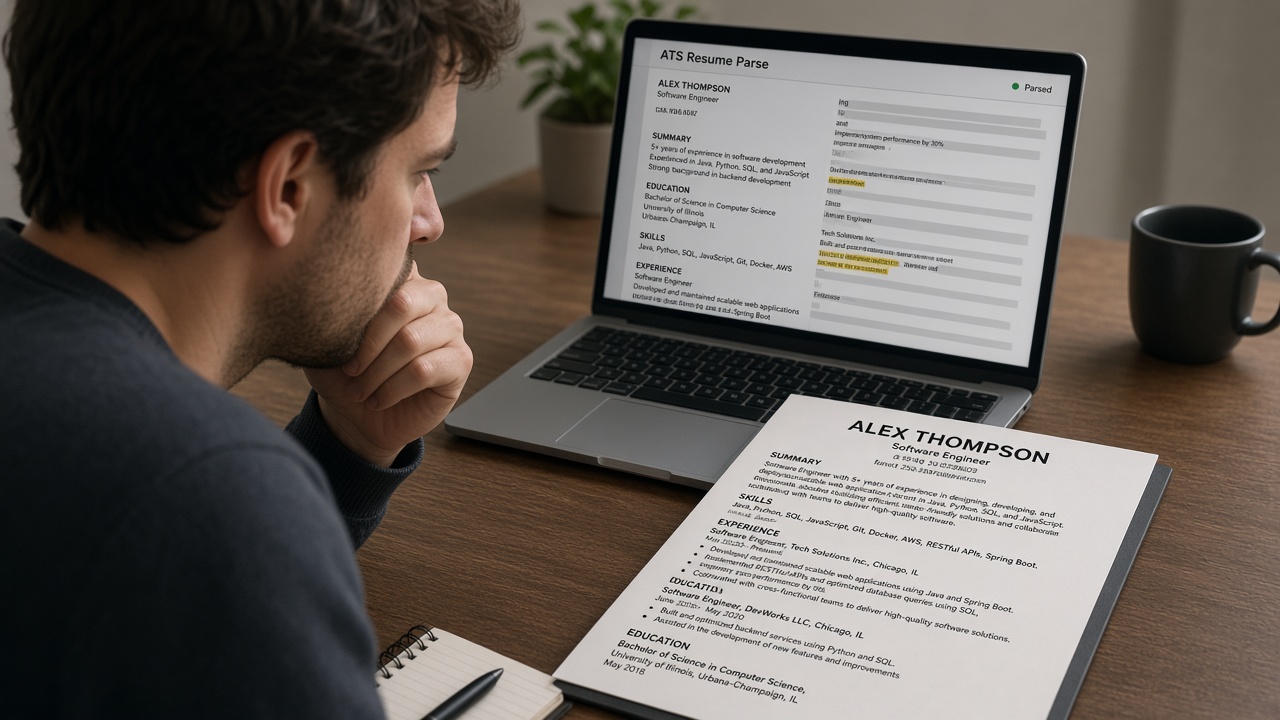
Short answer: Your resume parses wrong when hidden Word tables reorder employers. The file looks fine on screen but it's not what the ATS reads. The parser follows cells in row order, not how you'd scan the page. Paste the full export into Notepad before any US ATS fix. If Skills or contact info appears before your current job, or dates stack separately from company names, Workday and Greenhouse will import the same scramble. Rebuild single column first. Tune keywords second.
You've probably added keywords after a rejection while the layout stayed the same. That's not the same as a recruiter seeing your last title on line one. Check your resume for free only after Notepad paste shows employers top to bottom in order. I've opened Greenhouse previews where the skills rail parsed perfectly and the current title never reached Experience because a sidebar table fed text first.
Below: why parsers scramble, four fixes matched to symptoms, mistakes that waste an evening, and what you'll change tonight. Job searching's already draining. You don't need a prettier template that still exports employers out of order.
Quick Wins
- Paste PDF or DOCX text into Notepad before you change a single word.
- Turn on Show Table Gridlines in Word and delete layout tables you did not type data into.
- Put employer, title, and Month Year dates on one line per role.
- Open the portal parsed preview and compare field view to your source file.
Why your resume parses wrong in US ATS portals
US employers store applications in Workday, Greenhouse, Lever, iCIMS, and Taleo. Each system pulls employer, title, dates, and bullets into searchable fields. Parsers do not see your design. They read character order from the file. Hidden Word tables, text boxes, headers, and two-column Canva exports reorder that stream without changing how the PDF looks to you.
The parser reads cells and lines, not your visual layout. A common template puts dates in a left column and employers in a right column inside one invisible table. Export order becomes every date first, then every company name. Your 2024 role can land under your 2018 employer in the preview. Recruiters search parsed Experience, not the thumbnail.
Sidebars create a second failure mode. Skills in a right rail often paste before Experience. Contact info in a header graphic may never enter the body text stream. A composite marketing coordinator whose Canva export looks polished can show an empty Experience block in Greenhouse while a keyword cloud fills the first screen.
Notepad paste is the cheapest diagnostic. No account required. Copy all text from the file you will submit. Paste into Notepad with word wrap off. Read top to bottom. That sequence is what most parsers approximate. If it is wrong in Notepad, no keyword pass fixes it.
Read how to preview your resume like an ATS in the US for portal field view steps. This page explains why your resume parses wrong and which US ATS fixes match each symptom.
Four why your resume parses wrong (US ATS fixes) by symptom
Start with what Notepad shows, not what the template marketing page promised. Run the branch that matches your paste output, then re-export and paste again before you apply.
Fix 1: Dates and employers split across columns
Symptom: paste lists Jan 2021 to Mar 2024, Jun 2018 to Dec 2020, then Harbor Retail, Apex Logistics, with no title paired to the right date block. Portal preview attaches bullets to the wrong job.
Before: Two-column Word table with dates left and employers right; PDF looks correct on screen.
After: Single column lines: Harbor Retail | Marketing Coordinator | Jun 2021 to Present, then Apex Logistics | Associate | Mar 2018 to May 2021; bullets directly under each employer block.
In Word, turn on Table Gridlines from the Layout tab. Delete layout tables. Re-type each role as one line, then bullets below. Export PDF and paste test again.
Fix 2: Skills or contact info reads before Experience
Symptom: Notepad opens with Python, SQL, Tableau, then your name and phone, then Education, then Experience last. Recruiters see skills first in field view. Current title never surfaces on line one.
Before: Sidebar skills table and contact block in a text box above the fold.
After: Name and plain-text email and phone on line one in the body; Experience section immediately below; Skills after Experience or trimmed to tools not already in bullets.
Remove floating text boxes. Do not put email in a header zone the exporter skips. If you need a portfolio URL, type it as plain text in the header paragraph.
Fix 3: Headers, footers, and icon bullets
Symptom: phone number missing in paste; bullets show hollow squares or odd characters; page numbers interrupt employer lines.
Before: Contact info in Word header; custom wingding bullets; LinkedIn icon as an image.
After: Contact in body text; standard round or hyphen bullets; LinkedIn as a full URL string; no footer page numbers on a one-page file.
Clear header and footer areas in Word. Select all bullets and apply a simple List Bullet style. Re-paste. Every digit of your phone number should appear in Notepad.
Fix 4: Scanned PDF or design-tool export
Symptom: paste yields one blank line, gibberish, or text in random chunks. Portal preview is empty or shows a single skills paragraph.
Before: Resume designed in Canva or exported as image PDF from a scan.
After: Rebuild in Word or Google Docs as single column 11-point Calibri; Save As text-based PDF; paste test shows full Experience block readable.
When the posting accepts DOCX and PDF, run paste test on both. Submit the format whose order matches your source. Do not run keyword tools on a file that fails paste.
Copy-paste parse repair workflow
Copy-paste this sequence before any keyword work: "Export final file → paste full text into Notepad → note first employer line → upload to portal preview → compare Experience field order → delete tables and sidebars → re-export → paste again → only then mirror posting keywords inside bullets under the correct employer."
Example target line after repair: "Summit Health | Registered Nurse, Med-Surg | Jan 2022 to Present" followed by bullets on the next lines, not dates floating alone three paragraphs above the company name.
Before/after pair: nurse with certification badges
Before: BLS and ACLS as badge images in a two-column template; paste shows alt text fragments before employer lines; license fields in Workday stay blank.
After: Certifications as plain lines with expiration Month Year under a Certifications heading after Experience; parsed license section fills; employer order intact.
Before/after pair: operations lead with summary keyword pile
Before: Summary text box above a table-split Experience section; paste reads Lean, Six Sigma, Kaizen prose, then jumbled job titles and dates.
After: One-line target role summary; Experience as stacked single-column entries; Kaizen and Six Sigma appear inside bullets under the plant role where the work happened.
See eleven resume formatting mistakes that trip up ATS when paste passes but field labels still drop sections.
What wastes an evening when parsing fails
Adding keywords before paste test. New terms inside a scrambled layout land under the wrong employer. Recruiters never see them in search. Fix read order first.
Trusting the template thumbnail. Preview images in design tools hide table order. Notepad does not lie. Use it every time you change format.
Running five checkers on a broken file. Different tools still read the same character stream. One paste test beats three percentage scores on a sidebar layout.
Stuffing Skills after Experience stayed empty. Extra lines inflate keyword reports while Experience blocks remain blank in the portal. Recruiters hire from dated work, not a cloud alone.
Assuming PDF always beats DOCX. Format choice matters less than text order. A clean DOCX paste often beats a designed PDF from the same template.
Patching with manual entry in the application form. Some portals let you retype jobs. That helps once. It does not fix the file recruiters download later or internal search indexes built from the upload.
Ignoring oldest job surfacing first. That signal means sidebar or footer content fed the parser before Experience. Delete the rail, not bullet three.
Test after Notepad paste passes
A free ATS check belongs late in the sequence. Paste the full job description, upload the same PDF you will send, and read which must-have terms never appear inside Experience blocks. That list is actionable only when employer order is already correct in Notepad and portal preview.
Pair it with the employer field view on every application. When both show employer lines intact, keyword gaps are worth fixing. When either shows blank Experience or reversed order, stop scoring and rebuild layout before you rewrite bullets.
Run a free ATS check after paste order is clean. When you need a clean single-column base file, build your resume in a plain layout, then paste test before you apply again. When the posting wants a letter, generate a cover letter that repeats the same employer line from bullet one so human readers see one consistent title string.
Paste first, then apply these US ATS fixes
Why your resume parses wrong (US ATS fixes) starts with read order, not keyword density. Hidden Word tables reorder employers. Notepad paste shows the real sequence before you spend an evening tuning Skills.
Tonight: paste into Notepad, delete layout tables and sidebars, stack each role as employer | title | Month Year dates on one line, re-export, paste again, open portal field view, then mirror posting terms inside bullets under the correct job. Do not submit until Experience reads top to bottom in plain text.
This won't fix applying to roles you are not qualified for. It does stop qualified candidates from losing to a designed template that exports every date before every company name.
Read more
Frequently asked questions
Copy all text from your PDF or DOCX and paste it into Notepad or TextEdit with word wrap off. Read top to bottom. If Skills appears before your current employer, if dates sit on a different line than the company name, or if two jobs merged into one block, the employer ATS will likely read the same scramble. Upload the same file to the portal preview when available and compare field view to your source file line by line.
Invisible tables used for layout are the problem, not every grid. Many Canva and Word templates hide a two-column table behind a clean design. The parser reads cells in row order, not how your eye scans the page. A left column for dates and a right column for employers often exports with every date first, then every company name. Rebuild as a single column with employer, title, and Month Year dates on one line per role.
Submit whatever the posting allows, then run paste test on that exact format. Text-based PDFs exported from Word usually match DOCX paste order. Scanned PDFs and image exports fail entirely. Some Workday instances parse DOCX more reliably than designed PDFs. When both are accepted and paste order matches between formats, PDF is fine. When paste fails on PDF but passes on DOCX, switch formats for that employer.
No. Keyword edits on a broken layout add terms recruiters never see because bullets landed under the wrong employer. Fix read order first with Notepad paste and portal preview. Only after employer names, titles, and dates appear in correct sequence should you mirror must-have skills from the posting inside Experience bullets.
That usually means a sidebar or footer table fed text before your main Experience block. Move contact info and Skills below Experience or into plain paragraphs. Delete text boxes. Export again and re-paste. If the oldest role still surfaces first, rebuild the file from a blank single-column Word doc rather than patching the template.