12 min read
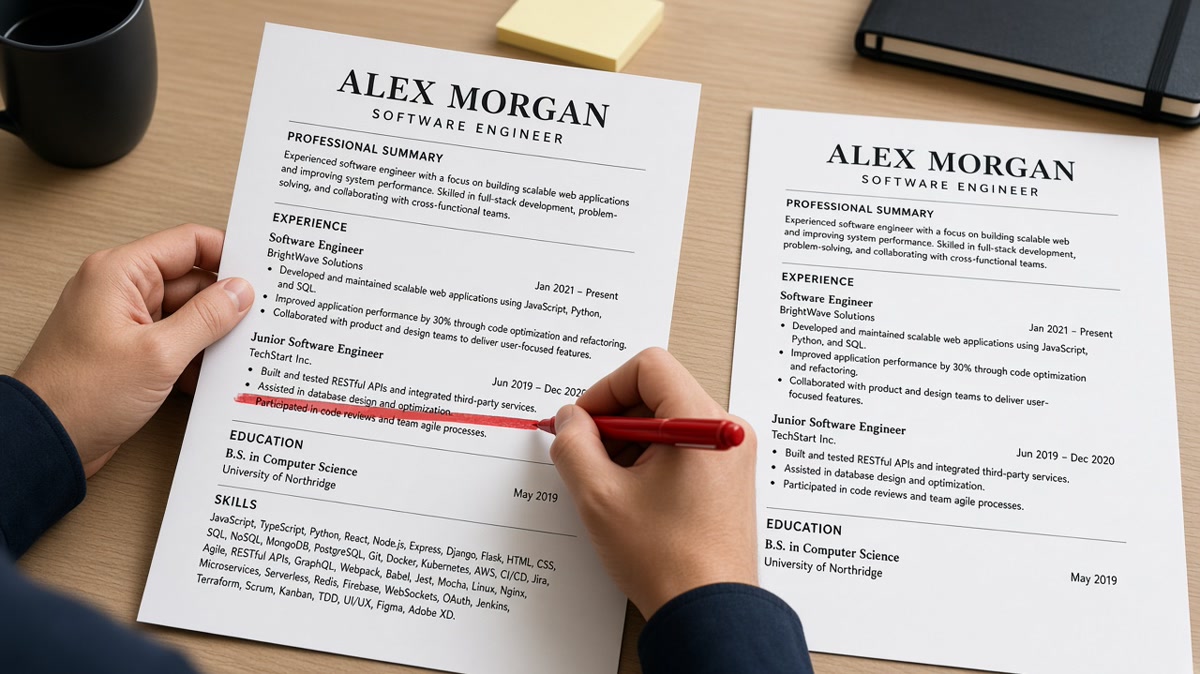
You've got strong experience. You pasted every tool from the posting into Skills. The checker lights up green. You still hear nothing. You're not failing a talent test. You're failing a trust test: parsers and recruiters treat Skills as unverified tags while Experience bullets carry the match score.
Why resume skills sections fail most candidates comes down to that split. A forty-item cloud signals keyword stuffing even when your work history is solid. The hiring manager ctrl-f's inside job blocks, not the footer you spent an hour polishing.
Before you add another acronym, check your resume for free with the req pasted in. You'll likely see matches flagged in Skills while the same terms never appear under a dated employer. The fix isn't more keywords. It's moving proof into bullets and shrinking Skills to an echo.
This page walks the symptom you feel, three causes that break Skills sections, how to tell which one is yours, and the fix for each. Job searching is hard enough without a footer working against a strong career story.
Quick Wins
- Ctrl-f the posting's top three skills inside your current job bullets.
- Cut Skills to terms you can defend in a phone screen.
- Move tools from the footer into the employer line where you used them.
- Export a single-column PDF and confirm Skills parsed after Experience.
The symptom: green keywords, silent inbox
The posting wants Python, SQL, and Looker. Your Skills row lists all three in bold. Your Experience section still opens with supported analytics projects and collaborated with stakeholders. Parsers in Greenhouse and Workday may match the strings. Hiring managers search for dashboards shipped, query time cut, or models deployed and won't find duty lines that prove you owned the work.
Skills tags are claims. Experience bullets are evidence. Recruiters under volume treat the footer as a keyword dump until bullets confirm it. A forty-item cloud doesn't make you look well-rounded. It makes you look like you optimized a template instead of describing a job.
You feel qualified and invisible at the same time. That's the skills-section trap: the file scores on strings while humans score on scope. When those stories diverge, Skills failed you even if a checker said pass.
Career changers hit this hardest. You add every tool from a bootcamp list to compensate for thin tenure. The cloud grows. The bullets stay vague. Recruiters see stuffing before they see potential.
Tenured candidates do the opposite mistake: they shrink Skills to three generic lines and hide twenty years of stack depth in prose paragraphs parsers skip. The symptom is the same. The match score lives in the wrong section.
Why resume skills sections fail: three causes and fixes
Cause 1: Skills cloud without dated proof
Symptom: posting terms appear in Skills but not under any employer. Parsers may flag a hit. Humans see unverified tags.
Before: Skills lists Python, SQL, Tableau, Power BI, Snowflake, dbt, Airflow, Spark, and forty more tools with no matching lines under Experience.
After: Bullet under current role reads Built weekly churn dashboards in Looker and SQL on Snowflake; cut ad-hoc report requests 35% in Q3. Skills echoes Looker, SQL, Snowflake only.
Fix: move each must-have from the posting into the employer block where you used it. Let Skills repeat eight to twelve terms bullets already proved.
Cause 2: Layout drops or scrambles the Skills block
Symptom: portal preview shows Skills merged with Education or trapped in a sidebar. Recruiters never scroll there on a first pass.
Before: two-column template puts Skills in a left rail; Workday imports tools under Certifications and leaves Experience first.
After: single-column PDF at 11-point Calibri; Skills sits below Experience as a short comma list; bullet one under current job names the top posting skill in the first eight words.
Fix: plain layout, Experience before Skills, Notepad test on export. If the parser cannot read Skills in order, no amount of keyword padding fixes the screen.
Cause 3: Proficiency labels and soft-skill filler
Symptom: Skills reads Expert in Python, Advanced Excel, Team Player, Fast Learner. Recruiters cannot verify bars or adjectives. Parsers strip graphics and leave noise.
Before: Skills shows five-star graphics for JavaScript and a line that says Communication, Leadership, Problem Solving.
After: Skills lists JavaScript, TypeScript, React only. Bullet reads Shipped React checkout flow in TypeScript; cut cart abandonment 12% across three markets in two quarters.
Fix: delete bars and soft-skill rows. Show communication in a bullet about stakeholders briefed or teams led. Show problem solving in an outcome line with scope.
How to tell which cause is yours
Open the portal preview after upload. If Skills parsed in the wrong section, fix layout first. If layout is clean but posting terms only appear in Skills, move them into bullets. If Skills is full of adjectives and bars, strip to tools with dated proof and cut the rest.
Run ctrl-f on your pasted PDF text: search the posting's top three skills. If hits appear only after your education block, your section order is fighting you.
Fix for cause 1: bullet-first keyword placement
Highlight three required skills in the posting. Rewrite bullet one under your current job so one lands in the first eight words. Repeat the other two in bullets two and three with scope: systems, users, or revenue touched.
Read impact-first resume bullets US hiring teams prefer for the general placement rule. Skills becomes a short echo after Experience carries the proof.
Fix for cause 2: parser-safe section order
US corporate templates that win are boring: Summary optional, Experience, Skills, Education. No sidebars between Experience and the employer name. Month Year dates inline.
Before: fancy icon headers push Skills above Experience because the designer liked the visual balance.
After: Experience fills page one; Skills is eight comma-separated tools beneath it; Education last.
Fix for cause 3: tools only, proof in bullets
Replace soft skills with work examples. Replace proficiency bars with one honest scope line. If you are expert in Python, the bullet should name systems served or latency cut, not five stars.
Copy-paste Skills trim block (mirror the posting, delete what you cannot defend in a screen):
Languages: [posting language 1], [posting language 2]
Platforms: [cloud or data platform from req]
Methods: [one methodology you used in a dated role]
Max 12 items total. Every term must appear in a bullet under an employer from the last 4 years.
Bullet skeleton: [Verb] [skill from posting] on [scope]; [outcome] by [specific change]
Edge case: career change with thin tenure
You cannot invent years. You can name tools inside project bullets with honest dates: contract, freelance, or bootcamp capstone with Month Year ranges. Skills echoes only what those lines prove.
Before: Skills lists every tool from a data bootcamp while Experience still shows unrelated retail management with no analytics verbs.
After: Contract Analyst line with three bullets on SQL pipelines and dashboards; Skills lists SQL, Python, Tableau only.
Edge case: principal scope with a bloated footer
Senior candidates sometimes hide leadership proof in Skills because bullets still read mid-level. Move architecture and team scope into Experience. Skills should not carry the only mention of Kubernetes or Terraform if you led the migration.
Before: Skills lists twenty infrastructure tools; top bullet still says participated in cloud initiatives.
After: Bullet reads Led Kubernetes migration for payments service across four teams; cut deploy time from 40 minutes to 7. Skills echoes Kubernetes, Terraform, Helm only.
See why your resume never reaches a human when layout fixes still leave you invisible in the queue.
Where skills sections break on US resumes
Pasting the entire posting into Skills. Recruiters recognize req mirroring without proof. Move three terms into bullets and cut the rest.
Listing tools you touched once five years ago. Dated proof matters. If Java hasn't appeared in a role since 2019, drop it unless the posting demands legacy maintenance.
Soft skills as comma-separated virtues. Team player and fast learner tell nobody what you shipped. Replace with bullets about teams led or deadlines met with scope.
Graphics, stars, and percentage bars. Parsers flatten them to noise or drop them. Type plain text tools only.
Skills above Experience on page one. You lead with unverified tags before evidence. Recruiters scroll to job blocks anyway. Put proof first.
Assuming ATS score equals human yes. A footer full of matches with weak bullets still dies on the skim. Match score and hire score diverge when Skills does all the work.
I've screened mid-level batches in Workday where every file listed AWS and Python in Skills while bullet one still said supported various IT projects. The parser sometimes matched. The hiring manager never saw platform ownership.
Duplicating Skills in Summary and Footer. Twice the keywords, zero new proof. Pick one short echo location after Experience.
Edge case: highly regulated roles that expect license strings in Skills. Put RN, CPA, or PMP next to the credential line in Experience and echo once in Skills. License without employer context still fails clinical screens.
Verify skills placement before the next apply
Paste the posting into the free ATS checker and read which section matched each keyword. If must-haves only hit Skills, rewrite bullet one before you submit again.
Then score your job match on the same file. Low fit after moving keywords into Experience usually means title or seniority mismatch, not a Skills formatting tweak.
When you need a clean one-page layout, build your resume in single-column order: Experience first, short Skills echo second. Export PDF and run the Notepad test before upload.
If the posting wants a short application note, generate a cover letter that repeats the same tools from bullet one instead of pasting the Skills cloud into prose.
Shrink Skills, move proof into bullets tonight
Why resume skills sections fail most candidates is not mystery. Parsers treat Skills as tags. Recruiters treat Experience as proof. When those two stories disagree, the footer works against you even on a strong career.
Open the posting. Highlight three required skills. Rewrite bullet one so one lands in the first eight words under your current employer. Cut Skills to a dozen terms bullets already defend. Export single-column PDF and run a free check before you upload again.
This won't fix applying to principal roles when your scope was junior. It does stop qualified candidates from losing to a forty-item cloud while the shipped work sat in bullet four.
And if you're between jobs, that's already stressful enough. Change the lines you control tonight. One bullet and a shorter Skills echo beat another hour stuffing keywords nobody will trust.
Read more
Frequently asked questions
Not always. Keep a short echo of terms you proved under Experience: eight to twelve items max, grouped by category, no proficiency bars. Delete the cloud if it repeats forty tools you never used in a dated role. The section should confirm what bullets already show, not replace them.
Most corporate workflows weight dated Experience lines higher than floating Skills tags. Parsers can match strings in either place, but recruiters ctrl-f inside job blocks first. A skill that only lives in Skills reads unverified even when the parser flags a keyword hit.
Inside bullets under the employer where you shipped the work. Put Kubernetes in the line where you cut deploy time, not in a footer with every tool you touched once. Skills can echo that term after Experience proves it.
Keyword hits in Skills without scope in Experience look like stuffing to a human skim. Fix bullet one so the posting's top skill appears in the first eight words under your current role. Run the checker again and read which section matched.
Enough to mirror the posting, not your entire career inventory. Aim for one tight group per layer: languages, platforms, and methods you used in the last three years. If a tool has no dated line, cut it unless you are actively studying it for the role you are applying to this week.