10 min read

Why ATS Prefers Job Specific Framing: Improve Your Resume Screening

HireFlow Editorial Team
August 19, 2026

Learn why ATS prefers job specific framing on resumes. Discover how tailored language improves screening results and gets more interviews.

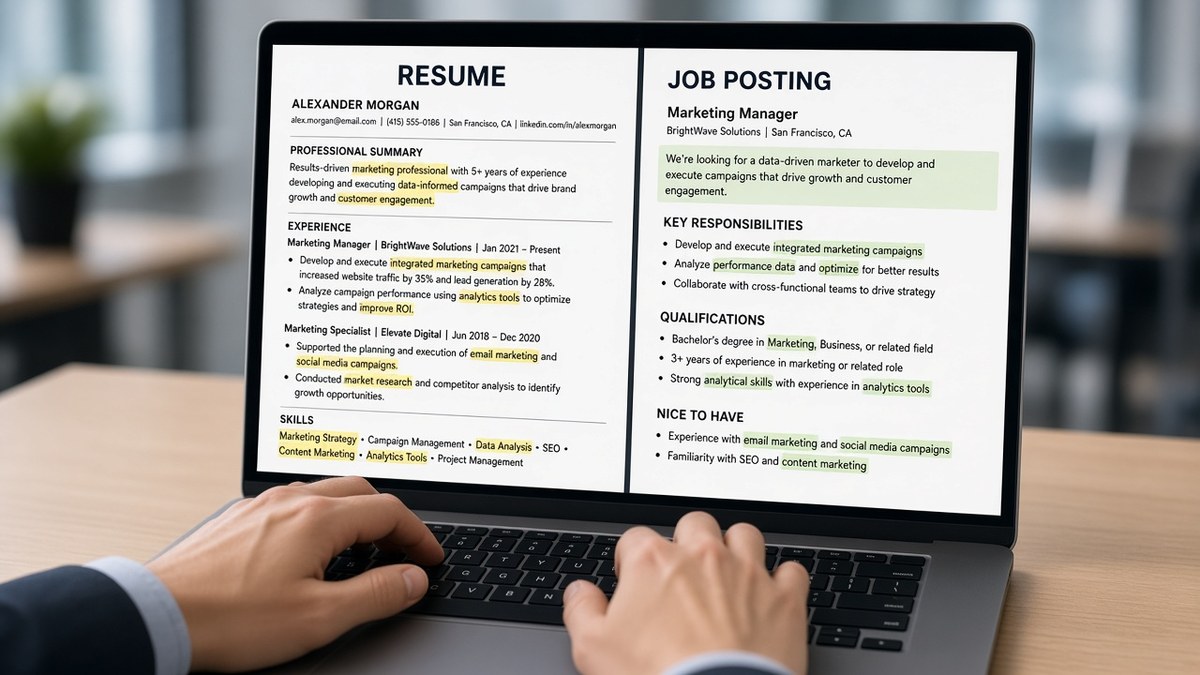
Applicant Tracking Systems (ATS) evaluate thousands of resumes daily, and they're not designed to interpret vague or generic language. Why ATS prefers job specific framing comes down to how these systems match candidate qualifications against job requirements. When you use language that directly mirrors the job description, ATS algorithms can quickly identify your fit for the role. Generic resumes—those written to appeal to any employer—often fail screening because ATS cannot establish clear connections between your experience and the specific position's needs.

Job specific framing means tailoring your resume language, skills, and accomplishments to reflect the exact terminology, priorities, and requirements of each position. This isn't about lying or padding your experience. It's about presenting your genuine qualifications in a way that ATS systems and recruiters can immediately recognize as relevant.

In this article, you'll learn:

  • How ATS systems interpret and rank resume content
  • Why generic resumes fail ATS screening despite strong qualifications
  • The specific framing techniques that improve ATS matching
  • Common mistakes that prevent job specific language from working
  • A step-by-step process to frame your resume for each application
  • Best practices that balance ATS optimization with human readability

Understanding How ATS Systems Match Resumes to Job Descriptions

ATS platforms use keyword matching, semantic analysis, and ranking algorithms to evaluate resume relevance. When a job posting is uploaded into an ATS, the system extracts key requirements—skills, job titles, certifications, experience levels, and industry-specific terminology. It then compares each incoming resume against these criteria.

The critical insight: ATS systems don't understand context the way humans do. If a job description asks for "project management experience" and your resume says you "coordinated team efforts on multiple initiatives," the ATS may not recognize these as equivalent. However, if you use the exact phrase "project management," the system immediately flags your resume as a stronger match.

This is why job specific framing matters. You're not changing your experience—you're expressing it in language the ATS recognizes as directly relevant to the role.

Key Elements of Job Specific Resume Framing

1. Mirroring Job Title and Role Language

If the job posting uses "Senior Software Engineer," don't describe yourself as a "Lead Developer" or "Principal Programmer." Use the exact or closely related title in your resume headline and experience section. ATS systems prioritize title alignment because job titles are standardized criteria in most hiring workflows. When your resume title matches the position title, you immediately pass a primary screening filter.

This doesn't mean your previous title changes—it means your professional summary or headline should reflect the target role's terminology. For example: "Senior Software Engineer with 8 years of full-stack development experience" directly mirrors the language an ATS is searching for.

2. Embedding Required Skills in Context

Generic skill lists fail because they lack context. Instead of listing "Python, JavaScript, SQL" separately, embed these skills within achievement statements: "Developed backend APIs using Python and SQL, reducing query time by 40%." This approach serves two purposes: ATS systems recognize the skills in context, and recruiters see concrete evidence of your ability to use them.

When skills appear in your experience bullets rather than just a skills section, ATS algorithms weight them more heavily because they're tied to measurable outcomes. This contextual embedding is a cornerstone of effective job specific framing.

3. Using Job Description Terminology in Achievement Bullets

Extract 5-7 key phrases from the job description and naturally incorporate them into your experience bullets. If the posting emphasizes "cross-functional collaboration," mention a project where you "collaborated across engineering, design, and product teams." If it highlights "agile methodology," reference your experience with "sprint planning and agile ceremonies."

The key word is naturally. Forced or repetitive keyword inclusion triggers ATS penalties and looks unprofessional to human readers. The goal is to show that your background genuinely aligns with what the employer is seeking.

4. Matching Industry and Vertical-Specific Language

Different industries use different terminology for similar work. In fintech, you might "ensure regulatory compliance." In healthcare tech, you "maintain HIPAA standards." In e-commerce, you "optimize conversion funnels." ATS systems are trained on industry-specific language, so matching that terminology significantly improves your match score.

If you're applying across industries, this is where job specific framing becomes essential. Your core skills remain the same, but the language you use to describe them should reflect the target industry's conventions.

Common Mistakes That Undermine Job Specific Framing

  • Keyword stuffing without context: Repeating required keywords unnaturally ("managed projects, managed teams, managed resources") triggers ATS quality filters that penalize obvious manipulation. ATS systems are designed to detect and downrank keyword-stuffed content.
  • Using outdated or alternative terminology: If a job posting uses "machine learning," don't describe your work as "artificial intelligence" or "predictive analytics." While related, these aren't exact matches, and ATS may not recognize the equivalence. Precision matters.
  • Keeping a one-size-fits-all resume: Sending the same resume to every employer is the opposite of job specific framing. Even 15 minutes of customization—updating your summary and 3-4 bullets to match the job description—significantly improves ATS performance.
  • Ignoring required certifications or credentials: If a job posting lists "AWS Certified Solutions Architect" as required, and you have it, explicitly state it. Don't assume ATS will infer it from your experience description. Certifications are often hard requirements in ATS screening.
  • Using pronouns or vague language: Avoid "Responsible for" or "Helped with." Use active, specific language: "Led," "Designed," "Implemented," "Optimized." ATS systems recognize strong action verbs as indicators of direct contribution and responsibility.
  • Mismatching experience level language: If applying for a senior role, don't use junior-level language ("Assisted with," "Supported"). If applying for a junior role, don't overstate your seniority. ATS systems evaluate experience level alignment, and mismatches result in lower scores.

Best Practices for Effective Job Specific Framing

  1. Start with the job description: Copy and paste the job posting into a document. Highlight 10-15 key phrases, skills, and requirements. These are your framing targets. Every bullet point you write should connect back to at least one of these items.
  2. Match the job description structure: If the posting emphasizes technical skills first, then leadership, then industry knowledge, structure your resume bullets in that same order. ATS systems often weight content based on the order it appears in the job description.
  3. Use specific metrics that align with the role: Don't just say "improved performance." If the job is in sales, say "increased revenue by 25%." If it's in operations, say "reduced processing time by 30%." Metrics that match the role's priorities carry more weight in ATS evaluation.
  4. Include the job title or a close variant in your professional summary: Your summary should open with language that directly reflects the target position. Example: "Senior Data Analyst with 6 years of experience in financial analytics and predictive modeling" for a financial data analyst role.
  5. Customize your skills section strategically: List the top 5-7 skills from the job description first, in the order they appear in the posting. ATS systems often scan skills sections sequentially, so positioning matters.
  6. Reference relevant certifications and credentials prominently: If the job requires or prefers specific certifications, place them in your summary or create a dedicated certifications section near the top. Don't bury them at the bottom.
  7. Adapt your experience descriptions, not your actual experience: You're not fabricating accomplishments. You're reframing genuine work using language that highlights relevance to the specific role. This is ethical and effective.
  8. Test your framing against the job description: Before submitting, read through your resume and the job posting side by side. Can you see clear connections between your bullets and the posting's requirements? If not, revise.

Step-by-Step Guide to Frame Your Resume for a Specific Job

  1. Extract the job's core requirements: Read the job description and list the top 8-10 must-have skills, qualifications, and responsibilities. These are your primary framing targets.
  2. Identify the industry and role-specific terminology: Note how the posting describes the work. Does it use "full-stack development" or "end-to-end engineering"? Does it say "agile" or "scrum"? Use the same language.
  3. Review your current resume: Identify which of your experiences directly address the job's requirements. You'll be emphasizing these and adjusting language to match the posting.
  4. Rewrite your professional summary: Open with the job title or a close variant. Include 2-3 of the most important skills or qualifications from the posting. Example: "Full-Stack Engineer with 7 years of experience building scalable web applications using React and Node.js, specializing in microservices architecture."
  5. Customize your experience bullets: For each relevant position, rewrite 3-4 bullets to highlight accomplishments that match the job description. Use the same terminology, metrics, and priorities as the posting.
  6. Adjust your skills section: Reorder your skills to match the job description's priorities. If the posting emphasizes Python before JavaScript, list Python first.
  7. Add certifications or credentials if relevant: If you have certifications mentioned in the posting, ensure they're visible in your summary or a dedicated section.
  8. Proofread and verify alignment: Read your customized resume alongside the job description. Every major requirement should have a corresponding section in your resume.

How Job Specific Framing Improves Your ATS Score

ATS matching algorithms evaluate multiple factors when scoring your resume. Job specific framing directly improves several of these:

Keyword density and relevance: When your resume contains the exact terminology from the job posting, ATS algorithms detect higher keyword relevance. This isn't about keyword stuffing—it's about using the right words in the right context. A resume that naturally incorporates 8-10 key terms from the job description will score significantly higher than a generic resume with only 2-3 matches.

Semantic matching: Modern ATS systems use natural language processing to understand meaning, not just exact matches. If you describe "leading a team of 5 engineers" and the job asks for "team leadership," the system recognizes the semantic connection. Job specific framing amplifies these connections by using the exact language the system is trained to recognize.

Experience-to-requirement alignment: ATS systems evaluate whether your experience directly addresses the job's requirements. A resume that explicitly connects your background to the posting's needs—through matching language and relevant examples—achieves higher alignment scores.

Credential verification: If you have required certifications, licenses, or degrees, job specific framing ensures these are clearly visible and use the exact terminology the ATS is searching for. Buried or poorly described credentials may be missed entirely.

Conclusion: Job Specific Framing Is Your ATS Advantage

Why ATS prefers job specific framing ultimately comes down to how these systems are designed: they evaluate resumes by matching candidate qualifications against specific job requirements. When you use language, terminology, and structure that directly reflects the job posting, you make the ATS's job easier—and you improve your chances of passing screening.

Job specific framing is not about deception or keyword stuffing. It's about presenting your genuine qualifications in a way that clearly demonstrates relevance to the specific role. This approach benefits both ATS systems and human recruiters, who can immediately see why you're a strong fit.

Start with your next application: spend 20 minutes customizing your resume to match the job description. Use the terminology from the posting, highlight relevant accomplishments, and structure your experience to align with the role's priorities. You'll see the difference in your ATS pass-through rate and interview invitation rate.

Frequently asked questions

A: Job specific framing is not keyword matching—it's strategic language alignment. You're using genuine accomplishments and skills, just expressed in terminology that matches the role. Recruiters won't see through authentic framing because it's based on real experience. What they will see through is keyword stuffing or fabricated credentials. The difference: "Managed 5 projects" (generic) vs. "Led cross-functional project teams using agile methodology" (specific) are both truthful, but the second connects directly to what the employer values. Recruiters appreciate resumes that clearly demonstrate relevance.

A: Effective customization takes 15-30 minutes per application. Start by updating your professional summary (5 minutes), then rewrite 3-4 key experience bullets to match the job description (10-15 minutes), and adjust your skills section (5 minutes). For roles that are very different from your background, spend more time. For roles that closely match your current resume, minimal changes may suffice. The time investment pays off: customized resumes have significantly higher ATS pass-through rates than generic ones.

A: Focus on framing the skills you do have in language that matches the posting. If you lack a specific tool or technology, don't fabricate it. Instead, emphasize related skills and your ability to learn quickly. For example, if the job asks for "React" and you know "Angular," frame it as "7 years of front-end framework experience with Angular; quick learner of modern JavaScript frameworks." Job specific framing works best when it's truthful. Employers often prioritize demonstrated capability over exact tool matches, especially for skills that transfer across similar technologies.

A: Yes. Every industry and role has specific terminology, priorities, and expectations. Whether you're applying for a software engineering role, marketing position, or operations job, matching the language and priorities of the job description improves ATS performance. The principle is universal: ATS systems match resumes to job descriptions, and job specific framing ensures your resume is clearly aligned with what the employer is seeking.

A: Partially. If two job postings are nearly identical, you can reuse most of your customized resume. However, each company likely has different priorities, terminology, and emphasis. Even if the role title is the same, one company might prioritize "innovation" while another emphasizes "reliability." Spend 5-10 minutes adjusting your framing to match each company's specific posting. This small effort significantly improves your ATS match score and shows genuine interest in the role.

A: Yes. Cover letters are also screened by ATS systems , and job specific framing applies equally. Use the job title, key skills, and terminology from the posting in your cover letter. Reference specific projects or achievements mentioned in the job description. This creates alignment across both documents and strengthens your overall application profile.

Done for you

Turn this advice into an interview-ready resume

Professional writers rebuild your resume for ATS + recruiters — unlimited revisions, interview guarantee.

Job match tool·Free builder

Tags

ATS resumejob specific framingresume optimizationATS screeningtailored resumejob applicationresume keywordsATS matching